

Keyword research is the process of finding the searches your audience uses, understanding the job behind those searches, and deciding what page or asset should exist next. The useful output is not a giant keyword spreadsheet. It is a prioritized execution queue: which page to create, which page to update, what angle will make it useful, and how you will measure whether it worked.
A good workflow starts broad, but it gets concrete quickly. Group ideas by intent, choose the right page type, check whether an existing URL already owns the job, validate technical feasibility, and only then send work to writers, designers, engineers, or product owners.
Start With Jobs, Not Volume
Search volume is a helpful signal, but it is a poor first filter. A small keyword with a clear product task can be more valuable than a big keyword that asks for a definition you cannot improve.
Use this first pass to translate raw keywords into user jobs:
| Keyword pattern | Likely job | First planning question |
|---|---|---|
| "what is...", "guide", "examples" | Learn a concept | Do we need an explainer, a hub, or a glossary-style answer? |
| "how to...", "checklist", "workflow" | Complete a task | Can we give steps, validation checks, and a reusable process? |
| "best", "tools", "software" | Compare options | Can we produce a fair list with real criteria and public evidence? |
| "alternative", "vs", "review" | Choose between products | Can we compare accurately without pretending to have private data? |
| Brand, login, pricing, support terms | Navigate or solve brand-specific tasks | Is this our brand, a fair intercept, or irrelevant navigational traffic? |
The goal is to avoid writing the wrong asset for the right keyword. If the query is looking for a tool, a blog post may lose. If the query is looking for a complete beginner path, a narrow product landing page may disappoint.
Map Keywords To Page Types
Once the job is clear, choose the page type before drafting. This is where keyword research becomes content architecture.
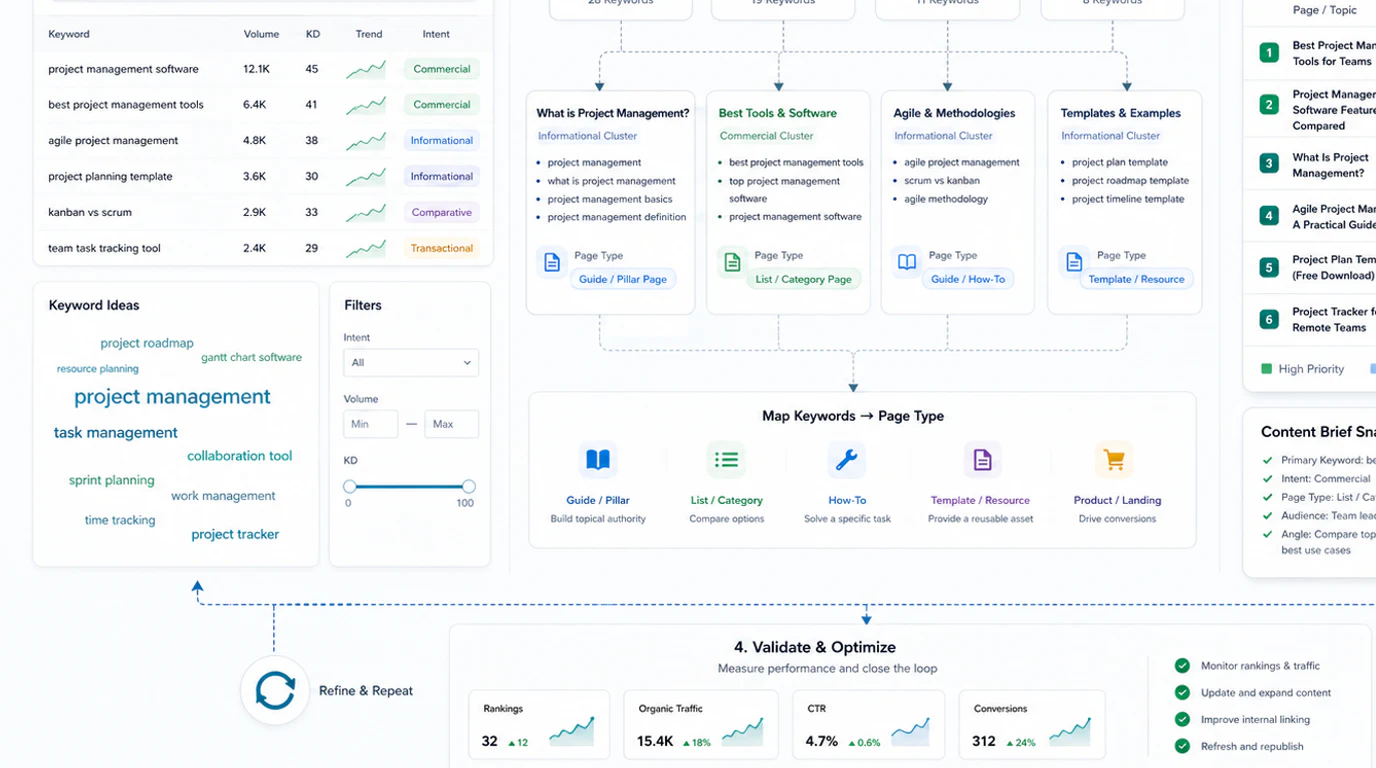
Use a simple routing model:
| Intent signal | Better page type | Why |
|---|---|---|
| Broad learning topic with many child questions | Parent hub article | Helps readers understand the topic and routes them into deeper pages |
| Specific operational task | How-to article | Steps, tools, and validation checks matter more than broad theory |
| High commercial comparison intent | Comparison or roundup | The reader needs criteria, tradeoffs, and options |
| Repeated action or calculation | Tool or template page | The reader wants an output, not only advice |
| Existing page already ranks but underperforms | Refresh existing URL | Avoids splitting authority across same-job pages |
This is also the point to check for cannibalization. A new article is only a problem when it targets the same core keyword, same page type, and same user job as an existing URL. Parent-child coverage is normal. A keyword research hub can link to future articles on long-tail keywords, internal linking, content audits, or keyword cannibalization without replacing them.
Build The Evidence Layer
Keyword research should combine multiple signals because every source has blind spots. A competitor page may prove demand, but it will not tell you whether your site can win. Search Console may show existing impressions, but it will miss topics you have not covered yet.
Use this evidence stack:
| Evidence source | What it helps answer | Watch out for |
|---|---|---|
| Existing Search Console queries | Which pages already get impressions and clicks | It only reflects queries your verified property already appears for |
| Competitor URL gaps | Which article shapes and page types competitors use to win traffic | Do not clone the competitor's angle |
| SERP review | Whether the intent is article, tool, local, shopping, or navigational | Use it when page type is unclear, not as theater |
| Site crawl | Whether the target page can be indexed, linked, and maintained | Keyword research fails if the page cannot technically compete |
| Content inventory | Whether you should create, refresh, merge, or redirect | Same cluster does not always mean duplicate |
| AI-search checks | Whether answers cite clear entities, definitions, and workflows | AI visibility depends on clarity, not just exact-match keywords |
Google's SEO starter guide is still useful for grounding the basics: make pages crawlable, useful, and understandable before chasing advanced tactics. For existing pages, the Search Console performance report can help you compare queries, pages, countries, devices, and search appearance over time.
For manual research, Google Search Operators can help you sample indexed pages, exact phrases, and competitor language before you commit to a full crawl.
Score Opportunities Before You Write
After clustering and evidence checks, score each opportunity by demand, fit, difficulty, and execution readiness. This keeps the queue honest.
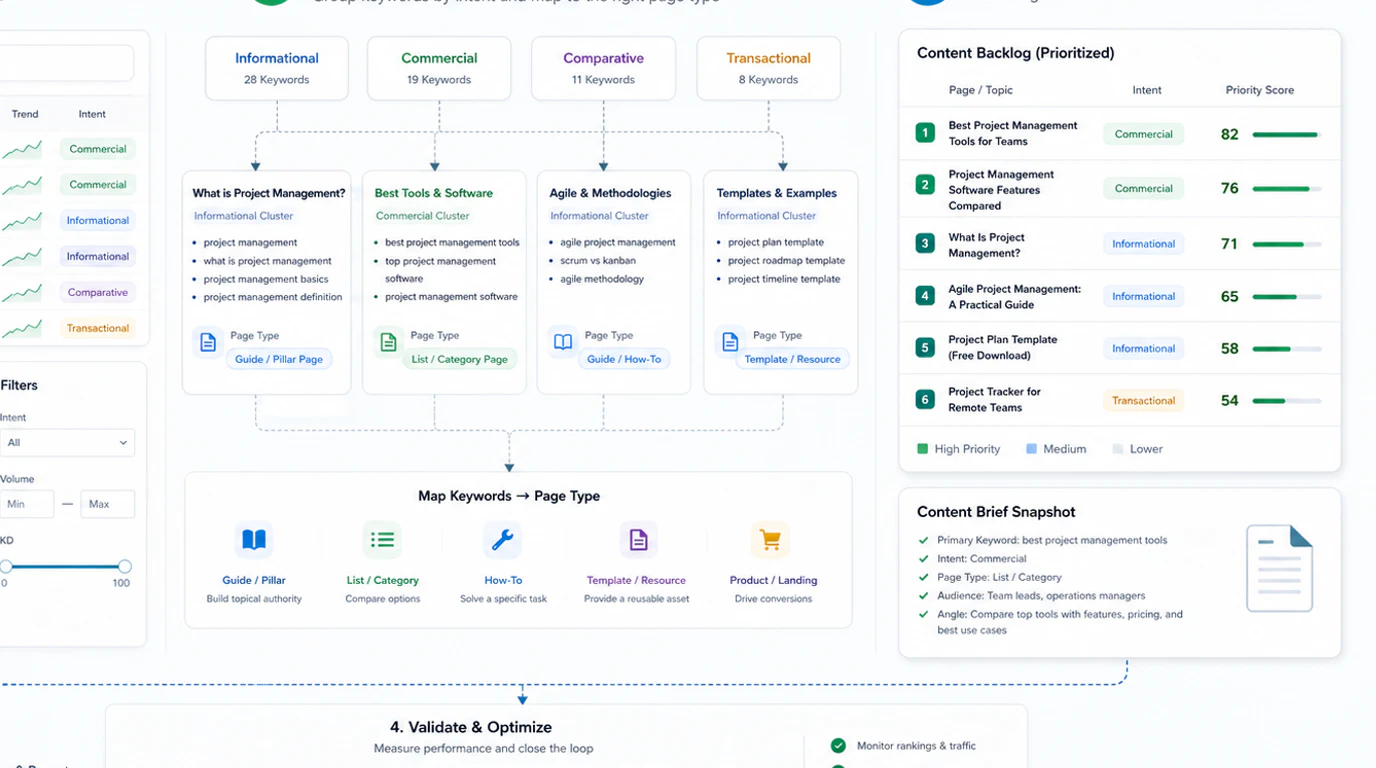
Use this scoring table:
| Dimension | High score looks like | Low score looks like |
|---|---|---|
| Search demand | Clear query family, competitor evidence, or existing impressions | One interesting phrase with no supporting pattern |
| Intent confidence | SERP/page evidence points to one page type | Mixed tool, local, article, and brand intent |
| Business fit | The page can connect to a product, workflow, or authority cluster | Traffic would be unrelated to Searvora's audience |
| Information gain | You can add a better framework, data, workflow, or examples | You would only rewrite what already ranks |
| Technical readiness | Crawlable, indexable, internally linkable page path | Blocked templates, weak architecture, or no owner |
| Production effort | Clear brief, assets, owner, and acceptance criteria | Needs unresolved research or stakeholder decisions |
Do not let a high-volume keyword jump the queue if the information gain is weak. The best opportunities usually have enough demand, clear intent, a realistic page type, and a strong reason your version will be more useful than the pages already ranking.
Turn Clusters Into Briefs
A keyword cluster becomes useful when it becomes a brief that a team can execute. Keep the brief short enough to ship, but specific enough to prevent generic content.
Every brief should include:
- Primary keyword and two to five supporting variations.
- The user job in one sentence.
- Recommended page type.
- Existing Searvora URLs that should be linked, updated, or avoided.
- The information-gain angle.
- Required evidence or screenshots.
- Suggested H2 structure.
- Primary product CTA, if there is a natural fit.
- Validation plan after publishing.
For a parent topic such as keyword research, the information gain should not be "cover every beginner tip." Searvora's stronger angle is operational: move from ideas to page-type decisions, then into a monitored execution loop. That connects naturally to the Geo SEO Foundations idea of diagnostics, decisions, and execution as one growth system.
Connect Keyword Research To Technical Checks
Keyword research can fail after the brief if the site cannot support the page. Before assigning a draft, check the URL pattern, crawl path, metadata rules, and internal link plan.
For a new or refreshed URL, verify:
| Check | Why it matters |
|---|---|
| Indexability | The page must be crawlable and not accidentally noindexed or canonicalized away |
| Title and H1 plan | The target keyword should be clear without forcing exact-match repetition |
| Internal link source | The page needs at least one natural path from a related hub or product page |
| Existing overlap | Similar pages should support the new page, not compete for the same job |
| Measurement segment | The page should fit a dashboard segment so performance can be reviewed later |
A technical SEO crawler is useful here because it turns keyword planning into site reality. You can check whether related pages are indexable, whether title patterns are clean, whether internal links reinforce the intended page, and whether old URLs need redirects or updates.
For metadata-heavy work, the Page Title SEO workflow is a good companion because the title, H1, and page promise need to match before search engines or AI answer systems can understand the asset.
Use AI Search As A Clarity Test
Keyword research now has to consider more than classic blue-link rankings. AI answer systems reward pages that make entities, tasks, definitions, steps, and evidence easy to extract.
That does not mean every article needs AI-generated sections or inflated FAQ blocks. It means the page should answer the core job directly, define terms plainly, use structured tables when they help, and show the workflow in a way that can be cited or summarized.
Use this AI-search clarity check before publishing:
- Can the page answer the primary query in the first few paragraphs?
- Are important definitions stated plainly?
- Does the article include a useful table, checklist, or decision framework?
- Are examples specific enough to distinguish the page from generic advice?
- Are product claims grounded in visible Searvora capabilities?
- Does the article link naturally to deeper supporting pages?
If the answer is no, the page is probably not ready for classic SEO either.
A Practical Keyword Research Workflow
Use this workflow when you need to move from keyword ideas to shipped SEO work:
- Collect seed topics from customers, products, existing pages, support requests, competitor URLs, and Search Console queries.
- Normalize the list by removing duplicates, brand-only noise, and keywords with no plausible Searvora audience.
- Group keywords by user job, not only by matching words.
- Assign a recommended page type to each cluster.
- Check existing Searvora URLs for exact same-keyword, same-type, same-job overlap.
- Review the SERP only when the page type or intent is unclear.
- Score each cluster by demand, intent confidence, business fit, information gain, technical readiness, and production effort.
- Create briefs for the highest-scoring clusters.
- Route each brief to article writing, product/landing work, tool planning, or an existing-page refresh.
- Publish with metadata, internal links, body visuals, and a measurement segment.
- Revisit the page after indexing and feed the results into the next keyword batch.
Keyword research works when it becomes a decision system. The deliverable is not a list of phrases. The deliverable is a clear queue of pages to create, pages to improve, and pages to leave alone, backed by evidence your team can act on.