

Page title SEO is the practice of writing each HTML title tag so searchers, search engines, and AI answer systems can understand the page's purpose quickly. A strong title is specific, aligned with intent, unique across the site, and validated after publication because Google may still choose a different title link in search results.
The useful work is not memorizing a character limit. The useful work is building a repeatable audit: crawl every important URL, classify title problems, rewrite titles by page type, validate the live result, and keep monitoring when templates or search behavior change.
Start With The Search Task
Most weak title tags fail because the team starts with a keyword instead of the searcher's job. Before rewriting anything, map each page to one primary task:
| Page type | Search task | Title should make clear |
|---|---|---|
| Product or feature page | Evaluate a solution | What the product does and who it helps |
| Blog guide | Learn a method | The problem, method, and level of depth |
| Comparison page | Choose between options | The compared choices and decision criteria |
| Tool or template page | Complete an action | The output the user can create or check |
| Local or service page | Hire or contact | Service, location, and trust signal |
If the title does not match the page type, a rewrite will usually be cosmetic. Fix the intent first.
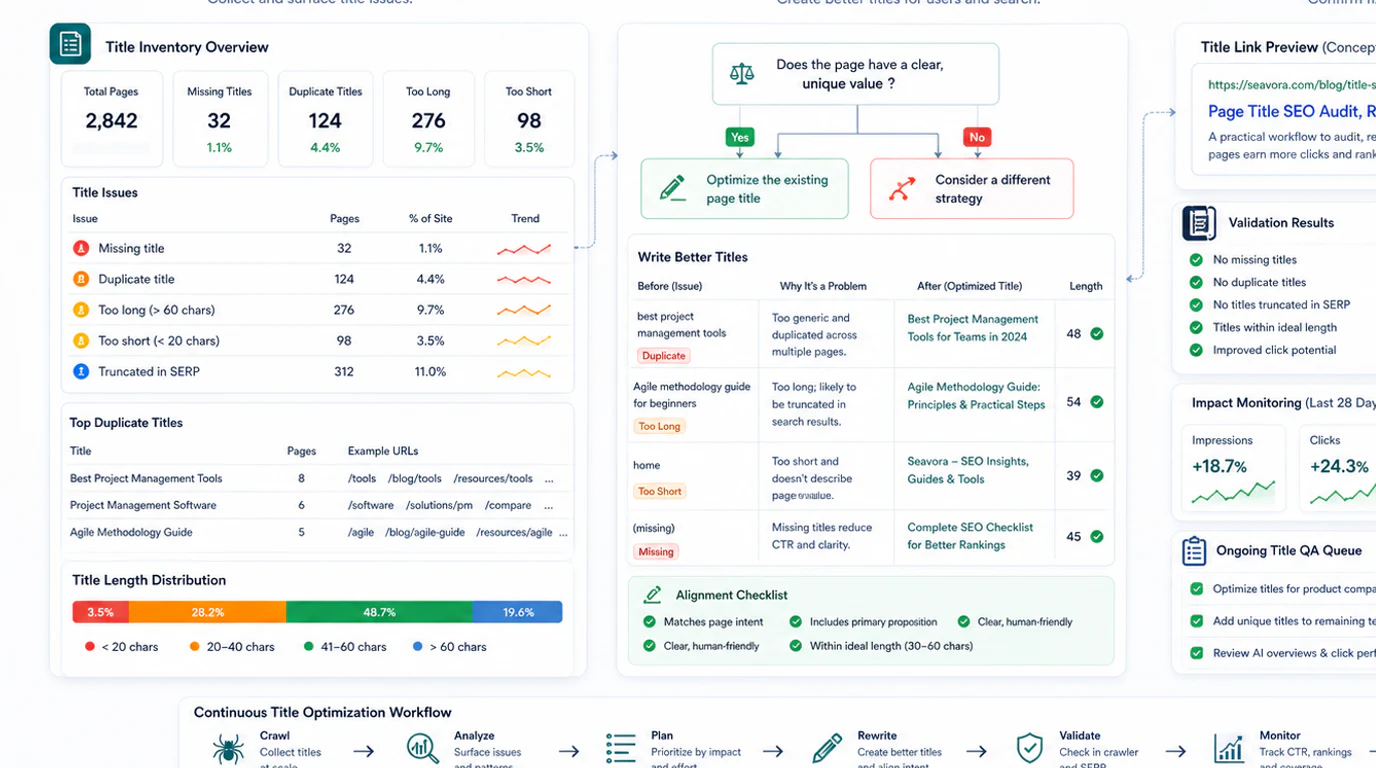
Crawl Before You Rewrite
Manual title review works for ten pages. It breaks down for a site with templates, faceted URLs, multilingual paths, and old blog archives.
Run a crawl and export at least these fields:
| Field | Why it matters |
|---|---|
| URL | Lets you group pages by directory, template, locale, and business owner |
| Status code | Prevents title work on redirected, blocked, or broken pages |
| Indexability | Keeps noindex and canonicalized pages out of the rewrite queue |
| Current title | Shows missing, duplicate, too short, too long, or template-heavy titles |
| H1 | Reveals whether the visible page promise matches the title tag |
| Canonical | Avoids rewriting alternate URLs that should not be the canonical target |
| Organic or conversion signal | Helps prioritize pages where title changes can matter |
The Searvora fit is strongest here: a technical SEO crawler can turn page title issues into a grouped queue instead of a spreadsheet guessing game.
Classify Title Issues By Risk
Not every imperfect title deserves a rewrite. A 66-character title on a low-priority support article is less urgent than a duplicated product template across 200 indexable pages.
Use this triage model:
| Risk level | Signal | What to do |
|---|---|---|
| Critical | Missing title on indexable canonical page | Add a unique title before further promotion |
| High | Duplicate title across different search intents | Rewrite by page type or template variable |
| High | Title promises a topic the page does not satisfy | Fix the page or retitle to match the content |
| Medium | Title is truncated in important SERPs | Move the differentiator earlier and remove filler |
| Medium | Google frequently rewrites the title link | Check H1, headings, anchor text, and page clarity |
| Low | Minor length or wording issue on low-impact URL | Batch with the next template cleanup |
Write Titles With A Pattern, Not A Formula
A reusable pattern helps teams move faster, but a rigid formula creates duplicate titles. Start with the page type, then add the differentiator.
| Page type | Useful title pattern | Example logic |
|---|---|---|
| Product page | Primary product job + audience or differentiator | "SEO Spider Crawler for Technical SEO Audits" |
| Blog guide | Method + outcome | "How to Audit Page Title SEO Before Rewriting Title Tags" |
| Comparison | Option A vs option B + decision angle | "Crawler vs Manual Audit: When Each Works" |
| Template page | Asset + use case | "SEO Audit Checklist for Product Pages" |
| Hub page | Topic cluster + scope | "Technical SEO Guides for Growth Teams" |
Good titles usually do four things:
- Put the main topic early without forcing exact-match wording.
- Make the page type obvious.
- Include a differentiator only when the page proves it.
- Avoid empty modifiers such as "ultimate" unless the article genuinely earns that promise.
Google's own title link guidance is a useful reminder: title tags are a strong source, but Google also considers visible page text and other signals when it generates title links.
Validate The Rewrite After Shipping
Publishing a title is not the finish line. Treat it like a testable SEO change.
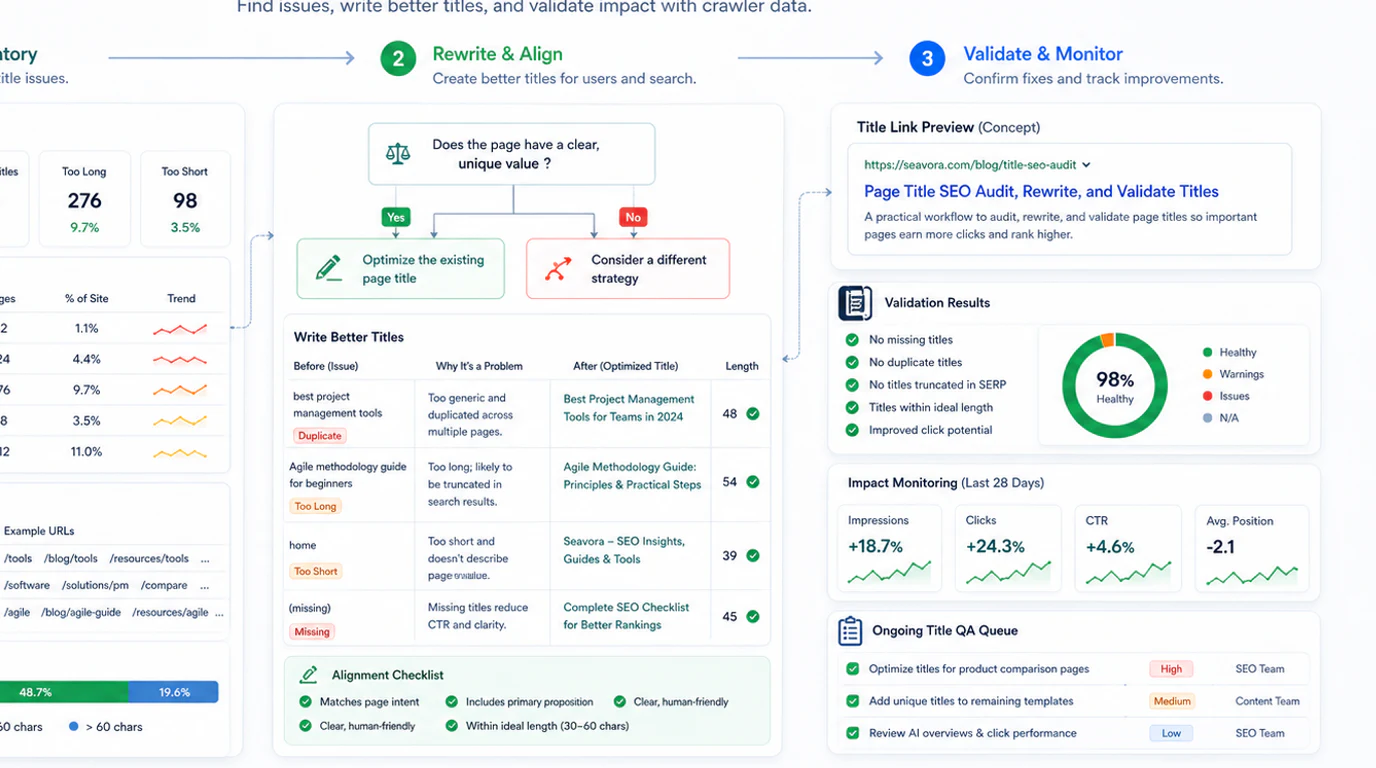
Use this validation loop:
- Re-crawl the affected URLs and confirm the new title is live.
- Check that the canonical page, H1, and title all tell the same story.
- Review key SERPs after Google refreshes the result.
- Note whether Google rewrites the title link and why that rewrite may be happening.
- Check AI-search answers for pages where the title frames a product category, comparison, or definition.
- Add recurring title checks to the same operating rhythm you use for crawl errors and canonical issues.
For teams building a broader SEO operating loop, the same detect, decide, ship, and re-measure pattern appears in Geo SEO Foundations.
Avoid These Page Title SEO Mistakes
The most common mistakes are operational, not grammatical.
| Mistake | Why it hurts | Better move |
|---|---|---|
| Rewriting every title at once | You cannot isolate what changed | Batch by template or page type |
| Optimizing noindex pages | Effort goes to pages that should not rank | Filter indexability first |
| Using one title template everywhere | Creates duplicates and weak intent fit | Add page-type variables |
| Chasing exact character counts | Pixel width and SERP context vary | Put the important promise early |
| Ignoring Google rewrites | The SERP may not show your intended promise | Compare title, H1, anchors, and page clarity |
| Treating AI search as separate | AI answers still need clear entity and page-purpose signals | Make titles explicit and supported by the page body |
If your team turns title rewrites into MDX or CMS updates, the quality gates in the MDX Automation Playbook are a useful companion for keeping metadata consistent.
A Practical Page Title SEO Workflow
Use this workflow when you need to move from audit findings to shipped improvements:
- Crawl the site and export indexable canonical URLs.
- Group URLs by template, directory, product line, locale, and owner.
- Flag missing, duplicate, overlong, vague, or intent-mismatched titles.
- Prioritize by organic opportunity, business importance, and template footprint.
- Draft title patterns for each page type.
- Rewrite a controlled batch first.
- Re-crawl to confirm implementation.
- Review SERP title links and AI-search summaries after recrawl.
- Keep the winning pattern and roll it out to the next group.
Page title SEO works best when it is connected to crawl data, page-type strategy, and validation. A title should not just contain a keyword. It should make the page's job unmistakable, then prove that promise on the page.