

Google search operators are commands that narrow a Google search result set. For SEO work, they are most useful when they help you create a better question before you crawl, rewrite, brief, or validate a page.
The mistake is treating operators as trivia. The useful move is to connect each operator to a job: find indexed URLs, inspect title patterns, check stale assets, compare competitor language, or validate whether a page is clear enough for search and AI answer systems.
The Operators SEO Teams Actually Use
Google documents a smaller set of search refinements than many old SEO cheat sheets claim. Some historic operators still produce results but are inconsistent, so use them as discovery aids rather than final evidence.
| Operator | What it helps with | Example SEO use |
|---|---|---|
site: | Restrict results to a domain or path | site:example.com/blog canonical tags |
- | Exclude noisy terms | site:example.com/blog seo -template |
"exact phrase" | Find exact wording | "AI SEO dashboard" site:example.com |
OR | Compare synonyms or intent language | "seo audit" OR "site audit" |
( ) | Group intent variants | (crawler OR spider) "canonical" |
intitle: | Find title tag patterns | site:example.com intitle:"pricing" |
allintitle: | Require several title words | allintitle: seo audit checklist |
inurl: | Find path or slug patterns | site:example.com inurl:/blog/ |
filetype: | Find PDFs and documents | site:example.com filetype:pdf seo |
related: | Explore adjacent sites | related:example.com |
before: | Inspect older result sets | technical seo before:2024-01-01 |
after: | Check recent coverage | AI search optimization after:2025-01-01 |
Google's own search refinement guidance is the safest source for current behavior. SEO workflows can still use broader operator patterns, but they should be checked against live results before decisions are made.
Match Operators To SEO Jobs
The best operator is the one that shortens a real workflow. Start with the job, then pick the search pattern.

| SEO job | Useful query pattern | What to do next |
|---|---|---|
| Check indexation coverage | site:example.com inurl:/blog/ | Compare the sample with your crawl and sitemap. |
| Find duplicate title themes | site:example.com intitle:"Guide" | Group by template before rewriting titles. |
| Locate outdated assets | site:example.com filetype:pdf after:2020-01-01 | Decide whether to refresh, canonicalize, or remove. |
| Inspect competitor content angles | site:competitor.com/blog "AI search" | Note page type, depth, CTA, and information gain. |
| Find internal-link candidates | site:example.com "target topic" | Add links only where the context is genuinely relevant. |
| Validate brand and entity clarity | "Searvora" "SEO Spider Crawler" | Check whether snippets describe the product accurately. |
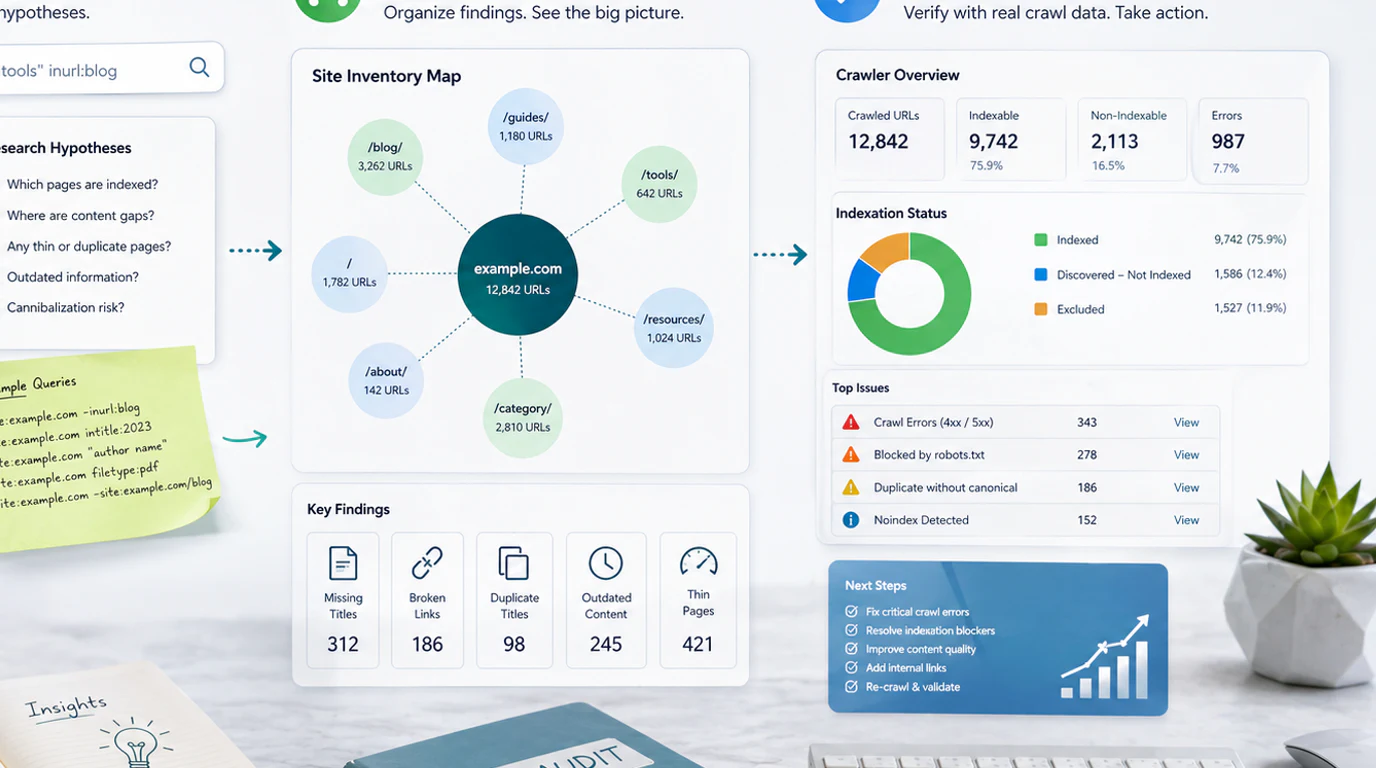
This is where operators pair well with crawl data. A manual query can reveal a pattern. A technical SEO crawler can confirm how many URLs are affected, whether they are indexable, and which pages should be fixed first.
Use A Four-Step Operator Workflow
Operators are fast, but they are not complete. Use them to build a hypothesis, then test that hypothesis with structured data.
- Query the live SERP sample. Use
site:, exact phrases, and exclusions to see what Google is already surfacing. - Classify the page type. Separate blog guides, product pages, PDFs, hub pages, and template pages before deciding what to change.
- Confirm with crawl and performance data. Check status code, indexability, canonical, title, H1, internal links, and traffic signals.
- Validate after the fix. Re-run focused queries and compare the result with the crawl output and dashboard movement.
Run These Practical SEO Searches
These examples are intentionally job-based. Replace the domain, path, and topic with your own site.
Find indexed blog pages about a topic
site:example.com/blog "technical SEO"
Use this when you need a quick view of visible topical coverage. If the result set includes unrelated pages, add exclusions such as -tag, -author, or -page.
Find page-title patterns before rewriting
site:example.com intitle:"SEO Audit"
This is useful before a title cleanup. Pair it with the page-title process in Page Title SEO: Audit, Rewrite, and Validate Titles so you do not rewrite titles by length alone.
Find stale or risky documents
site:example.com filetype:pdf seo
PDFs, slide decks, and old downloadable assets often remain indexable after the main site changes. If the asset is outdated, decide whether it should be refreshed, redirected, blocked, or supported by a stronger HTML canonical page.
Find competitor angles without copying them
site:competitor.com/blog ("AI search" OR "GEO")
Use this to understand how competitors frame a topic. Do not approve a blog post because the competitor has one. Ask whether the SERP proves article demand and whether your team can add a better workflow, data point, comparison, or implementation detail.
Find internal-link opportunities
site:example.com "canonical tags" -inurl:tag
Manual internal-link checks are not enough for large sites, but they are useful for editorial review. Add links where the reader needs the next step, not everywhere the phrase appears.
Validate AI-search and entity language
"brand name" "product category"
For GEO and AI-search work, exact-phrase checks can reveal whether the web consistently connects your brand, product category, and core use case. For a broader operating model, see Geo SEO Foundations.
Turn Query Findings Into An Action Queue
The handoff matters more than the clever query. Use this simple triage table before assigning work.
| Finding | Risk level | Owner | Searvora handoff |
|---|---|---|---|
Important canonical page missing from site: samples | High | SEO + engineering | Crawl and inspect indexability, canonicals, and sitemap inclusion |
| Many duplicate title patterns | High | SEO + content | Group by template and rewrite the highest-impact pages first |
| Old PDFs outranking current HTML pages | Medium | Content + engineering | Decide refresh, redirect, noindex, or stronger HTML support |
| Competitor has a clearer educational article | Medium | Content | Build an information-gain brief instead of copying the outline |
| Brand/product language looks inconsistent | Medium | SEO + marketing | Align product pages, internal links, and AI-search entity descriptions |
| One-off odd result on an unimportant URL | Low | Backlog | Record it, but do not interrupt higher-confidence work |
The AI SEO Dashboard is the right next layer when operator findings need performance context. Use operators to spot the pattern, then use segment-level monitoring to decide whether the issue is worth immediate work.
What Operators Cannot Tell You
Operators are useful because they are fast. They are risky when they replace evidence.
They cannot reliably tell you:
- The full set of indexed URLs.
- Whether a URL is canonicalized correctly.
- Whether a page is blocked by robots rules or meta directives.
- How Google is weighting a title, H1, internal anchor, or structured data.
- Whether a page is gaining or losing traffic.
- Whether an AI answer system will cite the page.
That is why the best workflow is layered: operators for discovery, crawl data for technical confirmation, analytics for prioritization, and AI-search checks for answer readiness. When the decision becomes strategic rather than technical, an AI SEO consultant can turn the evidence into a ranked action plan for content, SEO, and engineering.
A Repeatable Google Search Operator Checklist
Use this checklist during content audits, technical QA, competitor research, or monthly SEO reviews:
- Start with one question, not a pile of operators.
- Use
site:to scope the result set. - Add exact phrases only when wording matters.
- Use exclusions to remove directories, tags, templates, or brands that pollute the result.
- Check whether the SERP is article-led, tool-led, product-led, or support-led.
- Capture the hypothesis in plain language.
- Confirm the affected URL set with a crawl.
- Prioritize by traffic, business value, indexability, and implementation effort.
- Recheck the SERP after the fix ships.
- Record the query pattern if it should become part of a recurring audit.
Google search operators still matter for SEO because they compress exploration. They help you ask better questions before opening a crawler, dashboard, or content brief. The win is not the operator itself. The win is the evidence trail from query, to crawl, to priority, to shipped improvement.