

What is SEO? SEO means search engine optimization. It is the practice of making useful pages easier for search engines and AI answer systems to discover, understand, trust, and show to the right audience.
The practical version is not a bag of tricks. SEO connects search demand to pages that deserve to exist, makes those pages crawlable and understandable, builds evidence around them, and keeps improving them after they ship.
Start With The SEO System
SEO works when five layers support the same page job: demand, access, meaning, authority, and execution. If one layer fails, the rest of the work gets weaker.
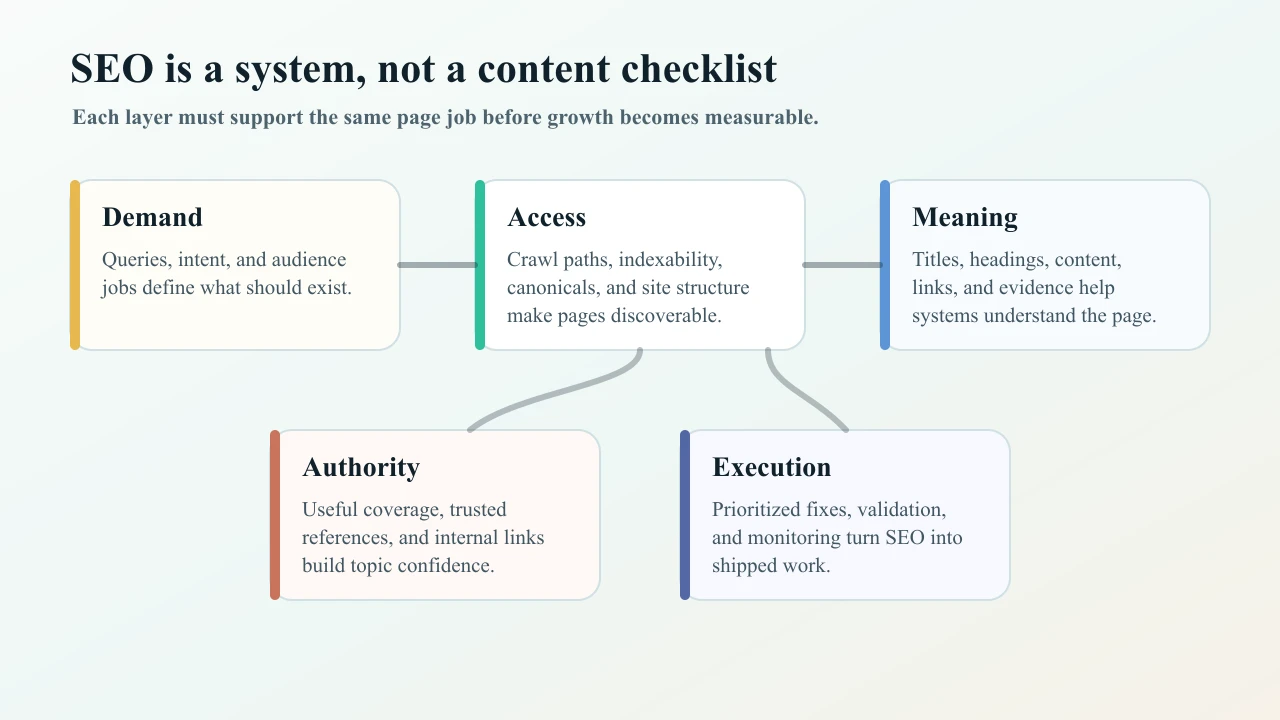
| SEO layer | Question to answer | Example work |
|---|---|---|
| Demand | What are people trying to solve? | Keyword research, customer questions, competitor URL gaps, Search Console queries |
| Access | Can search systems reach the page? | Internal links, status codes, robots rules, canonicals, sitemaps |
| Meaning | Can the page explain itself clearly? | Title, H1, intro, headings, schema, examples, images, internal anchors |
| Authority | Why should this site be trusted on the topic? | Useful coverage, expert review, links, citations, product evidence, fresh maintenance |
| Execution | What should the team do next? | Prioritized fixes, content briefs, validation checks, performance monitoring |
Google's SEO starter guide is a good baseline because it treats SEO as useful pages, crawlable structure, descriptive links, and clear content. The operator layer is turning those ideas into a repeatable queue of work.
How Search Engines Turn Pages Into Results
Search engines do not rank a page just because it exists. They first need to discover the URL, crawl or fetch the content, process what the page says, store useful information in an index, and then decide whether the page is a good result for a specific query.
Google's How Search Works guide explains the broad crawl, index, and serving model. In day-to-day SEO, that model becomes a simple operating check:
| Search stage | What can go wrong | What to inspect |
|---|---|---|
| Discovery | The URL is not linked, submitted, or reachable | Internal links, XML sitemap, crawl depth, orphan URLs |
| Crawl | Bots cannot fetch the page cleanly | Status code, redirects, robots.txt, server errors, rendering |
| Indexing | The wrong URL is selected or the page is excluded | Canonical, noindex, duplicate variants, thin or conflicting content |
| Understanding | The page promise is unclear | Title, H1, headings, main content, schema, media alt text |
| Serving | The page is less useful than alternatives | Intent fit, completeness, freshness, links, authority, user satisfaction |
This is why SEO is broader than writing. A strong article can still underperform if it is canonicalized away, buried too deep, or disconnected from the rest of the site.
Choose The Right Page Type Before Writing
SEO starts with the user job, not the keyword string. The same topic can require a guide, product page, hub, comparison page, template, glossary, or tool.
Use this routing table before creating a new URL:
| Query pattern | Better page type | Why it matters |
|---|---|---|
| "what is", "definition", "examples" | Explainer or parent hub | The reader needs a clear concept and next-step paths |
| "how to", "checklist", "workflow" | How-to article | The reader wants steps and validation checks |
| "best", "tools", "software" | Roundup or comparison | The reader needs verified options and criteria |
| "pricing", "cost", "plan" | Decision guide or commercial page | The reader is budgeting and comparing tradeoffs |
| "checker", "generator", "calculator" | Tool or tool-led landing page | The reader expects an output, not only advice |
The deeper keyword research workflow is useful when a raw keyword list needs to become page-type decisions. A beginner SEO page like this one should act as a parent hub, then route readers into narrower workflows.
Make Pages Crawlable And Understandable
Once the page type is clear, make sure the page can be accessed and interpreted. This is where many SEO programs lose momentum: teams rewrite copy while the technical layer is still uncertain.
Start with these checks:
- The final URL returns a healthy status code.
- The URL is internally linked from a relevant page.
- The canonical points to the intended URL.
- The page is not accidentally blocked or noindexed.
- The title, H1, intro, and first H2 all support the same task.
- Images have useful alt text when they explain something.
- Structured data matches visible content.
- Sitemap and internal links point to the same canonical version.
For technical audits, the technical SEO workflow is the better companion because it goes deeper on crawl access, indexability, rendering, metadata, links, and validation. For a beginner, the important lesson is simple: search visibility starts with a page search systems can reach and understand.
Build Authority With Coverage And Proof
SEO authority is not only backlinks. A site also builds trust by covering a topic with useful depth, linking related pages together, keeping facts current, and showing evidence that the page was made by people who understand the work.
For a Searvora-style operating workflow, authority has four practical signals:
| Authority signal | What it looks like in practice |
|---|---|
| Topic coverage | Parent hubs link to child guides, tools, comparisons, and operational checklists |
| Internal context | Related pages use descriptive anchors and help readers continue the task |
| External trust | Claims point to official documentation, first-party data, or clearly named sources |
| Maintenance | Pages are refreshed when search behavior, product behavior, or technical standards change |
AI answer systems make this clarity even more important. They need pages that define terms directly, explain steps with structure, and expose evidence in text rather than hiding the useful parts in decorative images. The GEO SEO foundations workflow is the natural next step when classic SEO fundamentals need to support AI-search visibility and citability.
Measure SEO As A Validation Loop
SEO is not finished when a page is published. The useful loop is define, build, validate, and monitor.
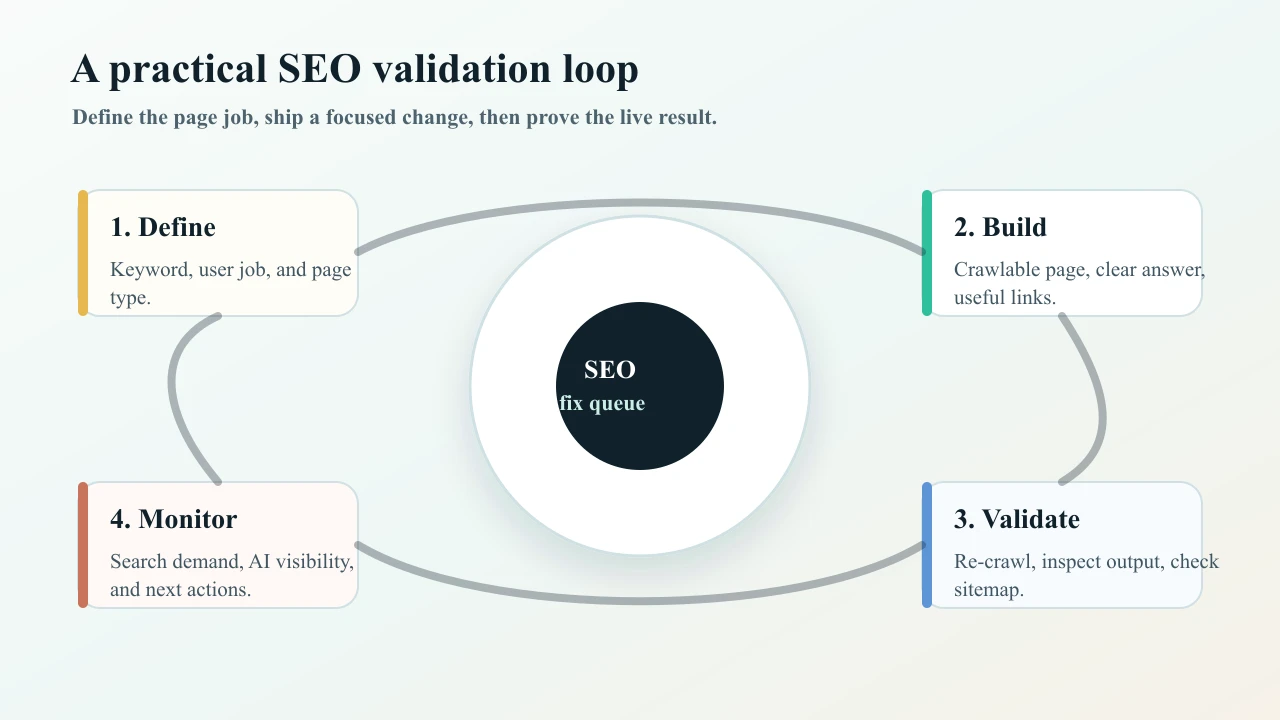
Use this loop for new pages and refreshes:
- Define the target keyword, user job, page type, and information gain.
- Build the page with crawlable structure, clear content, useful links, and local visuals.
- Validate the live output after publishing: status, canonical, title, H1, rendered content, sitemap, and internal links.
- Monitor Search Console and AI-search signals after recrawl windows.
- Turn the result into the next action: expand, refresh, consolidate, link, or leave the page alone.
The Search Console performance report is useful for measuring queries, pages, countries, devices, clicks, impressions, CTR, and average position. Those metrics become more useful when they are paired with crawl and content context.
| Signal | What it tells you | Possible next action |
|---|---|---|
| Impressions up, clicks flat | The page is being shown but the snippet or intent fit may be weak | Improve title, description, intro, or page promise |
| Clicks down on one template | A site section may have technical, content, or demand issues | Crawl affected URLs and compare against a baseline |
| Ranking split across similar URLs | The site may have same-job overlap | Decide whether to merge, canonicalize, or differentiate |
| AI citations missing | The page may be too vague or hard to extract | Add clearer definitions, tables, steps, and evidence |
| Traffic steady but conversions low | The page may lack a useful next step | Add a better internal link, CTA, or decision aid |
A Practical SEO Starter Workflow
Use this workflow when you need to turn "we should do SEO" into actual work:
- List the audience problems your product, service, or content can credibly solve.
- Collect search demand from customer language, existing queries, competitor URLs, and keyword tools.
- Group topics by user job instead of matching words only.
- Choose the right page type for each job.
- Check whether an existing URL already satisfies the same core keyword, page type, and user task.
- Write or refresh the page with a direct answer, useful structure, examples, and next-step links.
- Validate the technical layer before publishing: indexability, canonical, sitemap, links, rendered content.
- Build internal links from related hubs and product pages.
- Monitor query, page, and AI-search visibility changes after recrawl windows.
- Add the next fix to the queue instead of treating the page as permanently done.
This workflow also prevents low-quality content production. If the correct page type is a tool, do not force a blog post. If the topic is a parent hub, link naturally to child guides instead of trying to cram every detail into one page.
Where Searvora Fits
Searvora AI SEO Consultant fits the planning and prioritization layer of this workflow. It is designed to turn noisy SEO signals into clear priorities, action queues, and implementation-ready guidance for content, SEO, and engineering teams.
Use it when you have keyword ideas, crawl findings, content gaps, or AI-search visibility questions and need to decide what should happen next. The goal is not to generate another generic SEO checklist. The goal is to decide which pages to create, which pages to improve, which technical issues to fix first, and how each change will be validated.
SEO is the discipline of making useful pages easier to find, understand, trust, and improve. The teams that win do not stop at definitions. They build a system that turns demand into pages, pages into evidence, and evidence into shipped work.