

The Ahrefs Starter plan is best read as a low-commitment way to access Ahrefs research data, not as a complete SEO operating workflow. It can make sense for a beginner, founder, or single SEO owner who needs competitor research, keyword discovery, basic rank tracking, and site checks without jumping straight into a larger Ahrefs plan.
It becomes less comfortable when the work needs exports, multiple users, many tracked keywords, deeper history, client reporting, or a weekly action queue that turns findings into shipped fixes. This review uses Ahrefs' public pricing, help, and product-announcement pages as the source boundary, then maps the plan to the work a lean SEO team actually has to run.
Start With What Ahrefs Starter Is For
Ahrefs describes the Starter plan as an entry-level paid plan for SEO beginners who want more than the free Ahrefs Webmaster Tools plan. The original Ahrefs Starter plan announcement positions it around light usage and a simple way to explore the Ahrefs toolset.
That makes the plan useful when the bottleneck is research access:
| Reader job | Starter can help when | It may fall short when |
|---|---|---|
| Competitor research | You need quick Site Explorer checks and top-page ideas | You need large exports, many repeated reports, or historical analysis |
| Keyword discovery | You need enough Keywords Explorer access to validate ideas | You manage many lists, markets, or content briefs at once |
| Rank monitoring | You want a small keyword set to watch | You need many tracked keywords, client dashboards, or daily review loops |
| Site checks | You want a lightweight audit path for owned properties | Technical SEO fixes need crawl evidence, owners, and release validation |
| Learning Ahrefs | One person is learning the platform | A team needs roles, repeatable reporting, and shared decisions |
The useful question is not "is Ahrefs good?" Ahrefs is a mature SEO data platform. The better question is whether the Starter plan's limits match the way your team will use the data.
Check The Current Limits Before You Buy
The most important planning step is to check current limits directly on Ahrefs' public pages before subscribing. Public Ahrefs pages can describe the plan from different moments in time. For example, the launch announcement describes the Starter plan at $29/month and says it included 100 monthly credits, while the current Ahrefs Help Center article about the Starter plan lists Starter at $29 with 200 credits per month, no additional users, one unverified project, and unlimited verified projects.
Ahrefs' usage-based pricing help article explains that current Starter plans use credits for tools such as Site Explorer, Keywords Explorer, and Content Explorer, while Site Audit and Rank Tracker use their own limits. The public Ahrefs pricing page may also localize currency and package presentation by market.
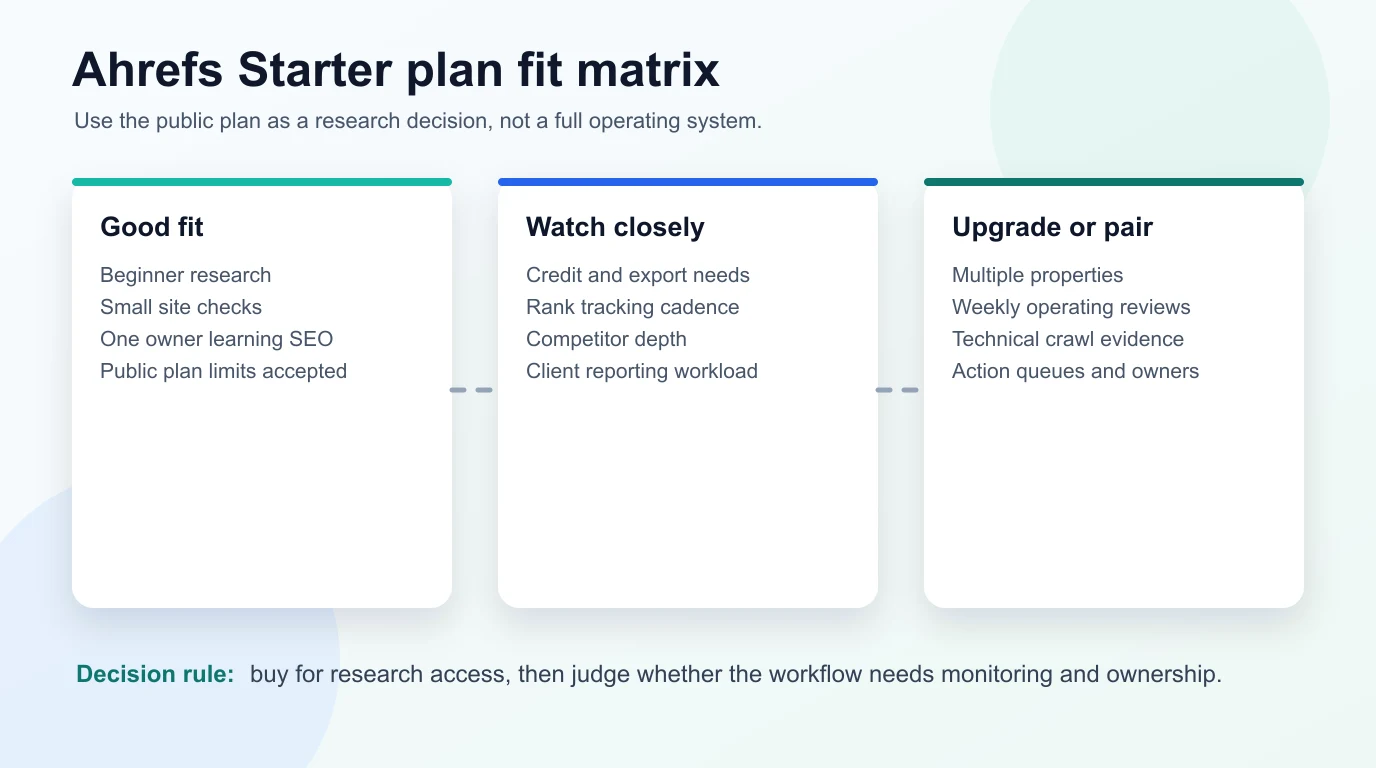
Use this rule: trust the live pricing and help pages for buying decisions, and treat older launch posts as context.
Use Starter When Research Access Is The Bottleneck
Starter is strongest when one operator needs to answer focused research questions quickly:
- Which competitors own the pages you want to beat?
- Which keywords and pages are worth studying before writing a brief?
- Which owned pages deserve a basic audit or rank-tracking watchlist?
- Which opportunities are real enough to move into a content or technical SEO queue?
That is a good fit for founders, small site owners, and solo marketers who are moving beyond free tools. It is also a reasonable learning path before a team commits to a larger Ahrefs plan.
The plan is not the same as a publishing workflow. Ahrefs can help you find evidence. The team still has to decide page types, write briefs, avoid cannibalization, fix crawl issues, and measure whether the work shipped. The Ahrefs tutorial for turning reports into SEO work is the more general version of that handoff.
Watch The Limits That Change The Workflow
The Starter plan becomes a strategic question when the limits start changing behavior. If the team avoids opening reports because credits feel scarce, the plan may slow research. If a client or leadership team needs recurring reporting, the lack of extra users and export depth can create workarounds. If rank tracking is the main reason to subscribe, the keyword count has to match the real review cadence.
Use this limit checklist before relying on Starter:
| Limit area | What to verify | Why it matters |
|---|---|---|
| Credits | Current monthly credits and what actions consume them | Report-heavy workflows can burn credits faster than expected |
| Users | Whether additional users are allowed | Shared SEO work often needs more than one active operator |
| Projects | Verified and unverified project rules | Competitor research and owned-site monitoring have different scopes |
| Historical data | How much history is available | Trend diagnosis needs more context than one-off research |
| Exports | Whether exports are included for your workflow | Briefing, reporting, and BI workflows often need rows outside the UI |
| Rank tracking | Keyword count, location needs, and cadence | Lean teams still need enough watchlist coverage to spot movement |
If the answer to several rows is "we need more," Starter may still be useful for evaluation, but it should not be the team's only operating layer.
Compare The Plan Against The Work
The cleanest way to decide is to compare the plan against jobs, not features. A plan can be affordable and still be wrong if it forces the team to skip the work that would make SEO decisions reliable.
| Scenario | Starter is likely enough | Consider Lite, another stack choice, or a paired workflow |
|---|---|---|
| One founder validates a niche site | Yes, if research is light and monthly | Upgrade if competitor checks become frequent |
| A marketer builds early content briefs | Yes, if lists and exports are not central | Pair with a brief and publishing workflow |
| An agency reports to clients | Usually no | Reporting, users, history, and exports matter more |
| A content team monitors many URLs | Usually no | The bottleneck is review cadence and action ownership |
| A technical SEO team validates fixes | Sometimes for research | Pair with crawl evidence and release validation |
| A team reviews growth weekly | Not by itself | You need segmentation, anomaly review, and an action queue |
For pure plan comparison, the SEO pricing workflow is the companion article. It helps separate subscription cost from the work needed to use the subscription well.
Turn Tool Findings Into A Monitored Queue
The strongest Searvora angle is not "replace Ahrefs." If you need Ahrefs' backlink index, keyword database, or proprietary reports, use Ahrefs for that job. The gap appears after research, when findings need to become tracked work.
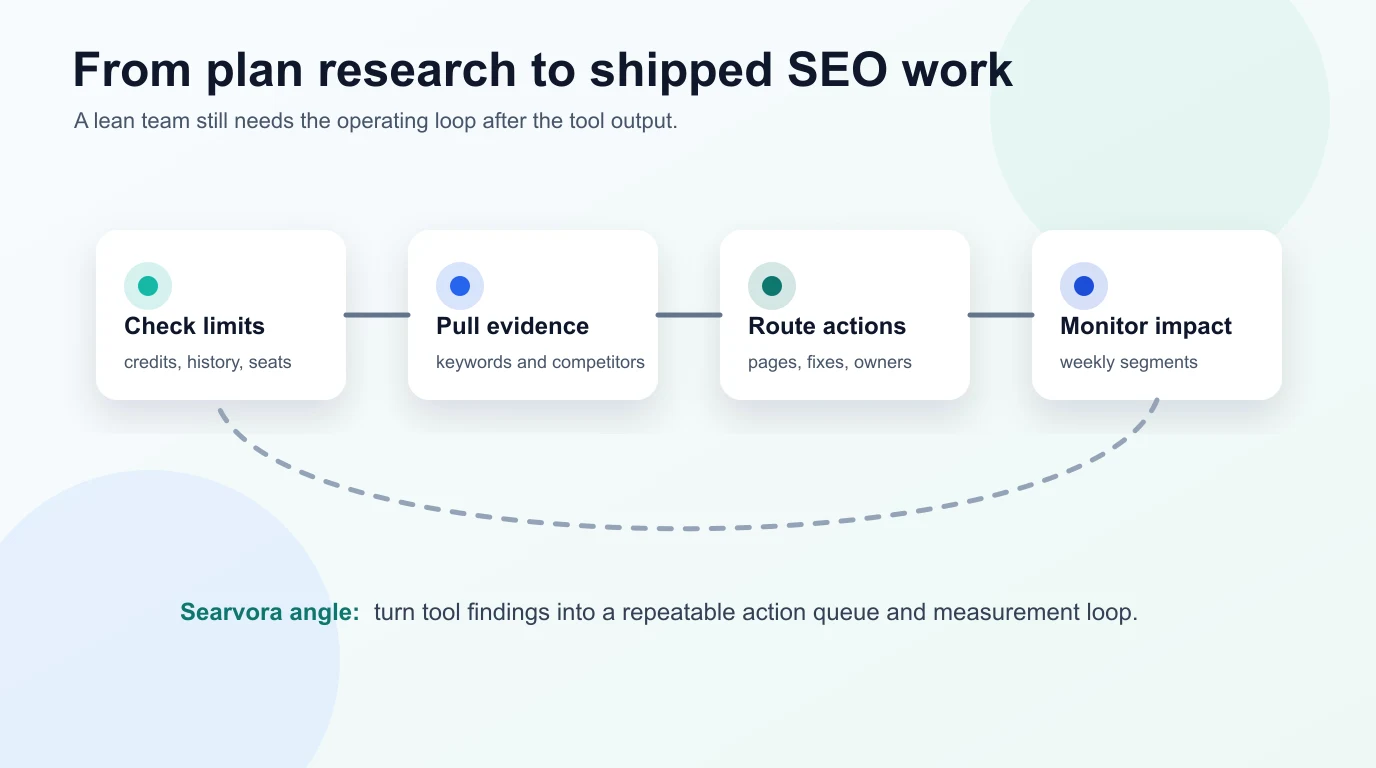
A lean team should turn tool output into four repeatable steps:
- Check plan limits before building the research routine around them.
- Pull evidence for a small number of competitors, keywords, pages, or issues.
- Route each finding to a page decision, content brief, technical fix, or monitoring segment.
- Review impact by page type, directory, locale, and owner in the next weekly cycle.
This is where an AI SEO dashboard fits. Searvora's local product page positions the dashboard around segment-first monitoring, anomaly detection, opportunity scoring, cross-team reporting, and action queues. That is the operating layer a lean team needs after a research tool says what changed.
If the team's weekly review already tracks demand, CTR, indexing, AI visibility, and revenue context, use the SEO metrics to track workflow to decide which Ahrefs findings deserve action first.
Ahrefs Starter Plan Checklist
Use this checklist before choosing the Starter plan as the team's research layer:
- Confirm the current price, credits, tools, project rules, and terms on Ahrefs' live pricing and Help Center pages.
- Decide whether the buyer is one operator, a founder, an SEO lead, an agency, or a team.
- List the reports you expect to open every month and whether credits will constrain normal research.
- Check whether you need exports, historical data, additional users, or many tracked keywords.
- Define the page, keyword, competitor, and technical decisions the plan must support.
- Choose where tool findings become briefs, fixes, dashboards, and owners.
- Revisit the plan after one month of real usage, not after a single interesting report.
The Ahrefs Starter plan is a useful entry point when the work is light, focused, and owned by one person. It is a weaker fit when the real need is repeatable SEO operations. Buy it for research access if the limits fit, then make sure the findings flow into a monitored action queue instead of staying inside another tool tab.