

An SEO checklist is useful only when it changes what the team does next. A long list of best practices can make a site review feel complete, but it rarely creates momentum unless each item has evidence, an owner, a priority, and a validation step.
Use this SEO checklist as an operating workflow. Start with crawl access, check whether the page deserves the query, separate authority work from technical fixes, measure the baseline, and turn the result into a fix queue instead of a loose audit document.
Use The Checklist To Route Work
The mistake is treating every SEO task as the same kind of work. A missing title tag, a blocked collection page, a weak intro, a stale internal link, and a drop in AI-search visibility all belong in the SEO system, but they need different evidence and different owners.
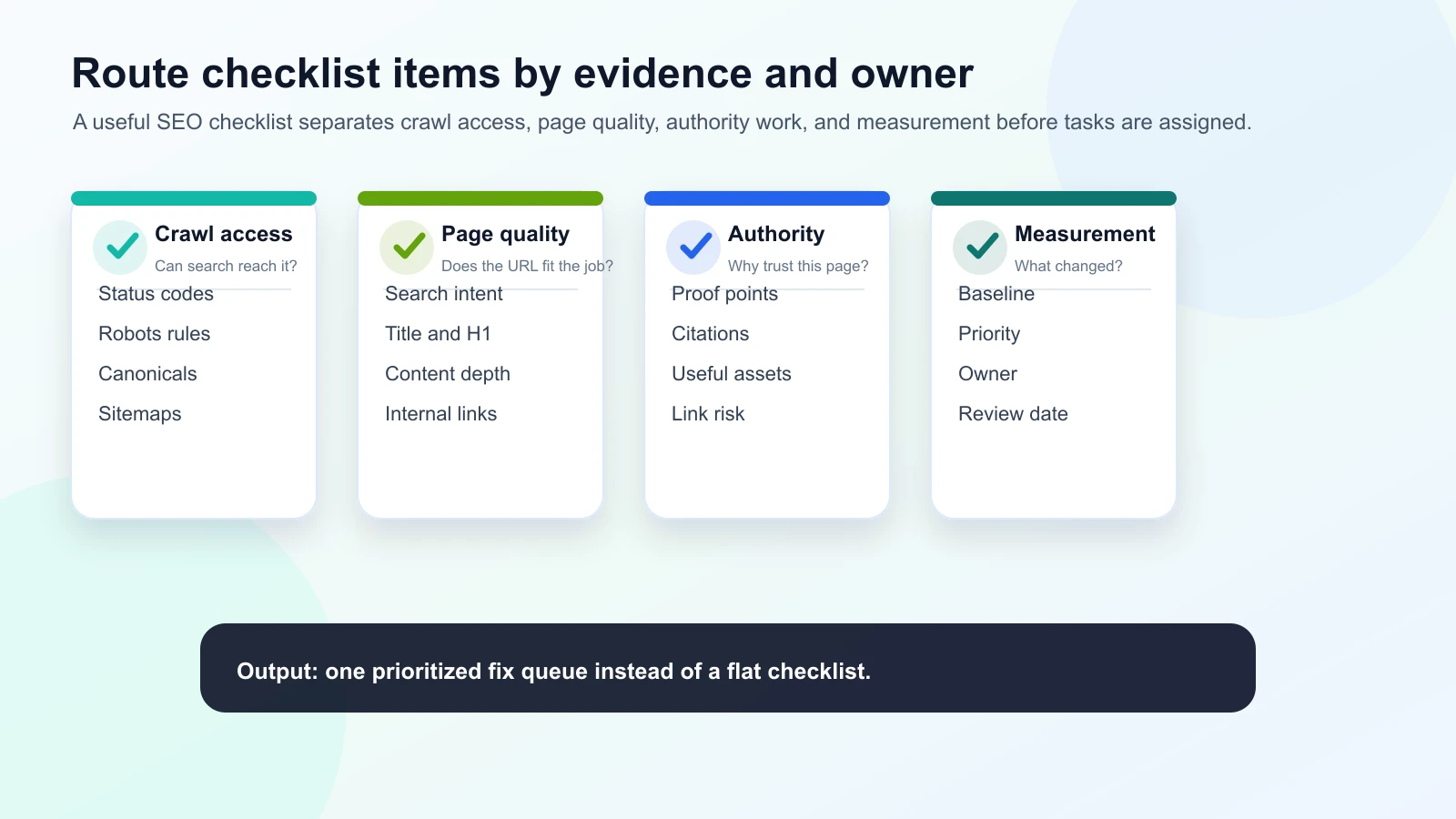
Use four lanes before assigning anything:
| Checklist lane | Evidence to check | Likely owner | Output |
|---|---|---|---|
| Crawl access | Status codes, robots rules, canonicals, sitemap inclusion, crawl depth | Technical SEO or engineering | Fix, validate, or monitor |
| Page quality | Search intent, title, H1, headings, content depth, internal links | SEO, content, or product marketing | Refresh brief or page update |
| Authority signals | Proof, citations, useful assets, expert review, link risk | Content, PR, or SEO lead | Strengthen evidence or outreach plan |
| Measurement | Baseline queries, impressions, clicks, AI mentions, revenue context | Growth or analytics | Priority score and review cadence |
This parent checklist can link into narrower workflows without replacing them. When the access layer is noisy, use the deeper technical SEO workflow. When the page exists but the value is unclear, use a content audit to decide whether to keep, refresh, merge, or retire it.
Start With Crawl Access
Crawl access comes first because content work cannot rescue a page that search systems cannot reach, render, index, or select as canonical. Before rewriting copy or adding schema, confirm that the intended URL is technically eligible to perform.
Check these items in order:
- The final URL returns a healthy status code.
- Redirect chains are short and intentional.
- Robots.txt does not block important pages.
- The page is not accidentally noindexed.
- Canonical tags point to the intended URL.
- Internal links lead crawlers to the page.
- XML sitemaps include only canonical, indexable URLs.
- Important templates are not buried too deep.
Google's SEO starter guide is a useful baseline here because it connects crawlable structure, descriptive links, helpful content, and clear page signals. The checklist job is turning those principles into a queue your team can actually inspect.
| Symptom | First check | Better next action |
|---|---|---|
| Important page missing from search | Robots, noindex, canonical, sitemap, internal links | Fix access before rewriting the page |
| Wrong URL ranking | Canonical, duplicate variants, internal links | Consolidate signals around the intended URL |
| Many low-value URLs discovered | Facets, parameters, internal search, archive pages | Control crawl paths and indexability rules |
| Recent fixes not reflected | Rendered HTML, deploy state, re-crawl timing | Validate the live output before changing more content |
Check Page Quality And Intent
Once the URL can compete, ask whether the page is the right answer for the search task. A checklist should not reward generic completion. It should expose whether the page type, promise, and body actually match the query.
Review these page-level checks:
| Item | What to inspect | Pass condition |
|---|---|---|
| Search task | Query pattern, SERP shape when needed, competitor page type | The page type matches the reader job |
| Title and H1 | Page promise, primary topic, uniqueness | The title and H1 set a clear expectation |
| Intro | First answer, scope, next step | The reader knows what to do without scrolling far |
| Heading structure | H2s, subtopics, examples | The page is scannable and complete enough for the task |
| Internal links | Parent, child, and related paths | Links reinforce the intended page role |
| Content evidence | Examples, sources, product proof, screenshots when relevant | Claims are useful and supportable |
If the page is thin, the fix may be a refresh. If the page serves the wrong job, the fix may be a rewrite, merge, redirect, or new page type. If the query asks for a tool, template, or comparison, another blog post may be the wrong answer.
This is where checklist work overlaps with search intent and content operations. The useful output is not "optimize page." It is "refresh the comparison table," "merge the duplicate how-to," "add crawl evidence," or "create a product page because the query expects a tool."
Separate Authority Work From Technical Fixes
Authority items often get mixed into the same queue as technical issues, which makes prioritization messy. A weak proof section needs a different owner than a canonical conflict. A link-risk review should not block a title rewrite unless they affect the same page decision.
Use a separate authority lane for questions like these:
- Does the page explain why this site should be trusted on the topic?
- Are examples specific enough to help the reader make a decision?
- Do external claims point to official or credible sources?
- Does the page have useful internal links from relevant hubs?
- Are backlink, mention, or citation opportunities tied to a real asset?
- Is link cleanup based on risk evidence, not tool anxiety?
Authority work should end with a concrete asset or evidence improvement. That might mean adding original examples, improving a comparison table, documenting a process, quoting an official source, creating a downloadable checklist, or earning references to a genuinely useful page.
Avoid vague tasks such as "build authority" or "get more links." They are hard to assign and easy to game. Use the checklist to name the proof gap and the asset that would close it.
Give Every Item A Decision
The checklist should create decisions, not just findings. Every row should end with one action label so the team can compare work across pages and templates.
| Decision | Use when | What to assign |
|---|---|---|
| Fix | A clear issue blocks crawl access, indexability, meaning, or measurement | Specific technical or content change |
| Refresh | The URL owns the job but needs fresher, clearer, or deeper content | Brief, source updates, examples, internal links |
| Merge | Multiple URLs serve the same core keyword, page type, and user task | Consolidation plan, redirects, internal link cleanup |
| Create | No existing URL serves a distinct job and page type | New page brief with information gain |
| Defer | Evidence is weak, impact is low, or ownership is unclear | Revisit trigger and data needed |
| Monitor | The issue is low risk or already fixed | Baseline, owner, next review date |
This keeps the checklist from creating low-confidence busywork. It also protects against cannibalization. A new page is risky only when the same core keyword, same page type, and same user job are already covered. Parent-child coverage is normal when the parent routes readers into deeper workflows.
Validate Before The Queue Moves On
SEO checklist work is not done when the ticket closes. It is done when the live page changed and the same evidence source confirms the issue improved.
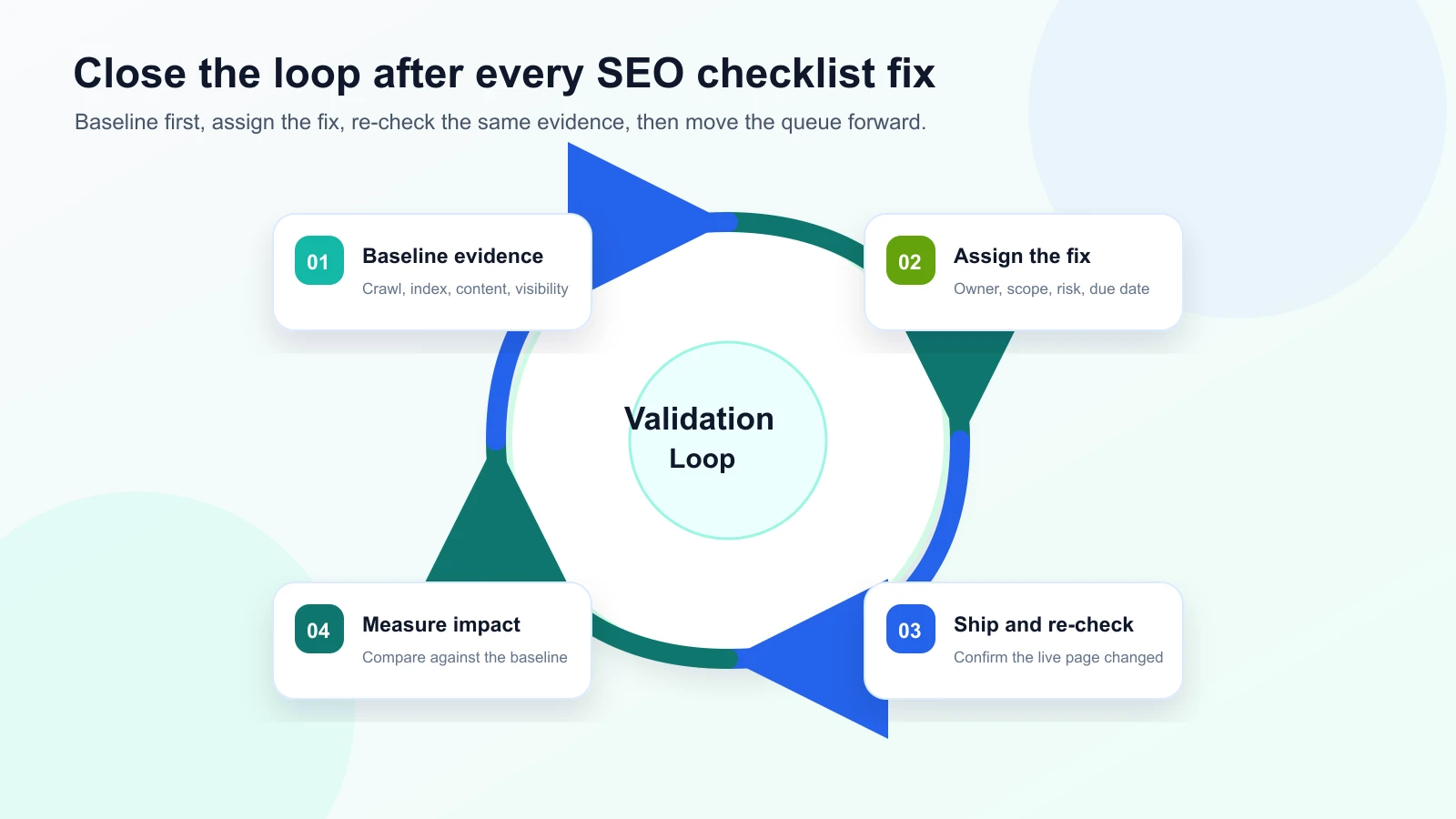
Use this validation loop:
- Save the baseline before assigning the work.
- Name the owner, page group, risk, and expected output.
- Ship the fix or refresh.
- Re-crawl or re-check the live page.
- Compare the same metric or evidence source.
- Move the item to monitor, reopen, or escalate.
For performance review, tie the checklist to a short set of metrics rather than every available number. The SEO metrics workflow is the natural companion when you need to connect index coverage, rankings, snippets, AI visibility, traffic, and revenue context to one weekly review.
| Validation question | Evidence source | Good outcome |
|---|---|---|
| Did the page output change? | Crawl, rendered HTML, CMS preview, deploy diff | The live URL matches the intended fix |
| Did search access improve? | Indexability, sitemap, canonical, internal links | Important URLs are eligible and discoverable |
| Did page quality improve? | Title, H1, body, media, links, source evidence | The page better answers the query job |
| Did visibility move? | Search Console, rank tracking, AI-search checks, analytics | Trend is improving or the next bottleneck is clearer |
Where Searvora Fits
Searvora fits when the checklist needs to become prioritized work. Use the crawler layer to gather access and page signals, then use the AI SEO Consultant layer to turn mixed evidence into decisions that content, SEO, and engineering teams can ship.
The strongest handoff looks like this:
| Input | Searvora workflow role | Output |
|---|---|---|
| Crawl findings | Group technical issues by page type and risk | Fix queue with validation checks |
| Content inventory | Compare page jobs and refresh candidates | Keep, refresh, merge, create, or monitor decisions |
| Search and AI visibility signals | Prioritize where changes could matter | Weekly action plan |
| Competitor URL gaps | Identify useful page shapes without cloning them | Briefs with information gain |
The SEO Checklist
Use this as the working checklist for each important page group. For large sites, run it by template first, then inspect high-value URLs individually.
| Stage | Checklist item | Evidence | Done when |
|---|---|---|---|
| Crawl access | Confirm status code, redirects, robots, noindex, canonical, and sitemap inclusion | Crawl export and rendered page checks | The intended URL is reachable, indexable, and canonical |
| Crawl access | Confirm internal links and crawl depth | Internal link report | Important pages are discoverable from relevant hubs |
| Page quality | Match query job to page type | SERP or competitor-page evidence when needed | The page format fits the reader task |
| Page quality | Review title, H1, intro, headings, and body completeness | Page review and content inventory | The page promise and body match the target job |
| Page quality | Add or refine internal links | Blog, product, and hub inventory | Links support parent-child structure without spam |
| Authority | Add proof, examples, sources, or original assets | Source review and editorial brief | Claims feel useful, current, and defensible |
| Authority | Separate link opportunities from link-risk cleanup | Backlink or mention review | Work is tied to a real asset or credible risk |
| Measurement | Save baseline visibility and business context | Search Console, analytics, dashboard, rank checks | Priority reflects impact and confidence |
| Measurement | Assign owner, due date, validation method, and review date | Fix queue | The item can be shipped and checked |
Keep The Checklist Alive
An SEO checklist gets weaker when it becomes a static document. Review it after releases, template changes, CMS migrations, new product pages, and content refresh cycles. Remove checks that never create decisions. Add checks only when they help the team catch a real failure mode.
The goal is not to complete the most items. The goal is to find the next highest-confidence action and prove that it changed something after it shipped.