

SEO pricing only makes sense after you know what work needs to happen. A monthly retainer, one-time audit, hourly consultant, and software subscription can all be reasonable. They become expensive when the scope is vague, the site evidence is thin, or nobody owns implementation.
The better question is not "What should SEO cost?" It is "Which pricing model will diagnose the right problem, ship the right work, and prove whether the spend helped?" Start there and SEO pricing becomes a buying decision, not a guessing game.
Start With Scope Before Price
The competing Ahrefs pricing article is useful because it treats SEO cost as a market question and points to survey evidence about common pricing models. That is a good starting point, but buyers still need a scope framework before they can decide whether a quote is fair.
Google's guidance on hiring an SEO is a useful baseline: useful SEO services can include site structure review, technical advice, content development, keyword research, training, and market expertise. Those jobs are not interchangeable. A quote for technical migration support should not be judged the same way as a content calendar, a local SEO setup, or a quarterly growth roadmap.
Use this first-pass scope table before comparing vendors:
| SEO job | Better pricing model | What the quote must include |
|---|---|---|
| Technical audit | Fixed project or short retainer | Crawl findings, severity, owners, and validation steps |
| Ongoing growth program | Monthly retainer plus clear backlog | Prioritized actions, reporting cadence, and shipped work |
| Migration or redesign | Project with milestone gates | Redirect map, crawl checks, launch QA, and post-launch review |
| Content operations | Retainer, software, or hybrid | Keyword decisions, briefs, publishing flow, refresh rules |
| Executive strategy | Hourly or project advisory | Decision memo, roadmap, risks, and implementation plan |
| Monitoring and triage | Software plus periodic review | Dashboards, alerts, anomaly review, and action routing |
Choose the Pricing Model That Fits the Work
SEO pricing usually falls into four practical buckets: retainers, projects, hourly advisory, and software. The right model depends on how repeatable the work is and how much execution help the team needs.
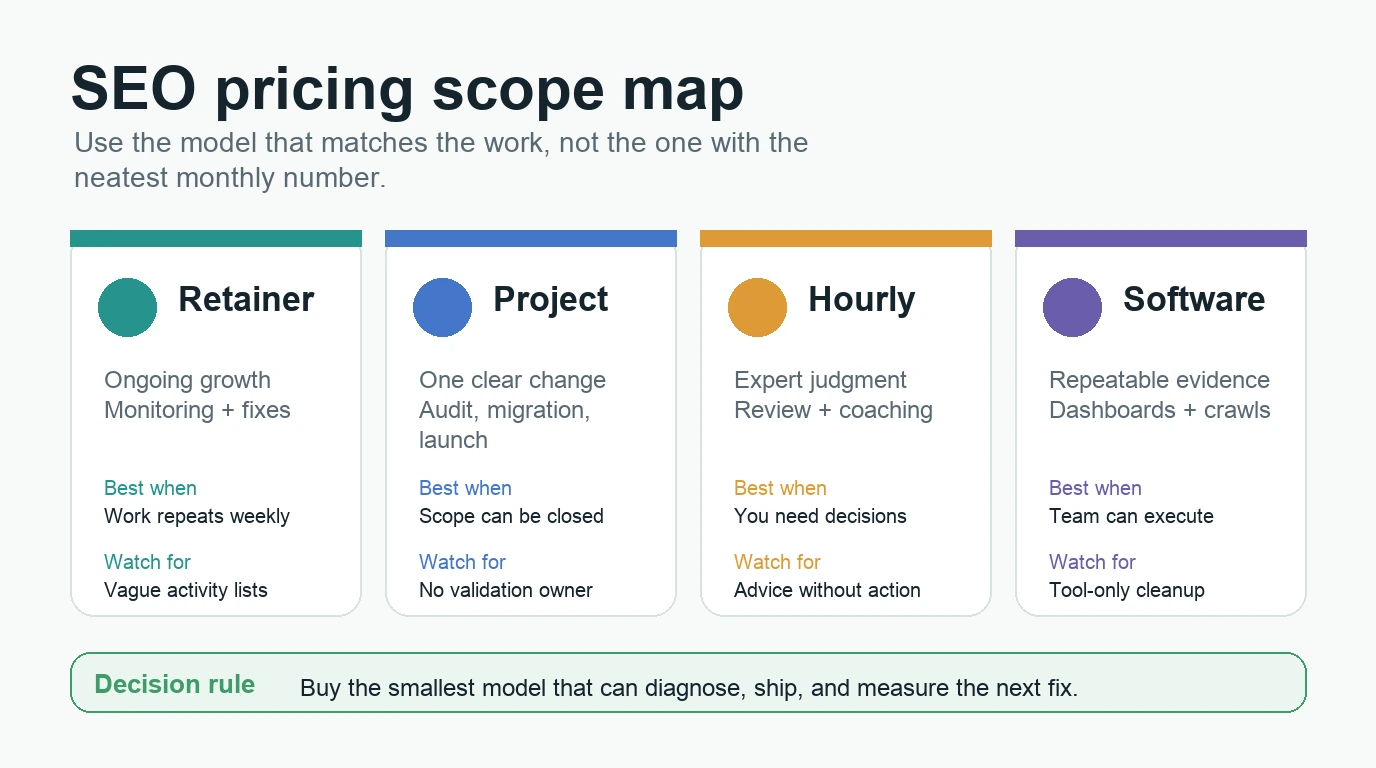
| Model | Best when | Risk to watch |
|---|---|---|
| Monthly retainer | The site needs recurring diagnosis, content, technical cleanup, and reporting | Paying for activity lists instead of outcomes |
| Fixed project | The job has a clear finish line, such as an audit, migration, or template cleanup | Receiving recommendations with no implementation owner |
| Hourly consulting | You need expert judgment, review, or coaching more than production labor | Advice becomes disconnected from shipped work |
| Software subscription | Your team can execute but needs better evidence, monitoring, or crawl coverage | Tool data piles up without prioritization |
| Hybrid model | The site needs software evidence plus periodic strategic decisions | Nobody decides which findings deserve action first |
The cheapest option is not always the smallest bill. A low retainer can be costly if it produces reports nobody acts on. A high project fee can be efficient if it fixes a crawl, indexation, or content system problem that has blocked growth for months.
If the quote is for content, connect it to a real keyword research workflow. If the quote is for technical SEO, connect it to a crawl-backed technical SEO workflow. Pricing gets clearer when the page type, user task, and validation path are visible.
Use Evidence to Judge the Quote
Good SEO pricing is evidence-backed. The vendor or internal team should be able to explain why this work matters now, what they checked, and what would happen if the site did nothing.
Ask for the evidence behind the quote:
- Which pages, templates, or markets are affected?
- Which crawl, Search Console, analytics, content, or SERP signals support the recommendation?
- Is the problem technical, editorial, structural, authority-related, or a mix?
- What is the estimated impact, confidence, and effort?
- What has to change in the CMS, codebase, content process, or internal linking system?
- How will the team know whether the work succeeded?
Google's SEO starter guide is a reminder that SEO work often spans crawlability, site structure, helpful content, links, images, and snippets. A quote that only says "optimize pages" is too thin. It should name the specific signals and the workflow that will improve them.
For larger sites, the quote should also separate discovery from delivery. A crawl can identify broken links, duplicate titles, redirect chains, canonical conflicts, thin pages, and internal link gaps. That does not automatically mean every issue should be fixed first. The pricing should include prioritization, not just detection.
Check Whether Implementation Is Included
Many SEO proposals sound strong until implementation starts. The work turns out to require developers, CMS access, design support, product approval, or content production that was never included in the price.
Use this quote quality check before approving spend:
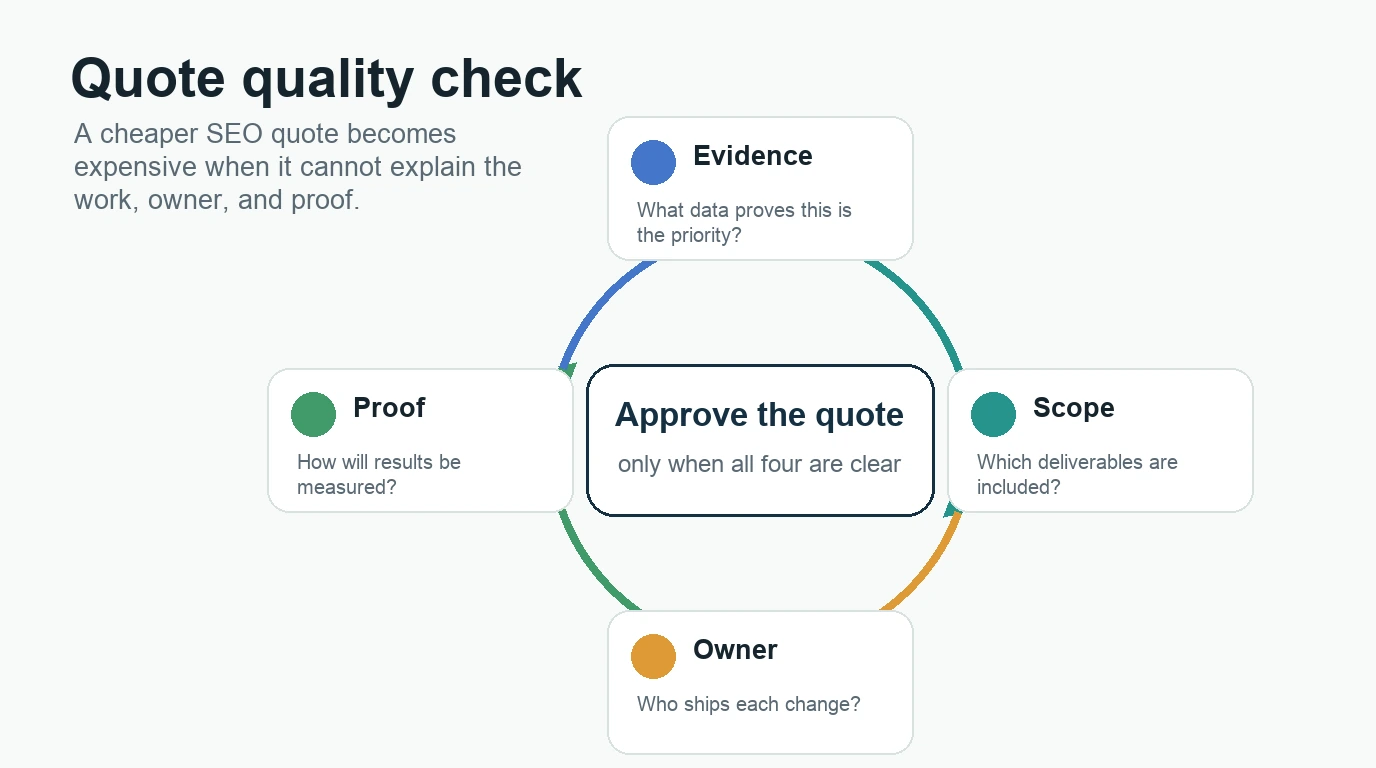
| Quote component | What to confirm |
|---|---|
| Evidence | The diagnosis comes from real site, search, crawl, or content data |
| Scope | Deliverables are named clearly enough to accept or reject |
| Owner | Each task has a person or team responsible for shipping it |
| Dependencies | Engineering, CMS, analytics, design, and content needs are visible |
| Measurement | The review date, metric, and expected signal are defined |
| Exclusions | The quote says what is not included, not only what is included |
A healthy quote uses plain language. "We will improve technical SEO" is not enough. "We will crawl the site, group indexability and redirect issues by template, send engineering a prioritized fix list, and validate the next crawl" is much easier to price, approve, and measure.
This is also where a content audit can prevent waste. If the site has hundreds of stale pages, a content retainer should not promise a random number of new articles before deciding which existing pages should be kept, refreshed, merged, redirected, or retired.
Match Spend to Your Team's Maturity
The same SEO pricing can be fair for one team and wasteful for another. A mature team with engineers, writers, analytics access, and a crawl process may need software and advisory review. A lean team may need a consultant or agency that can translate findings into work and help push it through.
Use this maturity lens:
| Team situation | Smarter spend |
|---|---|
| No SEO baseline | Start with a scoped audit and prioritized roadmap |
| Strong team, weak evidence | Buy monitoring, crawling, and reporting before more advice |
| Clear issues, slow delivery | Pay for implementation planning and owner-ready tickets |
| Publishing without strategy | Fund keyword decisions, briefs, and refresh rules |
| Traffic volatility | Invest in dashboard monitoring and anomaly review |
| Migration coming | Budget for pre-launch QA, redirect validation, and post-launch checks |
The trap is paying for the layer you already have. If the team already has good data but weak decisions, another dashboard will not solve the bottleneck. If the team has smart strategy but no reliable crawl evidence, more consulting calls may only produce better guesses.
Where Searvora Fits
Searvora fits when SEO pricing needs to become an execution decision. The AI SEO consultant is designed to turn mixed signals into prioritized work, while the broader Searvora stack connects monitoring, crawling, content planning, and action handoff.
Use Searvora around pricing decisions in three ways:
| Pricing question | Searvora workflow |
|---|---|
| What should we pay for first? | Compare crawl, content, and performance signals before approving scope |
| Is this quote specific enough? | Convert vague recommendations into owner-ready actions |
| Did the spend create progress? | Monitor changed pages, validate fixes, and keep the next queue focused |
Searvora does not replace every consultant, writer, or developer. It helps the team see which work deserves budget, what evidence supports the decision, and how to turn approved spend into shipped actions instead of another static report.
A Practical SEO Pricing Checklist
Use this checklist before approving a retainer, project, hourly package, or software subscription:
- Define the business and search problem the spend should solve.
- Separate technical, content, authority, reporting, and strategy work.
- Ask which site evidence supports the proposed scope.
- Confirm whether implementation is included or only recommendations.
- Name the owner for each deliverable before the work starts.
- Check dependencies in engineering, CMS, analytics, design, and content.
- Compare pricing models by delivery fit, not just monthly cost.
- Ask what is excluded from the quote.
- Define the validation window and success signal.
- Reject any proposal that cannot explain evidence, scope, owner, and proof.
SEO pricing is fair when it matches the work your site actually needs. Start with evidence, choose the smallest model that can ship the next useful fix, and keep measuring after the invoice is paid.