

Local SEO is the work of making a business easy to understand, trust, and choose in location-based search results. It covers business profiles, location pages, reviews, local content, structured data, links, and measurement.
The mistake is treating those pieces as separate chores. A useful local SEO workflow turns them into one operating loop: confirm the business entity, make the right pages crawlable and useful, earn local trust signals, monitor visibility by market, and prioritize the next fix with evidence.
What Local SEO Should Decide
Local SEO should not end with "optimize the profile" or "write city pages." The team needs decisions that can be assigned, shipped, and measured.
Use this decision frame before creating tasks:
| Local SEO question | Evidence to check | Work it creates |
|---|---|---|
| Can search systems understand the business? | Name, address, phone, categories, services, hours, service area, and entity consistency | Profile cleanup, citation cleanup, schema updates |
| Does the right page exist for the location or service? | Location page, service page, title, H1, internal links, local proof, and conversion path | Page creation, page refresh, internal link updates |
| Is the page technically eligible to perform? | Indexability, canonical, robots rules, status code, sitemap inclusion, crawl depth | Technical fix, re-crawl, sitemap cleanup |
| Does the business show enough trust? | Review themes, response cadence, local photos, community references, media mentions | Review response workflow, proof sections, local content |
| Can the team see what changed? | Search queries, map actions, calls, directions, page clicks, AI answer mentions | Weekly dashboard review and prioritized actions |
Google's local ranking guidance describes relevance, distance, and prominence as important local ranking factors. That is a helpful starting point, but the operator still needs to turn those factors into concrete work across profiles, pages, content, technical SEO, and reporting.
Build The Local Evidence Layer
Start by making the business entity clear. If the basic facts are inconsistent, every later tactic becomes harder to trust.
Collect these fields for each location or service-area business:
| Evidence field | Why it matters | Common issue |
|---|---|---|
| Business name and primary category | Defines what the entity is and which local searches it can satisfy | Category chosen for volume instead of accuracy |
| Address or service area | Helps search systems understand market coverage | Mixed public address and service-area rules |
| Phone, hours, and appointment path | Removes friction for high-intent visitors | Different values across profile, site, and citations |
| Services and attributes | Clarifies relevance for specific local tasks | Services listed in the profile but missing from pages |
| Reviews and responses | Shows trust, recency, and real customer language | No response cadence or no theme extraction |
| Photos and local proof | Helps users confirm the business is active and local | Generic stock visuals or outdated location photos |
Google's Business Profile guidelines are the guardrail for this layer. Do not force keywords into business names, invent locations, or present a service area in a way that misrepresents the real business.
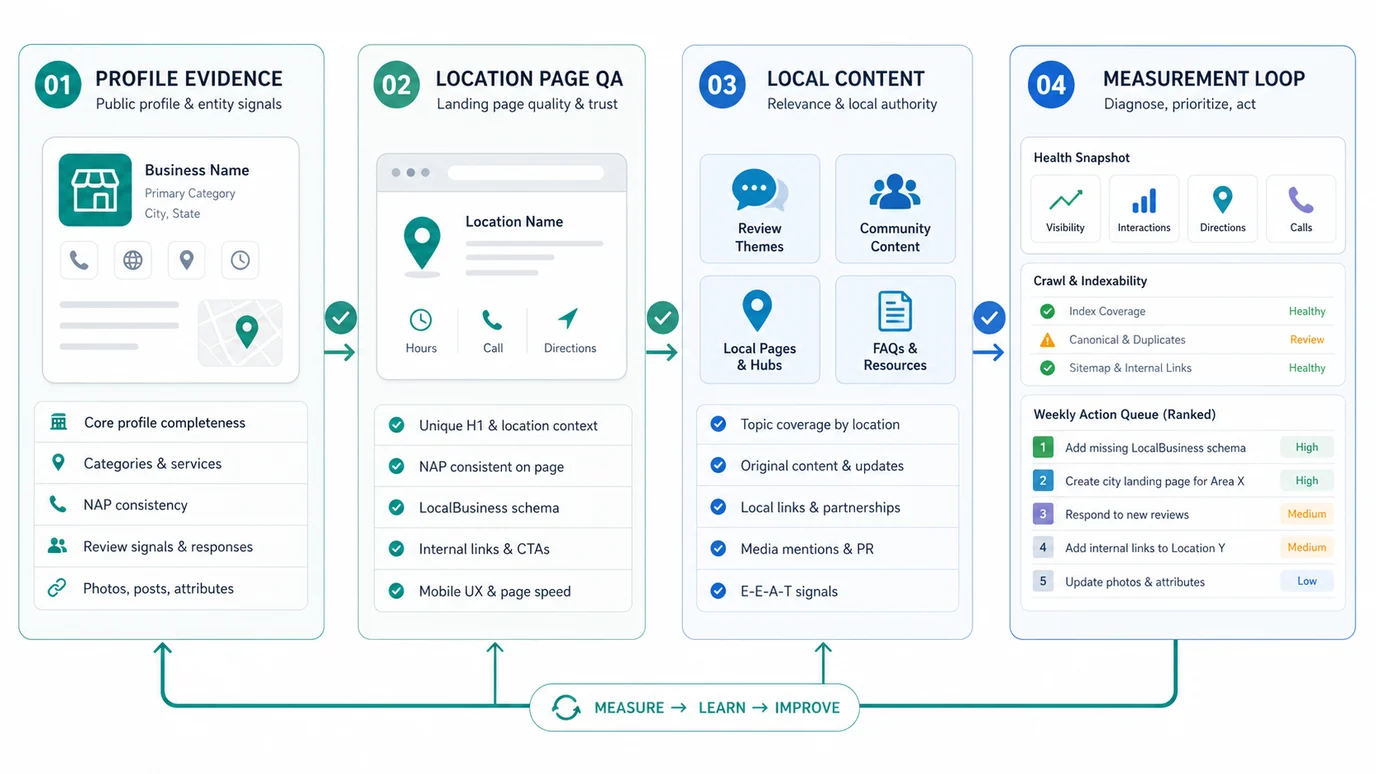
Once the profile facts are stable, compare them with the website. The location page should reinforce the same entity signals in a way users can act on: local services, address or service area, hours, contact options, unique proof, FAQs, directions when appropriate, and internal links to related service or resource pages.
If the business has many locations, do not copy the same city page dozens of times. Use a shared template only for structure. Each page still needs unique local context, staff or service details, proof, photos, and reasons the page is useful beyond the city name.
Fix Profiles, Pages, And Entity Signals Together
Profile work and website work should move together. A profile can rank for local pack visibility, but the website often carries the deeper proof, conversion path, and organic result that users need before choosing a business.
Use this sequence for each important market:
- Confirm the business profile is eligible, accurate, and complete.
- Match profile services and categories to the website's service and location pages.
- Add or refresh the local landing page only when it serves a distinct market or user job.
- Add local proof such as customer themes, staff expertise, project examples, service details, and FAQs.
- Add internal links from relevant hubs, service pages, and blog resources.
- Validate that the page is indexable, canonical, fast enough to use, and included in the sitemap.
- Track profile actions and organic page performance together.
For structured data, use Google's LocalBusiness structured data documentation as the implementation reference. Structured data does not replace a useful page, but it can make business details easier to parse when the markup matches visible page content.
This is also where local SEO connects to broader search operations. If the location page is thin, treat it like a content audit candidate. If the page is buried, add relevant internal links instead of waiting for Google to infer its importance. If it duplicates another page's exact job, use the same strict duplicate test you would use for any SEO workflow: same core keyword, same page type, same user task.
Use Crawl Checks To Protect Local Pages
Local pages often fail for boring technical reasons. A page can have the right local proof and still underperform because it is canonicalized elsewhere, excluded from the sitemap, blocked by robots rules, stuck behind a redirect, or too deep in the site architecture.
Run a local page crawl before assigning content work:
| Crawl check | What to look for | Local SEO risk |
|---|---|---|
| Indexability | 200 status, no unintended noindex, allowed by robots | Search systems cannot keep the page eligible |
| Canonical | Self-referencing or intentionally consolidated | Location page points to a generic parent page |
| Sitemap | Included only when canonical and useful | Important location page is missing or stale pages remain |
| Internal links | Linked from service, location, hub, and navigation paths where relevant | Page is orphaned or only reachable through search |
| Titles and H1s | Unique enough to identify service and market | Template duplication hides the local job |
| Structured data | Matches visible business details | Markup conflicts with profile or page content |
| Redirects | Clean final URL with no unnecessary chain | Old location URLs leak crawl clarity and user trust |
The technical SEO workflow is useful when local pages depend on many templates, parameters, or CMS rules. For smaller sites, the same logic still applies: prove the page is discoverable before asking writers to rewrite it.
Internal links deserve a separate pass. A local page should connect to the service it supports, the hub that explains the broader topic, and the conversion path users need next. The internal links for SEO workflow can help when local pages are isolated or when anchors do not explain the destination clearly.
Prioritize Weekly Local SEO Work
Local SEO becomes noisy because every signal feels urgent. Reviews, profile photos, city pages, citations, schema, link cleanup, local content, and reporting can all produce tasks. The team needs a scoring model that keeps the queue honest.
Score each candidate task by impact, confidence, and effort:
| Score dimension | High score means | Low score means |
|---|---|---|
| Impact | The task affects a high-value location, service, or search path | The task is cosmetic or affects a low-priority market |
| Confidence | Evidence clearly explains why the work matters | The task is based on a hunch or generic checklist item |
| Effort | The task can ship with available owners and low risk | The task needs unresolved data, engineering, legal, or operations input |
Then route the work into one of five lanes:
| Lane | Example task | Owner |
|---|---|---|
| Profile | Update categories, hours, services, photos, or review responses | Local operations or marketing |
| Page | Refresh a location page, add proof, improve title and H1, clarify calls to action | Content or SEO |
| Technical | Fix indexability, canonicals, redirects, schema, sitemap, or crawl depth | SEO and engineering |
| Authority | Build local partnerships, mentions, resources, and useful community content | Marketing or partnerships |
| Measurement | Review market-level movement, calls, direction requests, rankings, and AI-answer mentions | SEO operations |
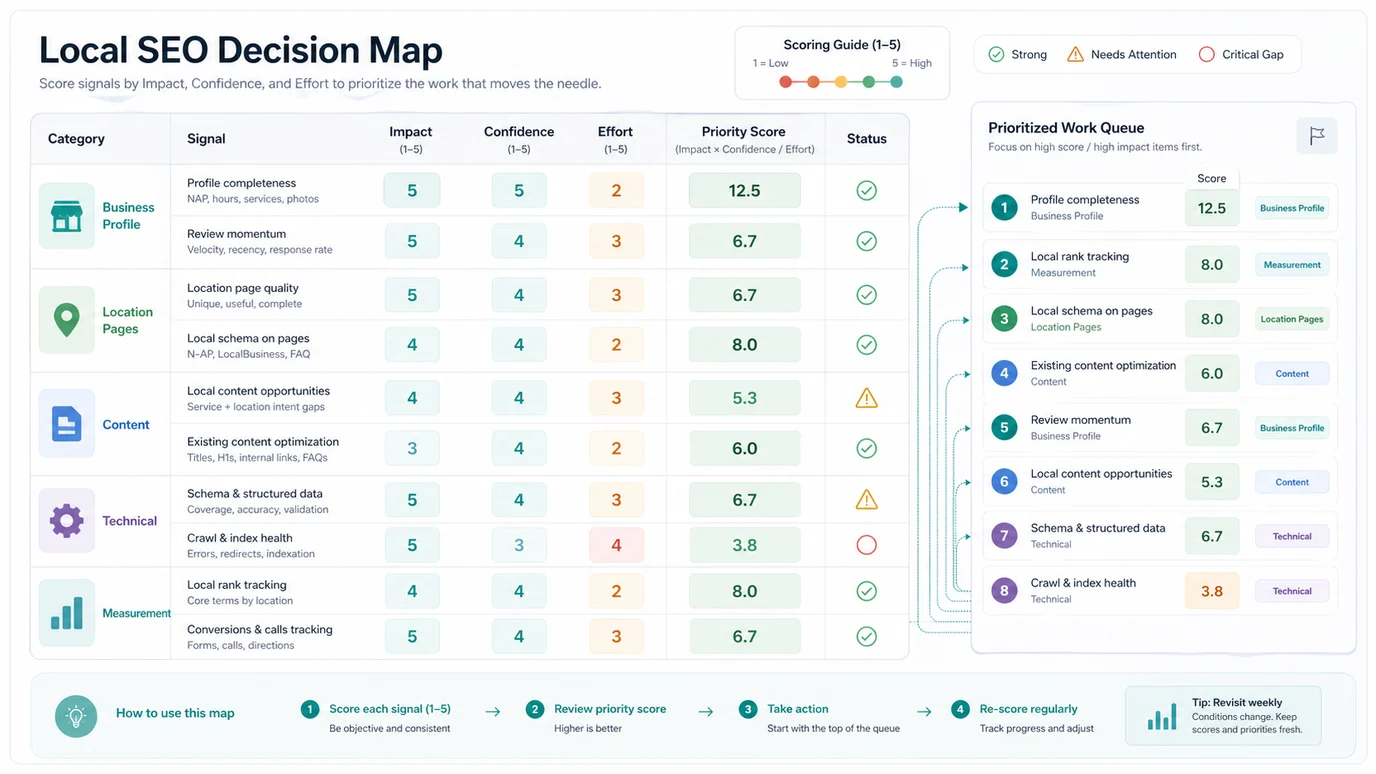
This is where Searvora fits naturally. Use AI SEO Dashboard to watch local page groups, markets, and page types together, then turn movement into a weekly queue instead of a disconnected report.
Measure Local Visibility Beyond Rankings
Rankings matter, but local SEO measurement should not stop there. A business can improve calls, direction requests, booked appointments, and branded trust before a broad ranking report looks impressive.
Review these signals together:
| Measurement layer | What to review | What it can reveal |
|---|---|---|
| Profile actions | Calls, direction requests, website clicks, bookings, messages | Whether high-intent local users are acting |
| Organic landing pages | Clicks, impressions, CTR, query mix, conversions | Whether location and service pages answer real searches |
| Technical health | Crawl errors, noindex issues, sitemap drift, duplicate titles, broken links | Whether local pages remain eligible and understandable |
| Review themes | Recency, sentiment themes, repeated questions, response cadence | What proof and FAQs the site should add |
| AI visibility | Whether AI answers mention the brand, services, locations, or supporting pages | Whether the business is easy to cite and summarize |
For AI search, the goal is not to stuff a profile with more phrases. The goal is to make the business easy to verify: consistent facts, clear service pages, original local proof, helpful FAQs, crawlable resources, and structured data that matches the page.
The GEO SEO foundations workflow is a good companion when the local SEO program needs to be visible in AI answer systems, not only classic search results.
A Practical Local SEO Checklist
Use this checklist when you need the work to become a repeatable operating cadence:
- Confirm the business is eligible for a public profile and follows platform guidelines.
- Clean up name, category, address or service area, phone, hours, services, attributes, photos, and appointment paths.
- Map profile services to website service and location pages.
- Create or refresh only the location pages that serve a distinct market and user job.
- Add local proof, FAQs, service details, conversion paths, and relevant internal links.
- Validate indexability, canonicals, sitemap inclusion, title, H1, structured data, and redirect paths.
- Review local content gaps from customer questions, review themes, community references, and service demand.
- Score tasks by impact, confidence, and effort before assigning owners.
- Track profile actions, organic page performance, crawl health, and AI visibility together.
- Revisit the queue weekly and record which work changed visibility, trust, or conversions.
Local SEO works best when the team can see the whole system. Profiles create public facts. Pages explain the offer. Reviews and local proof build trust. Technical checks keep everything eligible. Measurement turns the next cycle into a better decision instead of another generic checklist.