

Link building for SEO works when it earns attention for something useful. It becomes risky when the campaign starts with a list of sites, a target anchor, and pressure to manufacture authority faster than the brand has earned it.
The safer workflow starts with search demand, builds or improves a linkable asset, qualifies prospects by audience fit, documents outreach, and measures whether the earned links support the pages that matter. That keeps link building close to organic growth work instead of treating it as a separate spreadsheet game.
Start With The Asset, Not The Prospect List
The page that deserves links should be obvious before outreach begins. A prospect list cannot save a thin asset, a generic blog post, or a sales page that has no reason to be cited.
Use this asset check before building a campaign:
| Asset question | What to look for | If the answer is weak |
|---|---|---|
| Why would someone cite this? | Data, examples, templates, original explanation, public evidence, or a practical workflow | Improve the asset before outreach |
| Which search task does it support? | A clear keyword, comparison, checklist, definition, or decision job | Rework the page type and intent |
| Which audience would care? | Editors, practitioners, customers, partners, researchers, or community owners | Narrow the campaign to a real audience |
| What is the safe anchor range? | Branded, descriptive, URL, and natural phrase anchors | Avoid forcing exact-match anchors |
| How will success be measured? | Referring pages, qualified mentions, assisted rankings, conversions, or content refresh decisions | Define a measurement plan first |
The official Ahrefs link building guide frames link building as getting other websites to link to pages on your site and gives beginner-friendly tactics. Searvora's information gain is the operating layer around that idea: which assets deserve promotion, which prospects should be skipped, and how to turn the campaign into measured work rather than link count pressure.
If the linkable asset starts from keyword demand, pair this workflow with the keyword research execution process. The right keyword does not automatically deserve a link campaign, but it can reveal the kind of reference, template, statistic, or explanation that other sites may naturally cite.
Qualify Prospects Before Outreach
Prospect quality matters more than prospect count. A small list of relevant editors, partners, resource pages, and community references is more useful than a large list of weak sites that only share a metric.
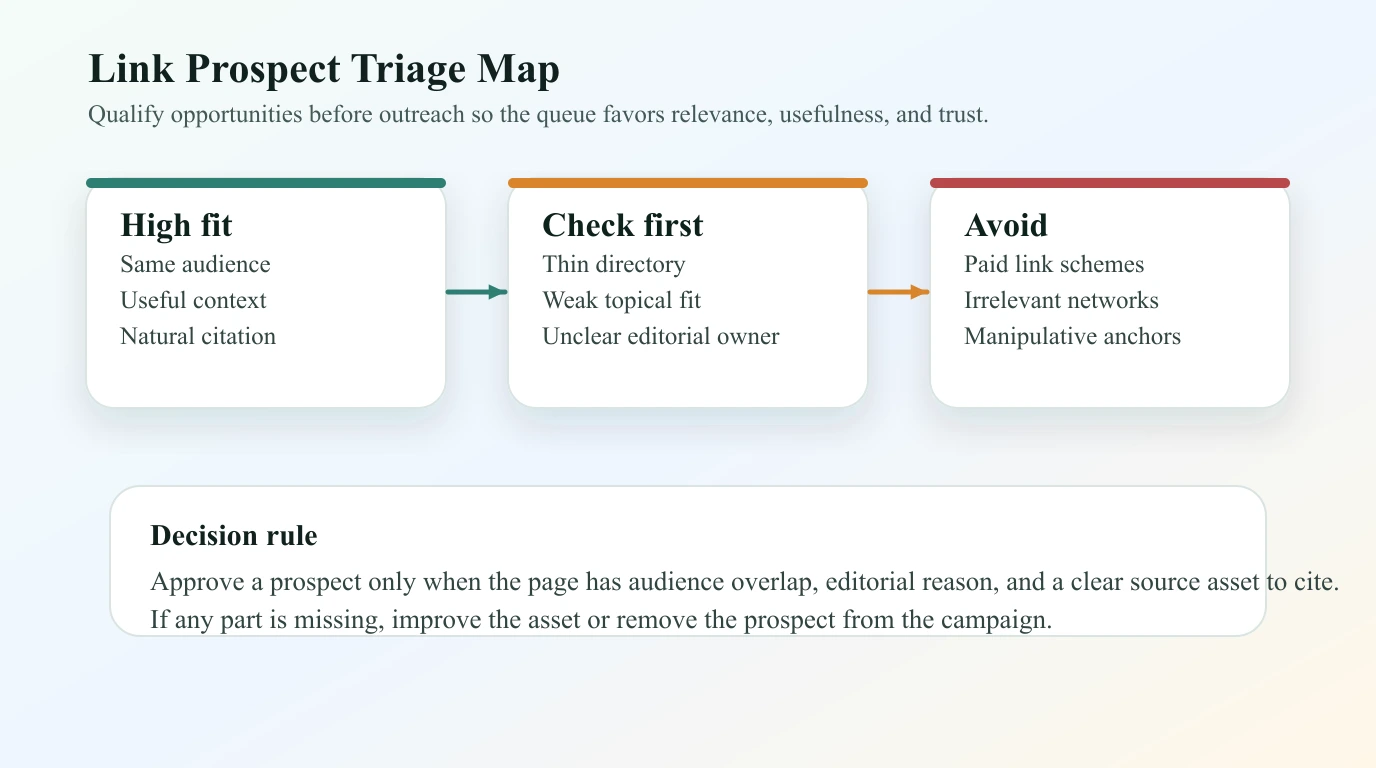
Use this triage map in your campaign notes:
| Prospect signal | Good sign | Risk sign |
|---|---|---|
| Topical fit | The page already covers the subject or adjacent job | The site is unrelated but has attractive metrics |
| Audience overlap | Their readers would genuinely benefit from the asset | The audience would never use the resource |
| Editorial reason | The link improves a page, list, example, or source citation | The only reason is an exchange or payment |
| Page quality | The page is indexed, maintained, and useful | The page is a thin directory or link farm |
| Anchor naturalness | Branded or descriptive wording fits the sentence | The campaign demands exact-match anchor text |
| Relationship context | There is a valid reason to contact the owner | The contact is scraped with no editorial context |
Google's spam policies are the guardrail here. Links intended to manipulate search rankings can become a liability, especially when the pattern involves paid placements, excessive exchanges, automated link creation, or unnatural anchors.
That does not mean every outreach campaign is unsafe. It means the campaign needs editorial logic. If a page would not make sense with the link included, remove it from the queue. If the only selling point is a domain metric, remove it from the queue. If the outreach email cannot explain why the asset helps that specific page, remove it from the queue.
Build A Campaign Queue With Risk Controls
A link building campaign needs enough structure that the team can see what was attempted, what was earned, and what should be stopped.
Start with these fields:
- Target asset and target page group.
- Prospect URL and site owner or editor context.
- Reason the asset improves the prospect page.
- Contact source and outreach status.
- Anchor expectation, preferably descriptive rather than exact-match.
- Risk flag for paid placement, exchange request, irrelevant page, or weak editorial fit.
- Outcome, earned URL, link target, and follow-up owner.
This is also where internal links matter. Before asking other sites to cite a page, make sure your own site can route authority and users cleanly. The internal links for SEO workflow helps find orphan pages, weak anchors, crawl depth issues, and important pages that need stronger internal paths.
Use this simple campaign policy:
| Campaign choice | Safer default |
|---|---|
| Anchor text | Let anchors be branded, descriptive, or natural to the sentence |
| Prospect volume | Cap outreach by quality, not by every site found in a tool export |
| Paid placements | Treat ranking-influence links as a risk and avoid manipulative patterns |
| Guest posts | Use only when the article is useful on its own and the link is editorially justified |
| Broken-link outreach | Suggest a replacement only when your asset truly matches the missing reference |
| Digital PR | Lead with the story, data, or resource, not the backlink request |
Google's link best practices are useful beyond technical implementation. Crawlable links and clear anchor text help people and search engines understand the destination. The same principle should shape outreach: the link should make the source page clearer, not just pass authority.
Measure Outcomes Without Chasing Raw Link Count
Raw link count is a weak success metric by itself. A campaign can add many low-quality links and still fail to improve organic growth. It can also earn a small number of strong references that help a page become more trusted, more cited, and easier to discover.
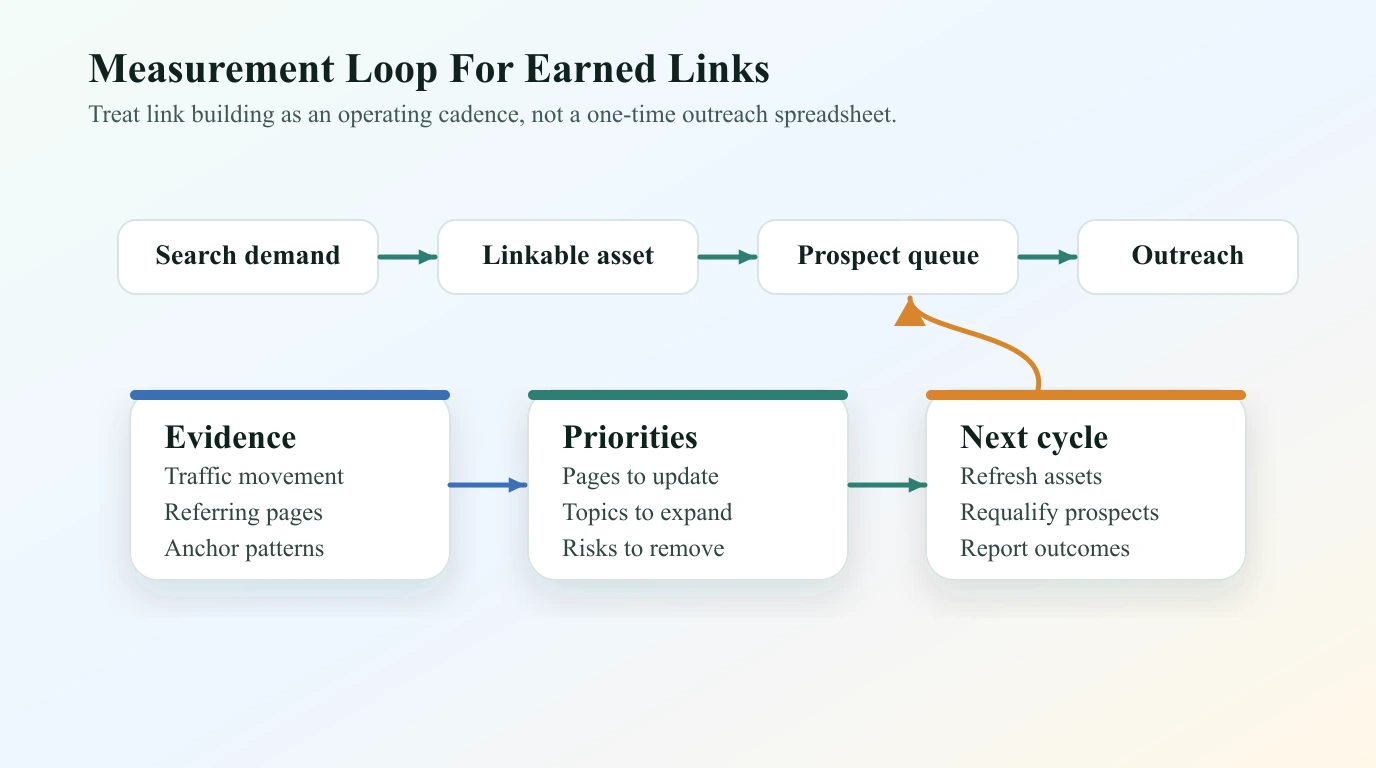
Track links as part of a measurement loop:
| Measurement layer | What to review |
|---|---|
| Asset performance | Impressions, clicks, assisted conversions, and ranking movement for the promoted page |
| Link quality | Relevance, source page usefulness, editorial context, and anchor naturalness |
| Content effect | Whether the campaign reveals missing examples, weaker sections, or new questions |
| Internal routing | Whether the promoted page now supports hubs, product pages, or related articles |
| Risk profile | Paid requests, unnatural anchors, irrelevant placements, or suspicious repeated patterns |
| Next action | Refresh the asset, expand the topic, prune risky prospects, or pause the campaign |
If a campaign produces suspicious patterns, do not jump straight to panic. Most sites do not need to disavow links just because a few strange domains appear. The Google disavow links workflow is a better fit when there is manual action risk, a history of manipulative link building, or clear evidence that links need to be disassociated.
The useful question after each campaign is not "how many links did we build?" It is "which pages became easier to discover, cite, and trust, and what should we improve next?"
Where Searvora Fits
Searvora is not a shortcut for buying links, scraping contacts, or manufacturing authority. It fits the planning and prioritization layer around link building for SEO.
Use Searvora AI SEO Consultant when the campaign needs to become a clear action queue:
| Searvora workflow step | What the team gets |
|---|---|
| Diagnose opportunity | Identify which assets, page types, or content gaps deserve promotion first |
| Score priorities | Separate high-impact campaigns from noisy ideas with weak fit |
| Turn findings into work | Convert campaign notes into owner-ready content, outreach, and refresh actions |
| Keep decisions documented | Preserve why a prospect, asset, or follow-up was approved or skipped |
For teams with an AI search visibility program, link building should also support citation-worthy content. That usually means clearer definitions, stronger evidence, original examples, crawlable resources, and pages that answer a task better than the alternatives. Earned links are a signal, but the asset still has to deserve the citation.
Link Building Checklist
Use this checklist before launching the next campaign:
- Pick one linkable asset, not a broad category of pages.
- Confirm the asset has a specific citation reason.
- Map the asset to a search task, page type, and audience.
- Improve weak sections before asking other sites to reference it.
- Build prospects from relevance and editorial context, not metrics alone.
- Remove paid-link, exchange-heavy, irrelevant, and thin-directory opportunities.
- Write outreach around the source page's reader, not your backlink target.
- Keep anchors natural and avoid exact-match pressure.
- Record outreach status, outcome, earned URL, and follow-up owner.
- Measure page performance, link quality, internal routing, and risk after the campaign.
- Use the evidence to refresh the asset or decide that the campaign should stop.
Link building for SEO is strongest when it behaves like a quality system. Build something worth citing, qualify who should see it, keep the campaign safe, measure the effect, and feed the evidence back into the next content and SEO decision.