

SEO competitor analysis is the process of studying the pages, keywords, search intent, and technical signals competitors use to earn organic visibility, then deciding what your site should create, improve, merge, or ignore. The useful output is not a copied outline. It is a prioritized work queue.
Start with the competitor URL, confirm the page type and user job, compare it against your existing pages, check whether your site can technically support the opportunity, and define the information gain before anyone writes. That keeps the analysis practical and prevents the team from turning every rival page into another unfocused article.
What SEO Competitor Analysis Should Decide
A good competitor analysis answers one question: what should we do differently because this competitor page exists?
That means every reviewed URL should leave the process with a decision:
| Decision | Use when | Next action |
|---|---|---|
| Create | The competitor proves demand for a page your site does not have | Draft a new article, landing page, tool, hub, or resource |
| Refresh | Your existing page targets the same job but lacks depth, structure, or evidence | Rewrite, expand, add visuals, or improve metadata |
| Merge | Two of your URLs already answer the same keyword, page type, and user task | Consolidate and redirect weaker overlap |
| Support | The opportunity is a child topic for an existing parent page | Add internal links, examples, or a follow-up brief |
| Ignore | The competitor page is off-topic, brand-only, unsafe, or impossible to improve on | Record the reason and move on |
This is where competitor analysis connects to the keyword research workflow. The competitor page is evidence of demand, but it does not replace intent judgment, page-type routing, or cannibalization checks.
Start With Pages, Not Domains
Domain-level comparisons are useful for market context, but page-level analysis is where execution starts. A competitor's homepage, product page, template, tool, glossary entry, support article, and blog post can all win traffic for different reasons. Treating them as one generic competitor signal leads to the wrong asset.
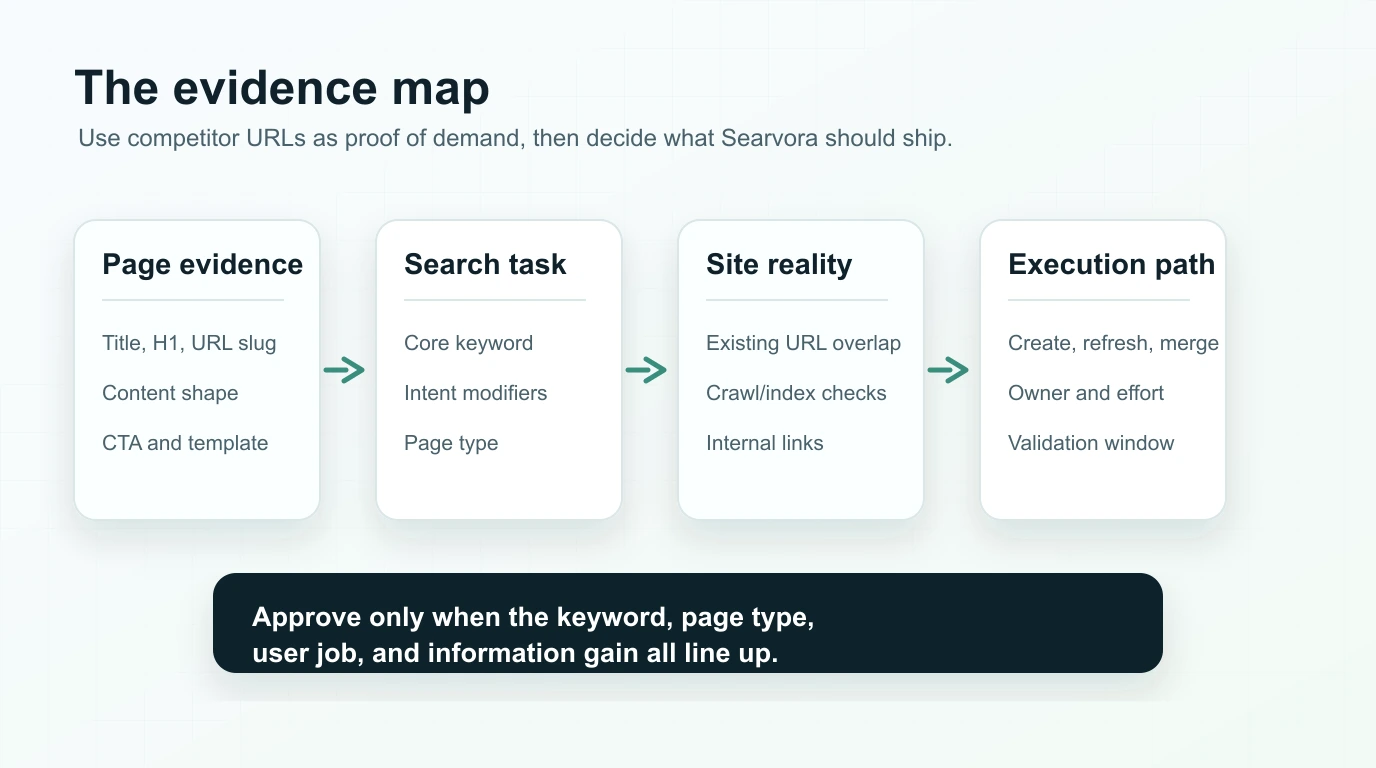
For each competitor URL, capture:
| Evidence | What to inspect | Why it matters |
|---|---|---|
| URL path and slug | Modifiers such as guide, template, tools, alternatives, pricing, or checker | Gives the first keyword and page-type hypothesis |
| Title, H1, and meta description | The promise made to searchers | Confirms whether the page is educational, commercial, navigational, or support-led |
| Content structure | H2s, tables, steps, screenshots, examples, and CTA | Shows what the winning page believes the user needs |
| Traffic and keyword footprint | Relative demand and query breadth | Helps prioritize review order, not automatic approval |
| Page archetype | Article, landing page, tool, comparison, hub, template, or directory | Prevents writing a blog post when the SERP wants a tool or landing page |
If the URL, title, H1, and content structure all point to the same task, you usually have enough to make a planning decision. Use a live SERP check when the evidence conflicts, the page type is ambiguous, or the approve/defer call is genuinely close.
Compare Against Your Existing URLs
Competitor analysis becomes dangerous when it ignores the pages you already own. Before approving a new asset, check whether an existing URL already satisfies the same core keyword, same page type, and same user job.
Do not reject a valid opportunity just because it belongs to the same cluster. A parent keyword research article can support a child article about long-tail keywords. A content audit article can support a narrower article about content decay. A product landing page can coexist with an educational article if they serve different jobs.
Use this overlap test:
| Test | Duplicate when yes | Not duplicate when |
|---|---|---|
| Core keyword | Both pages target the same primary query | One is parent, child, or adjacent |
| Page type | Both are the same asset type | One is a tool, one is an article, or one is a landing page |
| User job | Both solve the same task for the same reader | One educates, one compares, one executes, or one supports |
| Information gain | The new page cannot add a better framework, data, workflow, or validation | The new page adds a stronger decision path |
The stricter overlap rule from the keyword cannibalization workflow is useful here. Same topic is not enough. Same job is the real risk.
Build the Evidence Layer
The best competitor analysis combines search, page, technical, and business evidence. A competitor URL proves that someone is winning visibility, but it does not prove that your version should be a new article.
Use this evidence stack before creating a brief:
| Evidence source | What it answers | Planning risk it reduces |
|---|---|---|
| Competitor page snapshot | What page shape is currently attracting traffic? | Writing the wrong asset type |
| Your content inventory | Do we already have a URL for this job? | Cannibalization and wasted writing |
| Search Console data | Do our existing pages already get related impressions? | Missing refresh opportunities |
| Crawl data | Can the target URL be discovered, indexed, and linked? | Publishing content that cannot perform |
| Internal link map | Which pages can support the new or refreshed asset? | Orphan pages and weak clusters |
| AI-search clarity | Can an answer system summarize the entity, task, steps, and evidence? | Vague content that is hard to cite |
Google's SEO starter guide is a useful baseline because it keeps the analysis grounded in crawlability, helpful content, descriptive links, and understandable pages. For existing pages, the Search Console performance report helps compare queries, pages, countries, devices, and search appearance before deciding whether to refresh or create.
Separate Content Gaps From Technical Gaps
Not every competitor advantage is a content gap. Sometimes their page wins because it is better linked, clearer to crawl, faster to understand, or more tightly matched to the query. A new article will not fix a broken canonical, an orphan page, or a template that hides the real answer below unnecessary copy.
Before assigning a writer, run a technical reality check:
- Does the intended Searvora URL pattern already exist?
- Can search systems crawl and index the target page?
- Will the canonical point to the page you intend to measure?
- Does the page have a natural internal-link source?
- Are there existing pages that should be refreshed before creating a new one?
- Will the title, H1, and opening section answer the query directly?
- Can you validate the page after publishing with crawl, index, and performance checks?
For newly published or changed pages, Google's URL Inspection tool documentation is a useful reminder to verify index status, canonical behavior, and crawl details instead of assuming the page is eligible.
If the opportunity is clearly technical, pair the brief with the technical SEO workflow. Competitor analysis should decide whether the work belongs to content, engineering, internal linking, reporting, or a mixed queue.
Score Opportunities Before You Draft
Traffic-heavy competitor pages deserve careful review, but traffic alone should not approve a page. Score the opportunity by demand, intent confidence, business fit, information gain, and execution readiness.
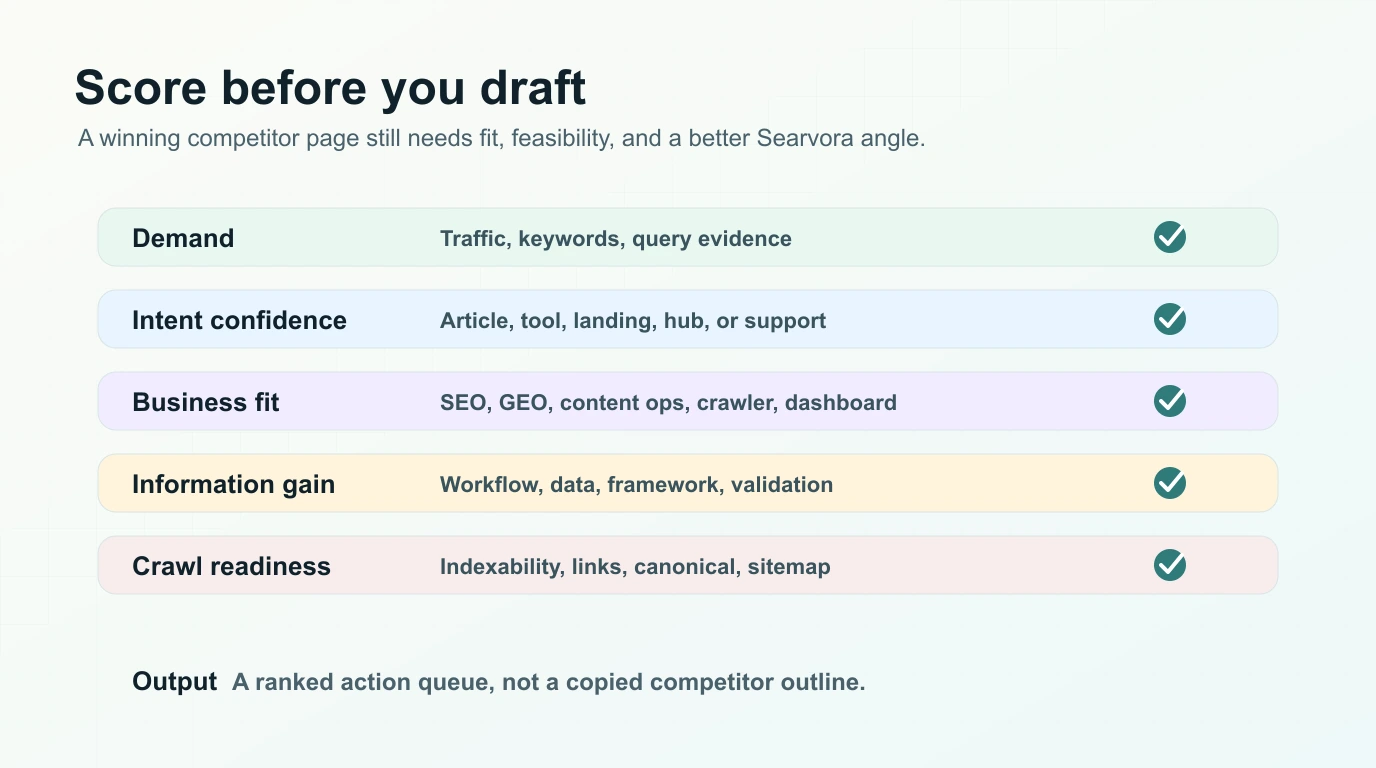
Use this scoring model:
| Dimension | High score | Low score |
|---|---|---|
| Demand | Competitor traffic, keyword breadth, or existing impressions show a real query family | One isolated keyword with unclear demand |
| Intent confidence | URL, title, H1, and content shape all point to the same page type | Mixed tool, article, landing, brand, or local intent |
| Business fit | The topic supports SEO, GEO, content operations, crawling, reporting, or strategy | The traffic would not help Searvora's audience |
| Information gain | You can add a better workflow, framework, data view, checklist, or validation path | You would only rewrite the competitor's outline |
| Execution readiness | Owner, asset type, internal links, visuals, and validation are clear | The brief depends on unresolved product or research decisions |
The best opportunities are not always the biggest. A lower-traffic technical query can be worth writing if it strengthens a product cluster and produces a concrete fix workflow. A broad marketing query can wait if the only possible article would be generic.
Add AI-Search and GEO Judgment
Modern competitor analysis should include AI-search visibility, but it should not become vague "AI optimization" theater. The practical question is whether your page is easier to understand, summarize, and cite than the competitor's page.
Check for:
- A direct definition or answer in the first section.
- Clear entities, product names, page types, and task names.
- Tables that make comparisons or decisions extractable.
- Steps that show how the task is performed.
- Internal links that connect the topic to a broader cluster.
- External sources only when they support the reader's decision.
This is also where competitor analysis feeds a content audit. If an existing page is close but too vague for AI answer systems, refresh it instead of creating a second page.
Turn Findings Into a Shipped Queue
Competitor analysis is only useful if it changes the publishing and technical queue. After reviewing a batch of URLs, record the decision in a format that a writer, SEO lead, or engineer can act on.
Use this handoff:
| Brief field | What to write |
|---|---|
| Competitor URL | The page that proved the opportunity |
| Target keyword | The primary query or phrase your page should own |
| Recommended page type | Article, landing page, tool, comparison, hub, resource, or update |
| User job | The task the reader needs to complete |
| Existing Searvora overlap | URLs to link, refresh, avoid, merge, or leave alone |
| Information gain | Why the Searvora version will be more useful |
| Required evidence | Sources, screenshots, crawl exports, examples, or public documentation |
| Validation plan | Crawl checks, index checks, internal links, and performance review date |
For Searvora teams, the natural flow is simple: use competitor URLs to detect the opportunity, use strategy judgment to choose the right asset, use crawl and content evidence to validate feasibility, then ship the highest-confidence work.
A Practical SEO Competitor Analysis Checklist
Use this checklist when a competitor page looks worth investigating:
- Record the competitor URL, title, H1, meta description, traffic, keyword count, and page type.
- Infer the target keyword from the URL slug and title, then confirm it from the page snapshot.
- Decide whether the page is an article, landing page, tool, comparison, hub, template, support page, or resource directory.
- Compare the opportunity against existing Searvora articles, product pages, and planned keyword rows.
- Reject only when the same keyword, same page type, and same user job are already covered or the topic has no credible information gain.
- Defer when the better response is a tool, landing page, downloadable asset, product comparison, or existing-page update.
- Approve only when the article type is clear and Searvora can add a stronger workflow, framework, evidence layer, or validation path.
- Define the primary product CTA before drafting.
- Plan visuals and screenshots before writing.
- Publish with a canonical URL, helpful internal links, local visuals, external-source hygiene, and a validation window.
SEO competitor analysis works when it turns rival visibility into better decisions. The goal is not to copy what another site wrote. The goal is to find the next page or fix your team can ship with confidence.