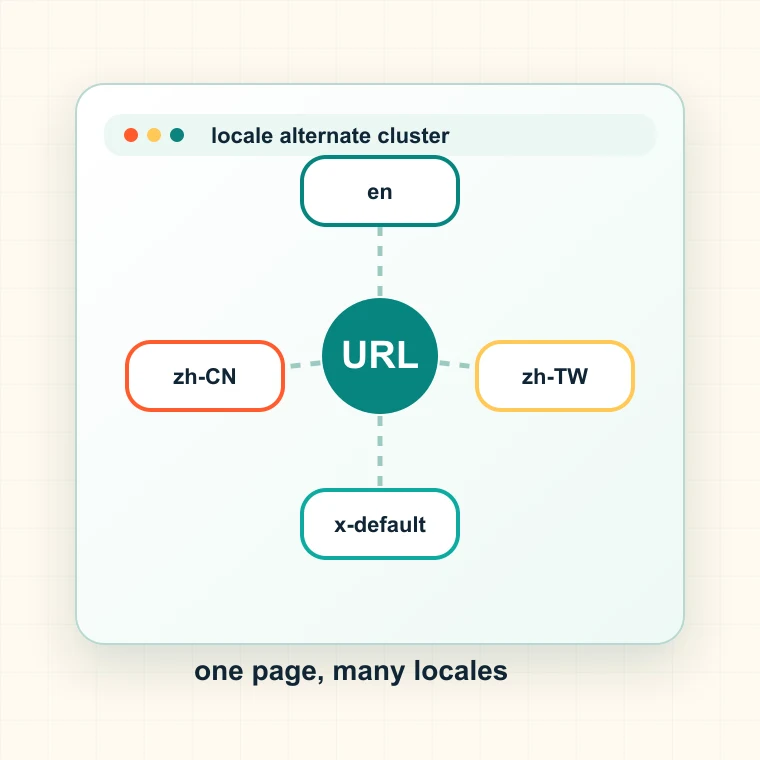
What this hreflang generator creates
The generator turns locale-to-URL pairs or URL patterns into implementation-ready hreflang tags. It helps multilingual sites avoid sending search engines incomplete or mismatched language clusters.
- Creates alternate link tags for each provided locale URL.
- Supports x-default fallback URLs for language selectors or global pages.
- Accepts manual mappings when locale URL patterns are irregular.
- Accepts URL patterns when language paths are predictable.
When to generate hreflang tags
Use it when launching translated pages, expanding from one market to multiple locales, fixing wrong-language search results, or reviewing whether localized pages reference each other correctly.
- Before publishing translated product, pricing, or landing pages.
- After changing locale paths, subdomains, or URL structures.
- When users in one region see the wrong language page in search.
- When canonical and hreflang signals need to be aligned.
How to interpret hreflang output
Hreflang works as a reciprocal cluster. Every alternate page should reference the others, use valid locale codes, and point to canonical, indexable URLs that serve equivalent intent.
- Each localized URL should be canonical to itself, not to another language.
- All alternates should return 200 and be indexable.
- x-default should point to a neutral selector or global fallback page.
- Locale codes should match the targeting strategy, such as en, zh-CN, or zh-TW.
Common hreflang mistakes
Hreflang errors are subtle because pages still render correctly for users. Search engines may ignore the cluster if alternates are missing, conflicting, non-canonical, or blocked.
- Do not point hreflang to redirected or noindex URLs.
- Do not mix canonical targets across languages incorrectly.
- Do not forget reciprocal tags on every alternate page.
- Do not use country codes when a language-only code is the real target.
Next step after generating hreflang
Place the tags in the page head or sitemap, then crawl the cluster. The real QA is confirming that every alternate returns the expected canonical, status, and language signal.
- Use canonical checker on each localized URL.
- Use indexability checker for alternates that fail to appear in search.
- Use sitemap validator if hreflang is managed through XML sitemaps.
- Use Spider Analysis to validate reciprocal clusters at scale.
- Document the URL group, owner, expected impact, validation step, and next publishing decision so the result becomes a fix ticket instead of another exported spreadsheet.