What this sitemap extractor checks
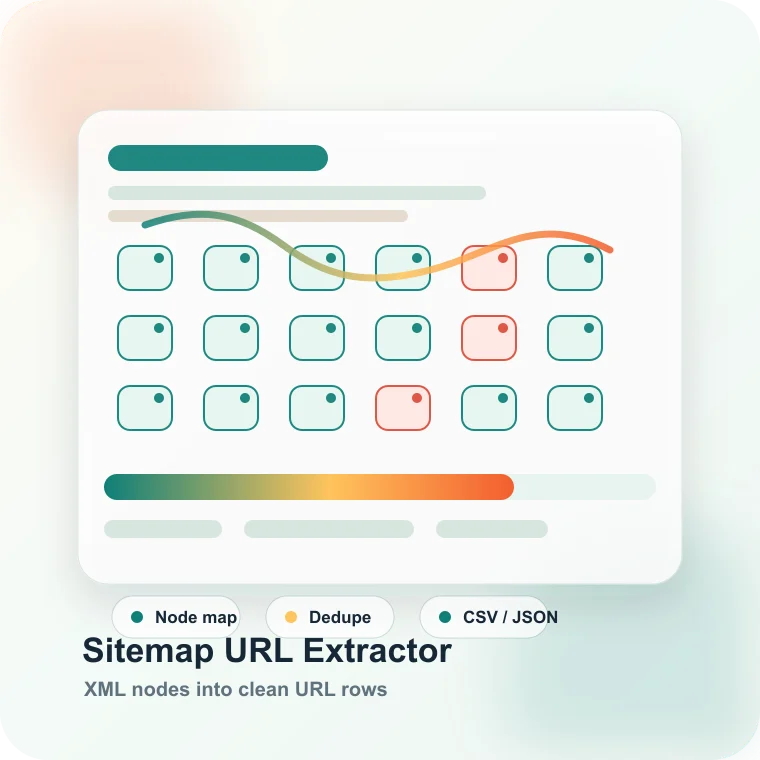
The tool reads a sitemap URL, detects whether it is a urlset or sitemap index, follows child sitemaps when requested, and converts raw XML into a structured inventory that is easier to audit.
- Extracts loc, lastmod, changefreq, priority, and source sitemap fields.
- Groups URLs by top-level path so architecture patterns are visible.
- Counts duplicate entries before deduplication so sitemap hygiene problems are not hidden.
- Flags truncation when a large sitemap exceeds the free tool limit.
When to use a sitemap URL extractor
Use it before a technical audit, migration, content inventory, or indexing investigation. A sitemap is not proof that every URL can rank, but it is often the fastest way to see what the site is asking crawlers to discover.
- Before crawling a large site to choose seed URL groups.
- Before a migration to compare old and new sitemap coverage.
- Before content pruning to see stale directories and old lastmod patterns.
- Before exporting URLs to another SEO workflow or spreadsheet.
How to interpret the extraction results
Start with URL count, sitemap count, duplicates, path groups, and lastmod coverage. The strongest insight usually comes from comparing what the sitemap contains with what the site actually needs indexed.
- Large path groups can reveal template sections that deserve separate crawl rules.
- Missing lastmod values are not fatal, but they make freshness harder to evaluate.
- Duplicate URLs usually point to generator logic, canonical drift, or mixed trailing slash rules.
- A clean export should become the starting point for status, canonical, and indexability checks.
Common sitemap extraction mistakes
Teams often treat the sitemap as a complete URL source, then miss orphan pages, blocked paths, faceted URLs, or pages that were removed from navigation but still rank. Extraction should be the first pass, not the final audit.
- Do not assume every URL in a sitemap is indexable.
- Do not ignore child sitemap indexes on large sites.
- Do not export duplicate URLs directly into crawl budgets or reporting dashboards.
- Do not use stale lastmod dates as proof that content changed recently.
Next step after extracting URLs
Once the inventory is clean, send priority sections into a technical crawl. Searvora Spider Analysis can validate whether the URLs are reachable, canonical, indexable, internally linked, and ready for search engines.
- Run the sitemap validator when XML structure or lastmod quality looks risky.
- Use the canonical checker on high-value duplicate patterns.
- Use the indexability checker on pages that are included but not ranking.
- Use Spider Analysis when you need issue ownership and fix queues.
- Document the URL group, owner, expected impact, validation step, and next publishing decision so the result becomes a fix ticket instead of another exported spreadsheet.