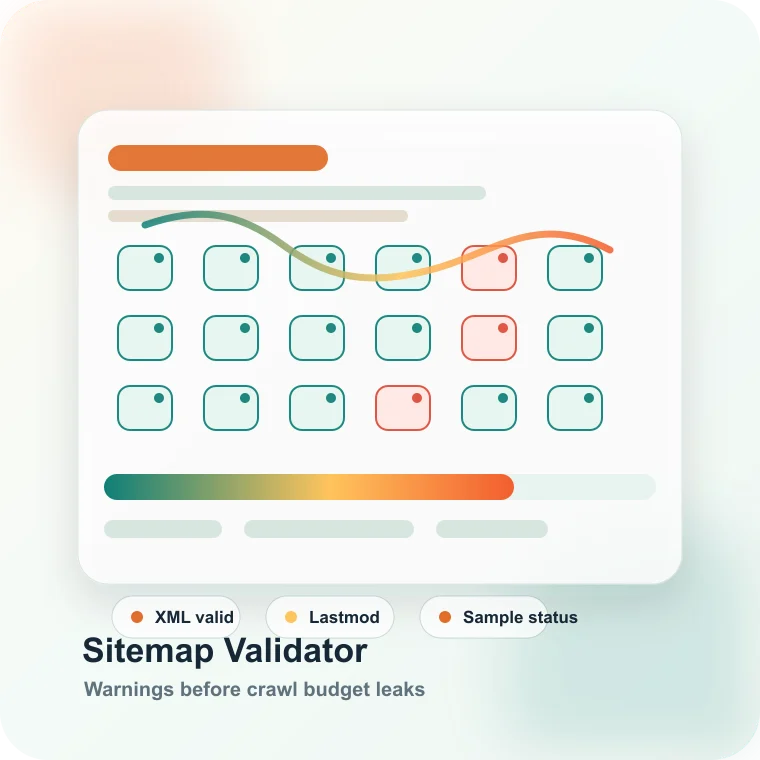
What this sitemap validator checks
The validator confirms that the XML can be parsed as a sitemap urlset or sitemap index, then reviews common SEO hygiene signals that often cause crawler waste or reporting noise.
- Validates sitemap type and child sitemap parsing behavior.
- Counts duplicate URL entries and cross-domain URLs.
- Reviews missing or invalid lastmod values.
- Optionally samples URL status so obvious broken entries surface early.
When to validate a sitemap
Run validation before submitting a new sitemap, after a migration, after CMS template changes, or when Search Console reports discovered URLs that do not match what your team expected.
- Before a release that changes URL structure or canonical rules.
- Before handing a sitemap export to an engineering or agency team.
- When blog, product, or collection sitemap counts suddenly change.
- When Google discovers pages but indexing stays weak.
How to interpret sitemap validation results
A pass means the sitemap is a usable discovery input. Warnings mean the file can still be read, but the signal quality is weaker than it should be for serious crawl planning.
- Duplicate warnings usually mean generation logic needs cleanup.
- Cross-domain warnings can confuse ownership and should be split by host.
- Missing lastmod is acceptable only if freshness is handled elsewhere.
- Status sample failures should become crawl or redirect tickets.
Common sitemap validation mistakes
The most expensive mistake is assuming a valid XML file is a healthy SEO sitemap. Search engines can parse a file that still points to weak, stale, redirected, or canonicalized pages.
- Do not submit staging, preview, or cross-domain URLs in production sitemaps.
- Do not fake lastmod dates on every deploy.
- Do not let deleted or redirected URLs remain in sitemap feeds.
- Do not ignore sitemap count drops after CMS or localization changes.
Next step after validation
If validation passes, use the sitemap as a clean crawl seed. If warnings appear, fix the generator first or isolate risky URL groups before running a deeper technical audit.
- Extract the URL list when you need CSV or JSON handoff.
- Check indexability when URLs are valid but not ranking.
- Check canonical signals when duplicate variants are present.
- Run Spider Analysis when warnings need owner-ready fix queues.
- Document the URL group, owner, expected impact, validation step, and next publishing decision so the result becomes a fix ticket instead of another exported spreadsheet.