

The best SEO certifications are useful when they help you do a specific kind of work better: diagnose a crawl issue, turn a query into a useful page brief, evaluate a source page for AI-search visibility, or explain a recommendation to a teammate. A certificate alone is not proof that a person can deliver those outcomes.
This roundup compares four current, provider-issued SEO credentials. It is not a universal ranking or a claim that one certificate guarantees a job, rankings, or employer recognition. Instead, use the course scope, assessment model, and practice requirement to choose the credential that closes your next operational gap.
What Counts as an SEO Certification
Most SEO certifications are provider-issued credentials or certificates of completion. They can still be useful evidence of structured learning, especially when the provider explains the curriculum and assessment. They are not a standardized professional license, and their value depends on the work you can demonstrate after completing them.
Use this distinction when comparing options:
| Signal | What it tells you | What it does not prove |
|---|---|---|
| Course certificate | You completed the provider's stated learning and assessment path | That every employer or client will value it equally |
| Final exam or quiz | The provider has a formal checkpoint beyond passive viewing | That you can handle every real site or business context |
| Capstone or applied assignment | You have a defined practice artifact to complete | That the artifact has been independently reviewed on a production site |
| Current curriculum | The provider publishes a maintained set of topics | That the material will stay current without a recheck |
The useful selection rule is simple: choose a credential whose assessment and coursework lead to the kind of SEO evidence you need to create next.
Compare SEO Certifications Before You Enroll
The four options below serve different jobs. Confirm current enrollment, accessibility, and pricing directly with the provider before signing up, since those details can change.
| Credential | Provider-issued model | Best fit | Practical follow-through |
|---|---|---|---|
| Semrush SEO Crash Course with Brian Dean | Course plus certification assessment | A learner who wants a concise, tool-oriented SEO foundation | Turn one lesson into a keyword, page, crawl, or reporting task |
| HubSpot AEO Fundamentals | Free certification course | A marketer who needs SEO and answer-engine visibility in the same framework | Audit one source page for intent, structure, citation readiness, and measurement |
| UC Davis SEO Specialization on Coursera | Multi-course specialization with a shareable credential | A learner who wants a longer, structured path with a capstone-style application | Build a consulting-style audit and recommendation artifact |
| Yoast SEO for Beginners | Free course with a certificate and badge | A beginner who needs search, content, and crawlability fundamentals | Improve one page's content, structure, and crawl signals |

Semrush SEO Crash Course With Brian Dean
The public Semrush Academy certification page currently lists the Semrush SEO Crash Course with Brian Dean as an SEO certification. Semrush describes its certificate path as course completion plus any required quizzes and a final exam, then provides a downloadable certificate after passing.
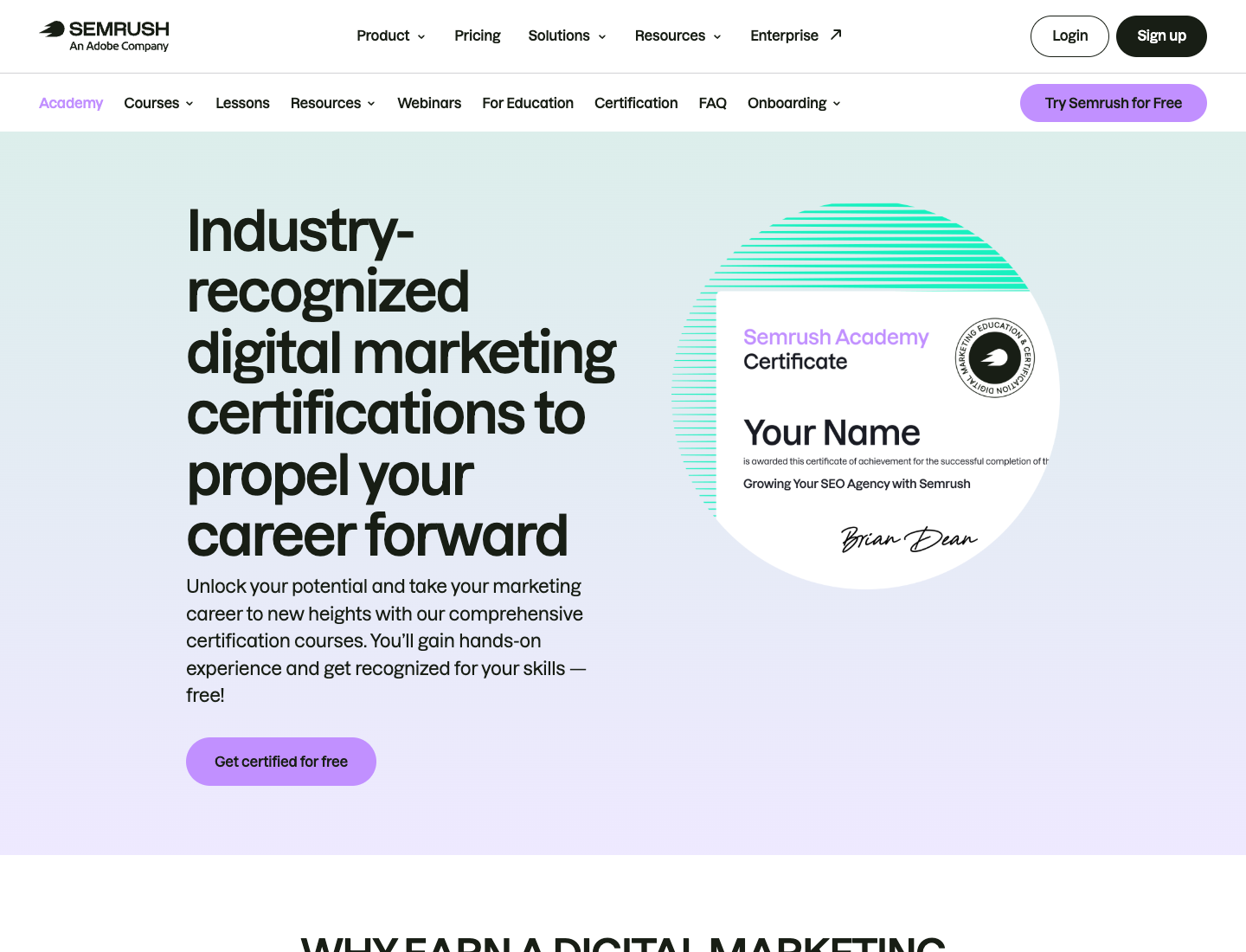
This is a sensible choice when you want a compact, provider-led way to connect foundational SEO concepts with a tool workflow. Treat the credential as the starting point, not the deliverable. After the course, choose one real URL and produce a short evidence pack:
- State the page's target search task and evidence for that interpretation.
- Record one content, technical, or authority signal worth investigating.
- Turn the finding into a clearly scoped action with an owner and validation step.
That practice keeps a tool-oriented course from becoming a collection of reports with no decision behind them.
HubSpot AEO Fundamentals
The public HubSpot Academy AEO Fundamentals page describes a free certification course focused on visibility across traditional search and AI-powered answer engines. Its published curriculum includes search intent, content trustworthiness, keyword strategy, AI citation, and measurement.
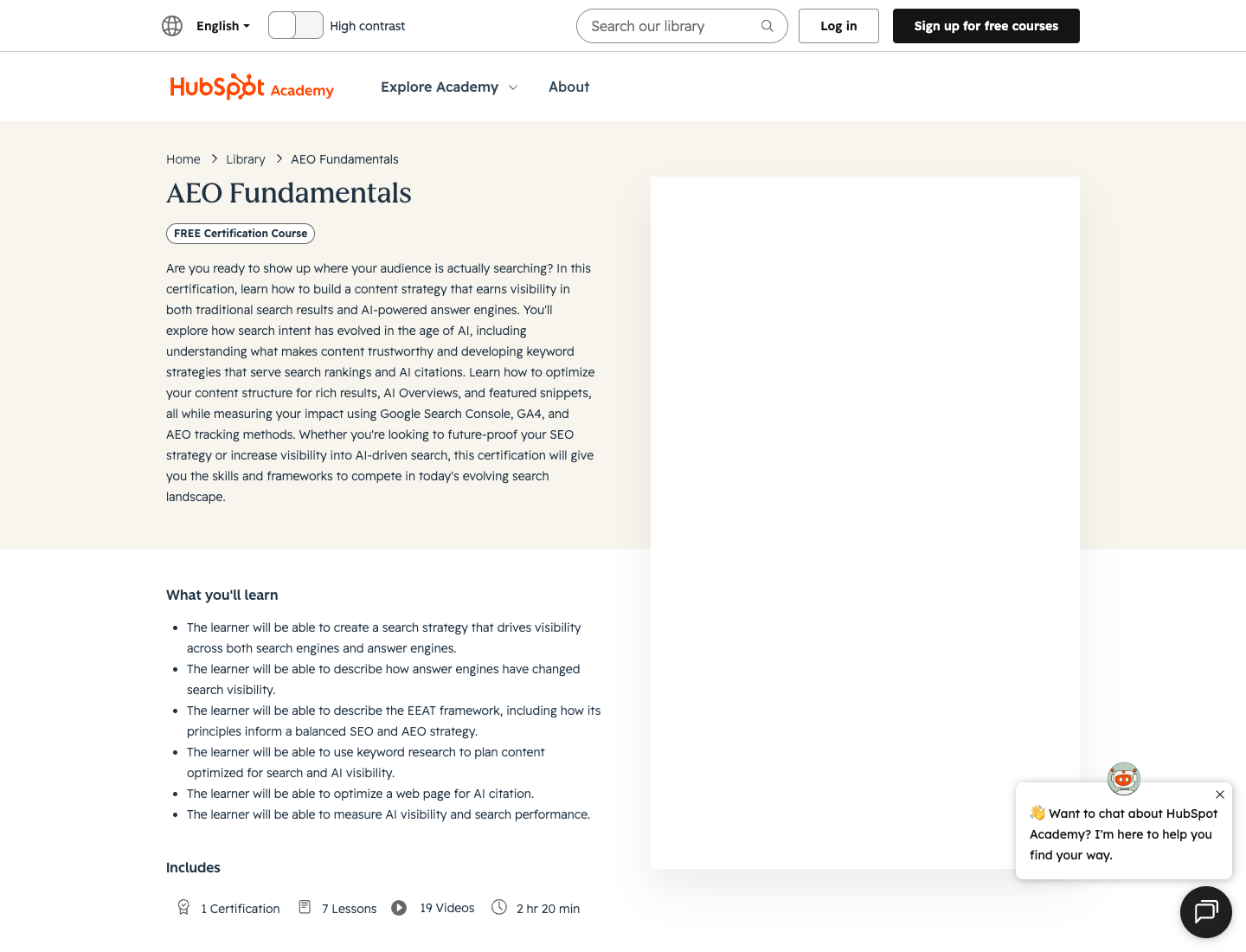
Choose it when your immediate gap is not just ranking a page, but making a page easier to evaluate, extract, and cite. The proof of work should be a source-page review, not a generic prompt experiment:
| Check | Evidence to capture |
|---|---|
| Search task | The query, expected page type, and first-paragraph answer |
| Source clarity | Named entities, definitions, examples, and verifiable supporting material |
| Technical eligibility | Crawl access, canonical behavior, and a readable content structure |
| Measurement | The query group, baseline, owner, and date for a recheck |
For a broader learning path, pair this work with the learn SEO roadmap, which focuses on turning study into page work and validation habits.
UC Davis SEO Specialization on Coursera
The official Coursera page for the UC Davis Search Engine Optimization Specialization presents a five-course series with a shareable credential and a capstone-style SEO consulting task. Its published description covers on-page and off-page optimization, local and international audiences, site audits, and SEO business strategy.
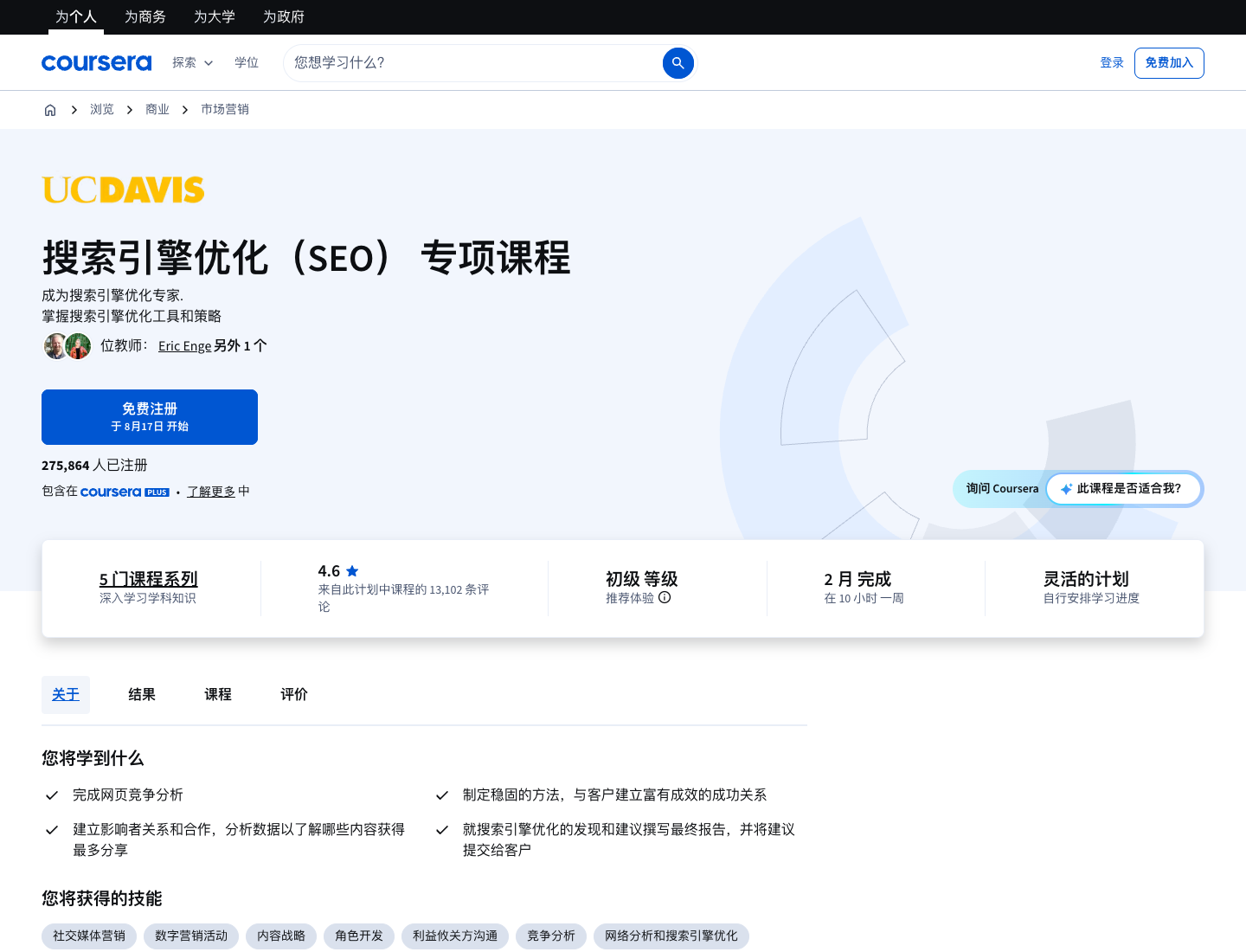
This is the strongest fit for someone who wants a longer sequence rather than a short overview. The capstone mindset is the important part: collect evidence, make a recommendation, and explain how you would validate the change. That makes the credential useful in an interview, portfolio, or team handoff without overstating what the certificate itself proves.
If your practice site has technical constraints, use the technical SEO workflow to turn the audit portion into a crawl, issue cluster, fix path, and recheck.
Yoast SEO for Beginners
The official Yoast SEO for Beginners page describes a free course with short video lessons, a certificate, and a badge on completion. Its current public outline covers how search engines find and read pages, keywords, SEO copywriting, site structure, crawlability, and rich results.
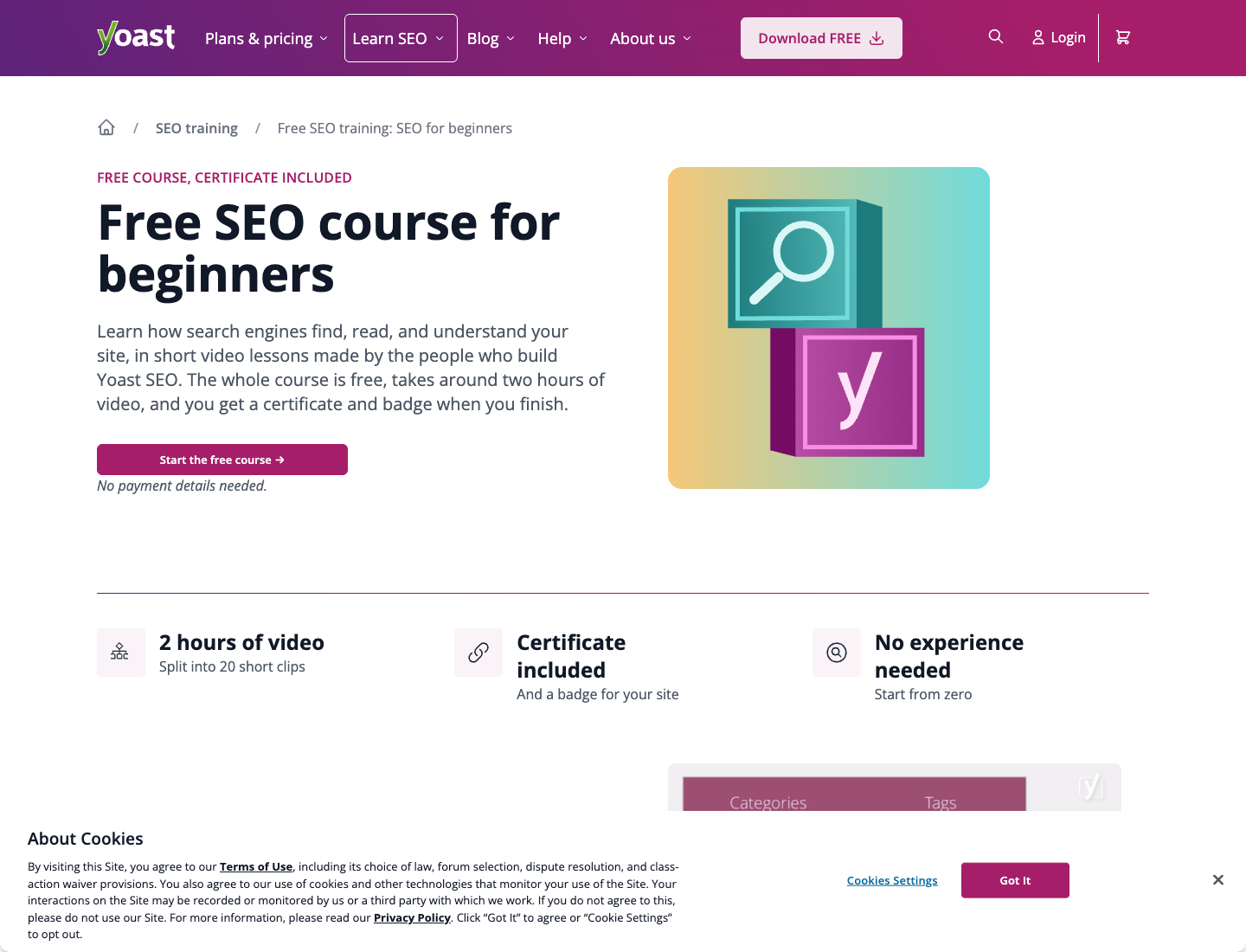
Choose this path when you are new to SEO and need a firm page-level foundation before taking on strategy or tooling. A good follow-up assignment is one page readiness review:
- Write the search task in plain language.
- Check whether the title, introduction, headings, and internal links answer that task.
- Verify that the page is reachable, indexable, and not contradicted by a canonical or sitemap signal.
- Decide whether the next action is a rewrite, a technical fix, an internal link update, or no change.
That is a more reliable learning outcome than treating any course badge as a ranking promise.
Turn a Certification Into Proof of Work
The value of an SEO certification rises when it produces artifacts that another person can review. Use this five-step loop after every course or exam.

- Choose one site problem. Start with a query, URL group, crawl issue, or content decision that matters now.
- Name the evidence. Capture the page type, the relevant search or crawl signal, and the source of the claim.
- Propose one bounded action. A better title, an internal-link change, a crawl fix, or a content brief is more useful than a vague strategy note.
- Assign validation. Define who checks the result, what signal should change, and when to recheck.
- Keep a decision record. Record what was observed, what was inferred, and why the team chose that action.
The same routine works for certificates that focus on classic SEO, content operations, or answer-engine visibility. It also keeps a team from confusing course completion with a finished SEO program.
Where Searvora Fits After the Course
Once training produces a real list of possible actions, the hard part is deciding what to ship first. Searvora's AI SEO consultant is positioned to turn mixed SEO and AI-search signals into prioritized, execution-ready guidance: it groups patterns, ranks work by impact and effort, and supports owner-ready handoffs.
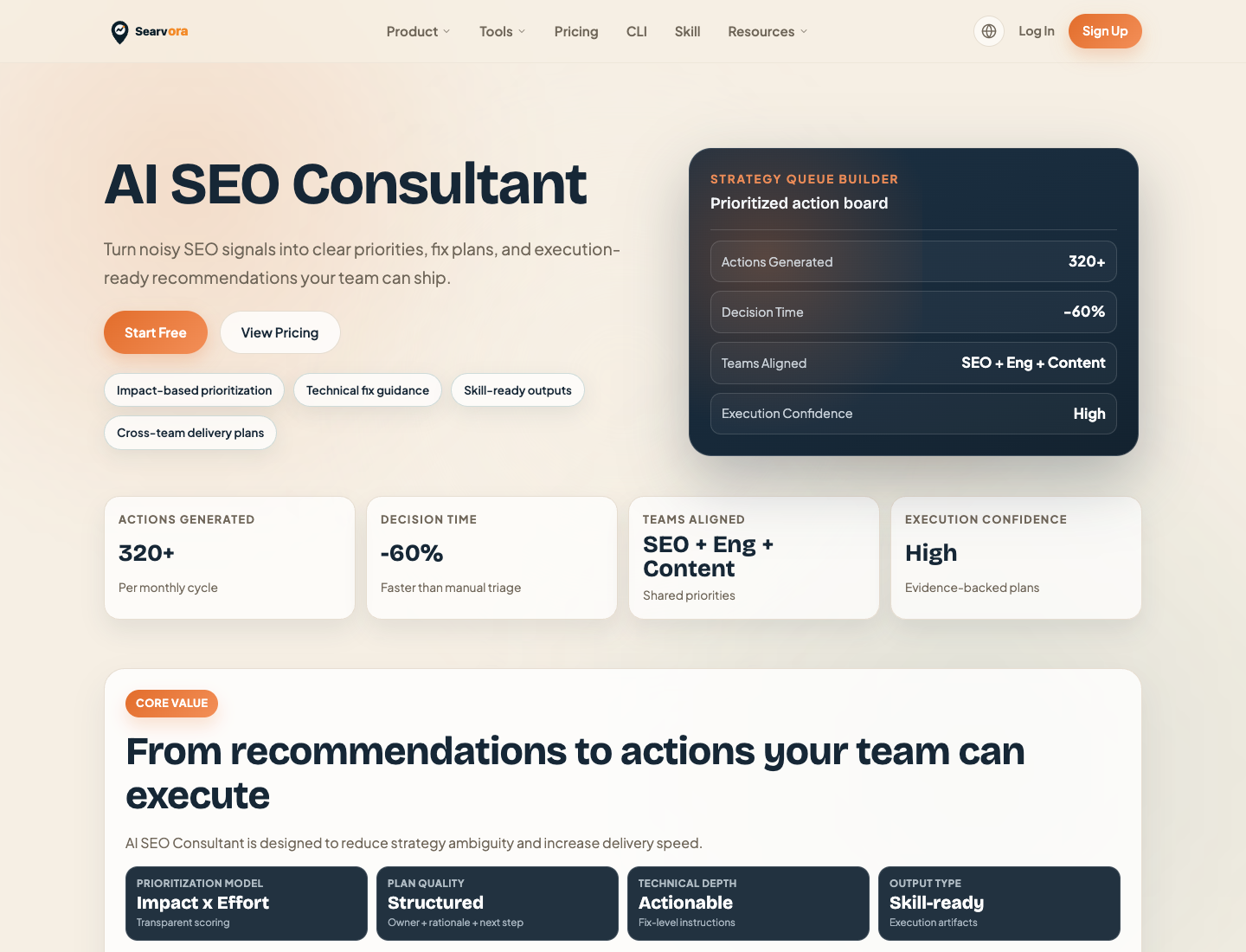
Use it after a course when you need to compare a crawl finding, a content opportunity, and an AI-search source gap without treating them as equal. The output should be a short, evidence-backed action queue your SEO, content, and engineering owners can actually review.
Use This Final Certification Checklist
Before choosing among the best SEO certifications for your situation, confirm these points:
- Is the credential a provider-issued certificate, a course completion record, or a longer specialization?
- Does the provider explain the curriculum and assessment path publicly?
- Will the course help with the next SEO task you actually need to perform?
- Can you turn the learning into a reviewable page, crawl, content, or reporting artifact?
- Does the program's current scope match the search, technical, or AI-search work you plan to do?
- Who will review your proof of work before it becomes a production recommendation?
The best choice is the one that leaves you with a useful capability and a repeatable way to prove it. Recheck provider details before enrolling, then use the learning to create an evidence trail that survives a real SEO review.