

To learn SEO, do not begin with a giant reading list. Begin with one real site, one page you can inspect, and a small sequence of questions: what is this page trying to rank for, can search systems reach it, does it answer the task clearly, and how will you know whether a change helped?
That approach turns study into evidence. You will still learn the fundamentals, but each topic produces something useful: a page brief, an internal-link decision, a crawl check, a revision, or a measurement note. The Google SEO Starter Guide is a solid baseline for how search systems discover and understand useful pages. This roadmap adds the practice loop that makes those principles stick.
Start With One Site and One Learning Goal
Choose a site you can safely inspect and improve. It can be your own site, a small demo project, a volunteer project, or an approved work property. Avoid trying to learn every SEO discipline at once.
Your first goal should be concrete:
- Make one important page easier to understand and reach.
- Explain the page's search task in one sentence.
- Record the technical and content checks you ran.
- Name the next action instead of guessing at a ranking outcome.
The What Is SEO workflow is the right starting point when the terminology is still new. It explains search demand, discovery, indexing, meaning, authority, and execution. This article has a different job: it helps you turn those basics into a staged learning plan.
Use a Five-Stage SEO Learning Roadmap
The most useful learning sequence moves from fundamentals to decisions, then from decisions to validation. You can spend longer in any stage, but do not skip the practice artifact.
| Stage | Learn | Practice artifact | Validation question |
|---|---|---|---|
| 1. Foundations | How search systems discover, index, and serve pages | A one-page map of the site's important URLs and their jobs | Can you explain why a search system should find each URL? |
| 2. Search task | How a query maps to an article, hub, tool, or commercial page | A short page brief with query, user job, page type, and information gain | Does an existing URL already serve the same job? |
| 3. On-page clarity | How titles, headings, intros, media, and links make a page understandable | A rewrite plan for one page promise and its supporting sections | Do the title, H1, intro, and first H2 make the same promise? |
| 4. Technical access | How status codes, canonicals, robots rules, links, and sitemaps affect eligibility | A technical check sheet for one URL and its closest template peers | Can the intended canonical URL be crawled and understood? |
| 5. Measurement and iteration | How to decide whether to expand, refresh, consolidate, or monitor | A dated decision log with a baseline and next review window | What observation would prove the next action was sensible? |

Stage two is where many beginners save time. The search intent workflow shows how to distinguish a definition, how-to, comparison, tool, or parent hub before you start drafting. That choice is more useful than forcing every keyword into a blog post.
Practice on Pages Before You Add More Theory
Reading about SEO can create false confidence. A short, repeatable practice cycle is more valuable than trying to memorize every ranking factor.
Use this four-week cycle for your first pass:
- Week one — map the page job. Pick one page and write the audience problem, primary query family, page type, and one reason the page deserves to exist.
- Week two — make the page clearer. Check the title, H1, opening answer, H2 structure, internal links, and image alt text. Change only what you can explain.
- Week three — check technical access. Inspect the response, canonical target, indexability signals, internal links, and sitemap treatment. Use the technical SEO workflow when you need the deeper crawl and validation sequence.
- Week four — review the evidence. Record what changed, what you expected to improve, what the live page now shows, and when you will recheck it.
This cycle is intentionally small. You are training judgment: seeing a page as a combination of search task, content promise, technical access, and proof. A site-wide audit comes later, after you can explain one page well.
Keep a Learning Log That Produces Evidence
Your notes should make the next decision easier. A useful log is not a collection of definitions; it is a record of claims, checks, and outcomes.
| Record | Example | Why it matters |
|---|---|---|
| Page job | "Help a new buyer compare two crawler workflows" | Protects the page from drifting into an unrelated keyword list |
| Evidence checked | Title, H1, canonical, internal links, rendered body, sitemap entry | Makes the decision reproducible |
| Change made | Rewrote the intro and added a descriptive link from a relevant hub | Separates an actual improvement from a vague intention |
| Expected signal | Clearer task match, better crawl discovery, or easier internal navigation | Prevents unsupported ranking promises |
| Review date | Recheck after a relevant crawl, release, or measurement window | Creates a maintenance habit instead of one-time optimization |
Use short notes. If you cannot write the page job or evidence checked in plain language, the next SEO task is probably too vague. Narrow it before adding more content or tools.
Learn the Difference Between a Page Problem and a Ranking Problem
Not every disappointing result is a content problem. Learning SEO means learning how to avoid the most expensive assumption: that more copy is always the fix.
Use this decision aid before changing a page:
| If you observe | Investigate first | Better learning action |
|---|---|---|
| The intended URL is missing or replaced | Canonical, redirect, noindex, robots, and internal links | Learn technical access before rewriting copy |
| The page appears but does not answer the query well | Title, H1, intro, page type, and competitor task | Practice intent and information-gain planning |
| Two similar pages compete for the same visitor | Core keyword, page type, and user job | Decide whether to differentiate, merge, or strengthen internal routing |
| The page is clear but the topic lacks proof | Sources, examples, first-party evidence, and topical coverage | Learn how to build support instead of adding filler |
| A new change is live but nothing is measurable yet | Release timing, crawl timing, and the baseline you recorded | Wait for evidence rather than make stacked untestable changes |
This is also a good way to learn AI-search readiness. Answer systems need the same basic foundations: an accessible page, a clear subject, structured explanations, and evidence that can be checked. Treat concise definitions, tables, and explicit next steps as useful reader aids first, not as a shortcut to visibility.
Turn Lessons Into a Weekly SEO Queue
Once you have a few practice cycles, organize learning around decisions rather than subjects. Your weekly queue can be simple:
- Pick one observation from a page, crawl, or content review.
- State the likely page job and the evidence you need.
- Choose one small, reversible improvement.
- Assign an owner and a validation check.
- Record the next review date.
That is the bridge between learning SEO and doing SEO. The goal is not to finish a course and declare the work complete. It is to build the habit of turning a signal into a justified, verifiable next action.
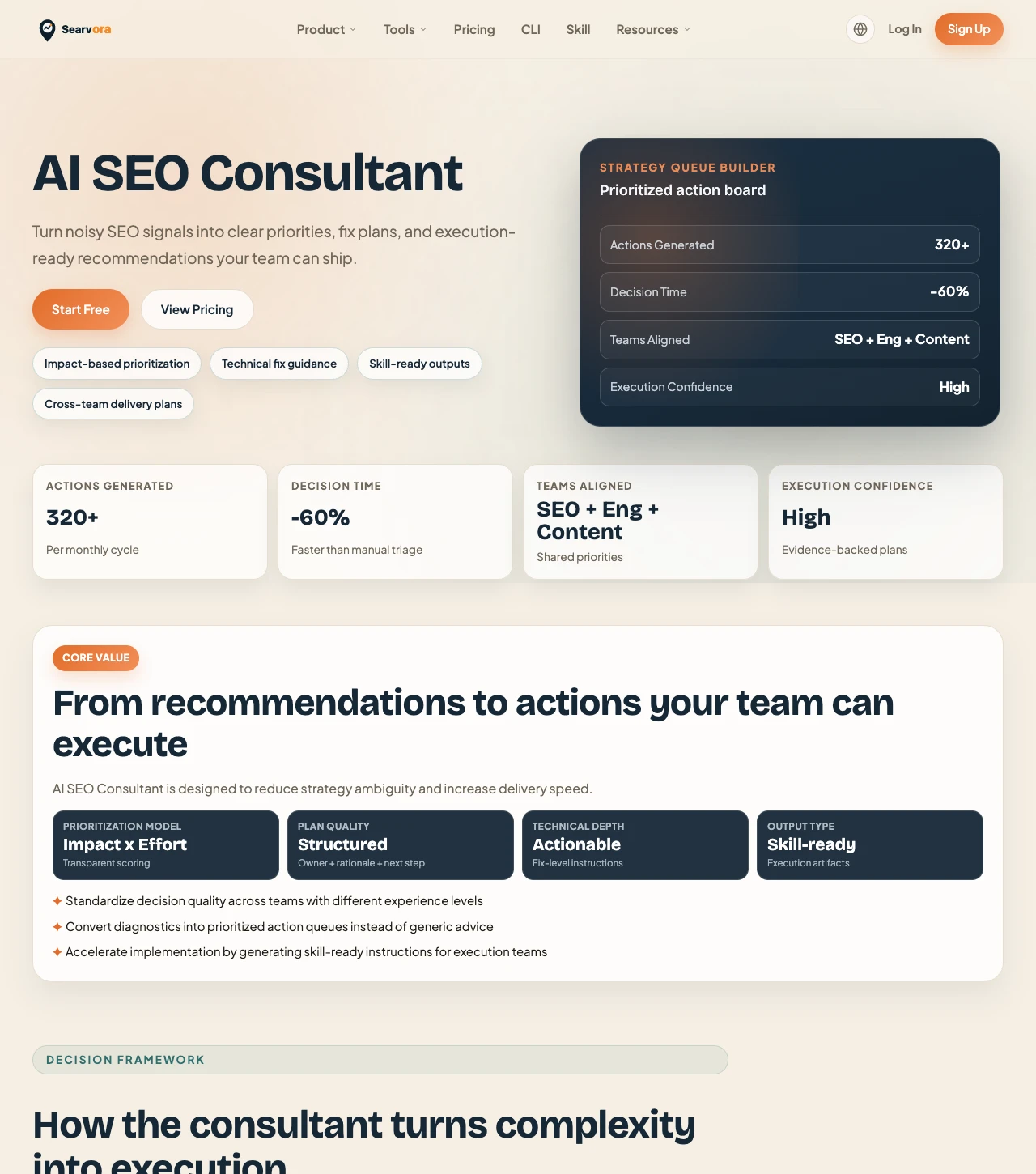
Searvora's AI SEO Consultant is useful when your learning notes have become a pile of mixed signals and you need to turn them into prioritized action plans, technical fixes, and implementation-ready output. Use it after you can state the page job and evidence; the product should sharpen a decision, not replace the judgment behind it.
A Simple Rule for What to Learn Next
Learn the thing that explains your next blocked decision. If you cannot tell whether a page needs a rewrite or a crawl check, study technical access. If you can see traffic but cannot tell what page should exist, study intent and page types. If the page is technically sound but feels interchangeable, study information gain, internal links, and evidence.
That rule keeps the roadmap practical. Learn SEO by making one good decision at a time, then validate enough of the outcome to make the next decision smarter.