

The practical answer to how agencies integrate AI search analytics into performance reports is to keep it as a distinct evidence layer, not fold it into an all-purpose visibility score. A useful report shows where a client appeared, which pages or third-party sources supported that appearance, what changed, and which action the team will validate next.
That distinction matters because AI-search evidence does not replace clicks, conversions, rankings, or crawl health. It answers a different set of questions. The agency's job is to connect those answers without claiming that every mention caused traffic or that every missing citation requires a new page.
Give AI Search Its Own Evidence Layer
Start by separating the report into four layers. Each layer can inform the others, but none should silently stand in for another.
| Evidence layer | What it can answer | What it cannot prove alone |
|---|---|---|
| Classic search demand | Which queries and pages gained impressions, clicks, or position | Whether the brand appeared in an AI-generated answer |
| Generative-search visibility | Whether owned URLs appeared in supported AI search surfaces | Whether the appearance changed revenue or assisted conversions |
| Citation and source evidence | Which owned or third-party pages were surfaced as sources | Why an answer system chose one source over another |
| Business and delivery context | Which page groups, markets, and offers matter to the client | Whether a visibility movement was caused by agency work |
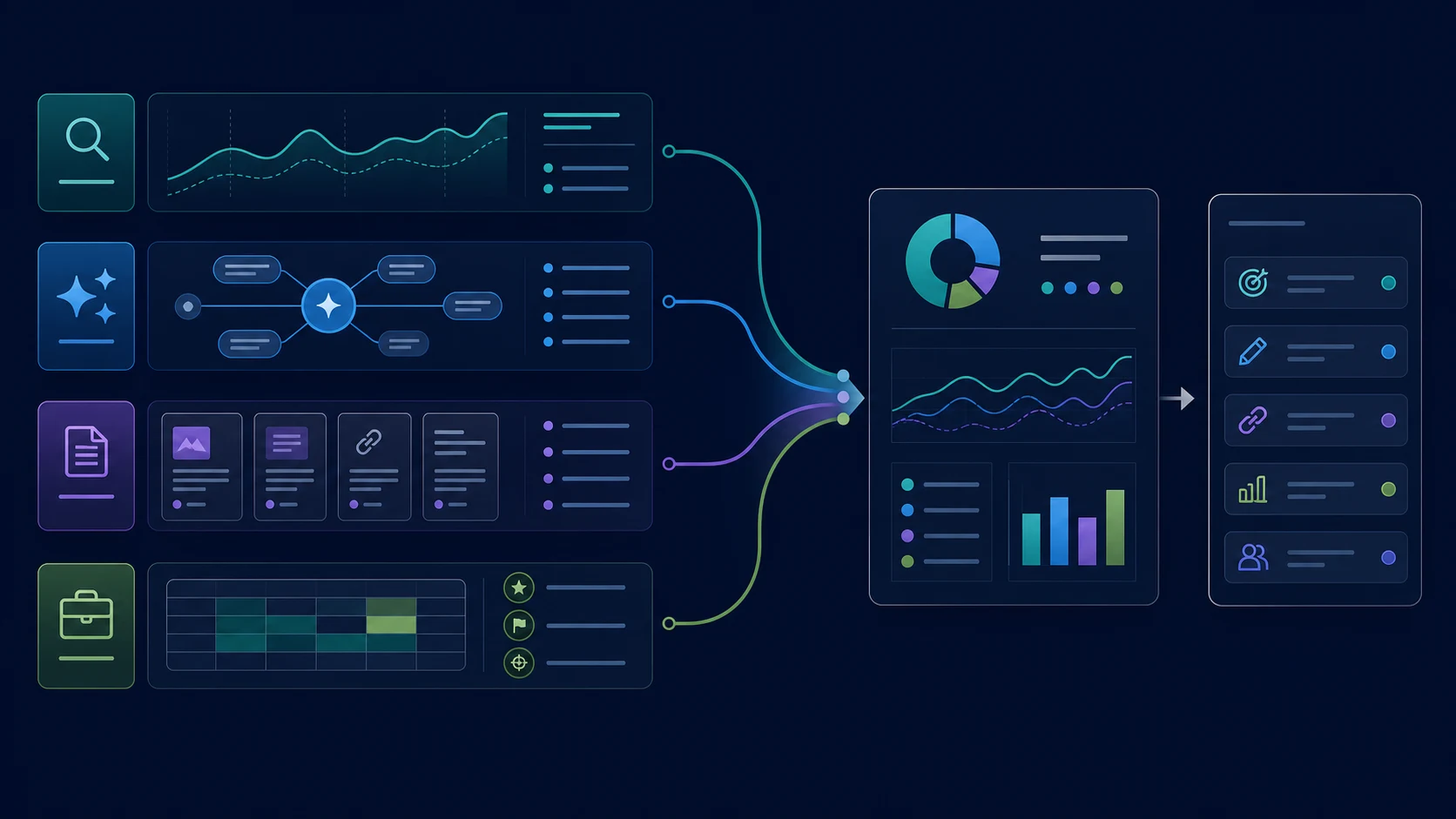
Google's Search Generative AI performance reports announcement makes this separation more practical for participating sites. Google says the dedicated views cover impressions in generative AI features, including AI Overviews and AI Mode in Search and generative AI features in Discover. The initial reports also break visibility down by pages, countries, devices for Search, and time.
The rollout is limited to a subset of sites while Google tests the reports. Agencies should therefore record the source and availability of each metric. A client with the dedicated Search Console view and a client without it do not have equivalent measurement coverage.
Set The Measurement Contract Before Automating
The reporting template should define what each observation means before a connector, spreadsheet, or dashboard begins filling cells.
Use a measurement contract with these fields:
| Field | Reporting rule |
|---|---|
| Surface | Name Search, Discover, an answer engine, or a tracked assistant separately |
| Observation | Distinguish impression, mention, citation, linked source, or manual answer check |
| Entity | Record the brand, product, expert, location, or topic being monitored |
| Source page | Attach the owned or third-party URL that appeared when the source exposes one |
| Segment | Preserve page type, directory, locale, market, and client priority |
| Timestamp | Store when the observation was collected and the window it represents |
| Confidence | Mark direct platform data, repeatable observation, or exploratory evidence |
| Next action | Assign monitor, investigate, improve, consolidate, or no action |
Do not collapse mentions and citations into one number. A brand can be named without a link. A page can be cited without the preferred product message. An owned URL can gain impressions in a generative feature without producing a measurable click change. These are related signals, not interchangeable outcomes.
For the planning layer after evidence collection, AI search analytics for content planning shows how to turn prompt groups, source pages, and missing questions into page decisions rather than a pile of observations.
Build The Agency Reporting Workflow
A recurring agency report needs a stable sequence so the team can compare periods without rebuilding the method.
1. Freeze the client scope
Choose the market, locale, page cohort, topic cluster, and reporting window before collecting AI-search evidence. Avoid switching from product pages one month to the whole domain the next.
2. Pull classic search and technical baselines
Record Search Console performance, analytics outcomes, important ranking changes, crawl eligibility, canonicals, and releases. These baselines stop the agency from treating an AI-search movement as the only explanation for a traffic change.
3. Add supported AI-search observations
Import direct platform metrics where available. Add repeatable manual or third-party observations only when the method, prompts, surfaces, locations, and dates are recorded. Keep the two collection methods visibly separate.
4. Join evidence by page cohort
Map observations to product pages, category pages, articles, comparison pages, local pages, or other meaningful groups. Page cohorts are more useful than a sitewide average because they point toward different owners and fix paths.
5. Write the diagnosis before the summary
For each material change, ask:
- Did the visibility change affect an important topic or page cohort?
- Is the movement supported by more than one observation?
- Did classic search, crawl health, or site releases move at the same time?
- Is there a clear source-page, entity, content, or technical action?
- What evidence would confirm or disprove the diagnosis next period?
6. End with an owner queue
Every material finding should end as an assigned action, a monitored hypothesis, or an explicit no-action decision. If the report cannot name the next review date, it is not yet operational.
Write A Client Narrative Without Overclaiming
The client-facing summary should distinguish observation, interpretation, and action. That protects the agency from presenting uncertain AI-search data as settled attribution.
| Narrative layer | Example |
|---|---|
| Observation | Three priority product pages appeared in the available generative-search report this month |
| Context | Classic impressions held steady, while one product cohort gained non-brand demand |
| Interpretation | The pages may be earning broader discovery, but the report does not establish causal traffic impact |
| Action | Improve source clarity on two pages and monitor the same cohort in the next reporting window |
| Validation | Recheck generative impressions, cited pages, classic search demand, and assisted outcomes after the change |
Use cautious language when the collection surface is incomplete. Say "observed in the tracked set" instead of "AI search visibility increased everywhere." Say "the page appeared as a source" instead of "the page drove the answer." Say "consistent with the release" instead of "caused by the release" unless the agency has stronger experimental evidence.
This is where the report differs from a generic automated export. Automated SEO reporting explains how to make collection and anomaly triage repeatable. The AI-search layer adds source provenance, surface availability, and explicit uncertainty to that operating rhythm.
Turn Findings Into A Validation Queue
The report should finish with work that the client and agency can review together.
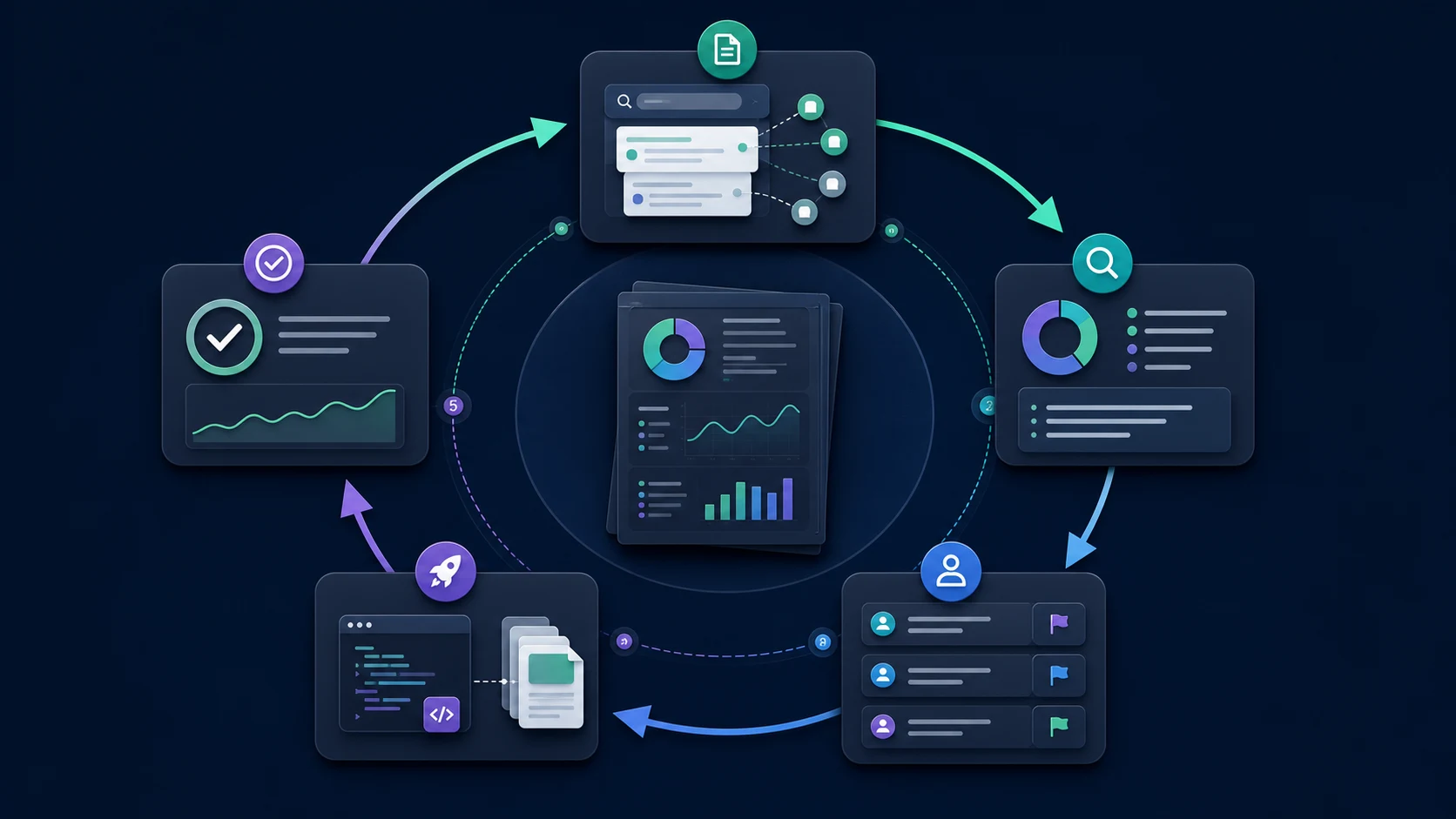
Use one row per finding:
| Queue field | Example |
|---|---|
| Client segment | US product comparison pages |
| Trigger | Generative-search impressions appeared for three pages |
| Supporting evidence | Stable classic impressions, clean crawl status, and two observed citations |
| Working diagnosis | Clear comparison structure may be helping source selection |
| Owner | Content strategist |
| Action | Standardize decision tables and evidence blocks on two adjacent pages |
| Validation window | Next monthly report after recrawl and index refresh |
| Status | Assigned, shipped, validating, watchlist, or closed |
The queue should also contain "do nothing" decisions. A weak observation, low-value topic, or unstable prompt does not deserve production work merely because it appeared in a dashboard.
For a reusable discipline around mentions, citations, and repeated checks, AI visibility measurement provides the broader evidence-loop model.
Where Searvora Fits
Searvora AI SEO Dashboard fits the segmentation and action-routing part of this workflow. The product page supports page-type, locale, and directory breakdowns, anomaly and trend detection, opportunity queues, cross-team reporting, structured exports, and timestamped evidence. Those capabilities help an agency keep AI-search observations beside classic SEO context without flattening them into one score.
Use the dashboard to preserve client cohorts and reporting windows, then route each finding to a named owner and validation date. Keep the agency's judgment visible: Searvora can organize signals and queues, but the team still decides whether a change is material, which explanation is plausible, and what should ship.
Agency AI Search Reporting Checklist
Before sending the report:
- Separate classic search, generative-search, citation, and business evidence.
- Name the source, surface, market, and date window for every AI-search metric.
- Preserve page type, locale, directory, and client-priority segments.
- Distinguish direct platform data from repeatable observations.
- Avoid merging mentions, citations, impressions, clicks, and conversions.
- Record availability gaps when a platform report is not enabled for the client.
- Write observation, interpretation, action, and validation as separate fields.
- Assign one owner and one next review date to each material finding.
- Include no-action decisions so weak signals do not create busywork.
- Recheck the same cohort and method after the agency ships a change.
The best agency AI search performance report does not pretend a new metric explains everything. It preserves the evidence chain, connects visibility to the right page cohorts, and ends with work the team can validate in the next cycle.