

The practical answer to how ai search analytics helps content planning and messaging is that it shows which questions, source pages, citations, and competitor narratives are shaping AI-search answers before a team writes another brief. That evidence can change what you publish, what you refresh, and how you explain the brand.
Keyword volume still matters, but AI search analytics adds another layer: answer evidence. It can show whether your source pages are cited, whether competitors are framed as the default choice, and whether your messaging is too vague for answer systems to reuse.
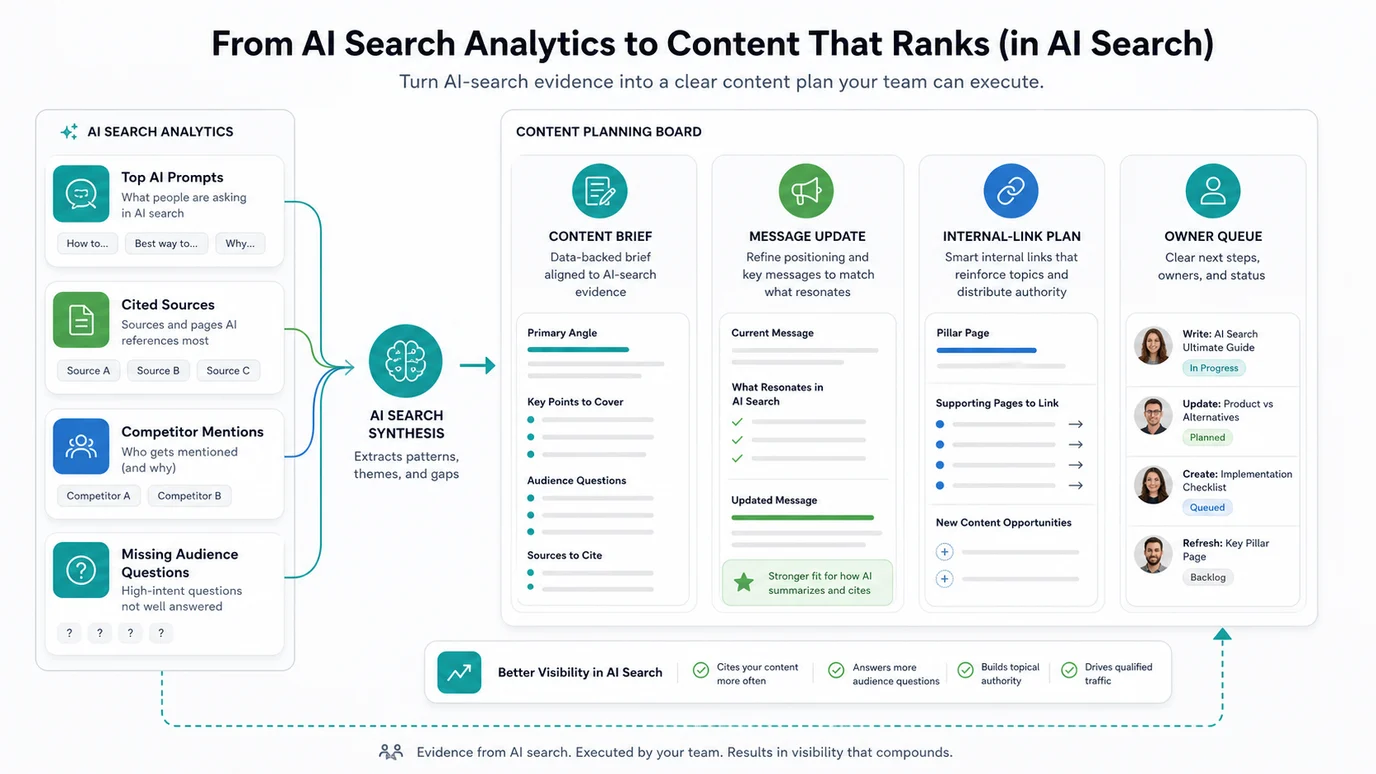
Turn Answer Evidence Into Page Jobs
Start by treating AI search analytics as planning evidence, not as a separate reporting ornament.
The useful inputs are:
| Evidence input | Planning question | Content output |
|---|---|---|
| Prompt or query group | What job is the searcher asking an answer system to perform? | A source-page role or article brief |
| Cited URLs | Which pages are trusted enough to support the answer? | Citation-gap fixes and source-page refreshes |
| Competitor mentions | Which names or categories are becoming default options? | Comparison pages, proof sections, or positioning updates |
| Missing questions | What does the answer skip or answer weakly? | New H2 sections, examples, or decision tables |
| Page cohort data | Which directory, locale, or page type is affected? | Owner-ready work by template or content group |
That is the bridge between analytics and planning. The team is not asking "what should we write?" in the abstract. It is asking which page job the evidence proves.
Build A Planning Matrix
A planning matrix keeps AI-search evidence from turning into a pile of screenshots.
| Finding | What it usually means | Planning decision |
|---|---|---|
| Your page is cited but the answer is incomplete | The source page has trust but lacks detail | Refresh the cited page with examples, constraints, and next steps |
| Competitor is mentioned and you are absent | The answer has a category pattern your site does not support | Create or strengthen the category source page |
| Your brand is mentioned with weak context | Entity language or use-case language is inconsistent | Update product, about, comparison, and support copy |
| AI answer cites third-party content about your category | External sources explain the topic better than your owned pages | Build a stronger neutral explainer and link it from product pages |
| The same issue appears across a directory | The problem is probably template or page-type level | Assign a cohort refresh, not one article |
| Query group changes but traffic does not | AI visibility may be influencing discovery without clean referrals | Add a reporting note and watch Search Console movement by page group |
The matrix also helps avoid cannibalization. If the finding belongs inside an existing article, update that page. If it reveals a new source-page role, plan a new asset. The keyword mapping process is useful when the choice is not obvious.
Shape Messaging With Evidence
Messaging gets sharper when it is tied to answer evidence. AI search analytics can show whether answer systems understand the category you serve, the problems you solve, and the sources that support those claims.
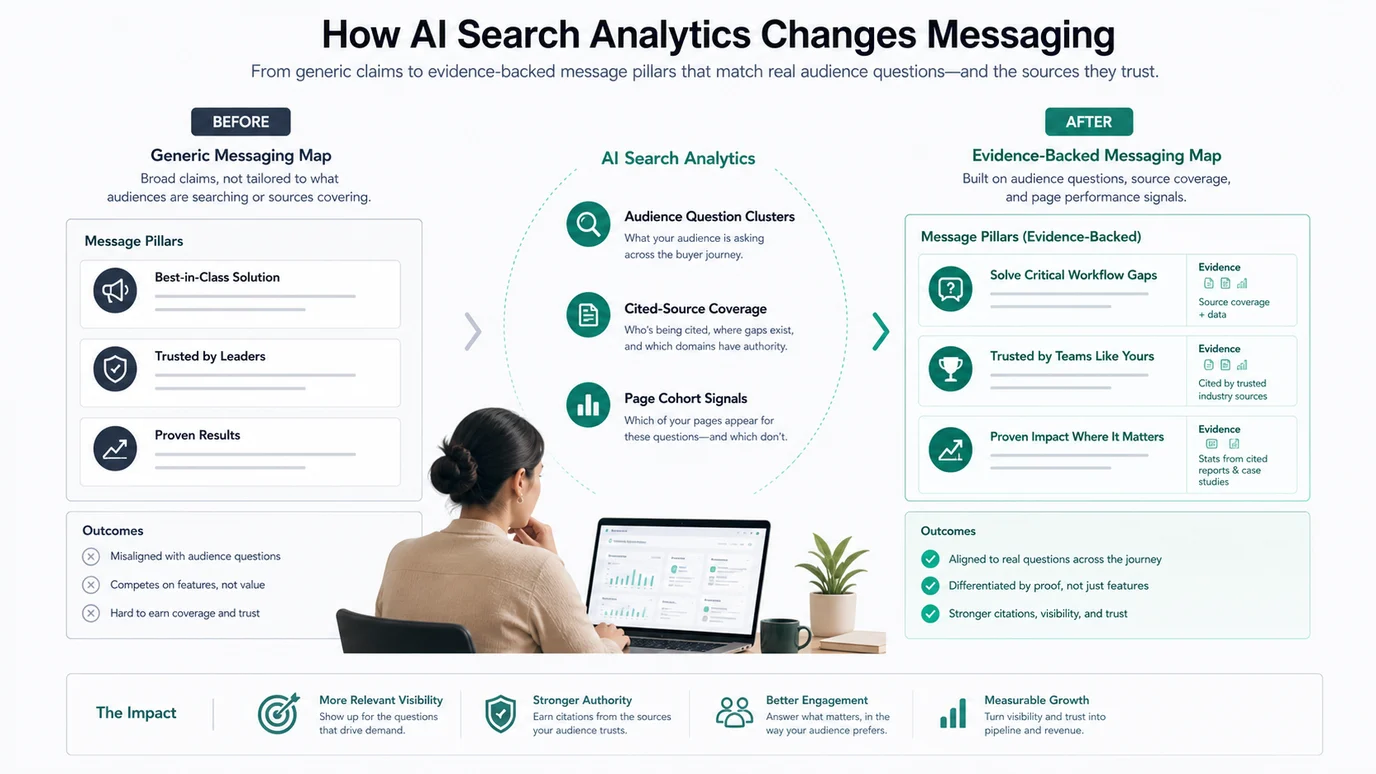
Review messaging in four layers:
- Category language: does the brand use the same category terms searchers and answer systems use?
- Problem framing: do source pages name the pain points users ask about?
- Proof language: are examples, constraints, and evidence visible on public pages?
- Differentiation: is the brand positioned against the actual alternatives that appear in answers?
This is different from adding AI-search keywords everywhere. The goal is to make the site's source pages easier to understand and cite. The AI search competitor analysis workflow can help when competitor mentions are the strongest signal.
Turn Signals Into Briefs
Content briefs should capture the evidence, not just the keyword.
A useful AI-search analytics brief includes:
| Brief field | What to include |
|---|---|
| Query group | The prompts, questions, and related keywords being reviewed |
| Existing owner URL | The page that should answer or support the topic |
| Answer evidence | Mentions, citations, competitor framing, and missing details |
| Content decision | Refresh, new article, comparison section, support page, or no action |
| Message change | The category, proof, or use-case language that needs to be clearer |
| Validation plan | Recheck query group, source citations, Search Console, and page cohort movement |
This prevents the common handoff problem where analytics says "visibility is down" and content receives a vague instruction to "write something about AI search." The brief should say which source page, which evidence gap, and which owner.
Report What Changed
AI search analytics belongs in performance reports only when it changes decisions. A good report does not need a giant prompt table. It needs a short narrative that explains what moved and what the team will do next.
Use this reporting structure:
- Query group reviewed.
- Brands, competitors, and source URLs observed.
- Page cohort or owner URL affected.
- Content or messaging decision made.
- Expected validation window.
- Next owner and status.
That structure pairs well with an SEO reporting dashboard because it connects visibility evidence with page cohorts, owner queues, and follow-up dates.
Where Searvora Fits
Searvora AI SEO Dashboard is the best product fit for this workflow. The current product page positions it around segment-first monitoring, anomaly and trend detection, opportunity scoring, and cross-team reporting. Those are exactly the views needed when AI-search evidence has to become a content plan instead of a one-off observation.
Use the dashboard to keep query groups, page cohorts, reporting slices, and prioritized opportunities in one operating cadence.
Weekly Workflow
Run this once a week for one market, one topic cluster, and one page cohort:
- Pick a stable query group instead of a random prompt list.
- Record mentions, cited URLs, competitors, and missing questions.
- Map every finding to an existing page, a new source-page need, or no action.
- Decide whether the work is content planning, messaging, technical validation, or reporting only.
- Write one owner-ready brief with evidence and a validation date.
- Recheck the same query group after the change is published.
AI search analytics helps content planning and messaging when it turns answer evidence into page decisions. It is noise when it only creates another report that nobody can assign, publish, or recheck.