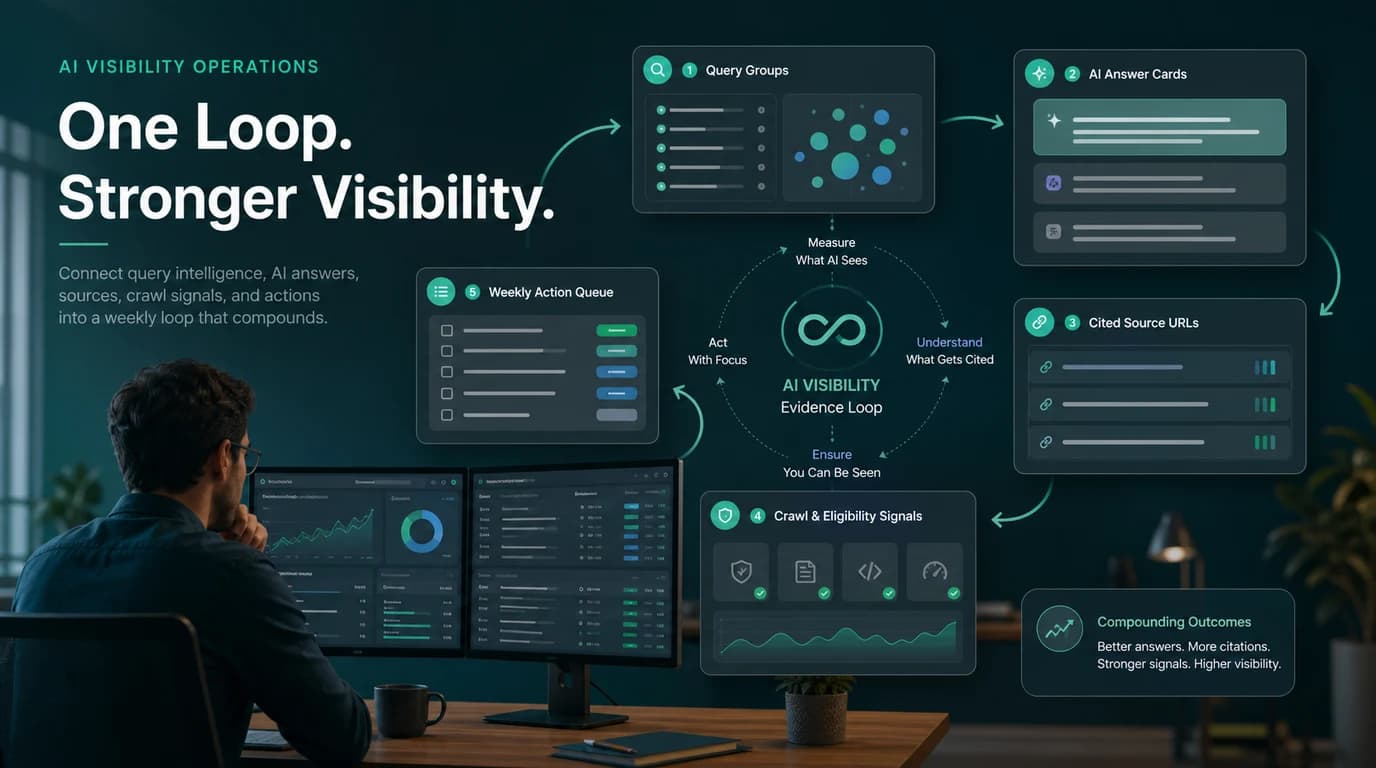
AI visibility is how often your brand, pages, products, and evidence appear inside AI-assisted search experiences. The useful work is not chasing one magic score. It is proving which queries mention you, which sources are cited, which owned pages should support the answer, and what needs to be fixed next.
The Ahrefs AI visibility guide that surfaced this opportunity treats the topic as a broad new measurement layer. Searvora's information gain is the operating layer around it: stable query sets, source-page ownership, crawl eligibility, and a weekly action queue that teams can rerun.
Start With A Stable Query Set
AI visibility gets noisy when every check starts from a new prompt. Start with a small query set that represents the pages and markets that actually matter.
Use four groups:
| Query group | What it tests | Page that should support it |
|---|---|---|
| Category queries | Whether the brand appears for a problem or product category | A category, use-case, or comparison page |
| Comparison queries | Whether the brand is included when users compare options | A fair comparison or alternatives page |
| Problem queries | Whether an owned source answers the user's task | A guide, support page, tool page, or workflow article |
| Branded queries | Whether AI systems describe the brand accurately | Homepage, product pages, about pages, and public profiles |
Split Visibility Into Three Ledgers
One blended AI visibility number hides the decision. Split the evidence into mention, citation, and performance ledgers.
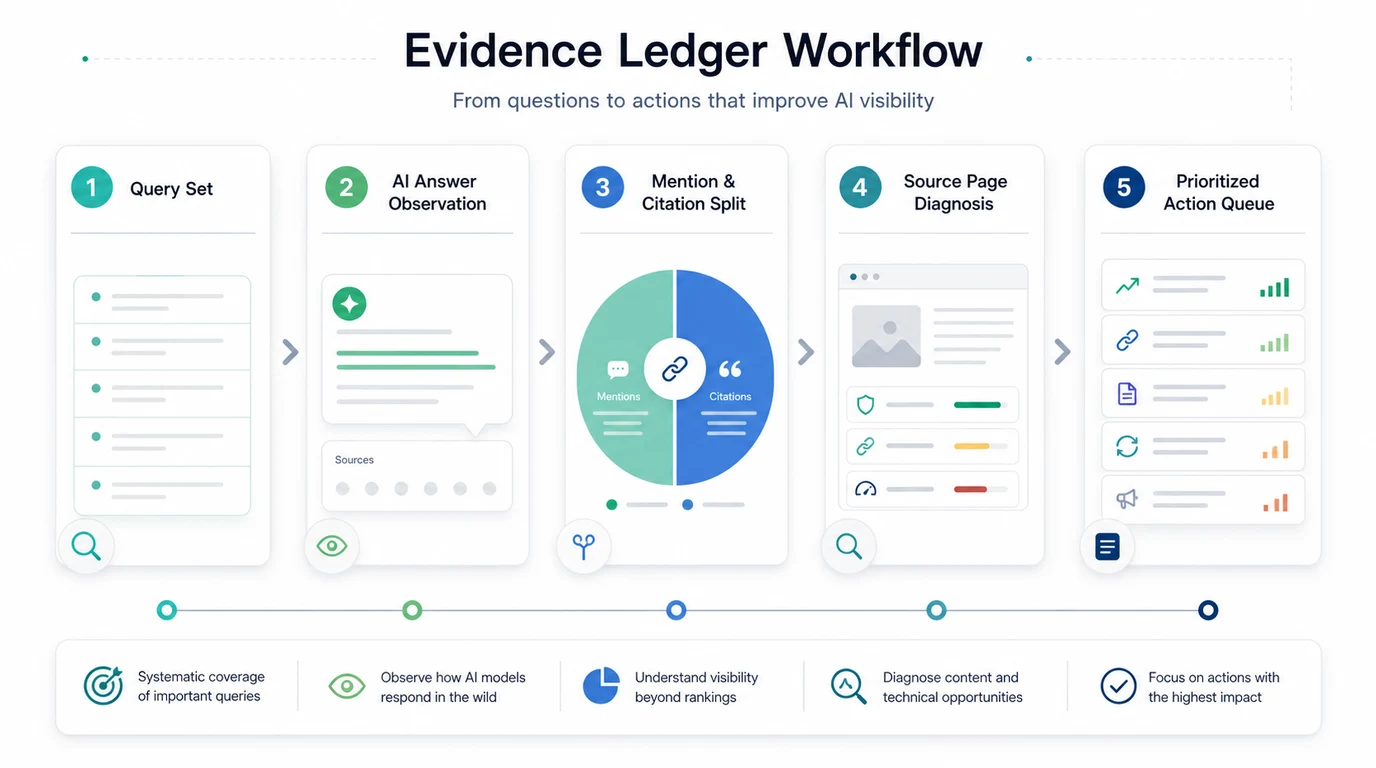
Use the split this way:
| Ledger | What to record | Better next action |
|---|---|---|
| Mention ledger | Whether the brand, product, or page is named | Fix entity clarity, public descriptions, and source coverage |
| Citation ledger | Which owned, competitor, or third-party URLs are cited | Improve the source page that should earn the citation |
| Performance ledger | Search Console query/page movement, CTR, conversions, and assisted leads | Decide whether visibility changes are worth shipping work |
Google's AI feature guidance keeps this grounded in normal SEO. Pages still need crawl access, useful content, indexability, snippet eligibility, and technical cleanliness to be candidates for supporting links in Google AI features. Google's Search Console Performance report still gives the core web-search metrics teams use for trend review: clicks, impressions, CTR, average position, queries, pages, countries, devices, and dates.
That means AI visibility should sit beside your SEO review, not replace it.
Diagnose The Source Page Before The Brand
When a competitor appears and your brand does not, the first instinct is often to write more copy. Slow down. The missing signal may be a source-page problem.
Check the page that should support the answer:
| Source-page check | Pass condition | Fix when weak |
|---|---|---|
| Crawl eligibility | The page is reachable, indexable, canonical, and in the internal-link path | Fix robots, noindex, canonical drift, redirects, or orphan-page issues |
| Extractable answer | Definitions, steps, tables, examples, and evidence appear in HTML text | Move useful material out of vague copy or image-only sections |
| Entity clarity | Brand, product, category, author, and use case are named consistently | Normalize wording across product pages, profiles, and comparison pages |
| Citation usefulness | The page can support one specific answer, not every possible prompt | Split overloaded pages or add a focused child article |
| Freshness signal | Time-sensitive sections show what changed and why it matters | Refresh only the section that creates trust or accuracy risk |
OpenAI's ChatGPT Search help also makes source-page access practical, not mystical: searched responses may include citations and source panels, and OpenAI says inclusion depends on factors such as relevance and reliability while allowing OAI-Searchbot to crawl the site. Treat that as an eligibility and evidence problem before treating it as a brand problem.
Turn AI Visibility Into Assigned Work
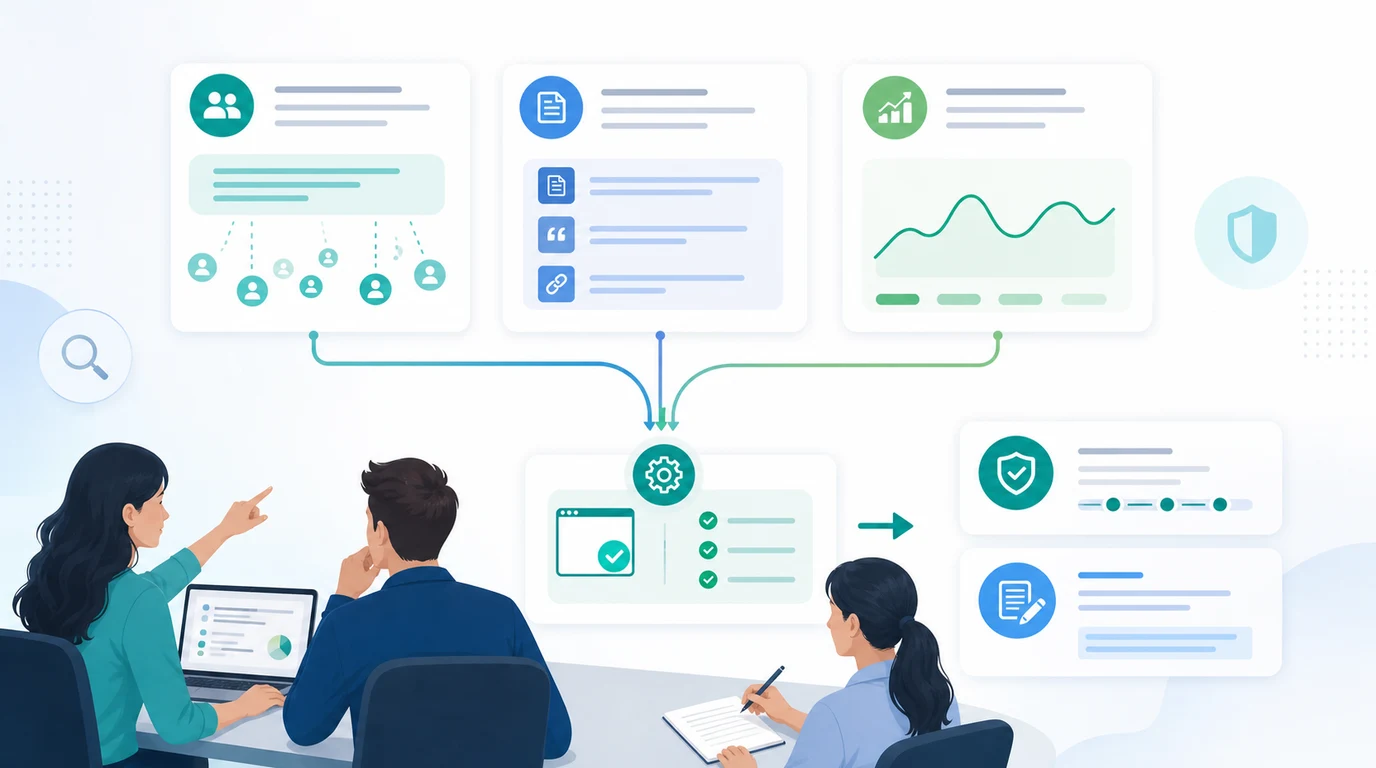
AI visibility monitoring becomes useful only when it creates a fix queue. Every finding should end with one action, one owner, and one validation window.
Use this decision table:
| Finding | Likely meaning | Assign this action |
|---|---|---|
| Brand mentioned but no owned URL cited | Entity awareness exists, but source ownership is weak | Improve or create the owned source page for that query group |
| Competitor cited with a stronger definition | Your page may answer too slowly or too vaguely | Add a concise answer block, examples, and internal links |
| Owned page cited but conversions are weak | Visibility exists, but the page is not ready for the next step | Improve CTA fit, comparison context, and page freshness |
| AI answer cites an outdated source | The answer may rely on stale evidence | Update the source page and add clearer current evidence |
| Search Console shows stable impressions but lower CTR | AI answers or SERP features may be changing click behavior | Segment the query group and review snippets, titles, and source usefulness |
| The result changes every time | The prompt set is unstable or too broad | Move it to watchlist and focus on more repeatable query groups |
The brand mentions in AI answers workflow is the right child process when the problem is entity awareness. The AI search citation audit is the right child process when the problem is source ownership. The AI Overview tracking workflow is the right child process when the query set is Google-specific.
This page is the parent loop: decide which signal you are looking at before asking a team to fix it.
Where Searvora Fits
Searvora AI SEO Dashboard fits the monitoring layer of AI visibility work. The product page positions it around segment-first monitoring, anomaly and trend detection, opportunity scoring, and cross-team reporting. Those are the views a team needs when AI visibility changes by page type, locale, directory, topic cluster, or owner.
Use the AI SEO dashboard to group query sets, source URLs, and page cohorts. Then connect the finding to the right execution path:
| Searvora layer | Use it when | Output |
|---|---|---|
| AI SEO Dashboard | You need to spot visibility movement by segment | A reviewed evidence queue |
| SEO Spider Crawler | The source page may have crawl, canonical, link, or rendering risk | A technical fix list |
| AI SEO Consultant | Multiple signals compete for the same team capacity | A ranked action plan |
Run The Weekly AI Visibility Review
Use this sequence every week or after major content releases:
- Choose one market, language, and topic cluster.
- Reuse the same category, comparison, problem, and branded query sets.
- Record the answer state, brand mention, cited source URLs, and owned page that should win.
- Check crawl eligibility, canonical, rendered text, internal links, sitemap inclusion, and source-page clarity.
- Compare Search Console movement for the same page and query group.
- Choose one action: improve a source page, fix technical eligibility, add internal links, create a child article, consolidate pages, or watch.
- Assign the owner and expected validation date.
- Recheck the same query set after enough time for crawling and answer changes.
AI visibility is not a separate universe from SEO. It is a stricter evidence loop. The pages that win are usually easier to crawl, easier to cite, easier to understand, and easier for a team to improve without guessing.