

Content gap analysis is the process of comparing competitor pages, search demand, and your existing content to find useful topics or page jobs your site does not fully cover yet. The valuable output is not a spreadsheet of missing keywords. It is a decision about what to create, refresh, merge, support, or ignore.
Start with the competitor page that proves demand, confirm the search task, compare it against your current URLs, and only approve a new brief when the page type and information gain are clear. That keeps content gap analysis from becoming a copy-the-competitor exercise.
What Content Gap Analysis Should Produce
A useful content gap analysis should end with a work queue, not just a list of absent phrases. Each gap needs a target keyword, a page type, an existing-page overlap check, and a next action.
| Output | What it answers | Example action |
|---|---|---|
| Create | We do not have a page for this search task | Draft a new article, tool page, landing page, or hub |
| Refresh | We have a page, but it does not satisfy the task well enough | Improve sections, examples, metadata, visuals, or links |
| Merge | Multiple URLs already answer the same job | Consolidate and redirect weaker overlap |
| Support | The gap is a child topic or FAQ for an existing page | Add a section, internal link, or follow-up brief |
| Ignore | The gap is off-topic, unsafe, or impossible to improve on | Record the reason and move on |
This is the difference between content gap analysis and raw keyword export work. A keyword can be missing because you need a new page. It can also be missing because the query belongs to an existing URL, a product page, a downloadable template, or no Searvora page at all.
Start With Competitor Evidence
Competitor pages are useful because they show a page shape that already earns visibility. Start with the page, not the domain. A blog post, support page, template, glossary, pricing page, and tool page can all win traffic for different reasons.
For each candidate, capture:
- URL path and slug.
- Page title, H1, and meta description.
- Page type and content structure.
- The query family or topic it appears to serve.
- The user job behind the page.
- Traffic, keyword footprint, and change signals.
- Calls to action and surrounding product context.
The competitor URL gives you the first keyword hypothesis. The page snapshot confirms or revises it. If the slug, title, H1, and structure all point to the same task, you usually have enough to plan. Use a SERP check when the page type is mixed, the keyword is unclear, or the approve/defer call is close.
This page-level habit pairs naturally with SEO competitor analysis. Competitor analysis tells you why a rival page matters. Content gap analysis decides what your site should do next.
Classify the Search Task Before the Gap
Most weak gap lists treat all missing topics as article ideas. That creates two problems: you write posts for tool intent, and you create duplicate articles when a refresh would have worked better.
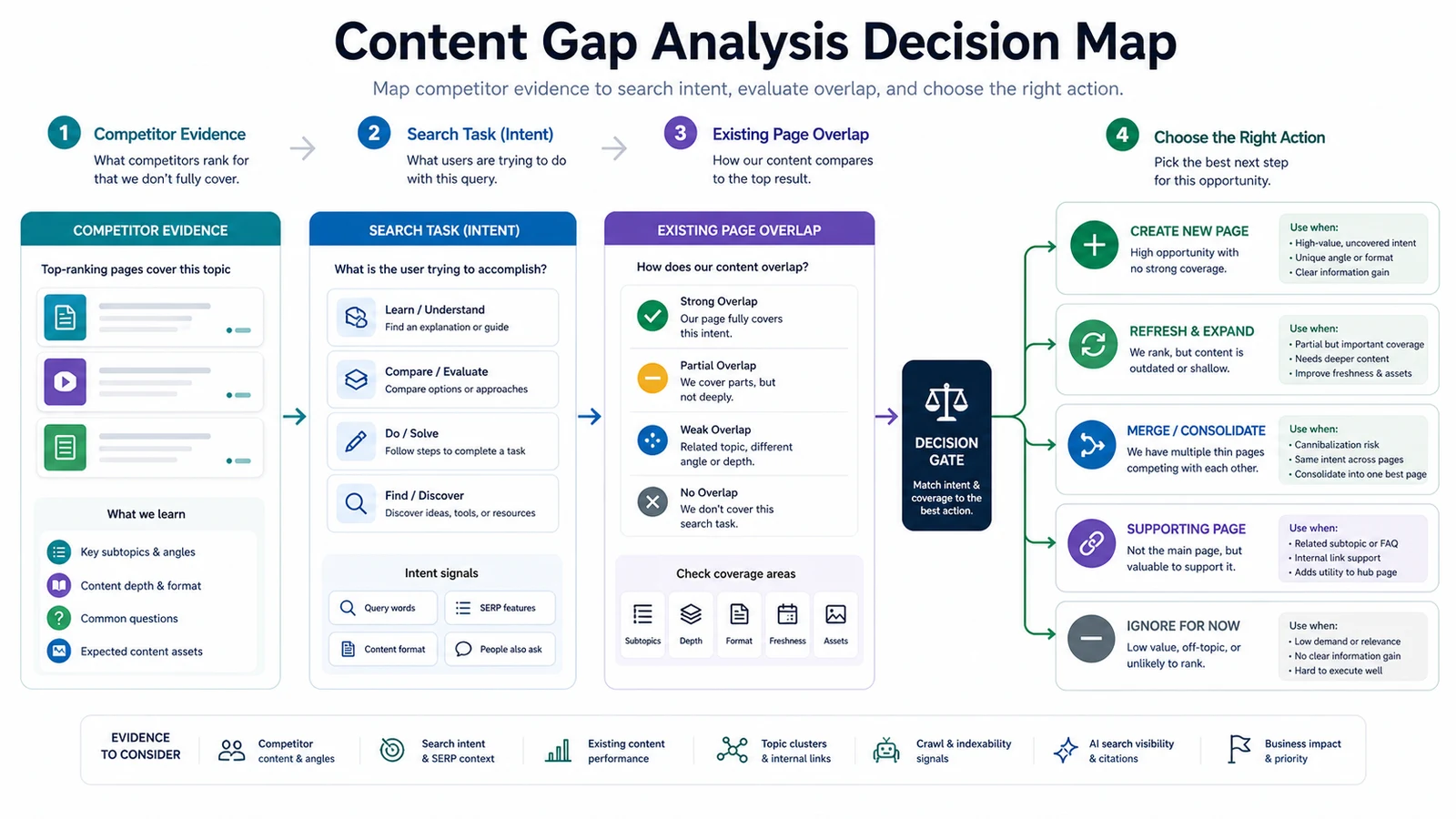
Use this routing table before drafting:
| Search task | Better page type | Planning check |
|---|---|---|
| Learn a concept | Explainer or parent hub article | Can we add a clearer definition, examples, and next steps? |
| Complete a process | How-to article or workflow guide | Can we show steps, validation, and owner handoff? |
| Compare options | Comparison or roundup | Can we verify options and avoid fake hands-on claims? |
| Get an output | Tool, template, or downloadable asset | Would a blog post disappoint the user? |
| Navigate a brand task | Support/intercept article or no page | Can we answer fairly with public information? |
| Fix a technical issue | Technical SEO fix guide | Can we diagnose causes and validate the fix? |
The target for this article is a how-to workflow. A reader searching for content gap analysis wants to find missing coverage, decide what matters, and turn it into action. That means the article should include process, evidence, tables, and validation rather than only a template download.
Compare Against Existing Pages
The overlap check is where content gap analysis becomes SEO-safe. Do not create a new article just because a competitor has one. Check whether an existing Searvora URL already covers the same core keyword, same page type, and same user job.
Same cluster is not enough to call cannibalization. A content audit article can support a content gap analysis article because one audits existing pages and the other finds missing or under-covered jobs. A keyword research workflow can support this article because keyword research chooses opportunities, while content gap analysis compares coverage against current and competitor pages.
Use this three-part overlap test:
| Test | Duplicate when yes | Not duplicate when |
|---|---|---|
| Core keyword | Both pages target the same primary query | One is a parent, child, or adjacent topic |
| Page type | Both are the same asset type | One is a tool, one is an article, or one is a hub |
| User job | Both solve the same reader task | One teaches, one compares, one executes, or one validates |
If all three match, refresh or merge instead of creating a new URL. If only one or two match, look for an internal-link path or a tighter information-gain angle.
Score Gaps Before You Brief Them
Traffic-heavy competitor pages deserve review, but traffic is not the approval rule. Score each candidate by demand, intent confidence, business fit, information gain, and execution readiness.
| Score area | High confidence looks like | Low confidence looks like |
|---|---|---|
| Demand | Competitor traffic, keyword breadth, or Search Console impressions show a real query family | One isolated phrase with no supporting evidence |
| Intent clarity | URL, title, H1, and body structure point to the same page type | Mixed article, tool, local, ecommerce, or brand-only intent |
| Business fit | The topic supports SEO, GEO, content operations, crawling, reporting, or Shopify content work | Traffic would not help Searvora's audience |
| Information gain | We can add a better workflow, decision table, validation path, or AI-search angle | We would only rewrite the competitor outline |
| Execution readiness | Owner, page type, internal links, visuals, and validation are clear | The brief depends on unresolved research or product claims |
For existing pages, Google's Search Console performance report is useful for checking queries and pages before choosing create versus refresh. For general crawl and content quality baselines, Google's SEO starter guide is still a practical guardrail.
Turn Approved Gaps Into Briefs
An approved content gap should become a short execution brief. The brief should prevent the writer from guessing, and it should prevent the SEO lead from approving another generic page.
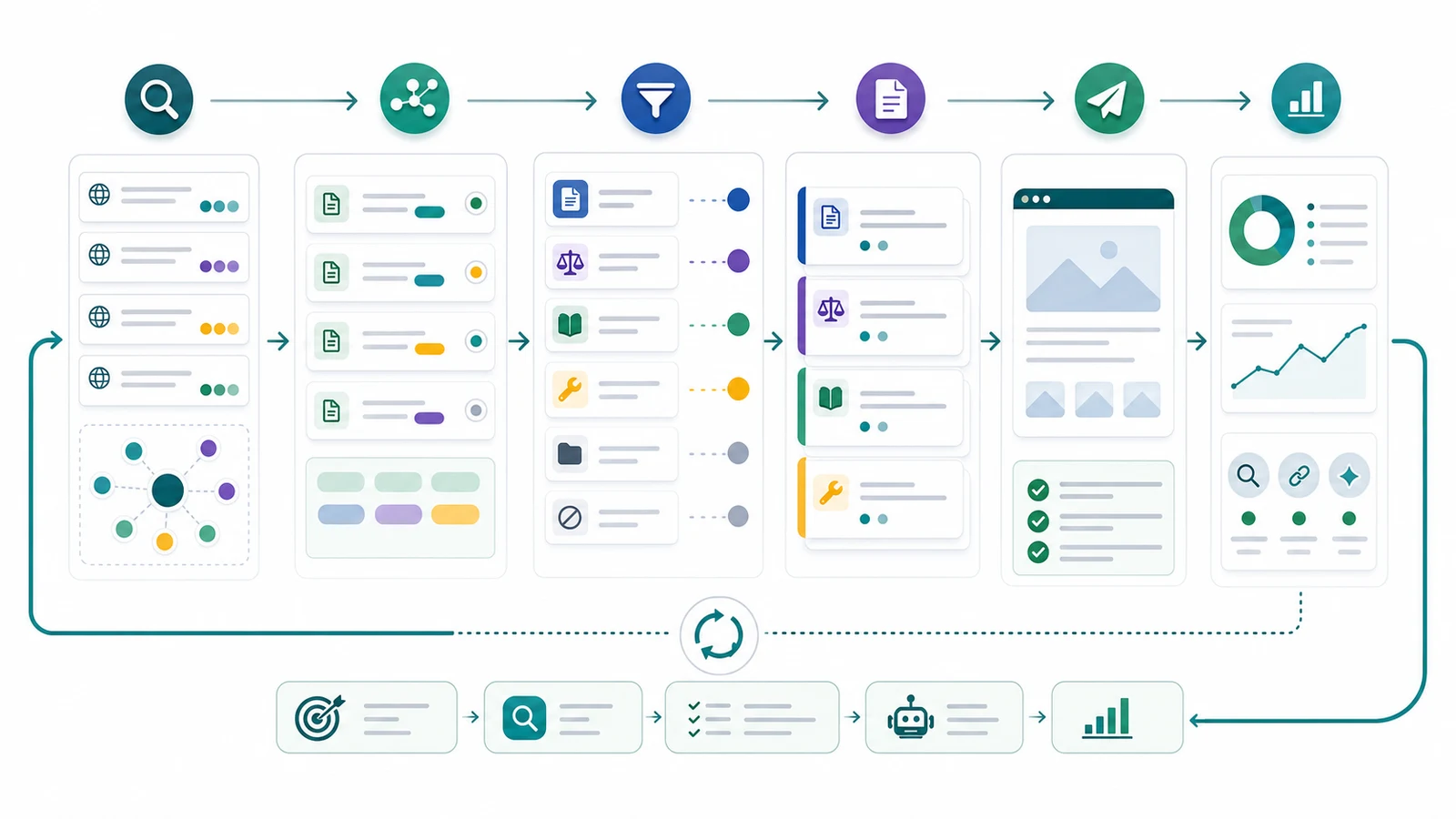
Use this brief structure:
| Brief field | What to write |
|---|---|
| Source evidence | Competitor URL, title, H1, traffic signal, and page type |
| Target keyword | The core query the new or refreshed page should serve |
| User job | The task the reader wants to complete |
| Recommended page type | Article, landing page, tool, comparison, hub, template, or refresh |
| Existing overlap | Searvora URLs to link, update, avoid, merge, or leave alone |
| Information gain | Why the Searvora version will be more useful |
| Required evidence | Public sources, screenshots, crawl exports, examples, or internal data |
| Validation plan | Canonical, sitemap, internal links, indexability, and performance review |
Do not skip the validation plan. A new article can still fail if it is orphaned, canonicalized incorrectly, missing from the sitemap, or disconnected from related pages. A refreshed article can still fail if the old URL is not measured after the change.
Add AI-Search and GEO Judgment
Content gap analysis should also ask whether the page will be easy for AI answer systems to understand and cite. That does not mean stuffing the draft with AI buzzwords. It means making the page's entities, task, evidence, and recommendations extractable.
Check the approved brief for:
- A direct answer in the opening section.
- Clear definitions for the main concept.
- Tables that expose decisions in searchable text.
- Specific page-type guidance.
- Internal links that connect the topic to a broader cluster.
- External sources only when they help the reader verify a claim.
- A next step that is operational, not vague.
This is where information gain matters. If the competitor page mainly explains a template, Searvora can add a stronger operating layer: decide whether the gap becomes a new article, an existing-page refresh, a technical fix, a Shopify content brief, or no page at all.
Where Searvora Fits
Searvora fits after the analysis has produced real decisions. Use the dashboard layer to spot page and query shifts, the crawl layer to validate whether pages can perform, and the consultant layer to turn mixed evidence into ranked work.
For this workflow, the primary handoff is strategy and prioritization. The AI SEO consultant is the natural place to compare competitor evidence, existing-page overlap, crawl risks, content effort, and information gain before assigning briefs.
A Practical Content Gap Analysis Checklist
Use this checklist when a competitor page looks like a possible gap:
- Record the competitor URL, title, H1, meta description, traffic, and keyword footprint.
- Infer the target keyword from the slug and title, then confirm it from the page content.
- Classify the search task and page type before looking at your own content.
- Compare the opportunity against existing Searvora articles, product pages, planned keyword rows, and related competitor decisions.
- Reject only when the same keyword, same page type, and same user job are already covered or the topic has no credible information gain.
- Defer when the better response is a tool, landing page, downloadable resource, product comparison, or existing-page update.
- Approve only when the article type is clear and the Searvora version can add a stronger framework, workflow, evidence layer, or validation path.
- Choose one primary product CTA and one to three supporting internal links.
- Plan visuals and any required public-source screenshots before drafting.
- Publish with canonical, sitemap inclusion, local visuals, external-link hygiene, and a measurement window.
Content gap analysis works when it creates fewer, better briefs. The goal is not to match every competitor page. The goal is to choose the gaps that deserve a page, avoid the ones that would split intent, and turn the approved work into something a team can actually ship.