

An affiliate niche is a focused audience, problem, and decision space that a content site can serve credibly. Choose one by testing whether you can help a specific reader make repeated decisions with useful pages—not by chasing a high commission rate or a large keyword list alone.
The practical way to choose an affiliate niche is to write a short viability brief before you join programs or publish a comparison. It should connect audience need, search-task fit, evidence and disclosure requirements, maintenance workload, and a small first content cluster. That creates a testable operating decision instead of a site full of unrelated offers.

Start With a Viability Brief
The question is not “Can this topic make money?” It is “Can we repeatedly publish pages that help a defined audience make decisions, support those pages with evidence, and keep them current?”
Use this brief before choosing a niche:
| Check | What to establish | Weak signal to avoid |
|---|---|---|
| Reader problem | A clear audience with a recurring purchase, setup, comparison, or support decision | A vague audience that only exists to click product links |
| Search task | The guides, comparisons, how-tos, tools, or resources that would genuinely help | Treating every query as a product roundup |
| Commercial fit | Programs and products that solve the reader's real task | Selecting offers before understanding the reader |
| Evidence burden | What you can verify through official documentation, firsthand work, or clearly attributed sources | Rewriting merchant claims, ratings, or specifications without proof |
| Maintenance load | Which pages need price, policy, product, or recommendation reviews | A content plan that cannot be kept accurate |
| First cluster | A small group of related pages that can link to one another naturally | Publishing disconnected “best” pages with no supporting coverage |
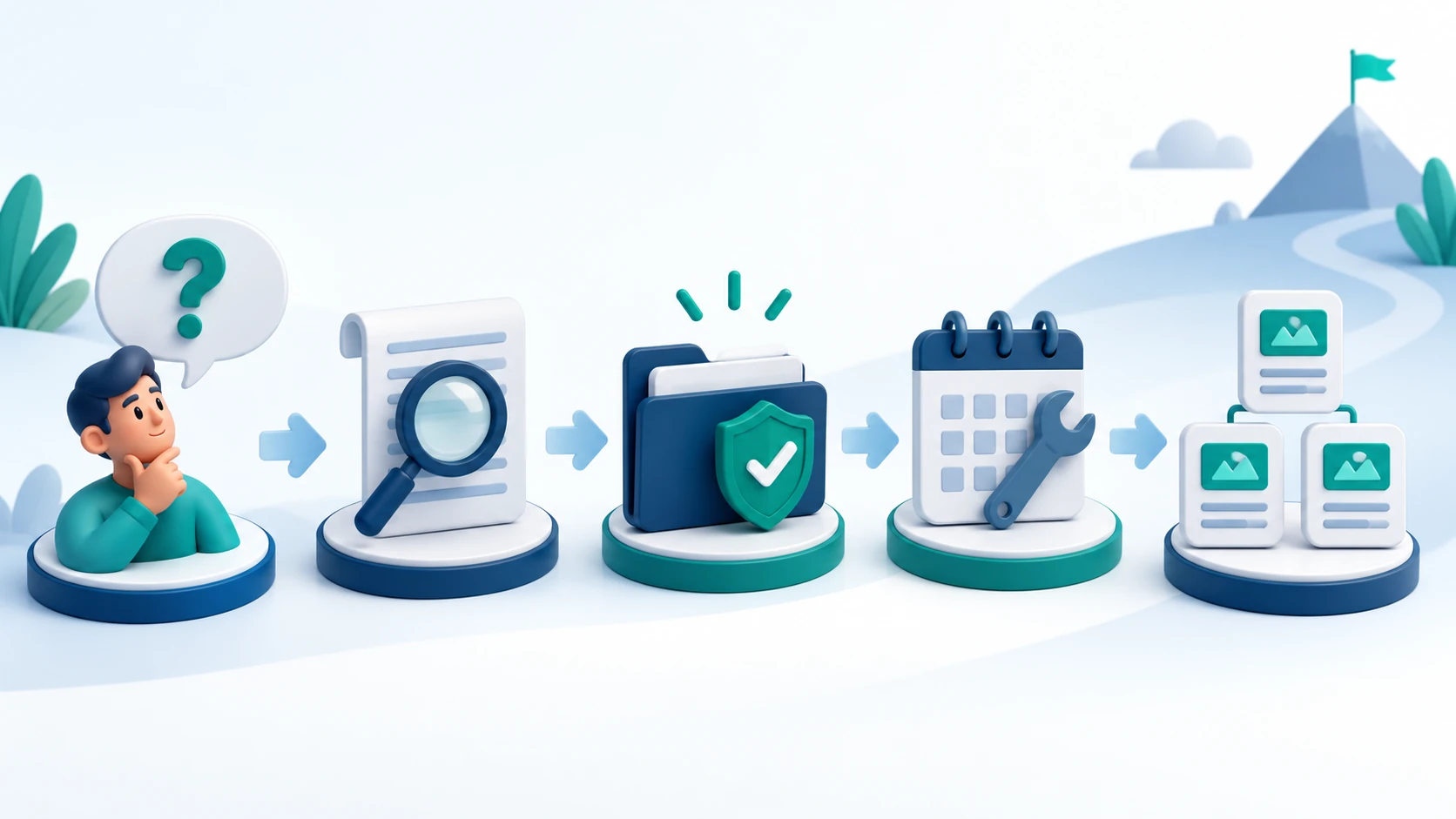
Define the Reader and the Decision Job
Start with a person who needs to decide something repeatedly. That could be a home cook choosing equipment, an ecommerce operator comparing shipping tools, or a developer evaluating a workflow. The niche becomes useful when its pages answer distinct jobs inside that decision, such as learning the basics, comparing options, solving a setup problem, or checking a policy.
This keeps an affiliate site from becoming a catalog with a different offer on every page. It also creates a cleaner relationship between the keyword, the page type, and the evidence you need. The search intent workflow is useful here: a “how to” query needs a method and validation steps, while a comparison query needs decision criteria and current source evidence.
Use a one-sentence niche statement:
We help [specific reader] make [recurring decision] by publishing [page types] supported by [proof standard].
For example, “We help first-time espresso buyers choose, set up, and maintain home equipment through setup guides, comparison tables, and troubleshooting pages backed by official specifications and clear disclosures.” The statement does not promise rankings or revenue. It gives the team a boundary for what belongs in the cluster.
Test a Small Content Cluster Before You Pick Programs
Do not begin with ten affiliate applications. First prove that the niche can support a small, useful content system. A good first cluster has a parent page plus three or four child page jobs that readers can move between naturally.
| Page role | Reader job | Evidence to prepare | First validation check |
|---|---|---|---|
| Parent guide | Understand the problem space and choose a path | Definitions, audience context, and a clear scope | Is the page useful without an affiliate link? |
| How-to | Complete a setup, evaluation, or maintenance task | Steps, constraints, and official documentation | Can a reader verify the result? |
| Comparison | Choose between approaches or products | Criteria, current specifications, and tradeoffs | Are the criteria more useful than a generic winner? |
| Research or update page | Follow a changing policy, product category, or recurring question | Dated sources and a review schedule | Who will refresh this when facts change? |

The cluster should make internal links obvious. A reader who finishes a parent guide may need a comparison next; a reader who finishes a how-to may need a troubleshooting page. If those next pages do not make sense, the niche is probably still too broad or the reader job is not defined tightly enough.
The existing affiliate marketing for beginners workflow is the right next read after a niche decision: it covers the broader trust, page-choice, crawl, and validation work that starts once the subject area is chosen.
Build Evidence and Disclosure Into the Choice
Affiliate content becomes fragile when the evidence standard is added after the site is built. Before choosing a niche, list the facts that readers will expect you to support: product specifications, policy terms, compatibility, price-sensitive recommendations, testing method, and commercial relationships.
If a page includes a compensated recommendation or affiliate link, the FTC's endorsement guidance says a material relationship should be disclosed clearly and conspicuously so readers can evaluate the recommendation. That is a publishing rule, not a footer you add after the content is finished.
The same standard improves the SEO decision. Google's people-first content guidance asks whether a page adds original value and satisfies the reader rather than merely attracting search visits. If the niche requires claims, testing, or current comparisons that your team cannot verify and maintain, narrow the scope before publishing.
Use this evidence checklist:
- Record the official source for any product, policy, or compatibility claim.
- Decide whether the page needs firsthand testing, a transparent methodology, or a clearly limited public-source analysis.
- Put disclosures close enough to the recommendation that readers can understand the relationship.
- Set a refresh trigger for pages that depend on changing specifications, policies, availability, or recommendations.
- Remove a page from the plan if it cannot be useful without exaggerated claims or copied merchant copy.
When you are ready to choose programs, use the beginner affiliate-program comparison to compare approval friction, content fit, disclosure safety, and the first pages you can publish with real evidence.
Score the Niche Before You Build the Site
You do not need a perfect market model. You need enough structure to compare two possible niches honestly. Score each candidate from one to five, then write one sentence explaining the evidence behind each number.
| Score area | A high score means | A low score means |
|---|---|---|
| Reader clarity | You can name the audience and the decision they return to make | The audience is only a demographic label |
| Content depth | You can map useful guides, comparisons, fixes, and updates | Most pages would repeat the same recommendation |
| Evidence access | You can cite official sources and explain your method | Critical claims would be guessed or copied |
| Maintenance fit | The team can assign reviews and update changing pages | The catalog will become stale after launch |
| Commercial alignment | Relevant programs exist after the reader task is clear | The commission is the only reason to cover the topic |
Choose the candidate with the most defensible total, not the most exciting hypothetical upside. Then create only the first cluster, record the baseline, and review whether readers reach the intended next page. A small proof cycle is safer than scaling a niche that cannot support useful, maintainable content.
Where Searvora Fits
Searvora's AI SEO Consultant fits the decision stage after you have gathered the niche brief. Its product workflow is designed to turn mixed SEO signals into priorities, action plans, and execution-ready recommendations. Use it to keep the reader job, page type, evidence gap, and validation step attached to the work instead of turning niche research into a disconnected spreadsheet.
An affiliate niche is not a promise of easy traffic. It is a commitment to serve one audience's decisions with pages you can explain, prove, maintain, and improve. Make that commitment visible in the brief before you build the site.