

Affiliate marketing for beginners is a revenue model where a publisher promotes another company's product and earns a commission when a tracked referral converts. The hard part is not only joining a program. It is choosing a focused niche, creating useful pages, disclosing the relationship clearly, and earning search visibility without turning the site into a thin catalog of offers.
The public Ahrefs affiliate marketing guide frames the beginner path around niche choice, content platform, programs, content, traffic, clicks, and conversion. Searvora's information gain is the operating layer around that path: how to make affiliate content crawlable, trustworthy, internally linked, search-led, and ready to monitor before scaling.
Start With A Narrow Reader Job
Affiliate marketing for beginners works better when each page has one reader job. A new site that publishes broad product roundups, unsupported reviews, and social posts at the same time usually creates a messy content system before it creates revenue.
Use this first gate before joining more programs:
| Planning question | Strong beginner answer | Risky shortcut |
|---|---|---|
| Who is the reader? | A specific buyer, operator, hobbyist, or problem owner | "Anyone who might click" |
| What problem does the page solve? | Compare options, explain a setup, answer a support task, or validate a choice | Repeat the merchant's sales copy |
| Which page type fits? | Explainer, review, comparison, tutorial, resource, or hub | One generic article format for every offer |
| What proof is needed? | Public product facts, screenshots, specs, policies, examples, or first-party experience | Unsupported claims and recycled ratings |
| How will it be found? | Search demand, internal links, crawlable pages, and refresh triggers | Social posts with no durable page strategy |
This is why affiliate marketing is also a content operations problem. The site needs a system for deciding what deserves a page, how that page earns trust, and when it should be updated or removed.
If the topic starts from keyword demand, use the search intent workflow before picking a format. If the page job is unclear, the article can rank for the wrong query, attract unqualified visitors, or cannibalize a better page later.
Choose Crawlable Content Before Promotion Channels
Beginners often ask which channel to use first. The safer answer is to build a crawlable content base before relying on short-lived promotion loops. Social, email, communities, and paid campaigns can help distribution, but search-led affiliate work needs pages that can be crawled, linked, refreshed, and measured.
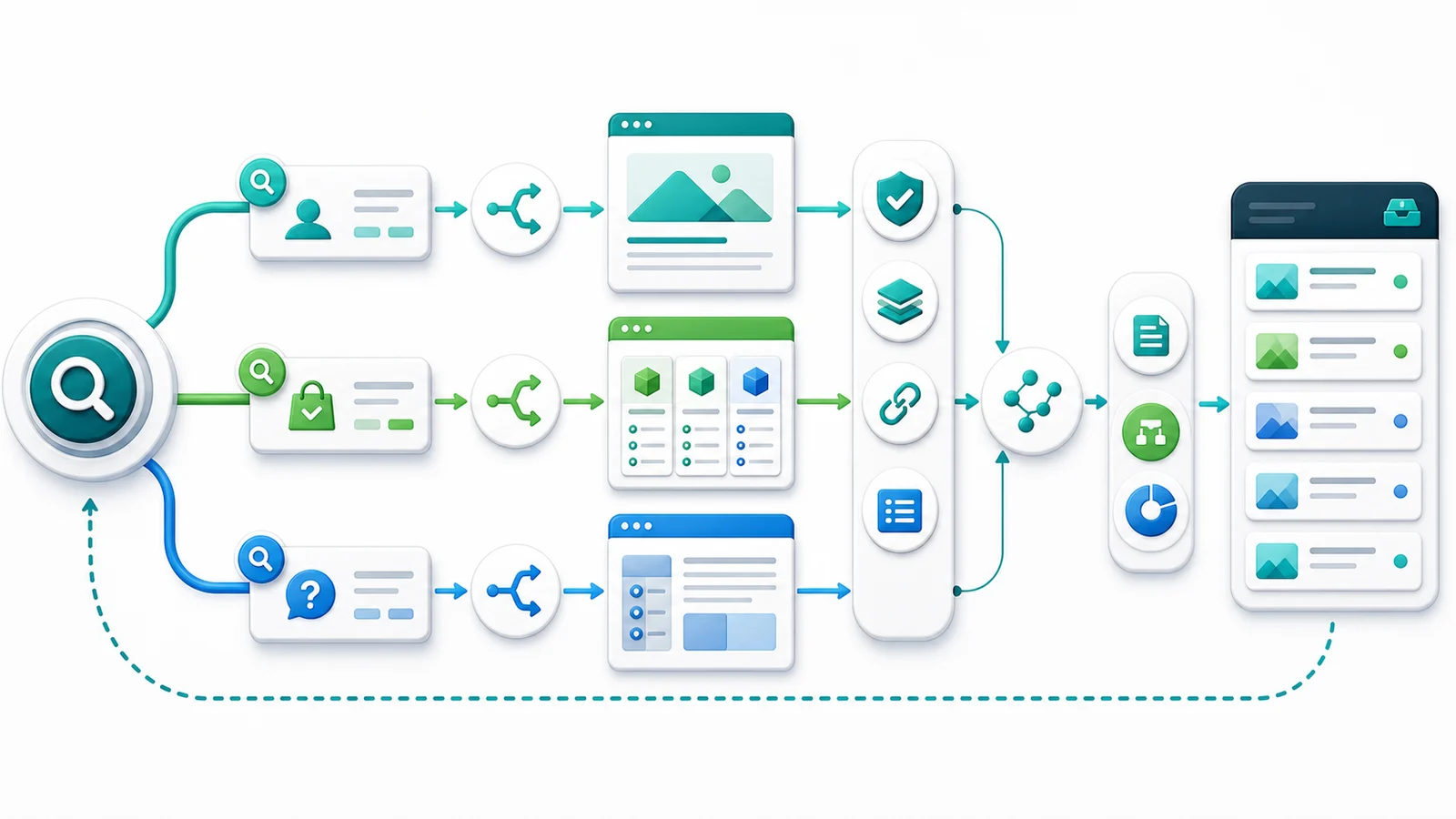
Use this routing table:
| Search pattern | Better affiliate page type | What the page must prove |
|---|---|---|
| "what is", "how does it work" | Explainer | The concept, use case, limits, and next step |
| "best", "top", "tools" | Roundup | Real criteria, multiple options, and fair limitations |
| "A vs B" | Comparison | Which scenario fits each option |
| "review" | Review | Public facts, evidence, tradeoffs, and disclosed relationship |
| "how to", "setup", "fix" | Tutorial | Steps, prerequisites, and validation checks |
| Brand or product support query | Intercept or help article | Answer the named-product task before introducing alternatives |
The official FTC endorsement guidance is a practical guardrail here. Affiliate relationships should be clear to readers when they affect a recommendation. Put disclosure close to the recommendation, write it plainly, and do not hide it in a footer or policy page.
For SEO, disclosure does not weaken a useful article. It strengthens the trust model. Readers can understand the relationship and still make a decision from your criteria, screenshots, examples, limitations, and alternatives.
Build Pages Around Trust Signals
Affiliate content gets thin when every section exists only to move the reader toward a link. A useful affiliate page helps the reader decide even when the best decision is not to buy.
Build the draft around these trust signals:
- State who the product or category is for.
- Explain when it is not a fit.
- Use official product pages, documentation, pricing pages, and policy pages for factual claims.
- Keep comparison criteria visible in a markdown table, not only inside an image.
- Separate observed public facts from opinion.
- Add disclosure near affiliate recommendations.
- Avoid fabricated hands-on claims, fake ratings, and invented screenshots.
- Update pages when pricing, policies, product names, or search intent changes.
Google's people-first content guidance is the right baseline: the page should help the reader, not simply exist to attract search traffic. For affiliate marketing, that means the article needs original selection logic, direct answers, current public facts, and a useful next step.
This connects naturally to SEO copywriting. Affiliate copy should still answer the query, structure evidence, use clear headings, and avoid pretending every offer is equally strong.
Validate The Affiliate SEO Loop
Once content exists, beginners need a validation loop. Publishing more affiliate pages without checking crawlability, trust, and performance usually creates a bigger cleanup job.

Use this weekly review:
| Validation layer | What to check | Action if it fails |
|---|---|---|
| Crawl access | Page is indexable, linked, canonicalized correctly, and included in the right sitemap path | Fix technical blockers before writing more |
| Disclosure and trust | Affiliate relationship is visible near recommendations and claims are sourced | Rewrite recommendation blocks |
| Page type fit | The page matches the query pattern and competitor page shape | Retitle, restructure, or merge |
| Internal links | Hubs, reviews, comparisons, and tutorials route users without spam anchors | Add or prune links by reader job |
| Refresh triggers | Pricing, policies, screenshots, product lineup, or SERP format changed | Update evidence and metadata |
| Monitoring | Clicks, impressions, CTR, conversion context, and AI-search mentions are watched by page group | Move the page into an action queue |
Google's spam policies are another guardrail. Affiliate pages should not become doorway pages, thin scraped content, or pages that exist mainly to manipulate rankings. If a page cannot add useful criteria, evidence, or experience beyond the merchant page, do not publish it yet.
The content marketing workflow is useful when affiliate content needs to become a repeatable publishing system instead of a pile of offer pages. The goal is not to write more. The goal is to publish the pages that can earn trust, search demand, and measurable action.
Where Searvora Fits
Searvora fits the planning, validation, and operating layer around affiliate content. It does not replace affiliate networks, commission tracking, disclosure review, or the merchant's product facts. It helps teams decide which pages deserve work and how to turn those decisions into an execution queue.
Use AI SEO Consultant when the team needs to choose, prioritize, or repair affiliate content:
| Workflow stage | Searvora fit | Output |
|---|---|---|
| Opportunity review | Compare search demand, content gaps, and page-type fit | Approved topic, rejected topic, or update task |
| Brief planning | Turn the keyword into a reader job and evidence checklist | Draft brief with proof needs and internal links |
| Technical validation | Pair the plan with crawler and indexability checks | Fix queue before or after publish |
| Monitoring | Connect content groups to performance and AI-search signals | Refresh, merge, expand, or stop decision |
If the site also sells through Shopify, Blogify can support the production layer after the brief is approved. Keep the strategy decision separate from the drafting tool: decide the reader job first, then produce the page.
Beginner Checklist
Use this checklist before publishing affiliate content:
- Pick a niche narrow enough to understand the buyer's problem.
- Choose one page job for the first article.
- Match the page type to search intent.
- Join only programs you can explain honestly.
- Collect official product facts before writing.
- Add clear affiliate disclosure near recommendations.
- Include criteria, limitations, and scenarios, not just praise.
- Keep comparison facts in text or tables.
- Check crawlability, canonical tags, internal links, and sitemap coverage.
- Monitor page-group performance and refresh outdated proof.
- Stop expanding a cluster if existing pages already serve the same keyword, type, and user task.
Affiliate marketing for beginners is easier to scale when it starts as a trustworthy content system. Choose the reader job, build crawlable pages, disclose the relationship clearly, validate the SEO basics, and let performance evidence decide what gets expanded next.