

If the question is does ai content optimization improve search visibility, the honest answer is yes when the update makes a page easier to trust, crawl, cite, and match to a real search task. It does not help when the work only rewrites wording, adds generic AI paragraphs, or chases a visibility score without improving the source page.
The useful test is whether the optimization changes evidence. A better page should answer the query more clearly, expose the facts an AI answer can reuse, resolve crawl or indexability friction, and give the team a way to recheck the same query group later.
Start With The Page Job
AI content optimization is not a synonym for "make this article longer." It should start with the job the page is supposed to win.
Use three questions before editing:
- Which query group should this page support?
- What fact, comparison, source, example, or proof is missing today?
- How will the team know whether the change improved visibility?
That keeps the work close to normal search quality. Google's guidance for succeeding in AI search points teams back to helpful content, technical eligibility, visible text, and source quality rather than a separate shortcut for AI results.
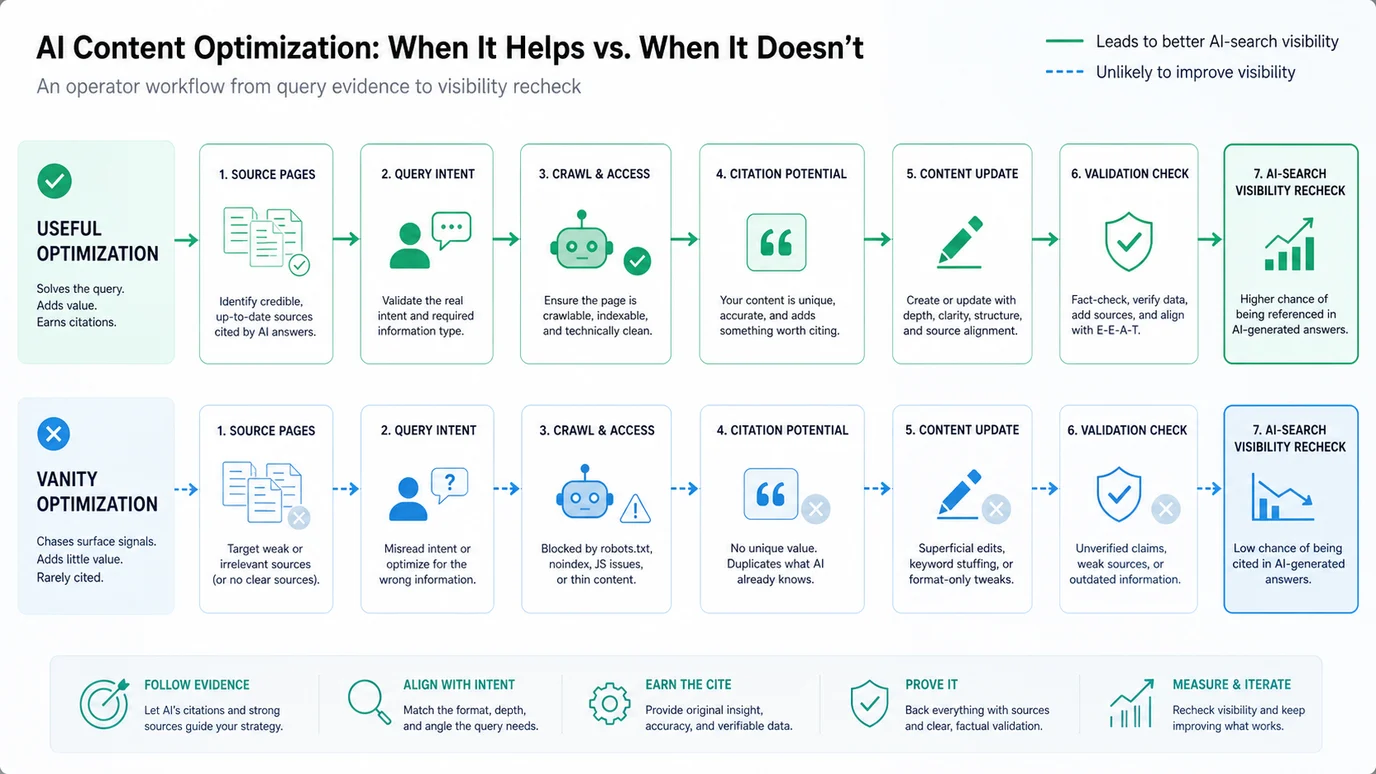
Use This Decision Table
The fastest way to avoid busywork is to separate useful optimization from churn.
| Signal | Useful AI content optimization | Vanity optimization |
|---|---|---|
| Query intent | Clarifies the exact task, comparison, or question the page should answer | Adds broad AI/SEO wording without a sharper task |
| Source quality | Adds definitions, examples, screenshots, tables, or evidence a reader can verify | Rephrases existing claims with no new proof |
| Entity clarity | Aligns product names, category language, and use cases across related pages | Repeats the brand name more often |
| Technical access | Checks canonical, noindex, crawl access, sitemap, and internal links | Assumes content edits matter while the page is hard to discover |
| Measurement | Rechecks a stable query set, cited URLs, impressions, clicks, and page cohorts | Declares success after one AI answer or one rank-tracking screenshot |
If the proposed edit does not improve at least one useful column, it probably will not improve durable search visibility.
Find The Missing Evidence
AI search systems and search engines both need usable source material. The page should not only say a brand is credible. It should show the evidence a reader or answer system can inspect.
Look for missing evidence in five layers:
- Definition: does the page explain the concept in plain language?
- Process: does it show how the work is done?
- Proof: does it include examples, screenshots, data, or constraints?
- Relationships: does it connect the topic to related source pages?
- Validation: does it show how the team will confirm the result?
This is where AI visibility work and content work meet. Visibility is not only whether the brand appears. It is whether the right page has enough evidence to deserve a mention, citation, or ranking improvement.
Make Keyword Strategy A Support Layer
Keyword strategy still matters in AI search, but it should guide page roles rather than stuff phrasing into every heading. The deferred keyword-strategy variant from this run belongs here because its SERP overlapped this topic strongly enough to make a separate article risky.
Use keyword strategy to decide:
| Strategy choice | What it changes in the page |
|---|---|
| Primary user job | The page's opening answer and H2 structure |
| Secondary questions | FAQ-style sections, examples, or comparison rows |
| Entity terms | Product category language and consistent naming |
| Internal links | Which supporting pages prove the cluster |
| Validation set | Which query group gets rechecked after the update |
For existing pages, a keyword mapping workflow helps decide whether one page should absorb the topic or whether the site needs a separate child article.
Validate The Visibility Loop
Content optimization is not finished when the editor approves the copy. The team needs a baseline, a changed page, and a recheck window.
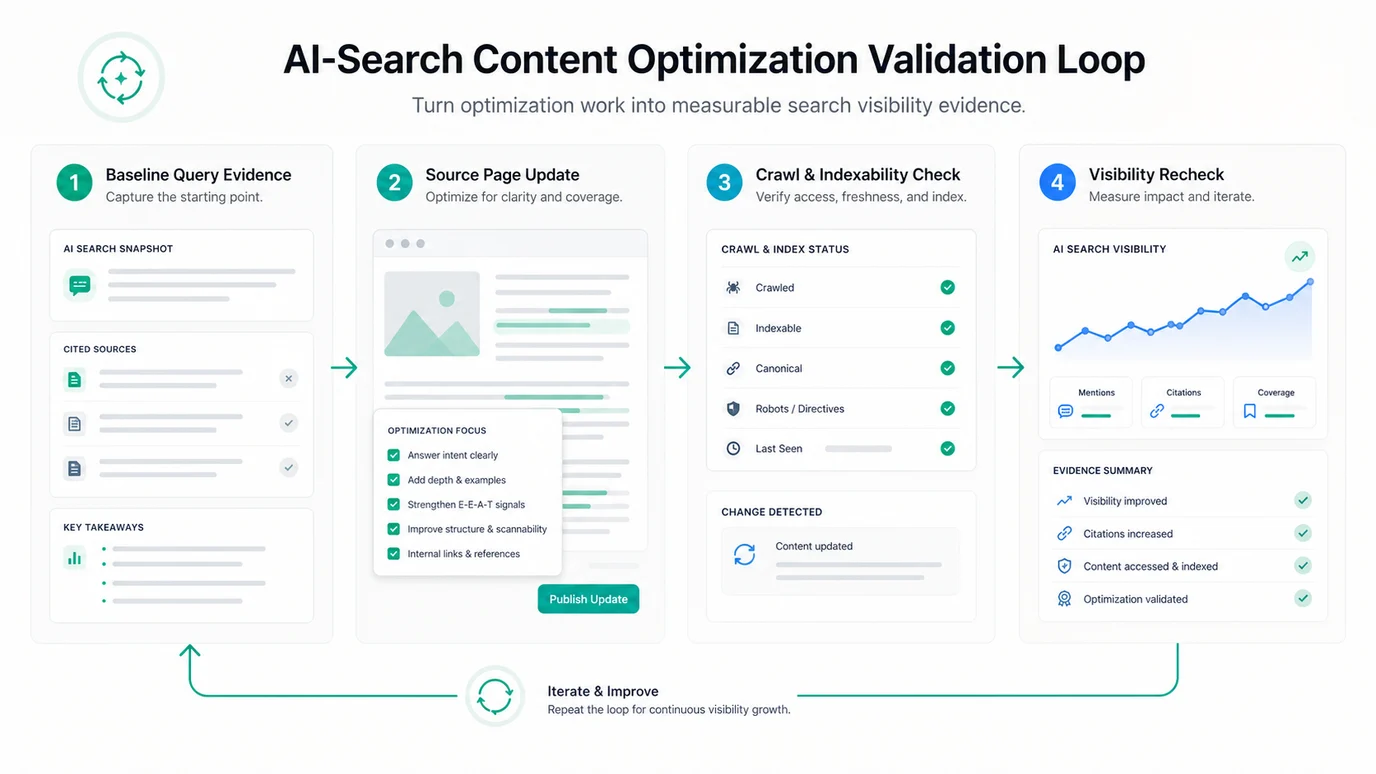
Run the loop like this:
- Capture baseline search demand, current ranking pages, AI answer mentions, and cited source URLs.
- Identify the page that should support the answer.
- Update the page with clearer structure, evidence, examples, internal links, and metadata.
- Check crawl access, canonical, noindex, sitemap inclusion, and visible text.
- Recheck the same query group after the page has had time to be crawled.
- Compare visibility movement with impressions, clicks, citations, and assisted conversions.
The brand visibility in AI search engines workflow is useful when the missing evidence is brand recognition. This article is narrower: it asks whether a specific content optimization should be made at all.
Where Searvora Fits
Use Blogify when the approved change needs to become a structured draft or refresh rather than a loose note. The current Searvora product page positions Blogify around store-aware topic intelligence, structured SEO drafting, internal links, metadata, product context, and Shopify draft workflows.
That makes it useful when a team already knows which content job matters and needs a repeatable way to produce the update with SEO structure intact.
Weekly Checklist
Use this checklist before approving an AI content optimization task:
- The page has a defined query group and source-page role.
- The edit adds evidence, examples, structure, or validation, not only wording.
- The target page is crawlable, indexable, internally linked, and in the sitemap.
- Entity and product language is consistent with related pages.
- The content brief says what should be measured after the update.
- The same query set will be rechecked after publication.
AI content optimization improves search visibility when it upgrades the page's usefulness and proof. It becomes churn when it creates more polished copy without changing what the page can prove.