
If the question is how to improve brand visibility in ai search engines, start by making the brand easier to recognize, easier to cite, and easier to validate. That means stronger owned source pages, consistent entity signals, crawlable evidence, and a repeatable review loop for the queries where your brand should appear.
Do not start by asking for more prompts. Start by asking which answer your brand deserves to be part of, which page should support that answer, and what proof is missing today.
Start With The AI Search Job
AI search visibility gets vague when teams track every prompt they can imagine. A better workflow starts with query groups that map to real demand.
Use three groups:
| Query group | Example user job | Brand visibility goal |
|---|---|---|
| Category queries | Find a type of product, service, workflow, or vendor | The brand is understood as a relevant option |
| Problem queries | Solve a pain point without naming a vendor | The brand's source page explains the problem clearly |
| Comparison queries | Choose between tools, approaches, or vendors | The brand appears with accurate context and evidence |
The AI visibility evidence loop is the parent process. This article is narrower: it focuses on improving the source and entity layer so the brand has a better chance to be recognized in AI search engines.
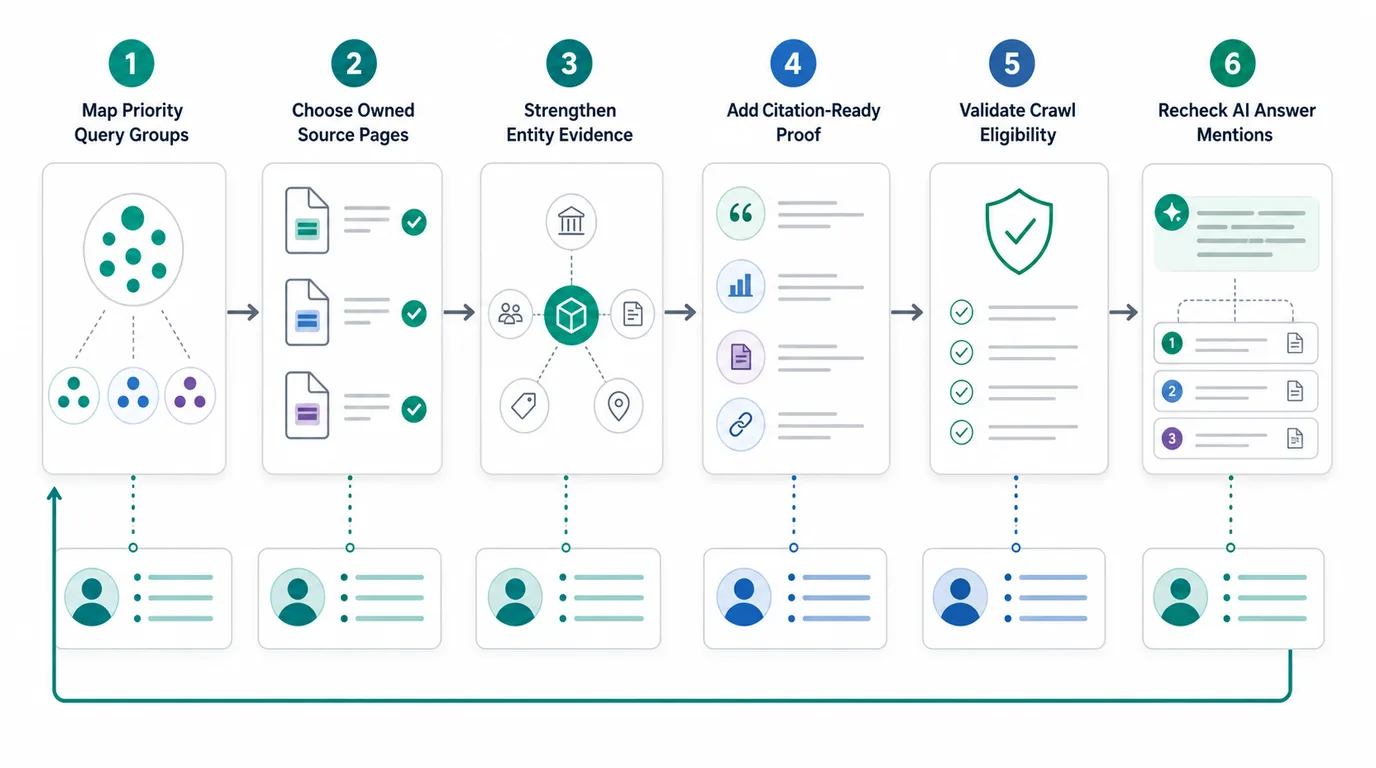
Build Owned Source Pages AI Systems Can Use
An AI answer needs material it can summarize and point to. If your important product, category, proof, and comparison details are scattered across thin pages, sales decks, private docs, and vague landing copy, the brand is harder to cite.
Create a source-page map:
| Source page | What it should prove | Common fix |
|---|---|---|
| Homepage | Official entity, product category, audience, and main value | Replace vague positioning with concrete category language |
| Product page | Use cases, workflow, features, limitations, and evidence | Add examples, page-type context, and clearer action paths |
| Category article | The problem space and how teams decide | Add comparison logic, decision tables, and source links |
| Case or proof page | Why the brand is credible | Keep claims specific, visible, and internally linked |
| Help or docs page | How the product works in detail | Make important facts crawlable and not hidden behind login |
Google's AI features guidance keeps this grounded in normal SEO work: technical eligibility, crawl access, internal links, helpful content, visible text, and structured data that matches the page still matter. There is no special schema shortcut that replaces source quality.
Strengthen Entity And Citation Evidence
Brand visibility in AI search engines depends on entity clarity. The brand name, product names, audience, use cases, and proof points should line up across owned pages and credible external references.
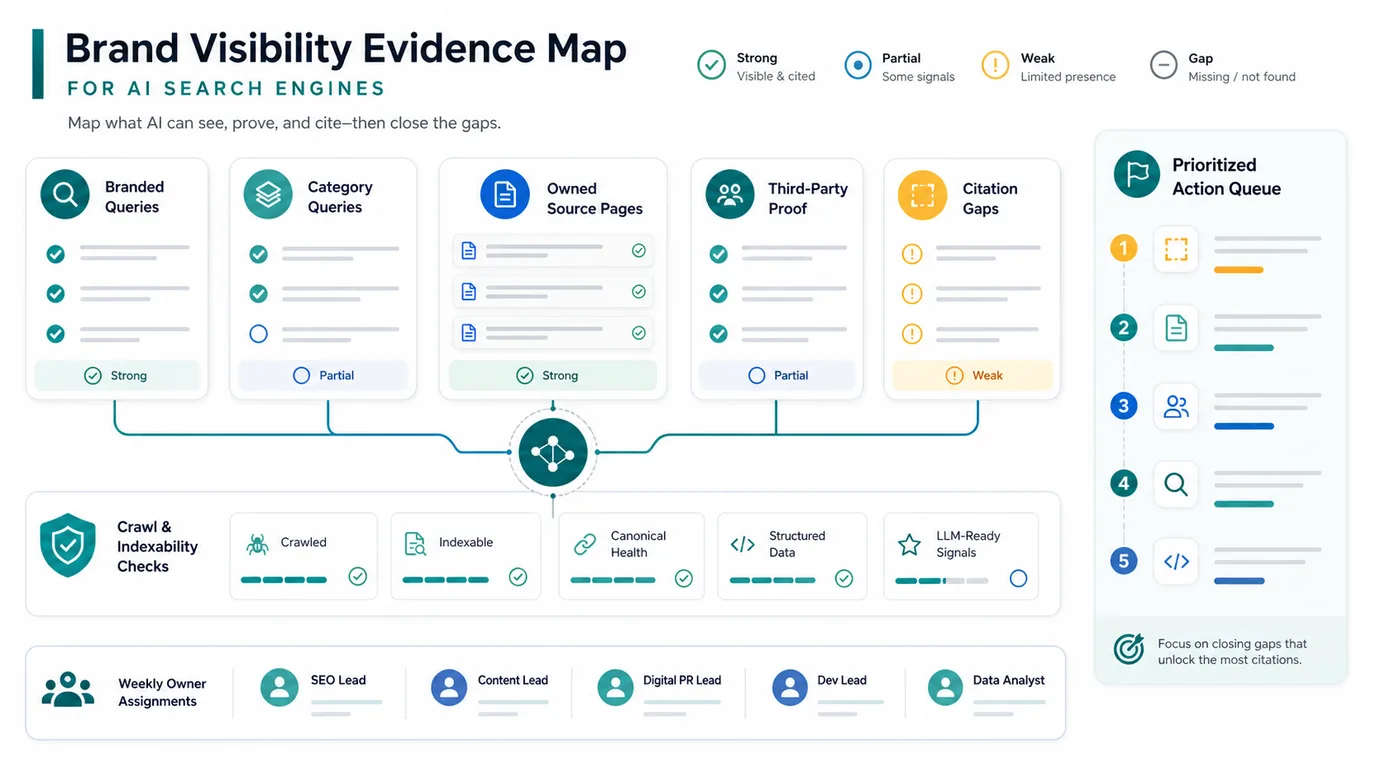
Audit the evidence in layers:
- Entity naming: official brand name, product names, aliases, and descriptions are consistent.
- Category fit: product pages explain the category in language searchers actually use.
- Source depth: pages include definitions, examples, tables, screenshots, and visible proof where useful.
- Third-party proof: partner pages, directories, reviews, podcasts, and articles describe the brand accurately.
- Citation ownership: answer systems cite owned URLs when they use your material.
The brand mentions in AI answers workflow is useful when you need to monitor whether the brand appears. The AI search citation audit is useful when you need to diagnose which source URL should be cited.
Turn Gaps Into Fixes
The improvement loop should end in assigned work, not a screenshot archive.
Use this decision table after every AI answer review:
| Finding | What it usually means | Next action |
|---|---|---|
| Brand missing and competitors mentioned | The category source page may be weak or absent | Build or strengthen a neutral category page |
| Brand mentioned but not cited | The entity is recognized, but the source page is not strong enough | Improve the likely citation target and link to it from related pages |
| Wrong product description appears | Public entity language is inconsistent | Normalize product descriptions across homepage, product pages, and articles |
| Third-party page cited instead of owned page | External proof is stronger than your source page | Add clearer definitions, examples, references, and internal links |
| Page should be eligible but is not cited | A crawl, indexability, snippet, or content clarity issue may exist | Validate robots, canonical, noindex, sitemap, internal links, and visible text |
| Visibility appears but traffic is unclear | AI search may influence demand without clean referral data | Compare AI observations with Search Console and analytics by query group |
OpenAI's ChatGPT Search help explains that search responses may show inline citations or a Sources panel when sources are available. That is why the useful metric is not just "did the brand appear?" It is "which source supported the answer, and what should the team fix next?"
Use A Dashboard To Keep The Loop Honest
Searvora AI SEO Dashboard fits the monitoring layer of this work. The local product page positions it around page-type cohorts, locale drill-down, anomaly detection, opportunity scoring, and cross-team reporting. Those are the views a team needs when AI-search brand visibility changes by product line, page type, market, or owner.
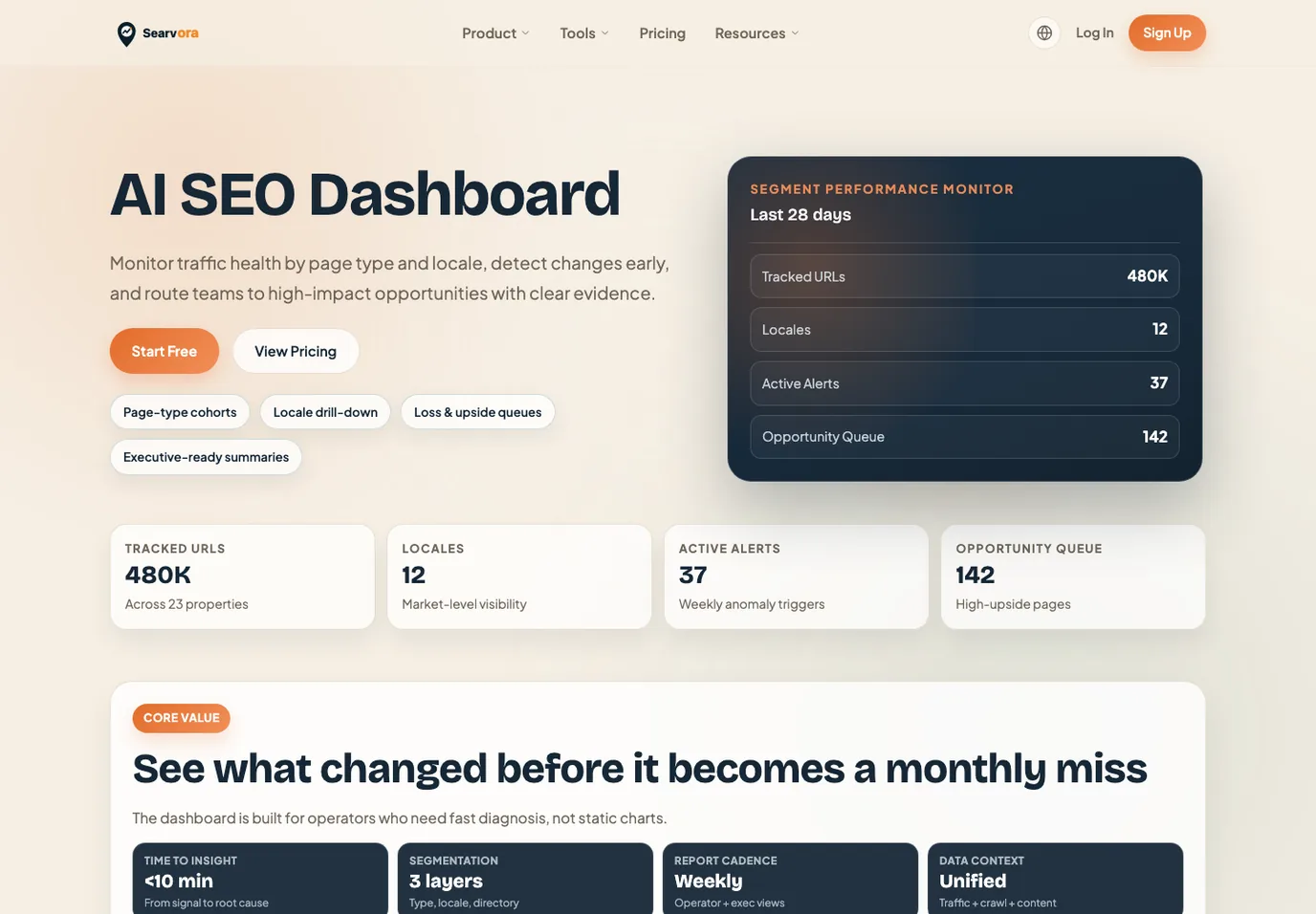
Use the dashboard to keep AI visibility evidence beside normal SEO signals:
| Evidence layer | Dashboard question | Action owner |
|---|---|---|
| Query group | Which topics changed? | SEO lead |
| Page cohort | Which pages should support those answers? | Content lead |
| Crawl health | Are source pages eligible and discoverable? | Technical SEO or engineering |
| Opportunity queue | Which fix has the best upside and confidence? | Growth owner |
| Reporting cadence | Did the change improve visibility or just create more content? | SEO lead |
Weekly Brand Visibility Checklist
Run this sequence once a week for one market and one topic cluster:
- Pick five to ten category, problem, and comparison queries.
- Record whether the brand appears, whether competitors appear, and whether any owned URL is cited.
- Match each query to the source page that should support the answer.
- Check crawl access, canonical, noindex, sitemap inclusion, internal links, and visible text for that page.
- Improve one source page at a time with clearer definitions, examples, tables, proof, and links.
- Normalize brand and product naming across the pages that support the topic.
- Recheck the same query set after the change has had time to be crawled.
- Compare AI search observations with Search Console and analytics movement before declaring a win.
That cadence keeps AI search brand visibility from becoming a vanity metric. The team sees the query, the source page, the gap, the owner, and the recheck date.
What Good Improvement Looks Like
Good AI search visibility work is usually quiet. The brand becomes easier to describe. Source pages answer real questions. Product pages use stable category language. Important proof is visible and crawlable. Internal links point systems and people toward the right source.
The goal is not to make every AI answer mention your brand. The goal is to make the brand a better, clearer, more citable source for the searches where it genuinely belongs.