

For the question does content structure matter for visibility in AI search, the answer is yes when structure makes the page easier to understand, crawl, summarize, cite, and recheck. It does not help when structure is only cosmetic formatting, a longer outline, or a set of headings that repeat the same keyword.
The useful version of structure gives every important page a clear job. It answers the search task early, exposes facts in visible text, supports claims with examples or tables, connects related pages, and gives the team a way to validate whether the page is still eligible to be used as a source.
Start With The Page Job
Before changing headings, decide what the page is supposed to do. AI search visibility is weaker when a page tries to be a definition, product pitch, checklist, comparison, and support article at the same time.
Use this first decision table:
| Page job | Structure that helps | Structure that hurts |
|---|---|---|
| Definition | Plain answer, examples, and links to deeper workflows | Long intro that delays the definition |
| How-to | Steps, prerequisites, owner handoff, and validation | A generic list of tips with no order |
| Comparison | Criteria, table, tradeoffs, and use-case fit | Marketing copy that avoids the real decision |
| Source page | Facts, constraints, screenshots, tables, and update signals | Claims that cannot be verified on the page |
| Product or tool | Problem, use case, capability, proof, and next action | Blog-style education when the query wants to act |
This is why content structure is not only a writing choice. It is a page-type decision. The same topic can need a product page, a tool page, a hub, or a focused article depending on the user's task.
Build An Answer-First Outline
For AI search visibility, the top of the page should make the answer easy to extract. That does not mean writing for a machine instead of a reader. It means respecting the reader's first question before expanding into detail.
Use this order for informational pages:
- Answer the exact question in the opening paragraphs.
- Name the page job and the audience.
- Show the decision framework or checklist early.
- Add supporting evidence, examples, and constraints.
- Link to adjacent pages only when they deepen the job.
- End with a validation step, not a vague recommendation.
Google's guidance for content in AI experiences on Search keeps this grounded in normal search quality: create helpful content, make important text visible, and keep technical access clean. Content structure works best when it improves those basics instead of pretending AI search needs a separate trick.

Put Evidence Where It Can Be Read
AI search visibility depends on source-page usefulness. If the useful facts live in decorative images, hidden accordions, vague UI labels, or a disconnected PDF, the page may be harder to trust as a source.
Strong content structure makes evidence visible:
| Evidence type | Good placement | Validation question |
|---|---|---|
| Definition | Intro or first H2 | Can a reader understand the concept without scrolling for context? |
| Steps | Ordered list or table | Can the team follow the sequence without guessing? |
| Examples | Near the claim they support | Does the example prove the point or merely decorate it? |
| Data or criteria | Searchable markdown table | Can the comparison be copied, audited, and updated? |
| Product context | Where the reader is ready for a next action | Does the CTA fit the job instead of interrupting it? |
| Related source pages | One to three descriptive internal links | Does each link clarify the cluster role? |
This is the narrower child process of AI content optimization. Optimization asks whether a page should be changed. Content structure asks whether the page exposes its answer, proof, and next step clearly enough to deserve that change.
Treat Formatting As A Risk Signal
The related question from this run was whether inconsistent formatting can hurt visibility in AI search. It can, but usually for practical reasons rather than mystical ones.
Formatting becomes a problem when it changes the meaning of the page:
| Formatting issue | Why it matters | Better fix |
|---|---|---|
| Repeated H2s with different meanings | The page job becomes hard to scan | Rename sections around tasks and decisions |
| Tables used only as decoration | Important criteria may be missing from visible text | Put real criteria and values in markdown tables |
| Image-only explanations | The evidence cannot be searched or easily reused | Add the explanation in body copy and use the image as support |
| Mixed product and article structure | The reader cannot tell whether to learn or act | Split the page job or move the CTA later |
| Hidden or delayed answer blocks | The page answers too slowly | Put the direct answer near the top |
Inconsistent formatting is not automatically a ranking problem. It is a source-quality warning. If the page's structure makes the answer, evidence, and owner unclear, the team should fix the structure before adding more copy.
Connect Structure To Crawl Eligibility
A beautifully organized page still fails if search systems cannot access the right URL or read the main content. Keep structure and crawl checks together.
Before publishing or refreshing a page, validate:
- The intended URL returns a clean status and self-canonical when appropriate.
- The page is indexable and not blocked by robots or noindex.
- The title, H1, intro, and H2s describe the same page job.
- Important body content appears in rendered HTML.
- Internal links point from relevant parent and sibling pages.
- The sitemap includes the URL when the page should be discoverable.
- Structured data, if present, matches visible facts on the page.
Google's AI features documentation ties AI features back to normal Search eligibility and controls. That is the right mental model: content structure helps when the page is also crawlable, indexable, useful, and technically coherent.
The broader content engineering workflow is useful when this checklist needs to become briefs, owners, and a weekly queue. The website structure workflow is the better companion when the issue spans navigation, crawl depth, canonicals, and internal links across many URLs.
Validate The Structure Change
Do not call a page "AI search ready" just because the outline looks clean. Save a baseline, ship the change, and recheck the same query group later.
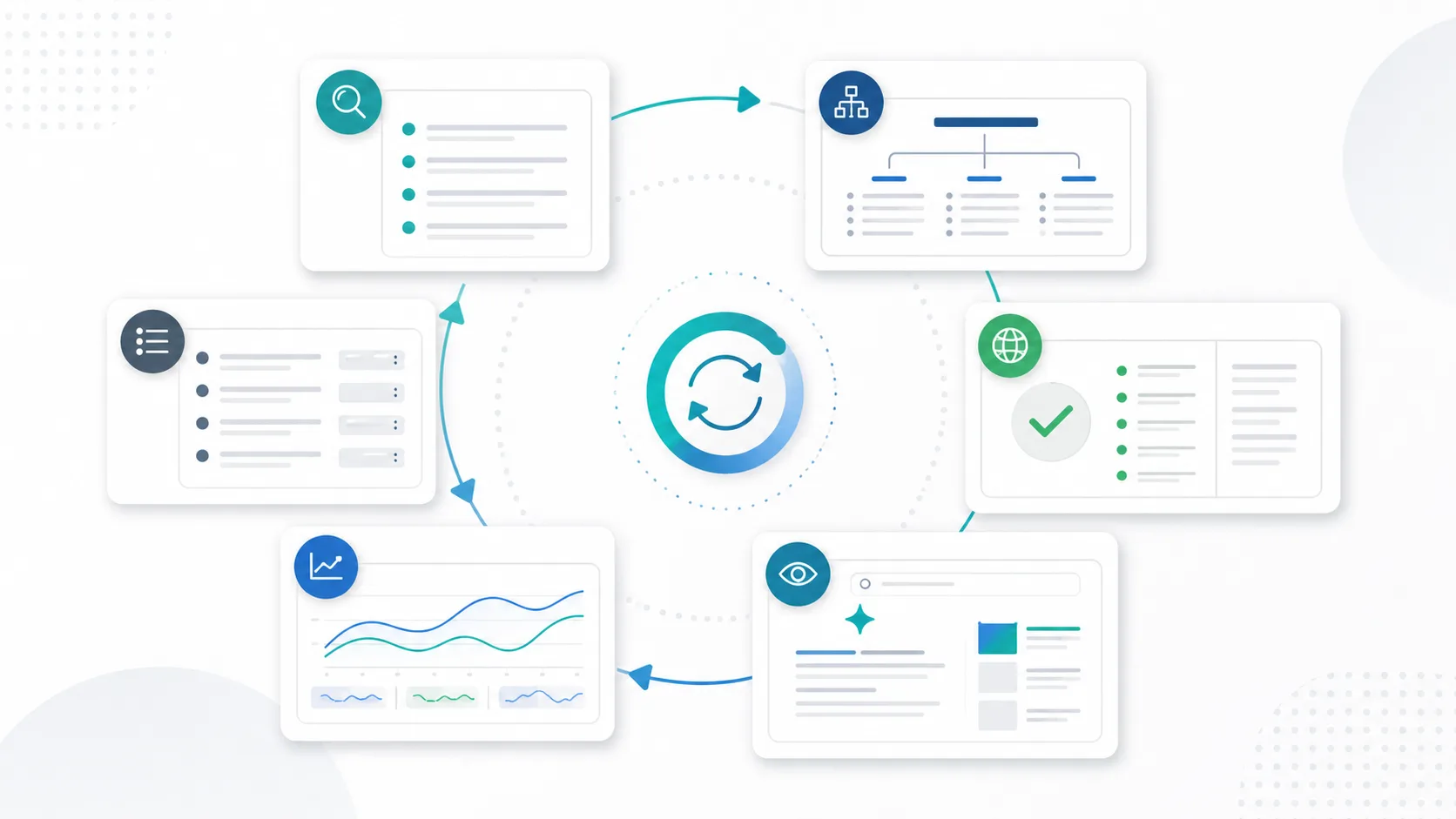
Use this validation loop:
- Choose the query group and the source URL that should answer it.
- Record the current page structure, cited URLs, and Search Console slice.
- Update the page with a clearer answer, evidence, links, and validation section.
- Recrawl the URL and confirm status, canonical, indexability, sitemap, rendered text, and headings.
- Recheck the same query group after a meaningful crawl window.
- Decide whether the result improved, stayed flat, exposed a technical blocker, or needs consolidation.
The point is not to prove that one heading caused one AI answer to change. The point is to keep the team from guessing. A strong structure change should create a page that is easier to read, easier to crawl, easier to cite, and easier to improve again.
Where Searvora Fits
Blogify fits when the team already knows the page job and needs to turn that decision into a structured draft or refresh. The local Blogify product page positions it around store-aware topic intelligence, structured SEO drafting, metadata, internal links, product context, editorial controls, and Shopify draft workflows.
Use Blogify for the content-production layer:
| Workflow layer | Blogify role | Output |
|---|---|---|
| Brief | Turn search task and page job into a draft brief | Clear target intent |
| Structure | Generate search-ready headings, metadata, and sections | Reviewable outline |
| Context | Add product and internal-link references where they fit | Less isolated content |
| Publishing | Route the output into Shopify draft workflows | Cleaner handoff |
Use This Checklist Before Refreshing A Page
Run this checklist when a page is weak in AI search visibility and the team suspects content structure is part of the problem:
- The first paragraphs answer the target question directly.
- The page has one clear job and one primary audience.
- H2s match decisions, steps, or evidence types rather than keyword variants.
- Important proof appears in visible, searchable body content.
- Tables and images support the text instead of replacing it.
- Internal links clarify the cluster role without over-linking.
- The CTA appears where it helps the reader take the next action.
- Crawl eligibility and rendered content checks pass after the change.
- The same query group will be rechecked after publication.
Content structure matters for AI search visibility when it turns a page into a better source. If the structure only makes the page look organized, it is cosmetic. If it clarifies the answer, evidence, crawl path, and validation loop, it becomes useful SEO work.