

Yes, having a Trustpilot profile can help with AI search visibility, but only when it gives answer systems useful evidence about your brand and points searchers back to pages you control. The search task behind "does having a Trustpilot profile help with AI search visibility" is really a source-evidence question. A profile alone is not an AI visibility strategy. It is one public proof source in a larger evidence loop.
The useful question is not "Will Trustpilot make us appear in every AI answer?" The better question is: does the profile add fresh, crawlable, third-party review evidence that supports the same entities, products, locations, and use cases your owned pages already explain?
Treat Trustpilot As A Source, Not A Shortcut
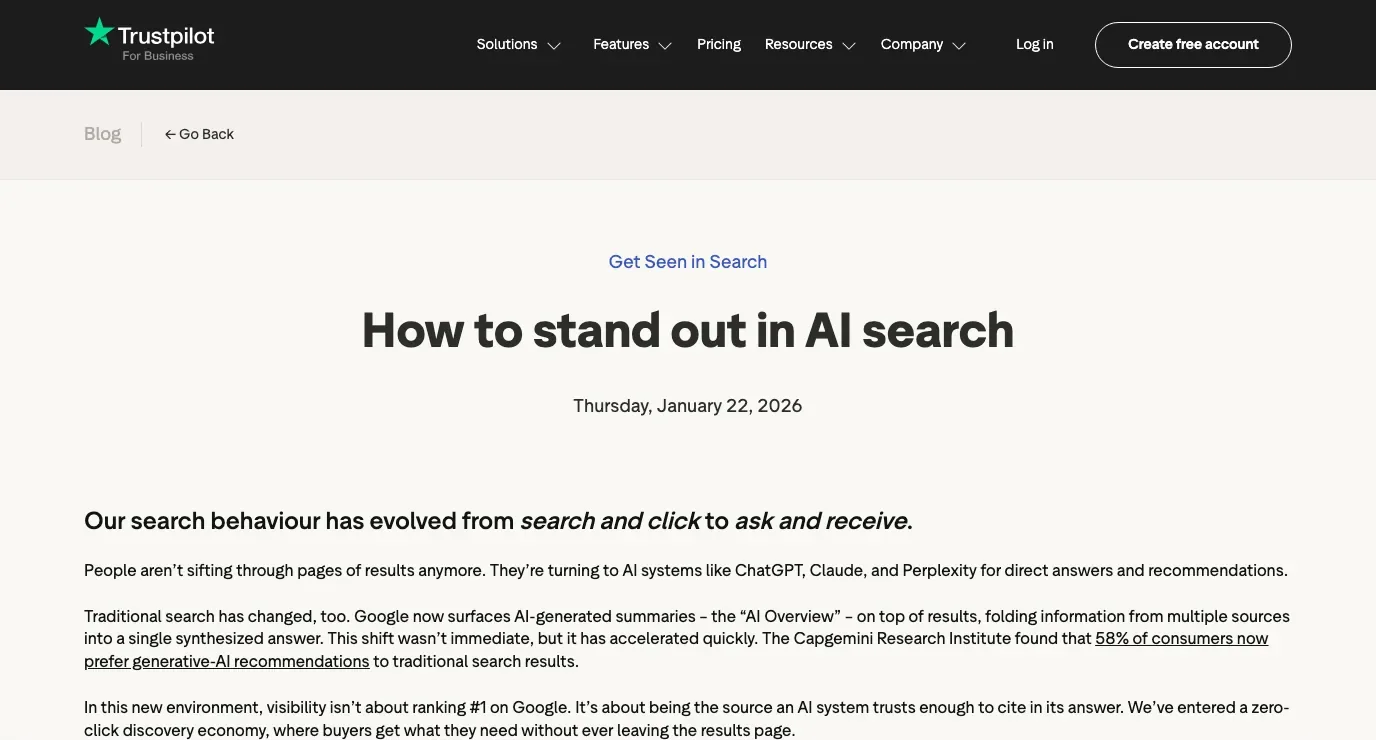
Trustpilot's own business page for Review SEO and AI Discovery says reviews can support AI visibility with trusted third-party data, organic search presence, profile optimization, Google review programs, and product review widgets. Its AI search article argues that third-party reputation signals can influence how answer systems understand a brand.
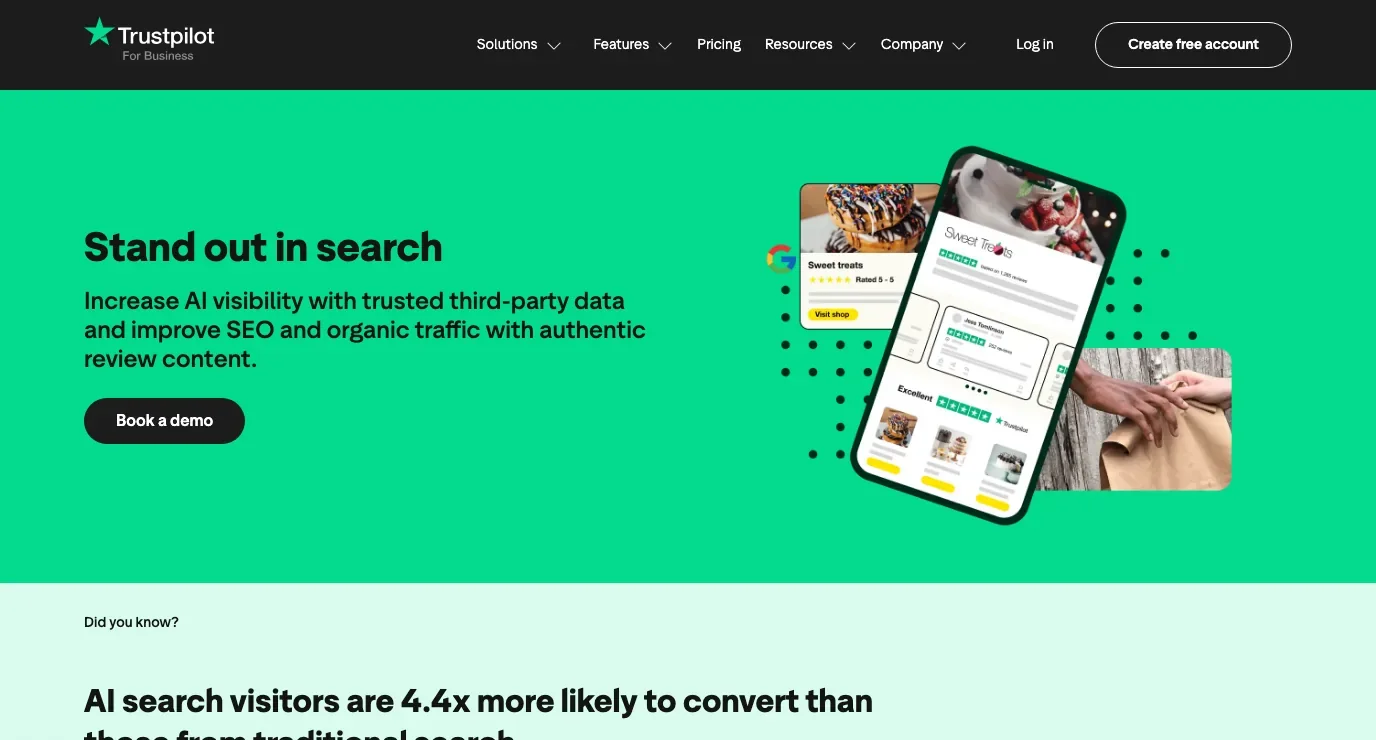
That is useful context, but a vendor claim should become an operating checklist before it becomes budget. AI search experiences still need accessible pages, clear source material, and reliable evidence. Google's AI features guidance keeps generative search eligibility tied to the normal foundations of useful, crawlable pages. OpenAI's ChatGPT Search help also frames answers around web results and source links.
Use Trustpilot when it strengthens the source layer. Do not use it as a substitute for pages that explain what your company does, which customers you serve, how products differ, and why a buyer should trust the recommendation.
Check The Evidence An AI Answer Can Use
Start by listing the jobs where reviews could matter. For most brands, those are commercial or reputation-sensitive queries: "[brand] reviews," "[brand] alternatives," "best [category] for [audience]," "is [brand] trustworthy," or "which [category] tool works for [use case]."
Then check whether the Trustpilot profile contributes evidence an answer system can interpret.
| Signal | What to check | Why it matters |
|---|---|---|
| Profile completeness | Company name, category, location, website, product context, and current contact details | Helps systems connect the review profile to the right entity |
| Review freshness | Recent review flow, not only a historical rating | Gives answer systems current reputation evidence |
| Review specificity | Reviews mention products, support, delivery, pricing, locations, or use cases | Makes the evidence useful for specific query groups |
| Public engagement | The business responds to positive and negative reviews with visible context | Shows accountability and reduces one-sided reputation signals |
| Owned-page alignment | The same product names, categories, and claims appear on your website | Prevents third-party evidence from contradicting owned content |
| Crawl eligibility | Your profile and owned source pages are accessible and not thin redirects | Keeps the evidence discoverable |
The profile is strongest when it confirms a story already visible on the site. If reviews mention "Shopify migration support" but the website only has a generic services page, AI search systems may see reputation evidence without a clear owned source page to cite.
Do Not Let Reviews Replace Owned Source Pages
A review profile is third-party evidence. It can support credibility, but it cannot do the job of a category page, product page, comparison page, help page, or case-study hub.
The fastest way to misuse Trustpilot is to improve the profile while leaving the website vague. That creates a source mismatch: the public reviews say one thing, the owned pages say less, and AI answers may cite another site that explains the category more clearly.
Use this split before assigning work:
| If the Trustpilot profile shows... | Do this on the owned site |
|---|---|
| Reviews praise a specific product feature | Make sure the product page names and explains that feature clearly |
| Reviews mention location or service area | Strengthen local or regional landing pages |
| Reviews compare your brand to an alternative | Add fair comparison language where it helps the buyer |
| Reviews reveal recurring objections | Add support, pricing, delivery, or policy context |
| Reviews are sparse or generic | Do not over-index on Trustpilot; improve collection and owned proof first |
The brand mentions in AI answers workflow is the entity layer. This Trustpilot decision is narrower: it asks whether a public review profile gives enough supporting evidence to reinforce the pages you want answer systems to trust.
Validate The SERP Before Calling It AI Visibility
The SERP for this keyword is mixed. It includes Trustpilot's own review SEO and AI search pages, a Reddit discussion about review platforms and SEO, third-party articles about Trustpilot and AI visibility, and broader posts about reviews as AI visibility signals. That means the query has article-shaped demand, but it is also vendor-influenced.
Before you approve budget or write new pages, run three checks:
- Search your brand plus "Trustpilot," "reviews," "AI search," and the category terms buyers actually use.
- Record whether AI Overviews, answer engines, or standard results cite Trustpilot, your owned pages, competitors, review sites, or neutral publishers.
- Compare the cited source to the page that should win the query.
This keeps the team honest. If Trustpilot appears for branded review searches but not for category recommendations, it may help reputation discovery without moving non-branded AI visibility. If competitors appear because they have clearer comparison pages, the fix is not only "collect more reviews." The fix may be a better comparison page, stronger internal links, or clearer product proof.
Turn The Profile Into A Fix Queue
Use Trustpilot findings as inputs to a weekly visibility queue. The queue should create owned-page work, not just profile maintenance.
| Finding | Better next action | Owner |
|---|---|---|
| Profile appears, owned page does not | Improve the canonical product or category page and link it from relevant content | SEO lead |
| Competitor review page appears | Compare evidence quality, product specificity, and source-page clarity | Growth or content lead |
| Reviews mention features not on the site | Add a source-backed feature section or FAQ to the right page | Product marketing |
| Reviews are recent but generic | Improve review prompts and post-purchase collection | Customer operations |
| AI answer cites a review article instead | Strengthen owned proof and cite official, useful sources | Content lead |
| No stable AI answer appears | Move the query to watchlist and prioritize stronger query groups | SEO operations |
Keep the validation window realistic. Review profiles, owned pages, and AI answers do not update on the same schedule. Record the query, country, language, observed source, owner, shipped fix, and recheck date.
Where Searvora Fits
Searvora does not replace Trustpilot. The AI SEO dashboard fits the validation layer after the profile and owned pages are in place.
Use it to group AI search visibility checks by brand query, product category, location, page type, and source URL. Then connect the result to the action queue: improve a product page, refresh a comparison section, fix crawl eligibility, add internal links, or keep the query on watchlist.
If the evidence points to technical eligibility, pair the dashboard with a crawl review. If the issue is entity clarity, use the AI search citation audit and AI visibility evidence loop to decide which page needs better source material.
The Practical Answer
A Trustpilot profile can help AI search visibility when it provides fresh, specific, third-party reputation evidence that reinforces crawlable owned pages. It is especially useful for branded review searches, reputation-sensitive recommendations, local or ecommerce proof, and buyer questions where trust signals matter.
It is less useful when the profile is thin, reviews are generic, owned pages are unclear, or the target query is really a product, comparison, or category page problem. In those cases, the profile may support the answer, but the owned source page still needs the fix.
Use Trustpilot as one source in the evidence loop:
- Define the query group where reviews should matter.
- Check whether Trustpilot, owned pages, competitors, or publishers appear as sources.
- Compare the review evidence with the page that should own the answer.
- Fix the owned page, profile completeness, review collection, or internal links.
- Recheck the same query set after the update has time to surface.
That is the difference between buying a review profile and operating AI search visibility with evidence.