

The practical answer to why AI website traffic is lower than search engines is that AI surfaces answer more questions without a click, expose fewer source links, send referrals through inconsistent source names, and often influence demand before analytics can attribute a visit. The smaller number does not mean AI search is irrelevant. It means the measurement job is different.
Treat AI traffic as a set of signals, not one channel. A chatbot referral, an AI crawler request, a cited source URL, a brand mention, and a later branded search can all matter, but they should not be reported as the same thing.
The Short Answer
Traditional search engines still send more website traffic because the user flow is built around clicking a result. AI answer systems often summarize, compare, or recommend before the user reaches a source page. That creates a visibility gap: a brand or page can influence the answer while producing fewer measurable sessions.
Use this split:
| Signal | What it shows | Why it can look small |
|---|---|---|
| Search clicks | Users clicked from classic search results | Mature source attribution and high search volume |
| AI referrals | Users clicked from an AI answer or chat result | Smaller interface share and inconsistent referrer labels |
| AI crawler visits | AI systems requested pages or assets | Bot activity is not human traffic |
| Citations and mentions | The brand or page appeared in an answer | The answer may satisfy the query without a click |
| Assisted conversions | AI influenced research before a later visit | The final session may be direct, branded, or paid |
Separate Five Signals Before You Diagnose
The fastest way to misread AI traffic is to mix signals that belong in different ledgers. A crawler hit is not a lead. A citation is not a session. A branded search lift is not proof that one AI answer caused demand. Keep the ledgers separate, then compare them during the same review.
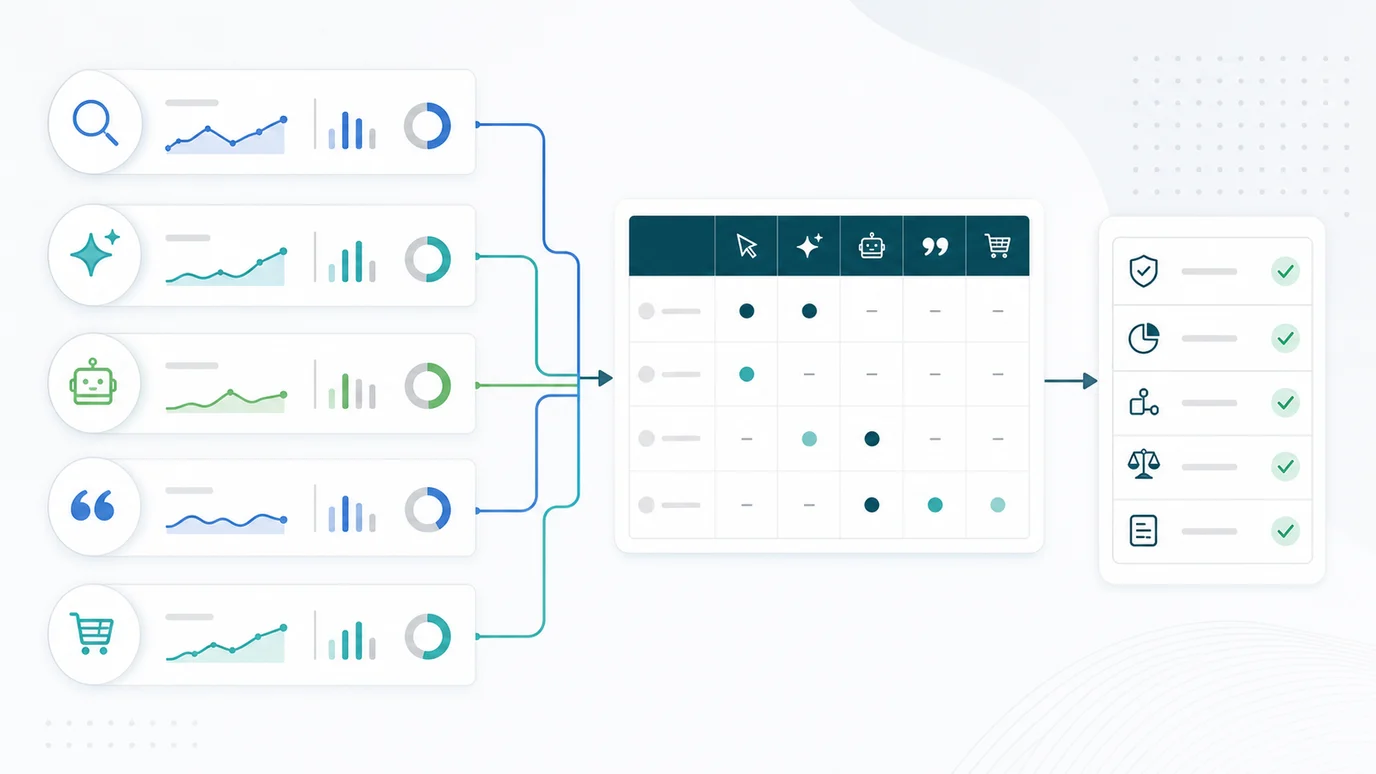
Use this model:
- Traffic ledger: sessions, source, medium, landing page, query group where available, and conversion context.
- AI referral ledger: known AI referrers, landing pages, engagement, and downstream action.
- Crawler ledger: AI bot requests from logs, CDNs, or crawl analytics.
- Visibility ledger: answer appearances, citations, brand mentions, source URLs, and observation date.
- Work ledger: page change shipped, owner, release date, and validation window.
If you need the analytics setup, pair this with the GA4 AI traffic tracking workflow. If the question is how AI visibility turns into broader organic movement, use the AI search optimization and organic traffic workflow as the companion.
Why Search Engines Still Send More Visits
Search engines have a mature click path. A user searches, sees result snippets, chooses a page, and lands on the website. AI answers compress more of that work into the answer surface. The user may read the summary, ask a follow-up, compare options, or search the brand later.
Several factors make AI traffic look lower:
| Cause | What happens | SEO action |
|---|---|---|
| Answer satisfaction | The AI surface answers the simple question | Improve pages that support deeper decisions, not just definitions |
| Smaller source-link behavior | Users may not click every cited source | Track citations and mentions separately from sessions |
| Referrer inconsistency | AI visits can appear under different source names | Normalize known AI referrers and keep a review list |
| Bot noise | AI crawlers request content without becoming visitors | Separate crawler logs from human analytics |
| Assisted demand | The user returns through branded search or direct traffic | Watch brand queries, product-page movement, and assisted conversions |
Google's AI features documentation still ties visibility back to useful, crawlable pages. Google's Performance report guidance remains the baseline for classic search clicks, impressions, CTR, queries, and pages.
The point is not to pick one source of truth. The point is to avoid asking one report to explain every surface.
Use AI Traffic As A Quality Signal
AI traffic is smaller, but it can be high-intent. A user who clicks from an answer system may already have compared options, asked follow-up questions, or narrowed the category. That means the page they land on needs to continue the decision, not restart with generic education.
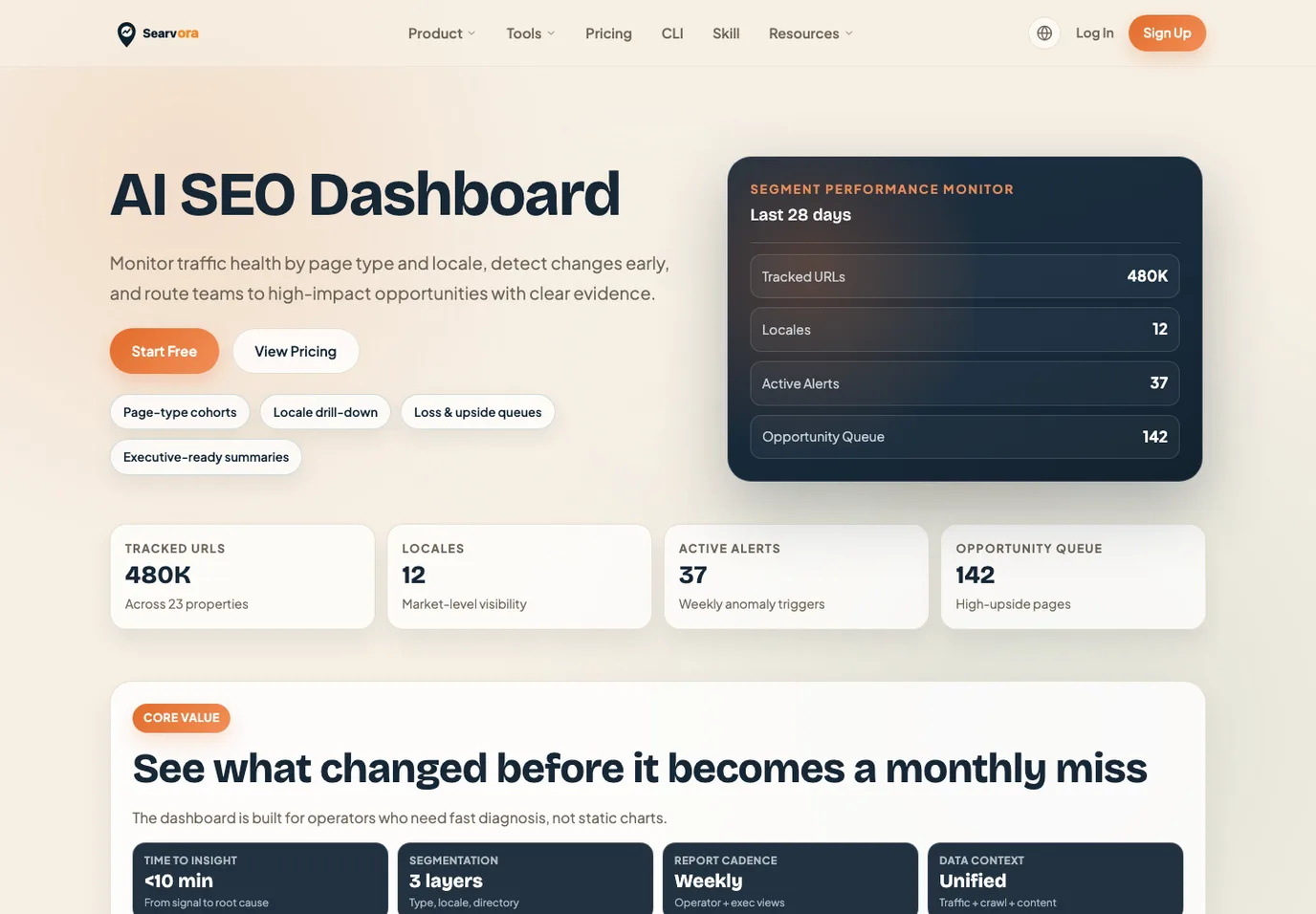
Searvora's AI SEO dashboard is useful for this review because the product surface is built around page-type cohorts, locale drill-down, anomaly detection, opportunity queues, and shared evidence. Those are the controls a team needs when AI signals must be compared with classic organic performance.
Review AI visits by landing-page job:
| Landing page | What to inspect | Better response |
|---|---|---|
| Product page | Does the page answer the category and next action quickly? | Clarify proof, use cases, and CTA fit |
| Comparison page | Does it help the visitor choose fairly? | Add scenario criteria and current public facts |
| Technical article | Does it validate the workflow? | Add steps, caveats, and owner handoff |
| Blog explainer | Does it route to a useful product or hub? | Improve internal links and decision context |
| Docs page | Does it confirm implementation depth? | Keep instructions crawlable and current |
Small AI referral volume can still identify which source pages deserve stronger extraction, clearer examples, or a better next step.
When The Gap Is A Problem
AI traffic being lower than search traffic is normal. It becomes a problem when the supporting signals are also weak.
Use this diagnostic:
| Pattern | Interpretation | Next action |
|---|---|---|
| Low AI referrals, no citations, no crawler access | Pages may be invisible or hard to use as sources | Check crawl access, indexability, internal links, and answer clarity |
| Low AI referrals, citations present, engagement strong | AI visibility may be working as assisted demand | Watch branded search, product movement, and conversion quality |
| AI crawler activity high, human referrals low | Bot access exists but answer or click behavior is limited | Separate bot reporting and inspect cited/source pages |
| Classic search dropping, AI visibility rising | SERP behavior may be shifting | Compare query groups before rewriting pages |
| Both search and AI signals declining | The issue is probably broader than AI search | Run a traffic-drop triage and technical eligibility review |
For the broader decline path, use the organic traffic drop triage workflow. Do not blame AI search until the page, query, crawl, and demand evidence supports that conclusion.
Run A Weekly AI Traffic Review
A useful weekly review is small enough to repeat.
- Update the known AI referrer list and keep source names normalized.
- Pull AI referral sessions by landing page and engagement quality.
- Check AI crawler requests separately from human traffic.
- Record answer appearances, citations, source URLs, and brand mentions for a defined query set.
- Compare classic search clicks and impressions for the same page group.
- Pick one source page to improve, consolidate, internally link, or validate.
- Recheck the same query and page group after the validation window.
What To Report
Leadership does not need every source label. They need to know whether AI search is creating risk, opportunity, or noise.
Report four lines:
- Classic organic search movement for the reviewed page group.
- AI referral sessions and engagement quality.
- AI visibility evidence, including citations and mentions.
- The action shipped or queued for the next validation window.
That is the practical answer to why AI website traffic is lower than search engines. The channel is smaller and less click-centered, but it can still influence discovery, trust, and later demand. Measure it separately, connect it to page jobs, and only change strategy when the evidence points to a real action.