

If you are asking does ai search reduce my organic traffic, the honest answer is: sometimes, but not every organic decline is caused by AI search. AI answers can reduce clicks for some informational queries, change how users compare sources, and move demand into assisted journeys. They can also distract teams from more ordinary causes such as ranking loss, demand shifts, tracking changes, crawl problems, or weaker page intent.
The useful job is not to blame AI search quickly. The useful job is to separate signals, decide whether the decline is AI-related, and assign the page work that can actually be shipped.
The Short Answer
AI search can reduce organic traffic when an answer surface satisfies the query before a click, cites another source, or changes how users evaluate options. But a traffic drop only becomes an AI-search diagnosis when the evidence points that way.
Use this first split:
| Pattern | Likely reading | First action |
|---|---|---|
| Impressions stable, clicks down, position stable | SERP layout or answer satisfaction may be reducing clicks | Inspect AI Overviews, snippets, and competing sources |
| Impressions down and position down | Ranking or demand loss is more likely than pure AI impact | Diagnose content, links, intent, and technical eligibility |
| Page indexed status changed | Technical access may be the real cause | Fix crawl, canonical, noindex, robots, or sitemap issues |
| AI citations appear but referrals are low | Visibility may exist without many sessions | Improve source depth and conversion paths |
| Direct or branded traffic rises after AI visibility | AI may be assisting demand without clean attribution | Track assisted signals separately |
This is why the broader AI traffic measurement workflow separates referrals, crawlers, citations, mentions, and assisted conversions. One report cannot explain every surface.
Separate AI Impact From Ordinary SEO Decline
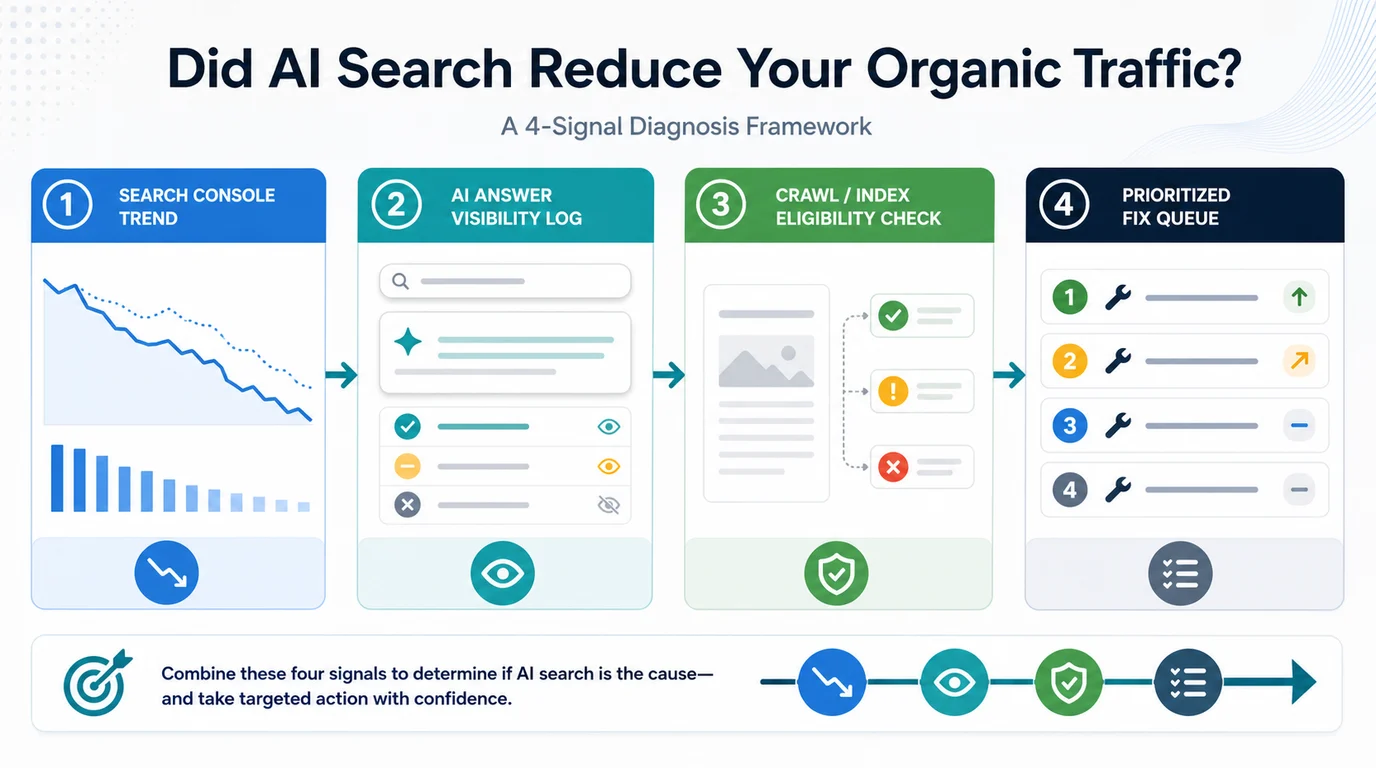
Start with four evidence lanes. Do not merge them into one "AI killed traffic" story.
| Evidence lane | What to check | What it can prove |
|---|---|---|
| Search Console trend | Clicks, impressions, CTR, average position, query set, page | Whether Google Search visibility changed |
| AI answer visibility | AI Overview presence, AI Mode observations, citations, source URLs | Whether the query is being answered or sourced differently |
| Crawl and index eligibility | Canonical, index status, robots, sitemap, rendered content, internal links | Whether the page could still compete |
| Fix queue | Owner, page action, validation date, expected signal | Whether the team has a measurable response |
Google says sites appearing in AI features are included in overall Search Console performance data for the Web search type. That makes Google's AI features documentation useful as a boundary: Search Console still matters, but it does not hand you a perfect isolated AI-impact column for every decision.
For the query and page movement, use the Search Console Performance report. For interpretation, Google's explanation of impressions, position, and clicks is worth reading because position, impressions, and clicks are not as simple as a single rank number.
Check The Query Group Before The Whole Site
AI-search pressure is usually query-specific. A sitewide organic decline can hide several different stories.
Segment the drop this way:
- Pick the affected landing page or page group.
- Pull Search Console queries for that page group.
- Compare clicks, impressions, CTR, and average position before and after the drop.
- Separate branded, non-branded, definition, comparison, and troubleshooting queries.
- Check whether the SERP now includes an AI Overview or answer-heavy layout for the important queries.
- Compare the affected page against nearby pages that serve a similar intent.
If only definition queries lost clicks while impressions stayed healthy, AI answer satisfaction is plausible. If every page in one directory lost impressions and position, the cause is more likely content quality, crawl access, internal links, demand, or a broader ranking change.
The organic traffic drop triage path is still the right companion when the decline is not clearly AI-shaped.
Look For AI Visibility Evidence
Do not treat low AI referrals as proof that AI search is irrelevant. Many AI-search effects are visibility effects before they are referral effects.
Build a small evidence log:
| Field | Why it matters |
|---|---|
| Query | Keeps the observation tied to a real search job |
| Country and device | AI answer behavior can vary by market and layout |
| AI answer present | Separates answer-surface pressure from ordinary ranking movement |
| Brand mentioned | Shows entity visibility even when no click happens |
| URL cited | Shows whether the page was used as a source |
| Competing source cited | Shows which page format the answer appears to trust |
| Search Console movement | Connects observation to clicks, impressions, CTR, and position |
| Page action | Prevents the log from becoming passive research |
If the question is Google-specific, pair this diagnostic with the AI Overview tracking workflow. If the question is broader AI-search acquisition, use the AI search traffic workflow as the source-page planning layer.
Turn The Diagnosis Into A Fix Queue
Once the cause is clearer, choose the fix by evidence type.
| Finding | Better response |
|---|---|
| CTR down, impressions stable, AI answer present | Improve title promise, direct answer, source evidence, examples, and click reason |
| Your URL is cited but clicks are low | Add deeper workflow value, comparison tables, tools, or next-step CTAs |
| Competitors are cited instead | Strengthen source quality, visible facts, examples, author/context signals, and internal links |
| Position and impressions fell together | Rework content fit, technical eligibility, internal links, or authority signals |
| Crawl/index status changed | Fix technical access before rewriting copy |
| AI referrals appear on weak landing pages | Improve CTA fit and route users to a stronger next action |
Searvora's AI SEO dashboard fits the review layer after the data is collected. The product page positions it around page-type cohorts, locale drill-down, anomaly alerts, opportunity queues, and executive-ready summaries. Those controls help a team avoid sitewide panic and instead route one page group into one action queue.
Decision Checklist
Use this checklist before saying AI search reduced organic traffic:
- Did the affected page group lose clicks, impressions, CTR, or all three?
- Did average position change enough to explain the click loss?
- Are the affected queries informational, comparison, troubleshooting, or brand/category queries?
- Does the current SERP show an AI answer, featured snippet, or answer-heavy layout?
- Is your brand or URL mentioned or cited in AI-style answers?
- Did crawl, indexability, canonical, sitemap, internal links, or rendered content change?
- Are analytics source labels mixing AI referrals, direct traffic, organic search, and branded demand?
- What exact page action can be shipped this week?
- What signal will you recheck after the validation window?
That is the practical answer to whether AI search reduced your organic traffic. It might have. But the team should prove the pattern before reacting, then turn the finding into a page-level fix that can be measured.