

If you are asking how AI search optimization tools increase organic traffic, the answer is not "publish more AI content." They help when a team chooses better source pages, makes those pages easier to crawl and cite, and turns visibility signals into shipped fixes. They do not create durable traffic by chasing every AI answer rumor.
The practical workflow is narrower: find the query group, identify the page that should win, check whether the page is eligible and useful enough, then assign the next change. If the tool does not help you make that decision, it is only another dashboard.
Start With The Traffic Decision
Before using an AI search optimization tool, name the organic traffic decision you need to make. A useful tool should help you answer one of these questions:
| Decision | Signal to inspect | Better next action |
|---|---|---|
| Which query group is changing? | Impressions, clicks, CTR, rank movement, AI answer presence, and cited URLs | Review the page group, not one isolated keyword |
| Which source page should support the answer? | Existing ranking URL, cited third-party URL, internal candidate page, and page intent | Improve, consolidate, or create the right source page |
| Is the page technically eligible? | Crawl access, indexability, canonical, internal links, rendered text, and sitemap state | Fix access before rewriting the article |
| Is the answer extractable? | Definitions, steps, tables, examples, entity clarity, and original evidence | Add clearer answer blocks and supporting proof |
| Did the work change anything? | Recheck the same query set and traffic segment after the validation window | Keep, adjust, or stop the change |
This is where broad "use AI for SEO" advice gets weak. Organic traffic does not rise because a tool labeled something as an opportunity. Traffic rises when the team ships the right page change and validates it against the same query group.
Map Signals Before Choosing Actions
AI search can affect organic traffic in more than one way. A page may lose clicks because the SERP changed. It may gain impressions because the page became more relevant to a query family. It may appear in an AI answer but fail to earn a click. It may be technically eligible but too vague to be cited.
The first job of an AI search optimization workflow is to keep those signals separate:
| Signal | What it can tell you | What it cannot prove alone |
|---|---|---|
| Search Console movement | Query and page demand changed | Why the change happened |
| AI answer observation | A brand, page, or competitor appeared in an answer | Whether the answer will stay stable |
| Citation or source URL | Which page helped support the answer | Whether that source drives qualified traffic |
| Crawl and index signals | Whether the page can be discovered and evaluated | Whether the content deserves to win |
| Content structure | Whether the answer is easy to extract | Whether the page has enough authority |
Google's AI features documentation still grounds the work in normal search eligibility: useful, accessible pages are the base. Google's Search Console Performance report remains the traffic baseline for clicks, impressions, CTR, position, queries, and pages.
That means the AI layer should sit beside your existing organic reporting, not replace it. Pair this workflow with the AI visibility evidence loop when you need mention and citation tracking, and use automated SEO reporting when the review has to repeat every week.
Use The Tool For Four Jobs
The phrase "AI search optimization tools" can mean many things. For organic traffic work, group tools by the job they help you finish.
| Tool job | What to ask it for | Output that can increase traffic |
|---|---|---|
| Query and topic monitoring | Which query groups are gaining, losing, or changing answer shape? | A focused page group to inspect |
| Source-page diagnosis | Which owned page should support this answer or query family? | A page to improve, consolidate, or create |
| Technical eligibility review | Can crawlers access, render, canonicalize, and understand the page? | A technical fix list before editorial work |
| Priority and handoff | Which change is worth shipping first, who owns it, and how will it be measured? | A validated fix queue |
This keeps the workflow honest. A content generator may help draft a section, but it is not the whole optimization system. A rank tracker may show movement, but it cannot decide whether the page needs a crawl fix, a stronger answer block, a better internal link path, or a different page type.
The highest-value use case is connecting the signals. If the same page has declining CTR, weak answer extraction, poor internal links, and a stale title, the next action is clearer than if each tool reports those problems separately.
Turn Findings Into A Fix Queue
Organic traffic work fails when the report ends with "optimize this page." A better AI search optimization workflow turns each finding into a small, assignable change:
| Finding | Likely action | Owner | Validation |
|---|---|---|---|
| Page ranks but AI answer cites a competitor | Add a concise answer block, original examples, and stronger source references | Content and SEO | Recheck the same answer query and Search Console page movement |
| Important source page is crawlable but isolated | Add internal links from relevant parent and sibling pages | SEO or content ops | Re-crawl and confirm discovered link path |
| Query group has impressions but weak CTR | Align title, intro promise, and snippet-worthy answer | Content owner | Compare CTR and query mix after the next reporting window |
| Page is cited but traffic does not convert | Improve CTA fit and add comparison or decision context | Growth or product marketing | Measure assisted leads and engagement |
| Technical issue blocks page eligibility | Fix canonical, noindex, robots, render, or sitemap conflict | Engineering | Re-crawl sample URLs and confirm search eligibility |
The SEO forecasting workflow helps when the fix queue needs budget approval. Forecasting does not promise exact traffic. It helps the team decide whether the expected upside, confidence, and effort justify the next sprint.
Measure Traffic Without Mixing Every Signal
AI search optimization can support organic traffic, but the measurement model should not pretend every signal is the same. Use a simple ledger:
- Traffic ledger: clicks, impressions, CTR, rank range, landing page, and query group.
- Visibility ledger: AI answer appearance, brand mention, cited source URL, answer surface, and observation date.
- Eligibility ledger: crawl status, indexability, canonical, sitemap, internal-link path, and rendered content.
- Work ledger: action shipped, owner, release date, expected leading indicator, and review date.
When traffic grows, this split helps you understand why. When it does not, the split prevents bad fixes. A page may need technical cleanup before content work. A query may be losing clicks because AI answers changed the SERP. A content refresh may help impressions but not conversions. Treat each result as evidence for the next decision.
Where Searvora Fits
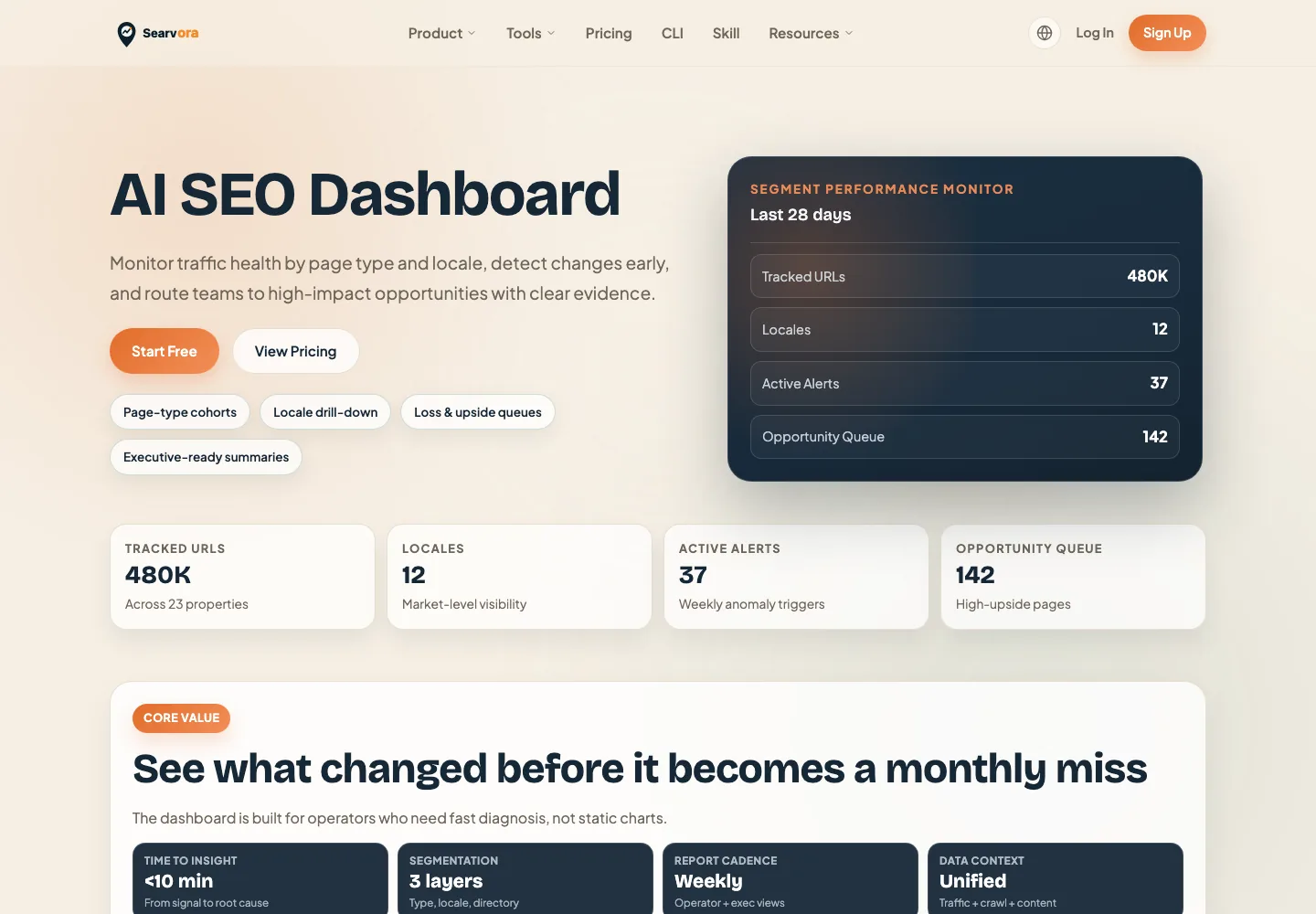
Searvora's AI SEO dashboard fits the monitoring and action-routing layer. The product page positions it around page-type cohorts, locale drill-down, anomaly detection, opportunity queues, and executive-ready summaries. Those are useful when organic traffic work needs to move from broad charts to page groups and owners.
Use Searvora this way:
| Searvora layer | Use it for | Output |
|---|---|---|
| AI SEO Dashboard | Segment query, page, and visibility movement | Reviewed opportunity queue |
| SEO Spider Crawler | Check crawl, indexability, metadata, links, and sitemap behavior | Technical fix evidence |
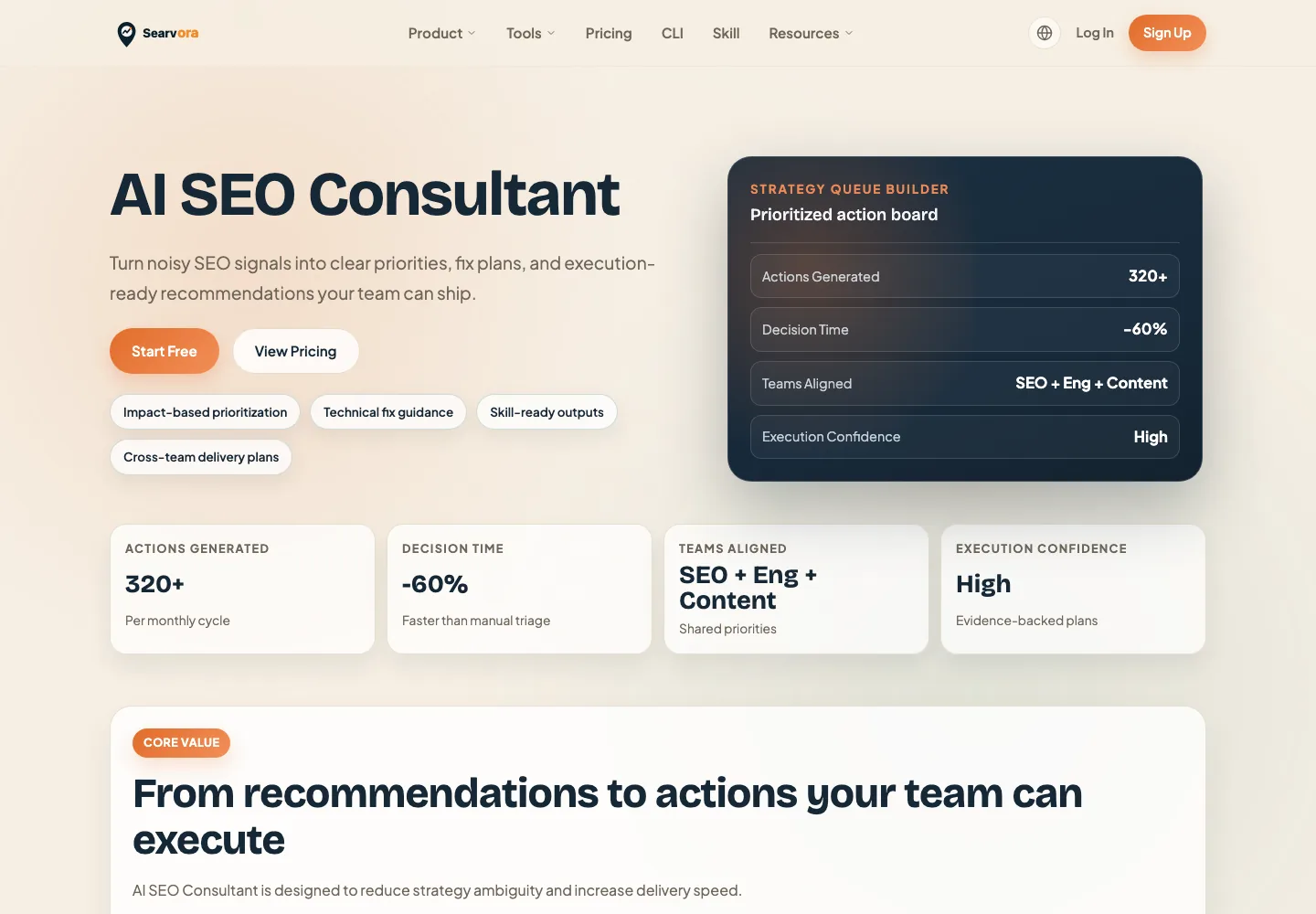
| AI SEO Consultant | Rank competing fixes by impact, effort, and confidence | Owner-ready execution plan |
A Practical Checklist
Use this checklist before trusting an AI search optimization recommendation:
- Name the query group and page group.
- Confirm whether the searcher wants an article, product page, tool, comparison, or hub.
- Record the current ranking URL and the source page that should win.
- Check crawl access, indexability, canonical, sitemap, internal links, and rendered text.
- Review whether the page gives an extractable answer, examples, and evidence.
- Separate AI visibility observations from Search Console traffic data.
- Assign one fix with an owner and validation window.
- Recheck the same query group before calling the work successful.
That is how AI search optimization tools increase organic traffic in practice. They make the next page decision clearer, help the team ship the right fix, and keep validation tied to the same source of demand.