

If the job is how to audit site citation presence in AI search engines, start with one practical definition: you are checking whether AI search experiences name or cite the pages that should support an answer, then deciding which source page needs a technical, content, or authority fix.
Do not reduce the audit to a visibility score. A citation audit should connect four things: the query or prompt, the observed AI answer, the cited source URLs, and the owned page that should earn or keep that citation. Only then can the team decide whether to improve the page, fix crawl eligibility, strengthen evidence, or move the query to watchlist.
Start With Citation Presence, Not A Score
Citation presence is source-level evidence. It asks whether an AI answer links to, names, or relies on a URL that supports the user's task. That is narrower than brand visibility and narrower than classic ranking.
Google's AI features guidance keeps the baseline grounded in normal SEO: pages still need to be accessible, useful, and eligible for Search features. OpenAI's ChatGPT Search help also frames search answers around web results and source links. The audit should therefore treat citations as evidence to verify, not as a magic metric to chase.
Use this split before changing a page:
| Evidence | What it means | Better next question |
|---|---|---|
| Brand mentioned with no URL | The entity is visible, but source ownership is unclear | Which owned page should support this answer? |
| Owned URL cited | The page is being used as evidence | Is the cited page fresh, crawlable, and conversion-ready? |
| Competitor URL cited | The answer trusts another source | What structure, proof, or entity clarity does that page expose? |
| Third-party URL cited | The answer may rely on neutral source material | Should your page cite better evidence or earn references? |
| No relevant citation | The query may not trigger source links or your page may be weak | Is this a technical eligibility issue, a content gap, or a watchlist item? |
Build A Query And Source Ledger
Do not audit random prompts. Build a stable query set around the pages that matter: category explainers, comparison pages, product use cases, support pages, research assets, and high-value articles.
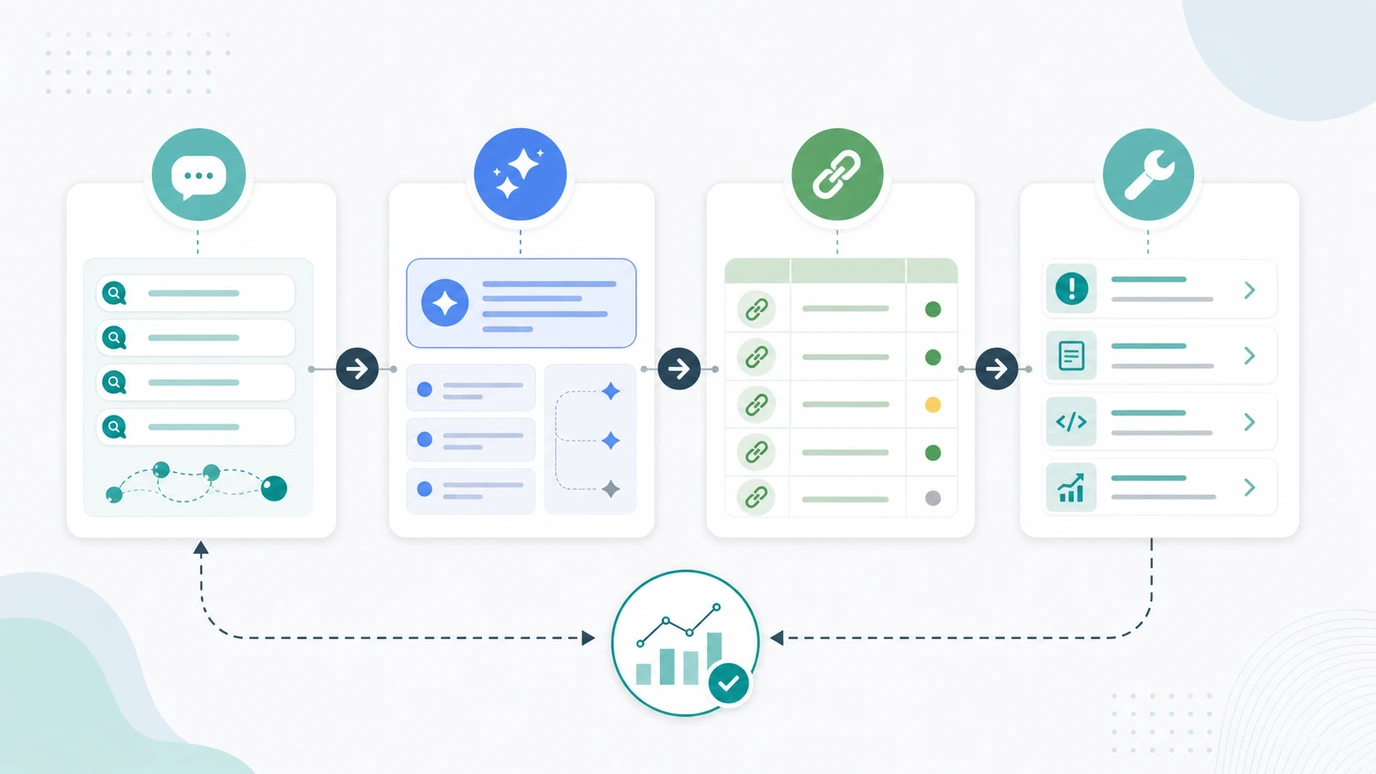
Start with a ledger that a teammate could rerun next week:
| Field | What to record | Why it matters |
|---|---|---|
| Query or prompt | Exact wording, country, language, device, and date | Prevents anecdotal checks from driving the roadmap |
| Answer state | AI answer present, absent, mixed, or unstable | Separates normal search results from AI-answer observations |
| Brand mention | Whether the brand, product, person, or site is named | Tracks entity visibility even without a click |
| Cited source URL | Owned URL, competitor URL, third-party URL, or none | Turns the audit into source-page work |
| Page that should win | The canonical owned page for that task | Prevents the team from improving the wrong URL |
| Search Console slice | Query group, page group, clicks, impressions, CTR, and position | Keeps citation checks tied to real search movement |
| Next action | Improve, crawl, link, consolidate, watch, or ignore | Stops the ledger from becoming passive research |
The AI Overview tracking workflow is useful when the query set is Google-specific. A site citation audit is broader: it can include AI Overviews, AI Mode-style answers, answer engines, and search experiences where source links may influence discovery even when direct referral data is incomplete.
Check Whether The Page Is Technically Eligible
Do the boring eligibility work before rewriting the article. Google says AI features in Search are measured inside normal Search Console performance reporting and that supporting links rely on the same foundational Search eligibility. That means a page with citation potential can still lose if it is blocked, canonicalized away, thin in rendered HTML, or missing from the internal-link path.
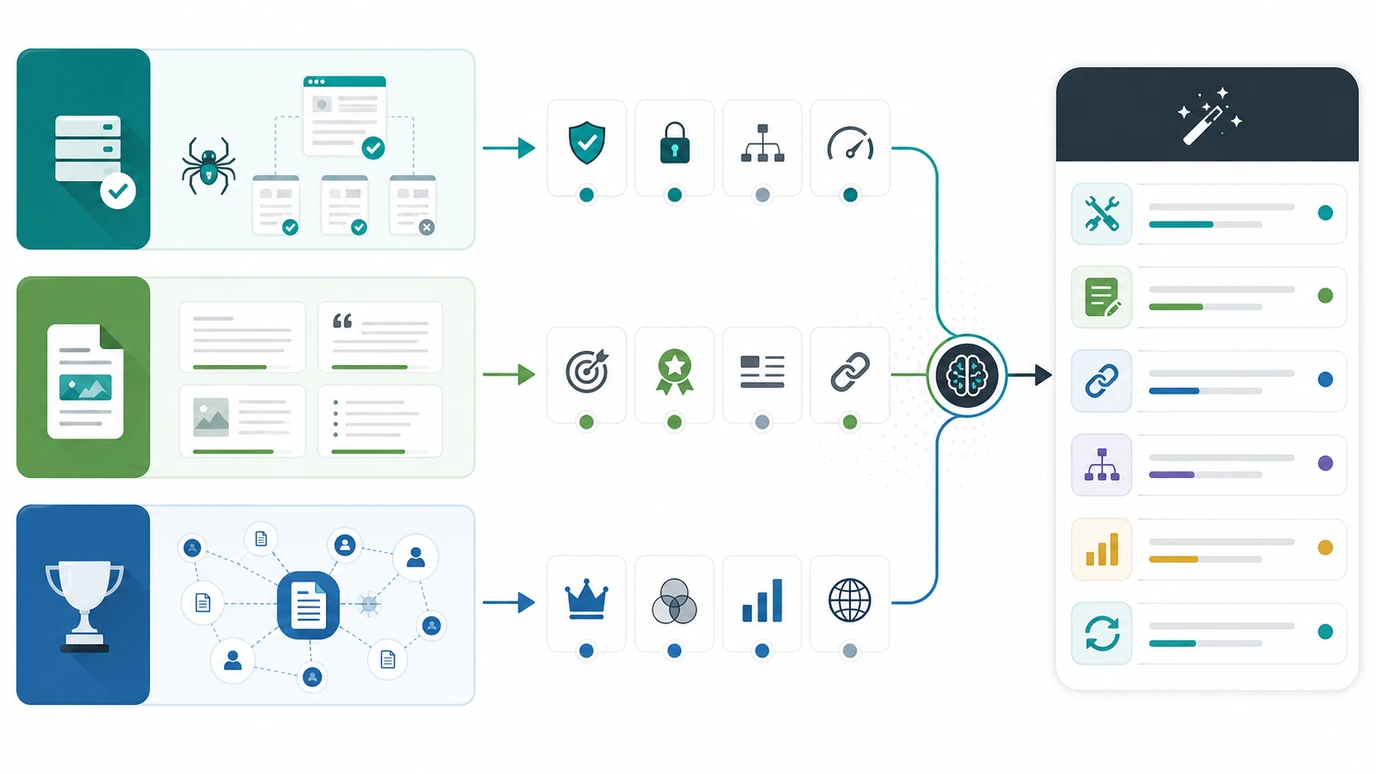
Use this technical check for every page that should be cited:
| Check | Pass condition | Fix when weak |
|---|---|---|
| Indexability | The page is indexable and eligible for a snippet | Remove accidental noindex, robots blocks, or preview-control conflicts |
| Canonical | The canonical points to the URL that should own the query | Consolidate duplicates or fix self-canonical drift |
| Rendered content | Definitions, tables, examples, and source material appear in HTML | Move important evidence out of hidden or image-only content |
| Internal links | Related pages link with descriptive context | Add links from hubs, product pages, and supporting articles |
| Sitemap and freshness | The page is discoverable and recently maintained when needed | Update sitemap inclusion, dates, and stale sections |
| Entity clarity | Brand, product, author, category, and use case are named consistently | Normalize naming across product, about, and source pages |
Pair this with the technical SEO workflow when the issue is crawl access, canonical drift, rendering, or sitemap coverage rather than AI-search copy.
Diagnose The Citation Gap
Once the ledger and technical checks are clean, classify the gap. This keeps the team from rewriting everything just because a competitor appeared once.
| Gap pattern | Likely reading | Better fix |
|---|---|---|
| Competitor cited with a clearer definition | Your page may answer too slowly or too vaguely | Add a concise answer block and examples near the top |
| Competitor cited with stronger data | Your page may lack original proof or source material | Add public evidence, methodology, screenshots, or maintained examples |
| Third-party guide cited instead of your page | The topic may need neutral supporting context | Strengthen citations, references, and comparison logic |
| Owned page cited but outdated | The page has trust, but freshness is weak | Refresh the section and record the update date |
| Brand mentioned but no owned source cited | Entity awareness exists without source ownership | Build or improve the page that should support the answer |
| No citation across repeated checks | The query may be unstable or not source-link friendly | Keep a watchlist and prioritize stronger query groups first |
The brand mentions in AI answers workflow covers the entity-level ledger. This article is the source-page layer: it asks whether the right URL is visible enough, useful enough, and technically clean enough to be cited.
Turn Findings Into A Fix Queue
A citation audit is only useful when it creates assigned work. For each query group, choose one next action instead of turning the review into a long rewrite brief.
| Decision | Use it when | Owner |
|---|---|---|
| Improve the source page | The page is eligible but weaker than cited competitors | Content or SEO lead |
| Fix technical eligibility | The page is blocked, duplicated, slow to render, or poorly linked | Technical SEO or engineering |
| Add internal links | The page is useful but isolated from the cluster | SEO or content operations |
| Consolidate pages | Two owned URLs compete for the same citation task | SEO lead |
| Create a child article | The current page is a broad hub and the query needs a narrower answer | Content lead |
| Move to watchlist | SERP and AI answer behavior is unstable or low-value | SEO operations |
Keep the action small enough to validate. If the fix is "make the page better," it is not ready. If the fix is "add a definition block, cite the official source, link from the GEO hub, and recrawl the URL," the team can ship it and measure again.
Where Searvora Fits
Searvora AI SEO Dashboard fits the monitoring layer for citation audits. The product page positions it around page-type cohorts, locale drill-down, anomaly detection, opportunity queues, and cross-team reporting. That is the right shape for this workflow because citation presence should be reviewed beside query movement, page groups, and assigned actions.
Use the AI SEO dashboard to group citation checks by topic cluster, country, page type, and source URL. Then route each finding into a weekly queue: improve a source page, check technical eligibility, refresh a comparison section, add internal links, or keep the query on watchlist.
When the evidence points in several directions, the AI SEO Consultant can help translate dashboard and crawl signals into a ranked action plan. Keep the roles clear: the dashboard shows where citation and visibility evidence changed; the action queue decides what ships next.
Run The Weekly Citation Audit
Use this sequence for a weekly or monthly AI search citation audit:
- Choose one topic cluster, market, language, and page group.
- Select the queries where a citation would influence discovery, trust, or a buying decision.
- Record AI answer presence, brand mention, cited URLs, and competing sources.
- Pick the owned page that should support each query.
- Check indexability, canonical, rendered content, internal links, sitemap inclusion, and entity clarity.
- Compare the same page and query group in the Search Console Performance report.
- Assign one fix, consolidation, or watchlist decision per query group.
- Record the owner, change date, and expected validation window.
- Recheck the same query set after enough time for crawling and answer changes.
The goal is not to prove that every AI answer caused every traffic change. The goal is to know which pages are acting as trusted sources, which pages should be trusted sources, and which evidence gap the team can fix next.