

Brand mentions in AI answers are appearances of your brand, product, people, or owned sources inside AI-generated responses. For SEO teams, the useful question is not just whether the brand appears. It is whether the answer represents the brand accurately, whether an owned URL is cited, and which source page should be improved next.
Treat this as an evidence loop. Sample the prompts that matter, record the mention, separate citations from plain awareness, audit the source pages that should support the answer, and assign one fix at a time.
Start With A Mention Ledger
AI-answer visibility becomes noisy fast if every screenshot, prompt, and anecdote goes into one pile. Start with a ledger that lets the team compare the same query set over time.
Google's AI features guidance is a useful baseline because it keeps the work grounded in normal SEO: pages still need to be crawlable, indexable, useful, and eligible to appear as supporting links. OpenAI's ChatGPT search help also points users toward cited sources when search is available, which means source ownership and citation quality matter alongside brand awareness.
Use a simple first ledger:
| Field | What to record | Why it matters |
|---|---|---|
| Prompt or query | The exact question, market, language, and device | Prevents one-off checks from driving strategy |
| Brand mention | Whether the brand, product, or founder appears | Tracks entity awareness even when no click happens |
| Sentiment and role | Neutral, positive, missing, outdated, or misleading | Shows whether the mention helps the user choose |
| Source cited | Owned URL, third-party URL, competitor URL, or no source | Separates visibility from source ownership |
| Page that should win | The owned page that best answers the task | Creates a target for content, crawl, or link work |
| Next action | One assigned fix or watchlist decision | Keeps the workflow operational |
Separate Mentions From Citations
A mention says the AI answer recognizes the brand. A citation says a specific source page was useful enough to support the answer. Those two outcomes need different fixes.
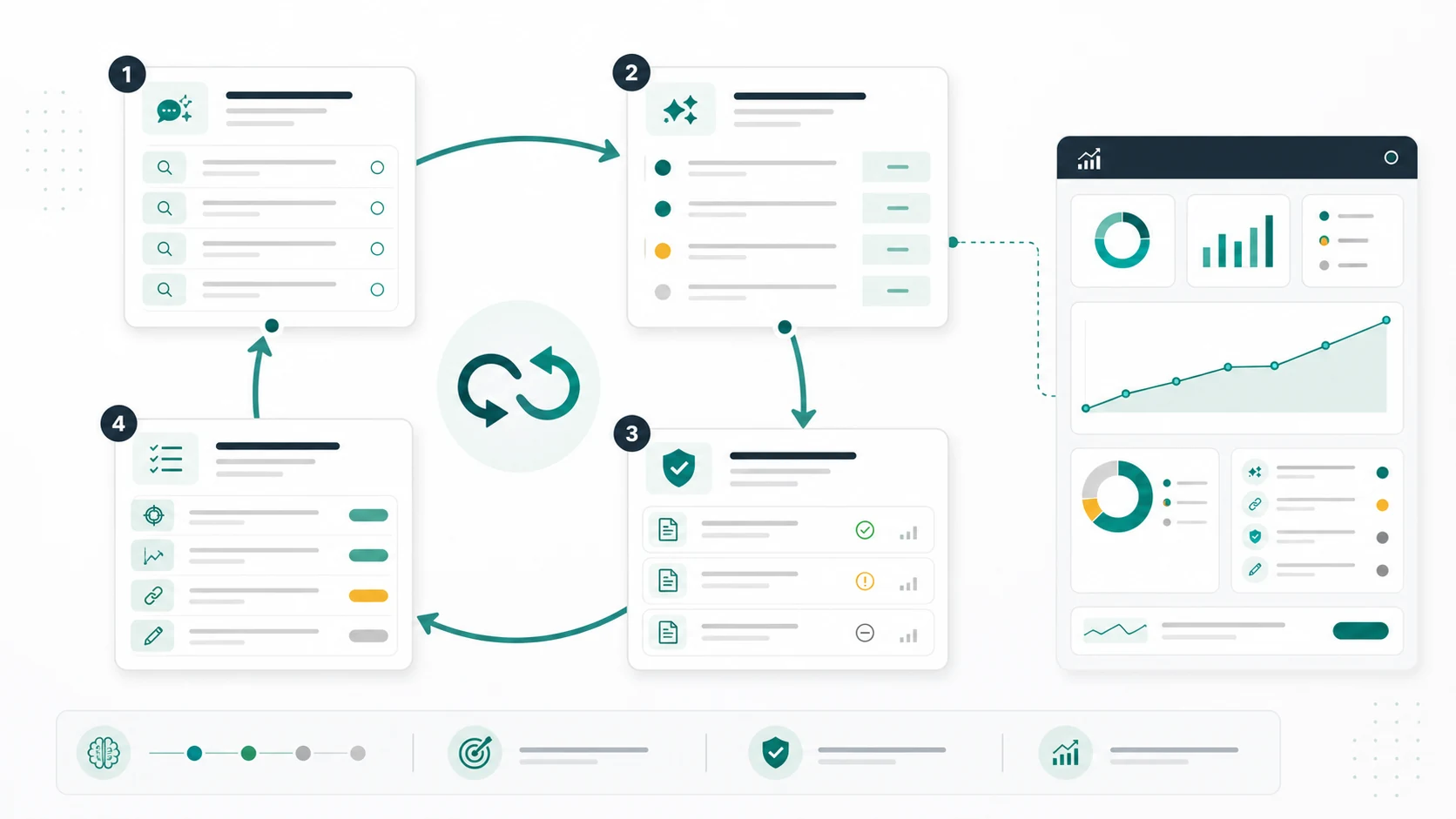
Use this split before rewriting anything:
| Evidence pattern | What it usually means | Better next action |
|---|---|---|
| Brand mentioned, owned URL cited | The source page may be useful, but still needs monitoring | Improve the cited page's freshness, examples, and internal links |
| Brand mentioned, competitor or third-party URL cited | Entity awareness exists, source ownership is weak | Build or strengthen the owned page that should answer that prompt |
| Brand missing, competitors mentioned | The topic cluster may lack strong public evidence | Compare competitor source pages, then create a better answer-ready asset |
| Brand mentioned inaccurately | The answer may be reading inconsistent or outdated sources | Normalize product descriptions, public profiles, and high-authority pages |
| Owned page cited but clicks are unclear | Citation influence may not show as clean referral traffic | Track query movement, citations, and Search Console trends together |
The brand SEO workflow handles the broader entity and reputation layer. This page is narrower: it turns AI-answer observations into source-page fixes.
Audit The Source Pages AI Answers Can Trust
Do not start by asking how to "influence AI." Start by asking which public pages deserve to be used as sources.
For each important prompt group, pick the owned page that should be the canonical source. Then check whether it actually gives an AI answer enough clean material to cite.
| Source-page check | What to look for | Fix when weak |
|---|---|---|
| Definition clarity | The page explains the product, category, or use case in plain language | Add a concise answer block near the top |
| Entity consistency | Brand, product, author, and company names match across pages | Normalize names, aliases, and descriptions |
| Crawl eligibility | Page is indexable, canonical, internally linked, and in the sitemap | Fix noindex, robots, canonical, redirect, or orphan-page issues |
| Extractable evidence | Tables, steps, examples, and public references are visible in HTML text | Move important claims out of images or vague copy |
| Citation target | The page has a clear job for one prompt cluster | Split or refocus pages that try to serve too many jobs |
| Update evidence | Fresh sections show what changed and why it matters | Add update notes only when the topic is unstable |
Google says AI features in Search are reported within the normal Search Console Performance report, not as a magic standalone SEO channel. The Performance report still gives clicks, impressions, CTR, average position, queries, pages, countries, devices, and date comparisons. Use that data beside your mention log instead of pretending AI answers produce a perfectly isolated metric.
Route Findings Into A Fix Queue
Monitoring only helps if it creates work the team can ship. For every prompt group, assign one source-page action, one technical check, or one watchlist decision.
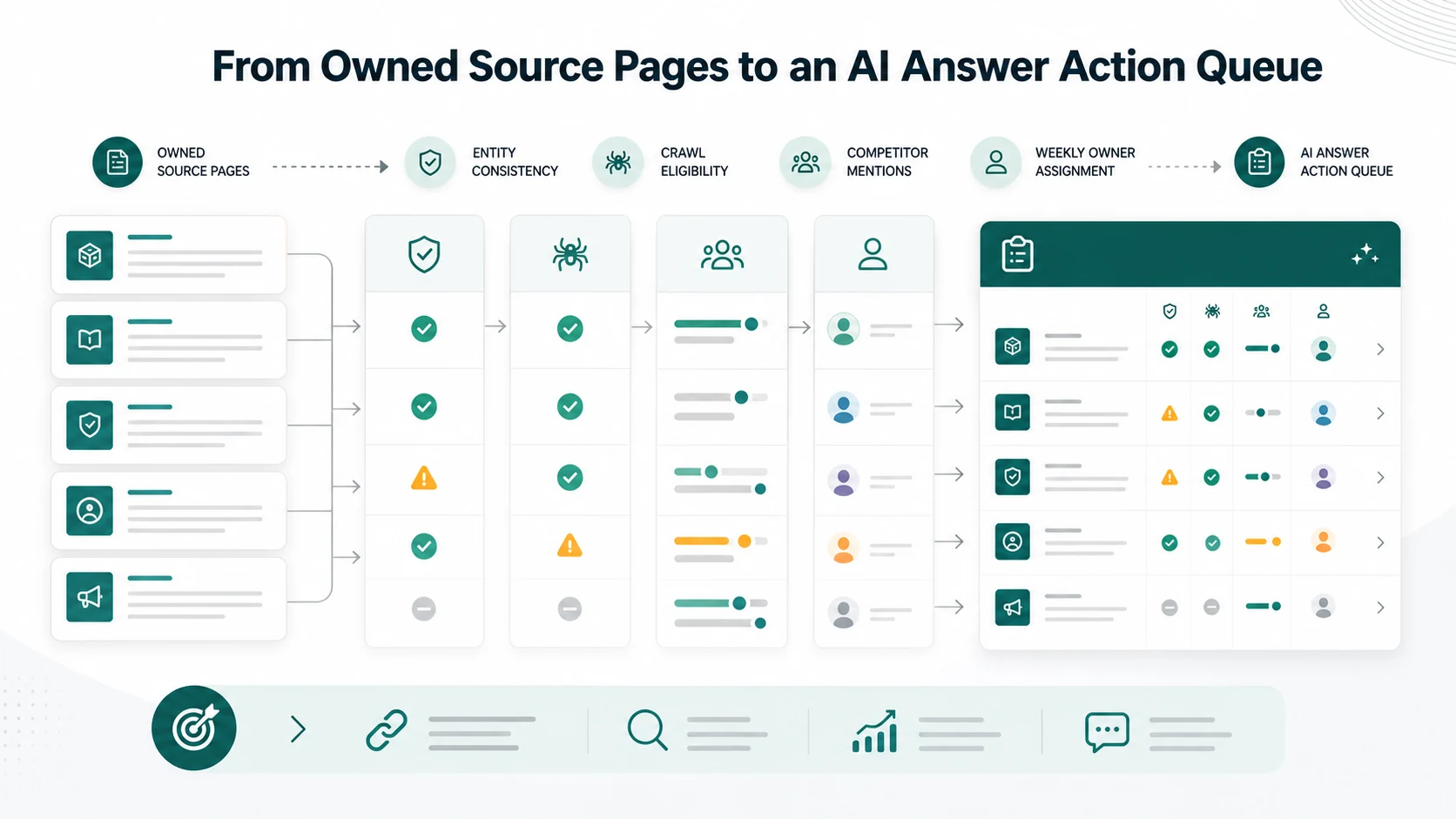
Use this queue model:
| Finding | Owner | Action |
|---|---|---|
| Brand appears but no owned source is cited | Content or SEO lead | Create or improve the page that answers the prompt directly |
| Wrong product description appears | Product marketing | Align homepage, product page, about page, and public profiles |
| Competitor owns the cited source | SEO lead | Compare source structure, then add better examples, definitions, and proof |
| Page is useful but technically weak | Technical SEO or engineering | Fix crawl, canonical, internal links, sitemap, or rendering blockers |
| Mention appears only for branded prompts | Growth or content lead | Build non-branded source pages around category and problem queries |
| Signal is inconsistent across checks | SEO operations | Keep in watchlist and recheck after the next crawl or content update |
The AI Overview tracking workflow is helpful when the query set is Google-specific. Use it to pair observed AI answer states with Search Console movement. For broader AI-answer brand visibility, keep the same discipline but add the entity and source-page fields above.
Measure Without Pretending The Data Is Perfect
AI answer tracking is not a lab instrument. Different platforms, locations, accounts, and prompt wording can change what appears. The goal is enough evidence to make better SEO decisions, not absolute certainty.
Use three ledgers instead of one blended score:
| Ledger | What it answers | Cadence |
|---|---|---|
| Mention ledger | Are we named, described correctly, or missing? | Weekly for priority prompts |
| Citation ledger | Which source URLs support the answer? | Weekly or after major page updates |
| Performance ledger | Are queries, pages, clicks, impressions, and CTR moving? | Weekly through Search Console segments |
Google's documentation on impressions, position, and clicks is a good reminder that Search Console metrics need careful interpretation. A citation, a mention, and a click are different signals. Keep them separate until the pattern is strong enough to assign work.
Where Searvora Fits
Searvora AI SEO Dashboard fits the monitoring layer of this workflow. The product page positions it around segment-first monitoring, anomaly and trend detection, opportunity scoring, and cross-team reporting. Those are the views a team needs when brand visibility changes by topic cluster, page type, locale, or owner.
Use the dashboard to group prompt sets by market, topic, page type, and source URL. Then turn each observation into a ranked queue: strengthen the owned source page, add internal links, fix crawl eligibility, update an entity description, or move the prompt group to watchlist.
If the team cannot decide what to fix first, the AI SEO Consultant layer can help translate dashboard and crawl evidence into prioritized actions. Keep the roles clear: the dashboard shows where visibility changed; the action queue decides what ships next.
Run The Weekly Review
Use this weekly sequence for brand mentions in AI answers:
- Choose one market, language, and topic cluster.
- Sample a stable set of branded, category, comparison, and problem prompts.
- Record whether the brand appears, how it is described, and which URLs are cited.
- Pick the owned page that should support each important prompt.
- Check crawl, indexability, canonical, internal links, sitemap inclusion, and page clarity.
- Compare Search Console trends for the relevant query and page group.
- Assign one action per evidence gap.
- Record the owner, change date, and next review date.
- Recheck the same prompt group after enough time for crawling and answer changes.
The llms.txt SEO workflow can support the discoverability layer, but it does not replace the source-page work. AI answers need clear public evidence. A maintained page, a clean crawl path, and a logged review cadence will beat a pile of disconnected screenshots.
The best outcome is simple: when an AI answer discusses a problem your brand can solve, the brand is named accurately, the right source page is cited when appropriate, and the team knows which evidence gap to fix next.