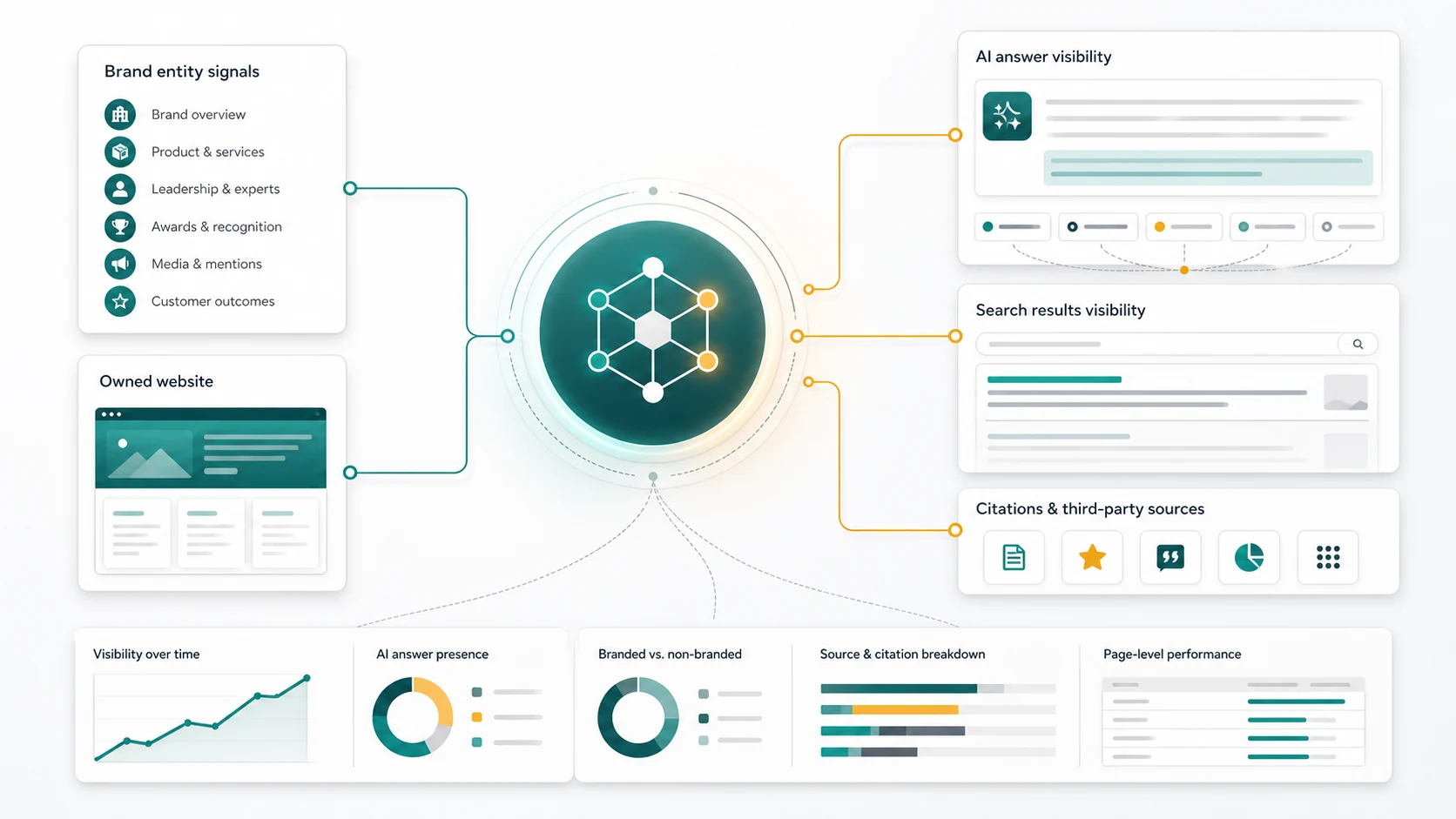
Brand SEO is the work of making a brand easy to recognize, understand, trust, and choose when people search. In AI search, that job gets more concrete: your brand needs clear owned sources, consistent entity signals, useful pages that can be cited, and a review loop that turns visibility changes into action.
Do not treat brand SEO as reputation polish. Treat it as an evidence system. If search engines and AI answer systems cannot confidently connect your name, products, expertise, source pages, and proof points, they have less reason to surface your brand when the query is not already navigational.
Start With The Brand Evidence Problem
Google's AI features guidance frames AI results around the same basic search eligibility work: pages need to be crawlable, indexable, useful, and eligible to appear in Search features. There is no special shortcut that makes an AI answer cite a brand just because the brand wants visibility.
That is why brand SEO starts with evidence. The useful question is not "How do we promote the brand harder?" It is "What public pages help a search system understand who we are, what we do, when we are relevant, and why we can be trusted?"
Use this first-pass map:
| Brand layer | What to check | Why it matters |
|---|---|---|
| Entity clarity | Official name, product names, site name, descriptions, and aliases | Reduces confusion across branded and category queries |
| Owned source pages | Homepage, product pages, about page, author pages, docs, policies, and evergreen articles | Gives search and AI systems reliable pages to read and cite |
| Search appearance | Titles, snippets, site name, favicon, structured data, and internal links | Shapes how the brand is represented before the click |
| Third-party evidence | Mentions, citations, reviews, directories, and partner references | Helps validate the brand beyond its own claims |
| Measurement | Branded queries, non-branded mentions, citations, CTR, and page-level actions | Turns brand SEO from a vague campaign into an operating cadence |
Build The Owned Source Map
Most brand SEO gaps are not caused by one missing keyword. They come from scattered evidence. The homepage says one thing, product pages say another, author or leadership pages are thin, and important use cases live only in sales decks or social posts.

Start with the pages you fully control:
| Owned page | Brand SEO job | Common gap |
|---|---|---|
| Homepage | Explain the entity, audience, category, and primary value | Vague tagline with no concrete product category |
| Product pages | Match product names to jobs, use cases, and proof | Feature lists with no searchable use-case language |
| About or company page | Clarify who operates the brand and what it stands for | Thin company copy with no useful context |
| Author or expert pages | Show experience and accountability for advice-heavy content | Anonymous blog content with no source depth |
| Help, docs, or policy pages | Provide stable public sources for factual claims | Important details hidden behind login or sales calls |
| Evergreen articles | Demonstrate topic expertise and cite useful sources | Generic posts with no operational examples |
Google's guidance on site names in Search is a practical reminder that brand representation depends on consistent signals across the site. Google's structured data policies also reinforce a simple rule: markup should describe visible, accurate page content, not invent claims the page does not support.
For brand SEO, that means your entity work should be boringly consistent. Use the same official brand name. Explain product categories in plain language. Make the strongest source pages easy to crawl and easy to understand. Avoid stuffing schema, footer copy, or generated pages with claims that the actual page cannot prove.
Separate Demand Signals From Citation Signals
Brand SEO gets messy when every metric is forced into one score. Branded search demand, AI-answer mentions, source citations, review-page visibility, and direct traffic are related, but they do not say the same thing.
Separate the ledgers:
| Ledger | What it records | Action it can trigger |
|---|---|---|
| Branded demand | Queries that include the brand, product, founder, category plus brand, or support terms | Improve branded SERP coverage, title clarity, support pages, and comparison pages |
| Entity consistency | How consistently the brand name, product names, and descriptions appear on owned pages | Fix naming drift, duplicate positioning, and weak source pages |
| AI answer presence | Whether the brand appears in AI answers for category, comparison, and problem queries | Strengthen pages that explain the brand's role in those topics |
| Citation ownership | Which owned URLs are cited or referenced | Improve source pages, examples, summaries, and internal links |
| Third-party proof | Which external sources mention or describe the brand accurately | Update public profiles, partner pages, directories, and PR references |
| Action history | What changed, who owned it, and when it will be reviewed | Prevents brand SEO from becoming passive monitoring |
The AI Overview tracking workflow is the measurement sibling of this work. It shows how to log query sets, observed AI answer states, citations, and Search Console movement. Brand SEO uses the same discipline, but the entity and owned-source questions come first.
Make Brand SEO Useful For Non-Branded Queries
Branded queries are the easy part. The harder work is earning visibility when the searcher has not named you yet.
For Searvora, that could mean queries around AI SEO dashboards, AI-search monitoring, technical SEO workflows, content operations, or SEO action queues. A brand SEO workflow should ask whether the brand has a source page that deserves to appear for those jobs.
Use this decision table:
| Query pattern | Brand SEO question | Better action |
|---|---|---|
| Category query | Does the site clearly explain the product category and buyer job? | Strengthen product page positioning and link from relevant articles |
| Comparison query | Does the brand have a fair page or article that helps the user choose? | Create a comparison or decision page only when it serves the search task |
| Problem query | Does an owned article give a better answer than generic advice? | Add examples, source links, validation steps, and next actions |
| AI answer cites competitors | What source pages are they earning that we lack? | Build or improve the missing owned source page |
| Brand mentioned but not cited | Which page should be the citation target? | Clarify the page, add supporting evidence, and improve internal links |
| Branded support query | Does the answer belong on support, product, or blog? | Route the page type correctly instead of forcing every topic into the blog |
This is also where the GEO SEO foundations workflow helps. AI-search visibility is not a separate content calendar. It is a loop that connects diagnostics, decisions, publishing, and validation.
Run The Weekly Brand SEO Review
Brand SEO improves when the review cadence is specific enough to create work.
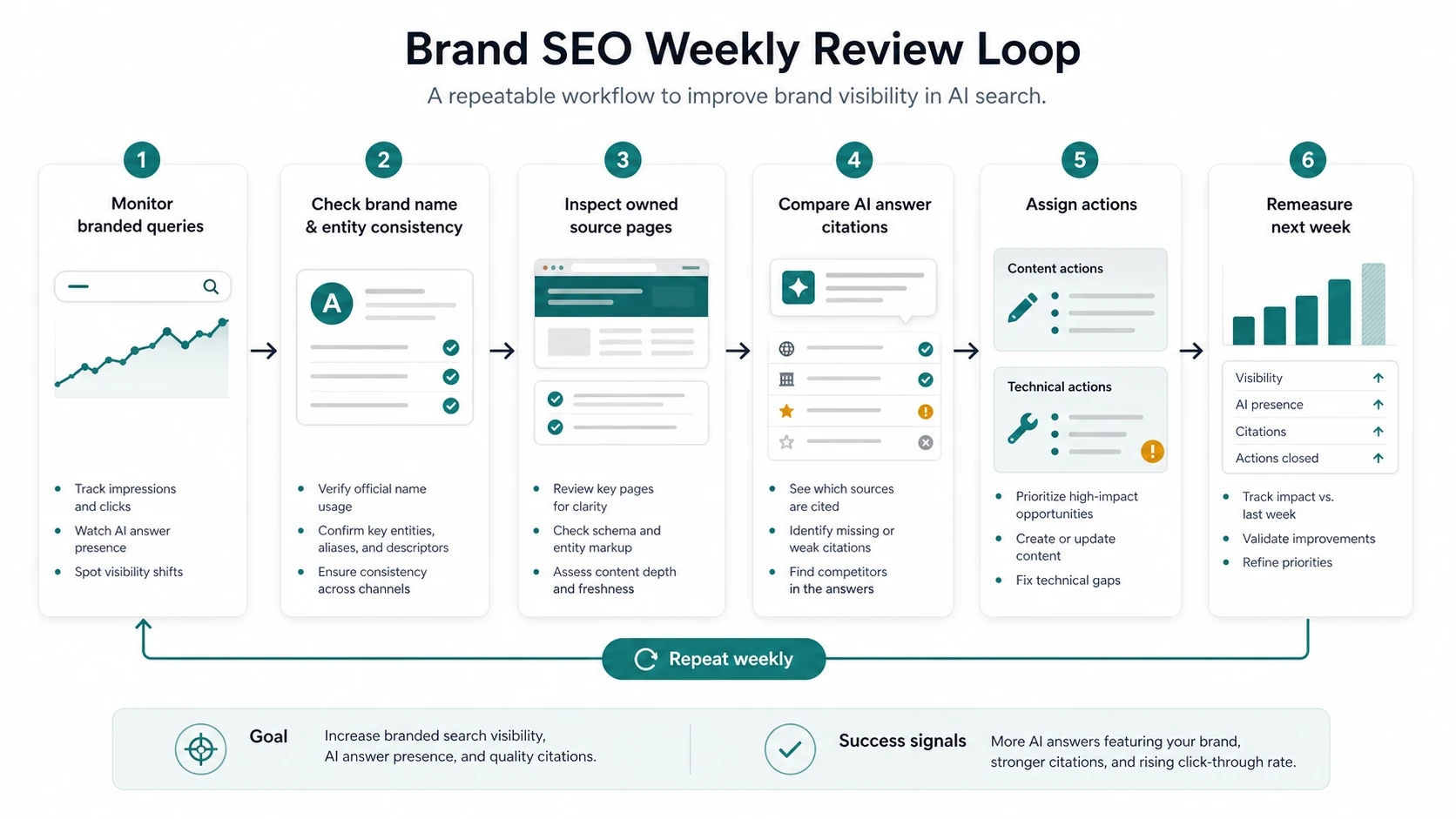
Use this weekly sequence:
- Pick one market, language, and topic cluster.
- Review branded queries, category queries, and comparison queries separately.
- Check whether the official brand name, product names, and descriptions are consistent on owned pages.
- Inspect the source pages that should explain the brand's role in the topic.
- Log whether AI answers mention the brand, cite an owned URL, or cite only competitors.
- Compare Search Console movement for branded and non-branded query groups.
- Assign one action per evidence gap.
- Recheck the same query set after the action has had time to be crawled and reflected.
Keep the actions small enough to ship:
| Evidence gap | Action |
|---|---|
| Branded result shows the wrong title or weak snippet | Rewrite the title, meta description, intro, and internal links for the canonical page |
| Product category is unclear | Add a plain-language product description and use-case section |
| AI answer cites competitors but not owned pages | Build a stronger source page with definitions, examples, and public references |
| Brand appears but no URL is cited | Strengthen the likely citation target and link to it from relevant articles |
| Entity naming is inconsistent | Normalize brand, product, and author naming across templates and source pages |
| Technical issue blocks source pages | Fix canonical, robots, noindex, sitemap, redirect, or crawl problems before rewriting |
Google's helpful content guidance is useful here because it pushes teams toward people-first content, clear experience, and useful source quality. Brand SEO should not create thin "about us" pages for machines. It should make genuinely useful source pages easier to trust.
Where Searvora Fits
Searvora AI SEO Dashboard fits the monitoring and prioritization layer of brand SEO. The product page positions it around page-type cohorts, locale drill-down, anomaly detection, opportunity queues, and executive-ready summaries. Those are the exact views a team needs when brand visibility changes across branded demand, category demand, and AI-search evidence.
Use the dashboard to group brand SEO evidence by query type, page type, locale, and owner. Then connect each signal to the next action: improve an owned source page, add internal links, fix crawl eligibility, update a comparison page, or move a topic into the watchlist.
When the action is not obvious, Searvora AI SEO Consultant can help translate dashboard and crawl evidence into a ranked work queue. Keep the roles separate: the dashboard shows what changed; the consultant helps decide what should ship.
Treat Brand SEO As Maintained Infrastructure
The best brand SEO programs do not depend on one big campaign. They maintain the public evidence layer that search systems, AI answers, customers, partners, and reviewers can all inspect.
Use the llms.txt SEO workflow for the AI-readable navigation layer, use dashboard segments for monitoring, and keep source pages tied to real search jobs. If a page helps a person understand the brand and helps a system cite the right source, it belongs in the brand SEO loop.
The goal is simple: when someone asks a relevant question, your brand should be clear enough to recognize, credible enough to trust, and organized enough to become the source instead of a footnote.