

How to Check Google Rankings starts with a simple rule: do not stop at the number a rank tracker gives you. Confirm the keyword, location, device, ranking URL, Search Console clicks and impressions, normal volatility, and the action your team should take next.
The Ahrefs page that surfaced this competitor opportunity is a useful tool-guide style article. Searvora's information gain is the operating workflow around the check: decide whether ranking movement is real, whether the right URL owns the query, and whether the next move is monitoring, CTR work, content improvement, internal linking, or a technical fix.
Start With The Exact Ranking Question
The first mistake is checking a broad keyword once and treating that position as truth. Google rankings vary by country, city, device, language, search personalization, SERP feature mix, and date. A useful ranking check starts with a specific question.
Write the question like this:
| Question element | Example | Why it matters |
|---|---|---|
| Query | "how to check Google rankings" | Keeps the review tied to one search job |
| Market | United States or a target city | Prevents local variation from looking like a sitewide problem |
| Device | Desktop, mobile, or both | Separates mobile layout issues from desktop-only movement |
| Target URL | The page you expect to rank | Reveals wrong-URL rankings and cannibalization |
| Review window | Today, 7 days, 28 days, or post-launch | Separates a one-day fluctuation from a trend |
This framing is also the first duplicate check. A query can look weak because another page on your site is ranking instead of the intended URL. Before rewriting anything, make sure the ranking result belongs to the page you want to improve.
Use A Five Step Evidence Loop
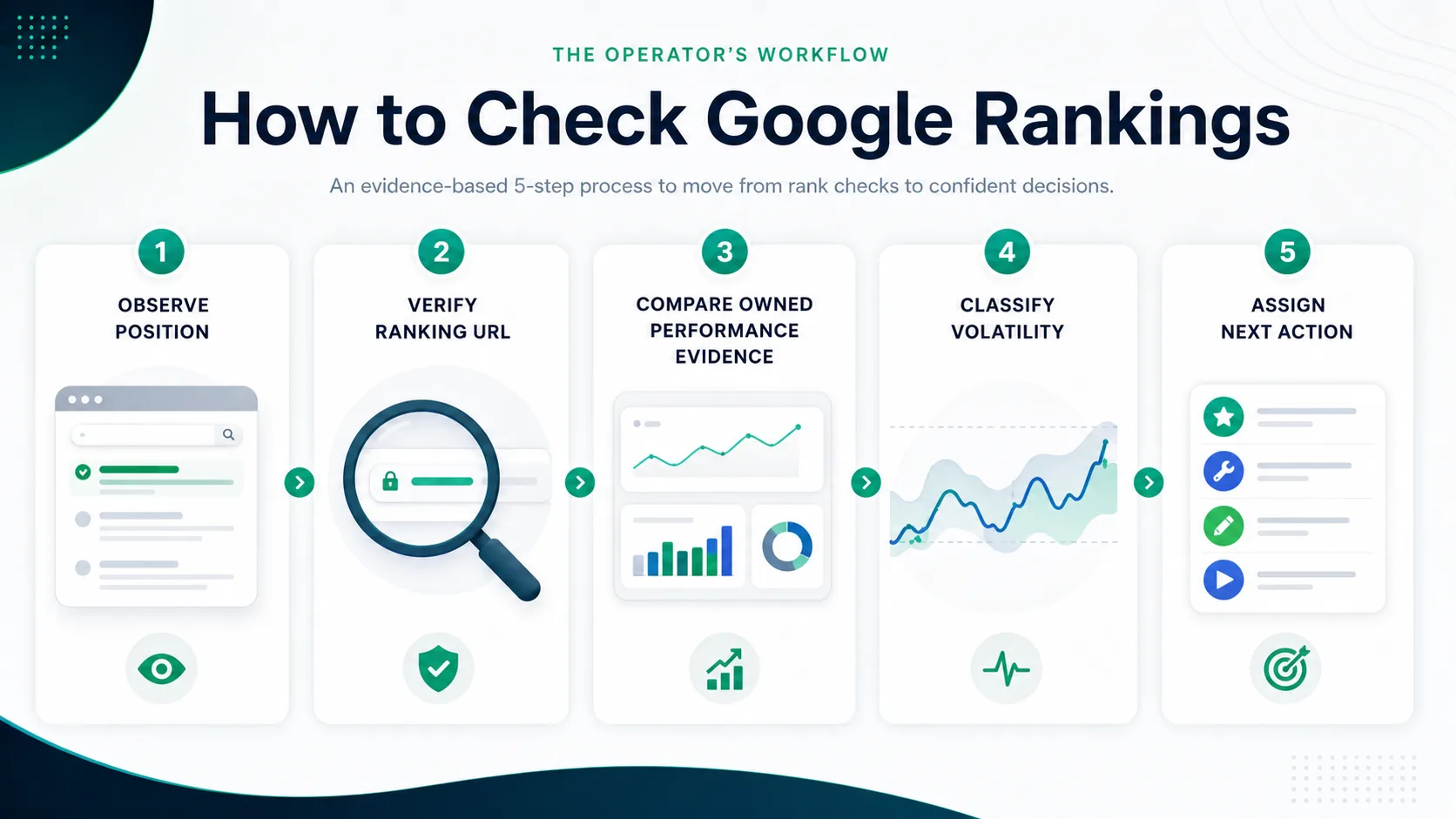
Use this loop whenever a stakeholder asks, "Where do we rank?"
- Record the ranking position for the exact keyword, market, device, and date.
- Verify the ranking URL and compare it with the page you intended to rank.
- Check Google Search Console impressions, clicks, CTR, and average position for the same URL and query group.
- Classify the movement as normal volatility, a CTR problem, a wrong-URL problem, a content gap, or a technical/indexing issue.
- Assign the next action, owner, and validation date.
That is the difference between rank checking and rank management. Rank checking says a keyword is position 8. Rank management says the right URL moved from page two into striking distance, impressions are rising, CTR is weak, and the next action is to improve the title and meta promise before the next 14-day review.
Verify The Ranking URL Before You React
A ranking position can be technically accurate and strategically misleading. If the wrong URL ranks, the fix is not always "make the page longer." The real job is to understand why Google chose that URL.
Check for these patterns:
| What you see | What it may mean | Better next action |
|---|---|---|
| Intended page ranks | The target page is eligible and relevant | Improve the page from performance evidence |
| Older article ranks | Google trusts another page for the same job | Merge, redirect, or separate the search intent |
| Category or landing page ranks | The query may have commercial or hub intent | Decide whether the article is the wrong page type |
| Thin support page ranks | Internal links or title signals may be confusing | Strengthen the canonical target and supporting links |
| No owned URL ranks | The page may be ineligible, weak, or not discovered | Check indexing, crawl access, and page fit first |
This is where the workflow differs from a generic keyword tracking tools comparison. Tools can show movement, but the SEO decision depends on URL ownership and the page job.
Compare Position With Search Console Evidence
Google Search Console is not a perfect rank tracker, but it is essential owned-site evidence. The official Search Console page frames it around measuring Search traffic and fixing issues for Google visibility. Use it to validate whether ranking movement changed the way real searchers saw and clicked your page.
Look at the query, page, country, device, and date filters together. Then compare:
| Signal | Stronger interpretation | Risky interpretation |
|---|---|---|
| Impressions rising, clicks rising | The page is earning more demand | Do not rewrite just because one rank tracker wobbled |
| Impressions rising, CTR falling | The result appears but the snippet may be weak | Test title, meta description, and SERP promise |
| Impressions flat, position down | The keyword may be volatile or low impact | Monitor before changing the page |
| Impressions down across a page group | Demand, ranking, or indexation may have shifted | Segment by URL type and release window |
| Average position up, clicks down | The query mix or SERP feature mix may have changed | Inspect the exact queries and ranking URLs |
If the ranking tool and Search Console disagree, do not pick the number you like better. Use the disagreement as a diagnostic prompt. The tracker may be showing a single keyword and location; Search Console may be averaging many query variants, URLs, countries, and devices.
Separate Noise From Action
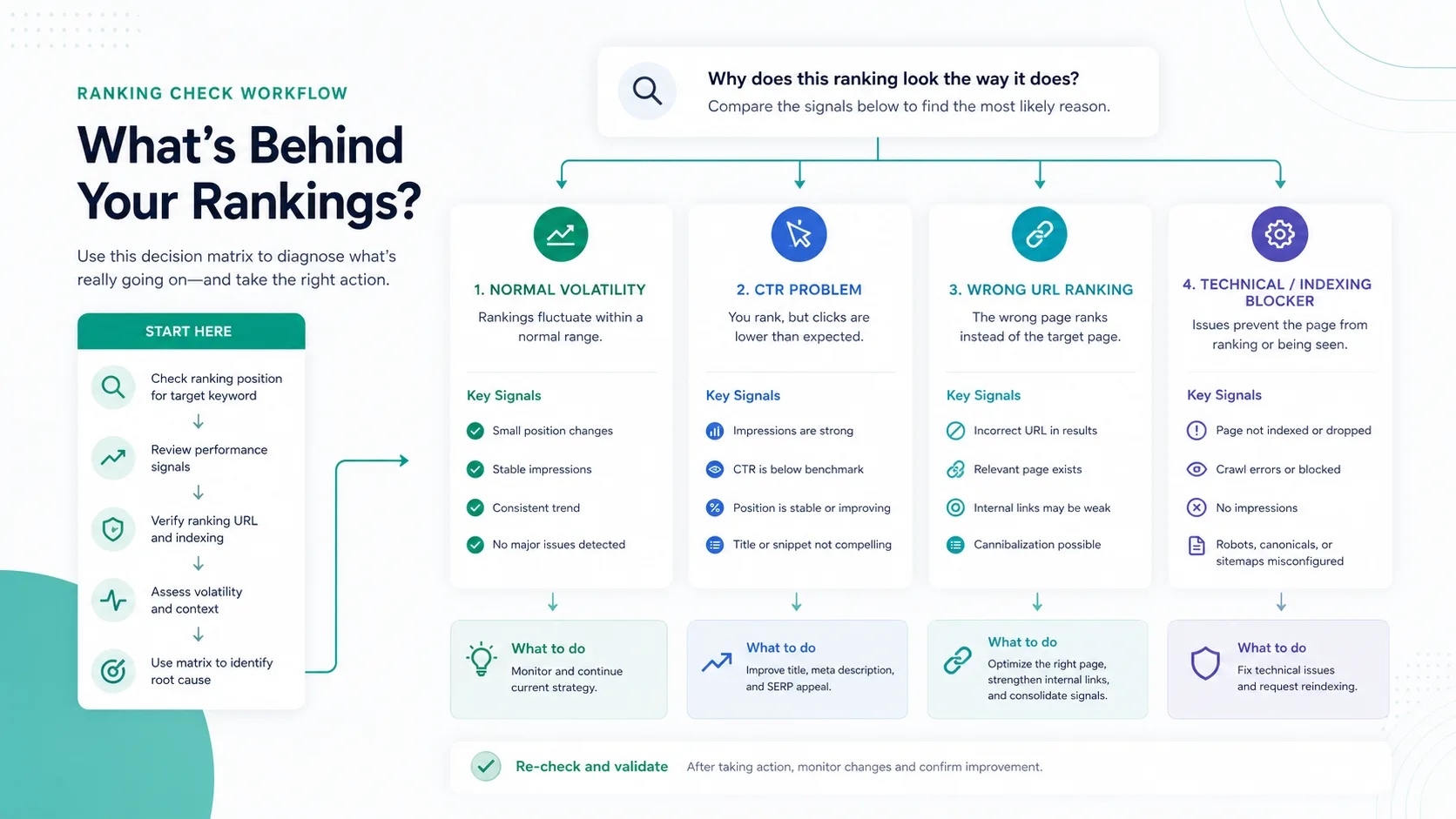
Ranking movement becomes useful when you classify the likely cause. Treat the rank change as a symptom, then choose the response that fits the evidence.
| Diagnosis | Evidence pattern | Action |
|---|---|---|
| Normal volatility | Small position change, stable impressions, stable clicks | Monitor until the next review window |
| CTR problem | Position is stable or improving, impressions are strong, clicks lag | Improve title, meta description, and SERP promise |
| Wrong URL ranking | Another owned page ranks for the query | Clarify intent, adjust internal links, merge, or separate pages |
| Content gap | Right URL ranks but stalls below competitors | Add missing examples, proof, sections, or comparison depth |
| Technical or indexing issue | No impressions, dropped page, blocked URL, bad canonical, or crawl error | Fix crawl/indexability first, then reassess rankings |
| AI-search context gap | Classic rankings are stable, but AI answer visibility or citations are weak | Add concise, source-worthy explanations and entity clarity |
For broader ranking strategy, pair this check with Google ranking factors. For one approved keyword, use the rank for a keyword workflow before deciding whether the page itself deserves a refresh.
Turn The Check Into A Next Action
Every ranking review should end with one of five decisions.
| Decision | Use it when | Validation check |
|---|---|---|
| Monitor | Movement is small or unsupported by Search Console evidence | Recheck the same query and URL in the next review window |
| Improve SERP promise | Impressions are healthy but CTR is weak | Compare title and meta changes against CTR and clicks |
| Strengthen the page | The right URL ranks but lacks depth, proof, or intent coverage | Watch impressions, positions, and assisted queries |
| Fix technical eligibility | The page is not crawled, indexed, canonicalized, or internally linked correctly | Re-crawl, confirm indexability, then review rankings |
| Consolidate or separate pages | The wrong owned URL ranks or two pages compete for the same job | Confirm which URL Google selects after the change |
The validation date matters. If you make a title change today, judging it tomorrow is usually noise. If you fix a noindex mistake, the validation check is crawl and indexability first, then performance. If you merge overlapping articles, the check is which URL Google selects and whether impressions consolidate.
Where Searvora Fits
Searvora fits when ranking checks need to become repeatable team decisions. The AI SEO Dashboard is positioned around page-type cohorts, anomaly detection, opportunity queues, locale drill-down, and executive-ready summaries. That makes it useful after a rank tracker or Search Console view spots movement but before the team rewrites pages on instinct.
Use Searvora to group ranking and Search Console changes by page type, directory, product area, locale, or owner. Then connect the movement to AI-search visibility, crawl evidence, content tasks, and weekly prioritization.
The best workflow is not "check rankings, panic, rewrite." It is:
- Spot the movement.
- Verify the URL and owned performance evidence.
- Classify the cause.
- Assign the right owner.
- Validate the result after the right waiting period.
Run This Ranking Check Checklist
Before you act on a Google ranking number, confirm:
- The keyword, market, device, and date are documented.
- The ranking URL is the page you intended to rank.
- Search Console impressions and clicks support the same story.
- The movement is large enough or persistent enough to deserve work.
- The page is crawlable, indexable, canonicalized correctly, and internally linked.
- The diagnosis is clear: volatility, CTR, wrong URL, content gap, technical issue, or AI-search context gap.
- The next action has an owner and a validation date.
- The result will be reviewed against the same query, URL, market, and device.
Checking Google rankings is a measurement job first and a content job second. Get the evidence straight, protect the pages that are already working, and turn only the meaningful movement into work your team can ship.