

If you are asking "how long does it take to rank on Google," there is no fixed number of days. A cleaner way to ask the question is what stage the page has reached: discovery, crawling, indexing, impressions, CTR, or competitive ranking.
The useful question is not "how many days until position one?" The useful question is whether the page is moving through the right stages. A page that is not indexed has a different problem from a page that earns impressions but no clicks. A page that ranks for the wrong query family has a different problem from a page that simply needs more time, links, or evidence.
The competing Ahrefs article on ranking timelines is useful because it frames ranking age as a measurable pattern, not a promise. Searvora's stronger angle is the operating workflow: segment new pages by age, verify eligibility, watch leading indicators, and decide when a page needs a fix instead of more waiting.
There Is No Single Google Ranking Timeline
Google Search uses automated ranking systems and many signals to show helpful, reliable results. Google's ranking systems guide is a better starting point than any universal timeline because it reminds teams that ranking is comparative, query-specific, and quality-sensitive.
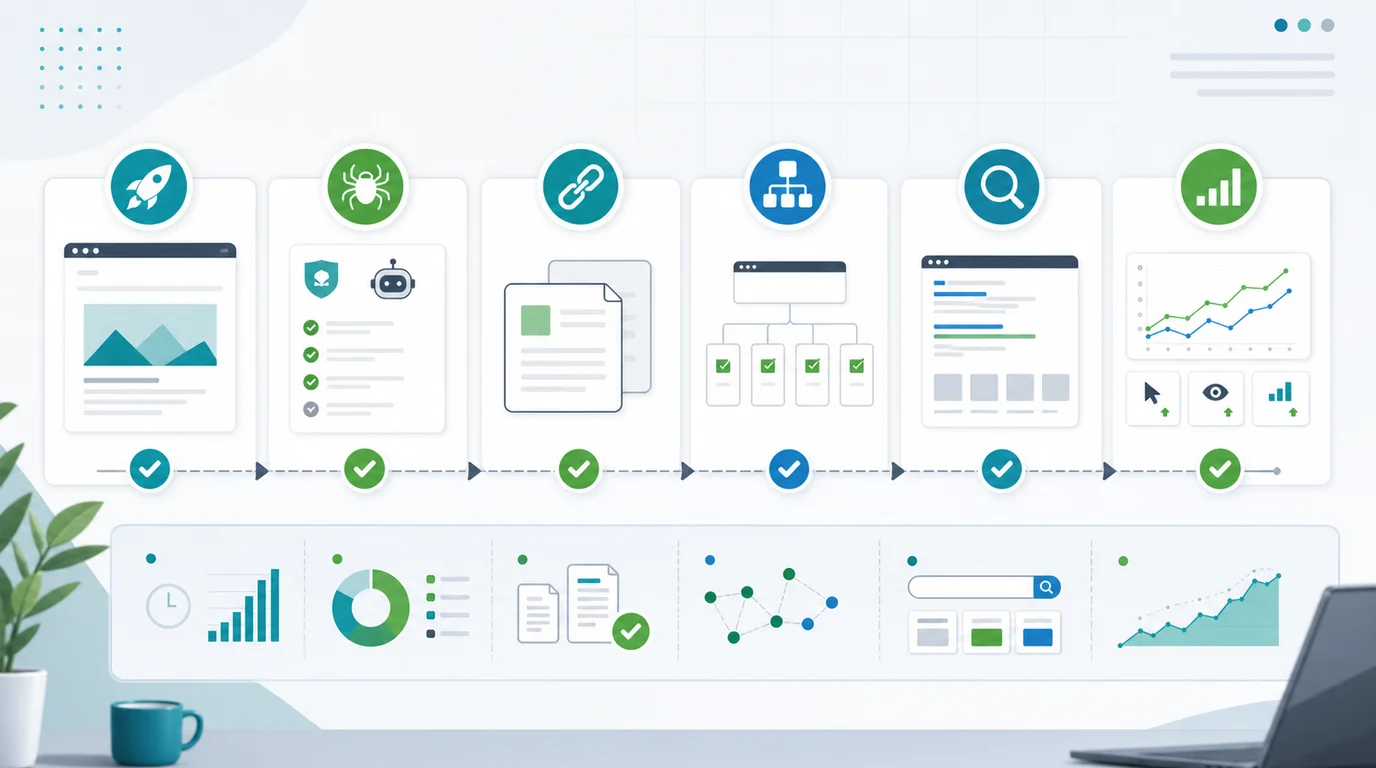
For a practical SEO review, treat ranking as a sequence:
| Stage | What should happen | What to check before changing the page |
|---|---|---|
| Launch | The page is live and internally reachable | Status code, noindex, canonical, rendered content, internal links |
| Discovery | Search systems can find the URL | Sitemap inclusion, crawlable links, robots rules, server health |
| Indexing | The intended canonical can appear in Search | Page indexing status, duplicate signals, canonical selection |
| Early visibility | The page starts receiving impressions for related queries | Query mix, page type fit, title/H1 alignment, snippet promise |
| Competitive ranking | The page earns stronger positions for the right task | Content usefulness, internal links, authority, freshness, SERP fit |
| Validation | The team decides whether to wait, improve, merge, or rebuild | Trend window, owner, expected signal, next review date |
A young page can move through the first stages quickly and still take longer to earn competitive rankings. That does not mean the page failed. It means the team needs to read the right signal for the page's age and role.
Check Eligibility Before You Judge Ranking
Do not judge a new page by rankings until you know it is eligible to compete.
Start with the basics:
- The URL returns a successful status code.
- Robots.txt allows Googlebot to crawl the page and important resources.
- The page is not accidentally noindexed.
- The canonical points to the intended URL.
- The main content appears in rendered HTML.
- XML sitemaps and internal links support the URL.
- The title, H1, intro, and body all answer the same search task.
- The page has at least one relevant internal link from a crawlable page.
Google's Search Essentials are the baseline for crawlability, indexability, and spam-safe practices. If the page fails those basics, ranking delay is not really a ranking problem yet.
For deeper troubleshooting, use the Google indexing workflow before you rewrite the article. It is common for teams to refresh copy when the real issue is a canonical conflict, weak internal links, or a page that Google has not selected for indexing.
Watch Leading Indicators Before Average Position
Average position is a lagging signal. It becomes useful only after the page has enough impressions and a stable query set.
Use leading indicators first:
| Signal | Healthy early movement | Problem pattern |
|---|---|---|
| Crawl and indexing | The intended URL is discovered and indexable | Crawled but not indexed, duplicate without user-selected canonical, blocked resources |
| Impressions | Related queries begin to appear | No impressions after eligibility is confirmed |
| Query mix | Queries match the page's intended job | The page appears for broad or mismatched terms |
| CTR | The snippet earns clicks for relevant queries | Impressions rise but CTR stays unusually low |
| Internal link support | Relevant pages route crawlers and readers to it | The page is orphaned or linked with vague anchors |
| AI-search readiness | Definitions, steps, examples, and evidence are extractable | The page is vague, thin, or hard to summarize |
The SEO metrics to track workflow is the right companion here. It keeps rankings beside impressions, CTR, indexing, AI visibility, authority, and revenue context so the team does not overreact to one number.
Decide When To Wait, Refresh, Or Escalate
Ranking timelines are easier to manage when every page has a review window before it launches. Without a window, teams either panic too early or ignore weak pages for months.

Use this decision table:
| Situation | Likely decision | Why |
|---|---|---|
| Page is new, indexable, and receiving no meaningful data yet | Wait and monitor | There may not be enough query evidence to act on |
| Page is not indexed or the wrong canonical is selected | Fix eligibility first | Content changes will not help if the intended URL cannot compete |
| Impressions grow but CTR stays weak | Improve snippet promise | Title, description, intro, and page angle may not match the query |
| Queries are relevant but positions stall below striking range | Add evidence and internal links | The page may need stronger proof, examples, or topical support |
| Two similar pages split the same task | Consolidate or clarify page jobs | Ranking delay may be cannibalization, not page age |
| The page ranks for the wrong intent | Rebuild the page type or route the query elsewhere | More copy will not fix a wrong search task |
This keeps the conversation specific. Instead of saying "the article is not ranking," the team can say "the page is indexed, earning impressions for the right query set, but CTR is weak and the intro does not answer the query fast enough."
Why Older Pages Often Have An Advantage
Older pages often have more ranking evidence because they have had more time to collect signals. That can include internal links, external references, user engagement patterns, historical query matching, and content updates.
But age is not a ranking strategy by itself. An old page can decay if the intent changes, sources become stale, competitors add better evidence, or the page drifts away from the product and cluster it supports.
Use page age as context:
| Page age pattern | What it may mean | Better next step |
|---|---|---|
| New page with no impressions | Discovery or demand may still be forming | Check eligibility and internal links |
| New page with impressions but poor CTR | The result promise may be weak | Improve title, description, and intro |
| Older page with declining clicks | SERP, snippet, or demand changed | Compare queries and refresh the promise |
| Older page with stable impressions but no growth | Content may be shallow or unsupported | Add evidence, examples, links, and clearer sections |
| Older page competing with a newer page | Page jobs may overlap | Merge, redirect, or clarify intent |
The Google ranking factors article is useful when a page is old enough to evaluate. It helps separate eligibility, relevance, helpfulness, trust, experience, and measurement instead of treating age as the only explanation.
Where Searvora Fits
Searvora AI SEO Dashboard fits the monitoring layer of ranking timeline work. The local product page positions it around page-type cohorts, locale drill-downs, anomaly and trend detection, opportunity scoring, cross-team reporting, and action queues.
Use the AI SEO dashboard to group newly published pages by template, directory, locale, product area, and launch window. Then review each cohort by the stage it should be in: discovery, indexing, early impressions, CTR validation, ranking movement, or fix queue.
That matters because ranking timelines are not only a content question. The same "not ranking yet" complaint can point to a crawl blocker, weak internal links, mismatched intent, thin evidence, a low-CTR snippet, or a page that simply needs a longer window.
Ranking Timeline Checklist
Use this checklist before deciding that a page has taken too long to rank:
- Confirm the intended URL is crawlable, indexable, and canonicalized correctly.
- Check that the page appears in the right sitemap and has internal links from relevant pages.
- Compare the title, H1, intro, and body against the target query's user task.
- Review impressions and query mix before judging average position.
- Inspect CTR only after impressions are meaningful enough to compare.
- Add evidence, examples, tables, screenshots, or official-source links where the page is thin.
- Strengthen internal links from adjacent articles, hubs, and product pages.
- Watch for cannibalization when similar URLs answer the same core task.
- Set a review date tied to the page's age, crawl state, and traffic potential.
- Decide one next action: wait, refresh, consolidate, rebuild, or escalate a technical issue.
How long it takes to rank on Google depends on the page, query, site, competition, and evidence. The reliable workflow is to stop guessing at a universal timeline and start reading the stage-specific signals that tell you what the page needs next.