
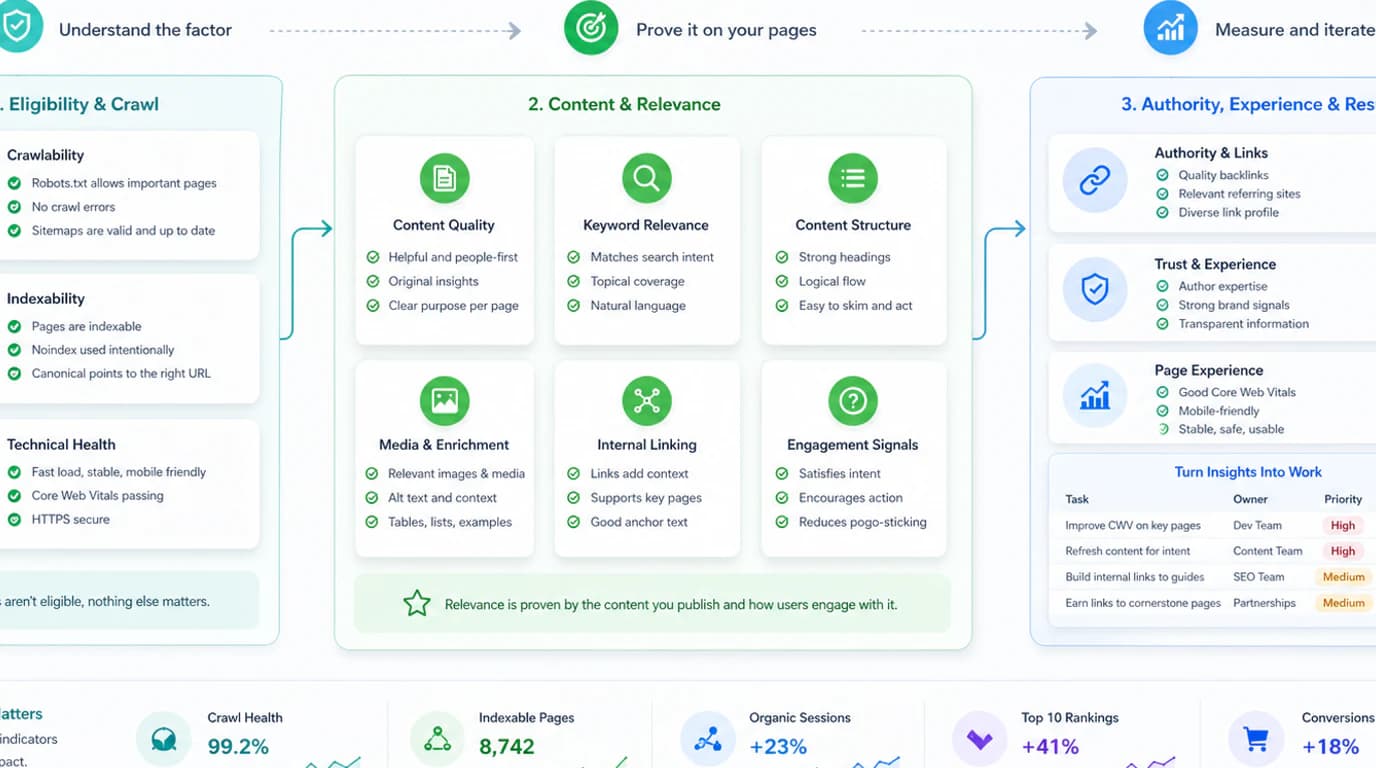
Google ranking factors are the signals and systems Google uses to decide which pages best answer a search. The hard part is not memorizing a rumored list. The hard part is turning the factors you can actually influence into content, technical, link, and measurement work.
The competing Ahrefs article on Google ranking factors is useful because it focuses on confirmed or practical signals instead of pretending anyone outside Google knows the full formula. Searvora's stronger angle is the operating layer: decide which factor category applies, check whether the page has evidence, assign the fix, and validate the result later.
Use Ranking Factors As Operating Checks
Google's ranking systems guide explains that Search uses automated ranking systems and many signals to show helpful, reliable results. That is a better mental model than chasing one magic factor.
For SEO teams, ranking factors are useful when they become checks:
| Factor category | Useful question | Practical SEO work |
|---|---|---|
| Eligibility | Can Google crawl, render, index, and choose this URL? | Robots, canonical, status code, sitemap, internal link, and noindex checks |
| Relevance | Does the page match the query task better than alternatives? | Page type, title, H1, subtopics, intent fit, and entity coverage |
| Helpfulness | Does the page provide original value and a complete answer? | Evidence, examples, screenshots, comparisons, workflows, and source quality |
| Authority and trust | Is the page supported by links, reputation, and clear ownership? | Internal links, external references, author/context signals, and brand mentions |
| Experience | Can users consume the page without friction? | Mobile readability, speed, layout stability, intrusive element review, and accessibility |
| Measurement | Did the change move the right signal? | Search Console, crawl recrawl, impressions, CTR, rank movement, and conversion context |
Start With Search Eligibility
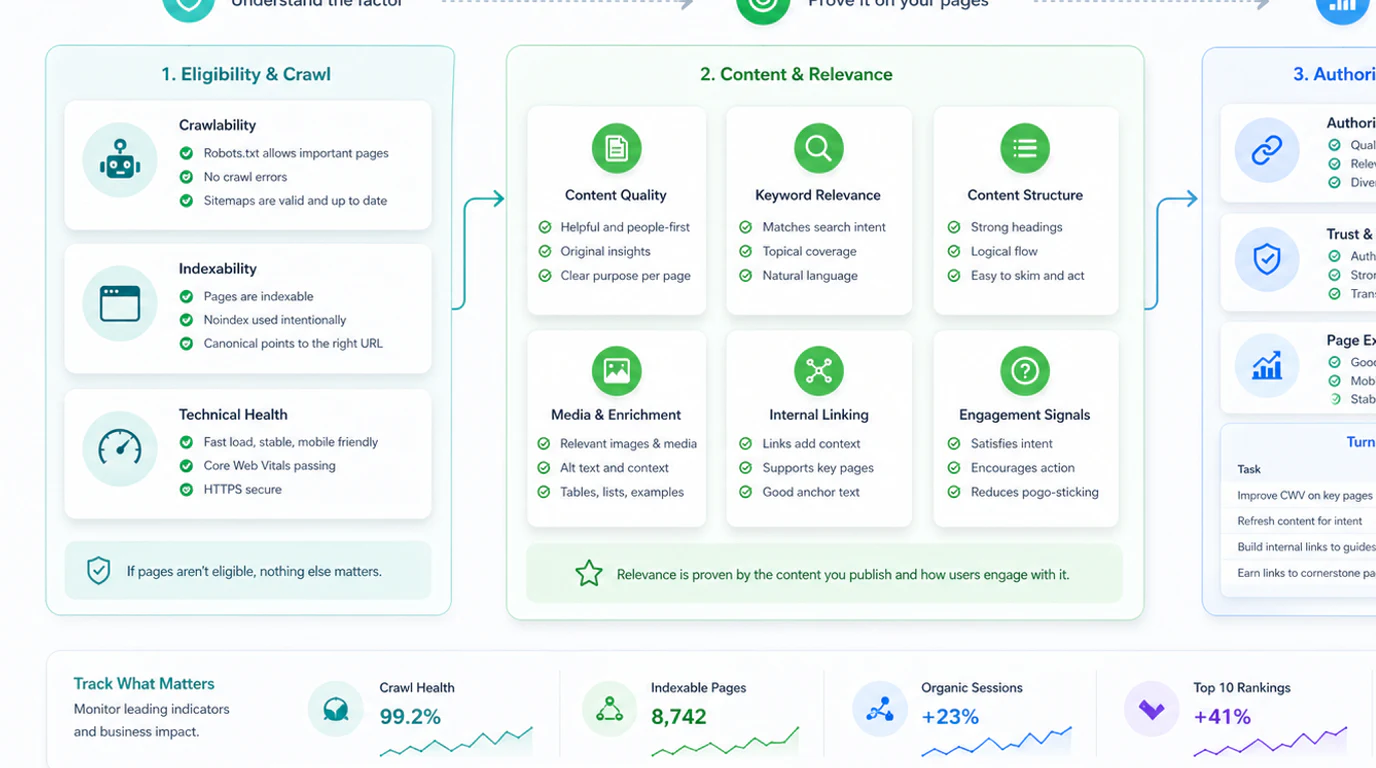
Eligibility comes before persuasion. A page cannot perform if Google cannot discover it, crawl it, render the important content, index the canonical URL, or understand which version should rank.
Google's Search Essentials are the first gate. They cover technical requirements, spam boundaries, and key practices for making pages eligible for Search.
Turn eligibility into a checklist:
- The URL returns a successful status code.
- Robots.txt does not block important resources.
- The page is not accidentally noindexed.
- The canonical points to the intended URL.
- The page appears in XML sitemaps when it should.
- Internal links can reach the page.
- The main content is present in the rendered HTML.
This is where a technical SEO workflow matters. Fixing title copy will not help much if the wrong canonical is selected or the page is stranded four clicks away from important hubs.
Match Relevance To The Query Task
Relevance is not just keyword usage. It is the fit between the searcher's task, the SERP shape, and the page type you publish.
Use the query to decide the job:
| Query pattern | Likely job | Better page type |
|---|---|---|
| "what is..." | Learn a concept | Explainer or glossary-style article |
| "how to..." | Complete a task | How-to guide with steps and validation |
| "best..." or "tools" | Choose between options | Roundup with criteria and comparison table |
| "pricing" | Evaluate cost | Product, pricing, or comparison landing page |
| "template" | Download or copy an asset | Resource page or downloadable asset |
| "vs" | Compare two choices | Side-by-side comparison |
This is why Searvora's competitor URL lane does not approve every high-traffic page as a blog post. A product page should usually be answered with a product page. A resource directory should usually be answered with a resource. A true article-shaped gap can become a blog post.
For content pages, use on-page SEO checks to align titles, headings, subtopics, examples, and internal links with the search task. Relevance improves when the page makes the right promise and then keeps it.
Prove Helpfulness With Evidence
Google's guidance on creating helpful, reliable, people-first content is a useful filter because it pushes teams away from thin rewrites and toward useful evidence.
For an SEO operator, helpfulness becomes concrete when the page includes:
- A direct answer near the top.
- Examples that match the reader's situation.
- Original analysis, screenshots, workflows, or decision rules.
- Clear sourcing for public facts.
- A structure that lets users complete the task without bouncing between ten tabs.
- A next step that fits the user's intent.
Do not confuse helpfulness with length. A short page can be helpful if it answers a narrow task. A long page can be weak if it repeats generic advice without proof, workflow, or decision support.
Treat Links And Trust As Validation Signals
Links still matter, but not every link-related task deserves the same priority. The useful question is whether the page has enough internal and external support for the job it is trying to win.
Start with internal links because they are under your control:
| Check | What to look for | Fix |
|---|---|---|
| Discovery | Important pages have few or no internal links | Add links from relevant hubs, navigation, or related articles |
| Anchor fit | Anchors are vague, duplicated, or misleading | Use descriptive anchors that match the destination task |
| Crawl depth | Priority pages sit too deep in the architecture | Route them closer to strong hubs |
| Orphans | Valuable URLs are not linked from crawlable pages | Add editorial or structural links |
| Link intent | Links send users to a page that does not answer the next question | Change the target or update the destination page |
External references are slower to influence and easier to abuse. Treat them as validation that a page, brand, or resource is useful enough to cite. Do not turn ranking factor work into shortcuts that create spam risk.
Do Page Experience Work Where It Supports The Task
Page experience is important, but it should not become a disconnected performance score chase. Google's page experience guidance frames experience as part of helping users complete the task.
Prioritize page experience issues when they block reading, comparing, purchasing, or taking action:
| Problem | Why it can affect SEO work | Practical fix |
|---|---|---|
| Slow main content | Users cannot reach the answer quickly | Improve rendering path, media weight, and template performance |
| Layout shifts | Users lose trust or click the wrong element | Reserve image, ad, and component dimensions |
| Poor mobile layout | The page is hard to scan on the main device | Tighten headings, tables, spacing, and tap targets |
| Intrusive overlays | The answer is hidden or delayed | Reduce interruption and keep the main content accessible |
| Weak accessibility | Content is harder for users and systems to interpret | Improve labels, headings, alt text, and semantic structure |
Experience work should support the page's purpose. A comparison page needs scannable tables. A tutorial needs clear steps. A technical SEO article needs examples and validation checks.
Turn Ranking Factors Into A Fix Queue
The ranking factor discussion becomes useful when it changes what the team ships next.
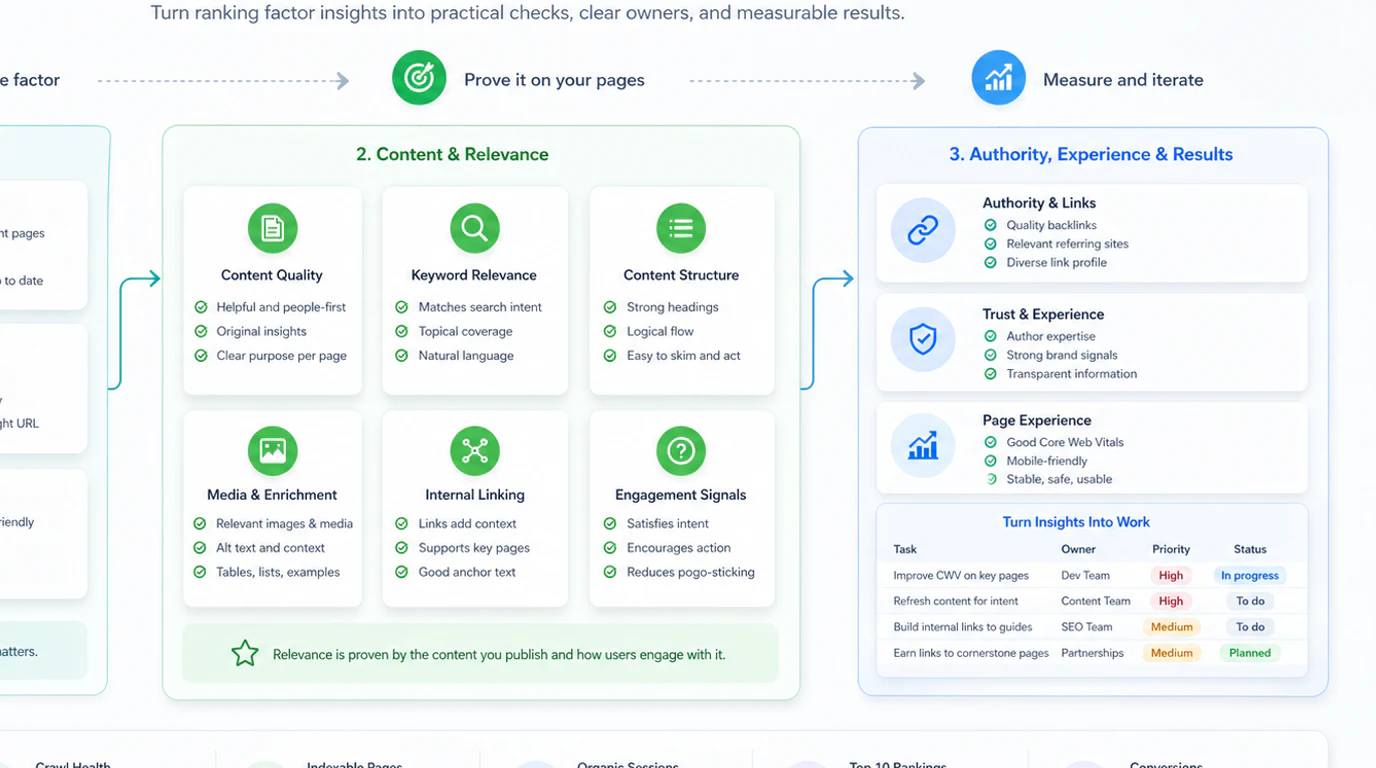
Use this queue format:
| Field | Example |
|---|---|
| URL or cohort | /blog/technical-seo or all product comparison pages |
| Ranking factor category | Eligibility, relevance, helpfulness, trust, experience, or measurement |
| Evidence | Crawl issue, Search Console drop, missing subtopic, thin proof, weak internal links |
| Fix | Update canonical, rewrite title, add comparison table, add source evidence, improve internal links |
| Owner | SEO, content, design, engineering, or product marketing |
| Confidence | High, medium, or low |
| Validation signal | Recrawl, indexing status, impressions, CTR, rank movement, conversions |
| Review date | A specific window after the fix ships |
This is also where a broader SEO checklist helps. Use the checklist to avoid skipping fundamentals, then use the queue to make ownership and validation explicit.
Where Searvora Fits
Searvora AI SEO Dashboard fits the monitoring layer of ranking factor work. The local product page positions it around page-type and locale performance, anomaly detection, opportunity scoring, cross-team reporting, and action queues.
Use the AI SEO dashboard to group pages by page type, directory, and locale. Then monitor whether ranking-factor fixes create movement in the right order: crawl and index eligibility first, then impressions, CTR, rankings, and business context.
That matters because ranking factor debates can stay theoretical for too long. A dashboard-centered workflow keeps the team focused on pages, issues, owners, and evidence.
Google Ranking Factors Checklist
Use this checklist before turning a ranking factor into work:
- Name the search task and page type.
- Confirm the page is crawlable, indexable, and canonicalized correctly.
- Check whether the title, H1, and intro match the query promise.
- Add useful evidence, examples, screenshots, tables, or decision rules where the page is thin.
- Review internal links, anchor text, and crawl depth.
- Keep external link work focused on real usefulness and citations, not shortcuts.
- Fix page experience issues that block reading, comparison, or action.
- Assign every fix to an owner.
- Define the validation signal before the work ships.
- Recheck the page after Google has had time to recrawl and users have had time to respond.
Google ranking factors are not a trivia list. Treat them as operating categories: eligibility, relevance, helpfulness, trust, experience, and measurement. Then turn the weak spots into a queue your team can actually ship.