

Digital marketing Facebook groups are useful only when they match your job, show signs of active moderation, limit low-value promotion, and give you enough current public evidence to justify requesting access. The largest group is not automatically the best one.
This roundup rechecks the ten communities named in the Ahrefs 2022 Facebook marketing groups article. As of August 8, 2026, every direct group URL redirected a logged-out browser to Facebook login. That means the old member counts, privacy labels, and activity claims cannot be treated as current facts. The list below is therefore a verification queue, not a fabricated leaderboard.
Ten Digital Marketing Facebook Groups at a Glance
Use the evidence column to decide where to start. "Owner-side" means an organizer or affiliated organization still references the community publicly. "Directory-side" means a recent third-party page identifies it, but Facebook itself must still be checked. "Stale" means the public evidence is too old or inconsistent for a confident recommendation.
| Group candidate | Best-fit topic | Public evidence available now | Confidence before login | Next check |
|---|---|---|---|---|
| Marketing Solved | General and social media marketing | A public operator page still points toward a Facebook group, but the surfaced page is on a staging domain | Low | Confirm canonical group, owner, rules, and recent posts in Facebook |
| SaaS Growth Hacks | SaaS growth and conversion | A current community directory identifies the same group path and an application process | Medium-low | Verify current admins, discussion quality, and promotion limits |
| CXL Conversion Optimization, Analytics and Growth | CRO, analytics, and experimentation | CXL has publicly described the group, but the supporting article is dated | Medium-low | Check whether the group still carries the same name and focus |
| SaaS Products and Marketing | SaaS product marketing | A 2024 third-party roundup identifies the group | Low | Verify continuity, recent activity, and who moderates it |
| Facebook Ad Hacks | Paid social and creative testing | A current third-party directory still identifies the group and founder | Medium-low | Confirm whether current posts match the paid-social job you need |
| Sisters in SEO | SEO community for women and gender-nonconforming practitioners | The affiliated team page still identifies the community and its co-founder | Medium | Confirm current access rules, scope, and recent moderation signals |
| Google SEM Mastermind | Search marketing | No reliable recent owner-side evidence; public naming also drifts between SEM and SEO | Low | Do not join from an old link until the canonical identity is confirmed |
| Dumb SEO Questions | General SEO questions | A Facebook post under the named group path was indexed within the past year | Medium | Confirm that the current path matches the old numeric group URL |
| Local SEO Strategies and Google My Business Help | Local SEO | Founder-side public evidence exists, but it is several years old | Low | Recheck the name, Google Business Profile scope, and recent activity |
| Superstar SEO | SEO, freelancing, and agency growth | An owner-affiliated current article still links the same group path | Medium | Verify present rules, topic mix, and promotional volume |
This is a true roundup, but it deliberately avoids current member counts and activity scores. Those facts were not visible without login, and a login page is not evidence that a group remains active.
Use Five Gates Before You Request Access
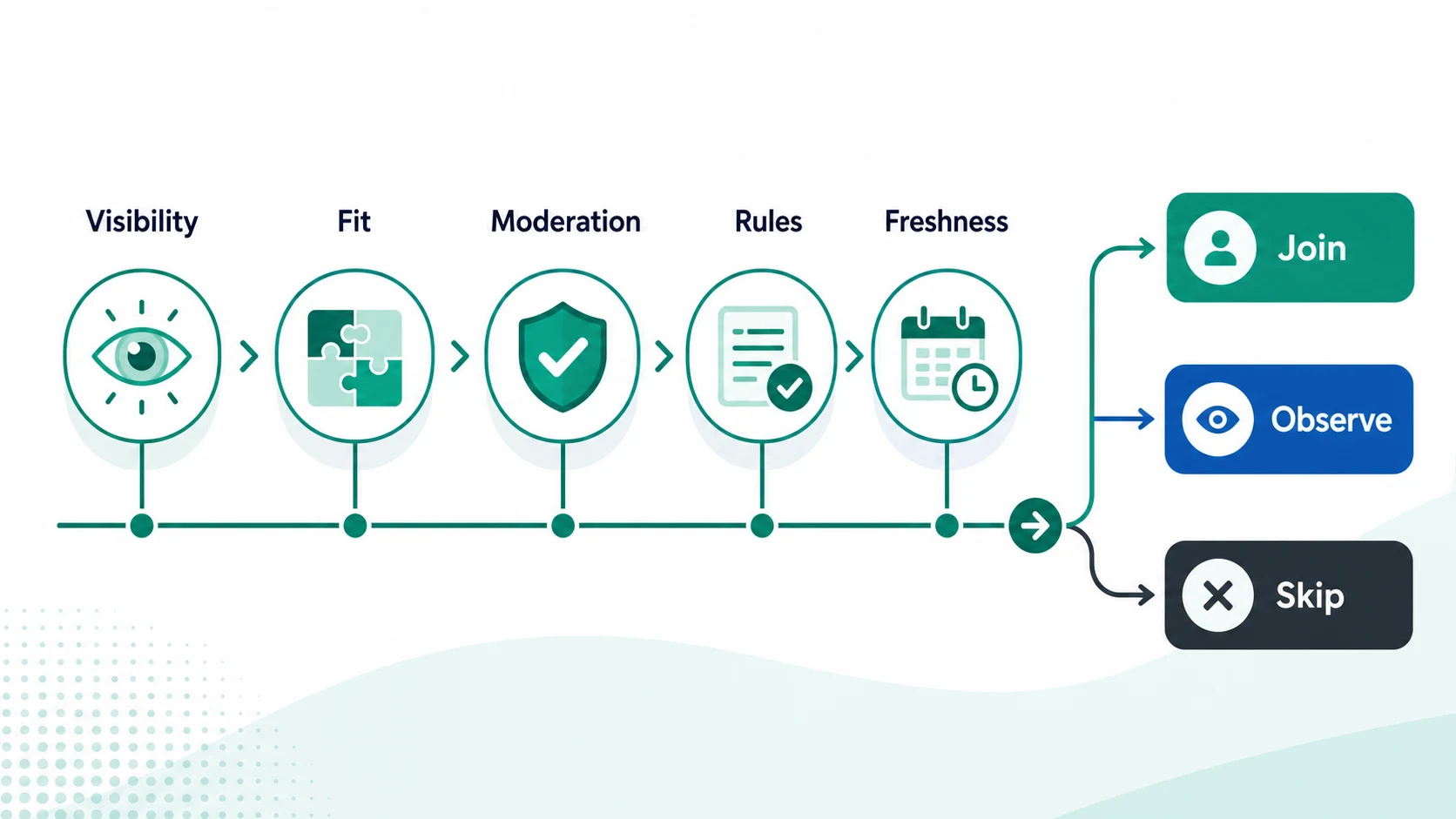
Run every candidate through the same five gates. This protects you from choosing a group because an old article called it "best."
- Public visibility. Can you confirm the exact name, canonical URL, owner, and topic from current public evidence?
- Job fit. Does the community serve the decision you need to make: local SEO, CRO, SaaS growth, paid social, technical SEO, or general marketing?
- Moderation. Are rules visible? Do admins appear to remove spam, protect members, and keep discussions on topic?
- Promotion rules. Is self-promotion limited to named threads, disclosed clearly, or prohibited? A group dominated by links and pitches is not a peer-learning system.
- Freshness. What is the most recent visible post date? Are useful questions receiving replies? Is the group name and admin identity still consistent with public references?
Meta explains that posts and membership in public groups can be visible publicly, while private-group content is limited to members. Its group privacy guidance is the right source for interpreting the label you see in Facebook. It does not validate any individual community's quality.
1. Marketing Solved Needs a Canonical-URL Check
Marketing Solved appeared in the original roundup as a general marketing and social media community. The positioning can fit founders and marketers who want broad peer discussion rather than a specialist technical group.
The current public evidence is not strong enough for a direct recommendation. A surfaced operator page still invites people toward a Facebook group, but it sits on a staging subdomain and does not expose current platform facts. Confirm the canonical URL, admin identity, rules, and recent posts before requesting access.
Choose it only if the current discussion mix is specific enough for your job. A general group can be useful for distribution and messaging questions, but it may be too broad for technical SEO diagnosis.
2. SaaS Growth Hacks Is a Specialist Candidate
SaaS Growth Hacks is positioned around SaaS growth, conversion, and founder problems. A current community-directory entry identifies the same Facebook path and describes an application process.
That directory is discovery evidence, not proof of current activity. After login, inspect whether discussions still focus on SaaS acquisition, activation, retention, conversion, and experimentation rather than generic promotion. Check whether questions receive substantive replies and whether admins enforce the stated scope.
This candidate is a better fit for SaaS growth teams than for local businesses or ecommerce operators looking for platform-specific execution advice.
3. CXL Is the CRO-Focused Lead
CXL Conversion Optimization, Analytics and Growth has the clearest specialist job in the list: experimentation, analytics, and conversion optimization. CXL has publicly referenced the group, which supports its identity, although that article is not current enough to prove 2026 activity.
Evaluate the current community for evidence standards. Useful CRO discussion should separate a hypothesis from a result, describe the audience and page context, and avoid treating one test outcome as a universal tactic. If the current feed is mostly tool promotion or screenshot-free wins, the specialist label is not enough.
4. SaaS Products and Marketing Has Weak Current Evidence
SaaS Products and Marketing may fit product marketers and SaaS founders who need positioning, launch, onboarding, and acquisition discussion. The strongest public corroboration found in this review was a third-party list published in 2024.
That is too weak for a current endorsement. Verify whether the group still exists under the same name, whether admins are identifiable, and whether recent posts serve product-marketing decisions rather than broad founder promotion. Keep it in the "observe" column until those checks pass.
5. Facebook Ad Hacks Serves Paid-Social Work
Facebook Ad Hacks is the paid-social specialist in the set. A current directory page still identifies the group and its founder.
Do not join it expecting an organic SEO community. Use it when your job involves Meta ad creative, campaign setup, testing, or paid acquisition. After login, review whether tactical claims include enough context to be useful and whether promotional posts are controlled.
Paid-social observations can inform landing-page messaging, but they should not automatically become organic content briefs. Search intent and page type still need separate validation.
6. Sisters in SEO Has the Strongest Owner-Side Signal
Sisters in SEO is intended for women and gender-nonconforming people working in SEO. The affiliated team page still identifies the community and its co-founder, giving it a stronger public identity signal than most candidates here.
The logged-out Facebook page still reveals nothing about current activity, privacy, or rules. Eligible practitioners should confirm those details directly and respect the community's stated audience boundary. A focused peer space is valuable precisely because it is not designed for every marketer.
7. Google SEM Mastermind Should Stay on Hold
The original roundup linked a group described as Google SEM Mastermind. Current public references drift between "SEM" and "SEO," and this review found no reliable recent owner-side page that resolves the difference.
Do not rely on the old link or a copied directory entry. Confirm the exact group name, canonical URL, owner, and current scope inside Facebook before treating it as a search-marketing resource. Name drift is a practical impersonation and stale-link risk, not a minor editorial detail.
8. Dumb SEO Questions Has a Recent Platform Signal
Dumb SEO Questions is designed for broad SEO questions without the pressure to sound advanced. A post under that named Facebook path was indexed within the past year, which is a better continuity signal than an old external roundup.
The original Ahrefs article used a numeric group URL, so confirm that the named path and legacy URL refer to the same current community. Then inspect the response quality: good beginner communities explain why an answer applies, identify exceptions, and link to primary documentation when rules or platform behavior matter.
If your preferred learning format is curated publishing rather than discussion, compare the best SEO blogs for practical workflows. A community is strongest for context and follow-up questions; a maintained source is stronger for stable reference material.
9. Local SEO Strategies Needs a Freshness Check
Local SEO Strategies and Google My Business Help was associated with Tim Kahlert and serves local-search questions. Founder-side public evidence exists, but it is several years old, and the name still uses the former Google My Business terminology.
The old name does not automatically make the group obsolete, but it raises a maintenance question. Verify whether the current description reflects Google Business Profile, local landing pages, reviews, entity consistency, and current platform policies. Treat advice about suspensions, reviews, or business-profile eligibility as high risk until it is checked against current official documentation.
10. Superstar SEO Has an Owner-Affiliated Continuity Signal
Superstar SEO is positioned around SEO, freelancing, and agency growth. An owner-affiliated current article still links the same Facebook path.
That supports continuity, not quality. Review the current topic mix and promotion volume before joining. A community that combines SEO and freelancing may be useful for client delivery and agency operations, while offering less depth on crawl, indexation, or AI-search measurement.
Turn Community Questions Into Ethical Content Evidence
Communities are useful because practitioners surface language, edge cases, and implementation friction that polished documentation can miss. They are not a license to copy private posts or publish member details.
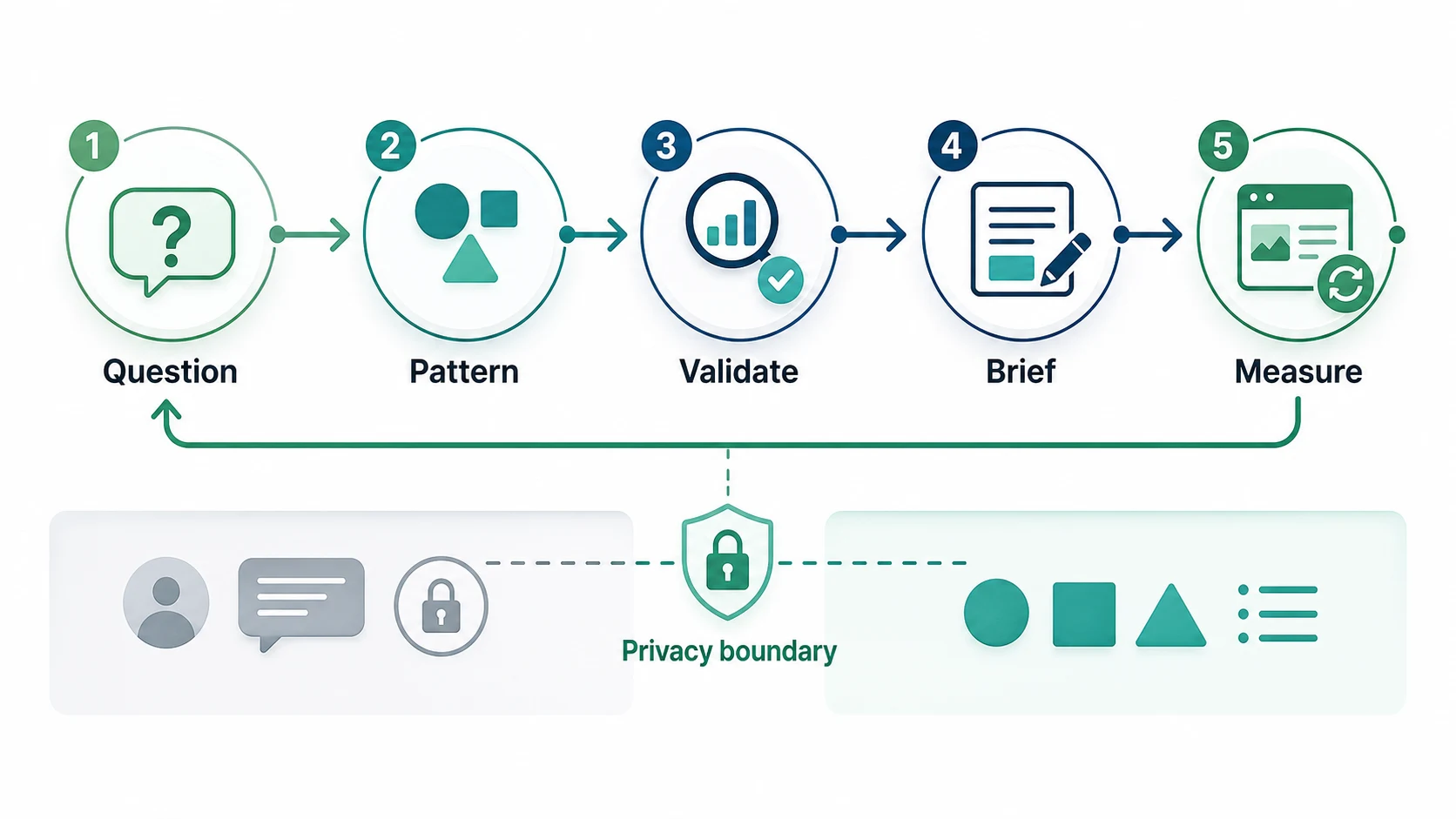
Use this five-step workflow:
- Capture a recurring question as a generalized problem, without names, screenshots, or private details.
- Separate the reusable pattern from one person's circumstances.
- Validate search demand, existing coverage, page type, and primary sources.
- Create a content brief with sources, links, visuals, and acceptance checks.
- Publish only when the page adds evidence, then measure whether it answers the intended query and refresh it when the underlying platform changes.
Never present a group's private discussion as market consensus. Ask permission before quoting a member, and keep client data, credentials, account details, and unpublished performance information out of public briefs.
Add a Safety Check Before Participating
Facebook groups can expose members to impersonation, malicious links, fake support, account-takeover attempts, and investment or shopping scams. The CISA social-media safety guidance recommends protecting credentials and sensitive information. The FTC's current social-media scam guidance recommends verifying businesses independently and treating unsolicited offers cautiously.
Before you join or respond:
- use a unique password and multi-factor authentication;
- never share client access, recovery codes, billing data, or private analytics in a post or direct message;
- verify admins and vendors outside the group before paying or granting access;
- open shortened links cautiously and check the destination domain;
- report impersonation, credential requests, and obvious fraud;
- leave when moderation repeatedly fails to protect the stated purpose.
Where Searvora Fits
A useful community can produce dozens of questions, but that does not mean every question deserves a page. Searvora AI SEO Consultant fits the decision layer after discovery. Its public product surface focuses on pattern-based diagnosis, impact-and-effort prioritization, fix-ready guidance, and assignable action queues.
Use the AI SEO consultant to turn verified recurring themes into decisions:
- update an existing page when the same job is already covered;
- create an article when the query is editorial and evidence-backed;
- choose a landing, tool, or hub when the user needs a different page type;
- defer when current public evidence is too weak;
- stop when the idea would expose private information or drift from product scope.
A 10-Minute Group Evaluation Checklist
Before requesting access to any digital marketing Facebook group:
- Confirm the exact current group name and canonical URL.
- Read the Facebook privacy label and group description.
- Match the topic to the job you need help with.
- Identify current admins or an owner-side reference.
- Inspect the most recent visible post date after login.
- Review rules for self-promotion, links, recruiting, and direct messages.
- Sample several questions and assess the specificity of replies.
- Reject copied claims, unexplained wins, and advice that conflicts with primary documentation.
- Protect credentials, client data, and private analytics.
- Record the observation date and recheck the community before recommending it to someone else.
The right group is a current, moderated environment for a specific job. Verify it on the platform, use public evidence honestly, and turn only validated patterns into work your team can own and measure.