

SEO content is content created to satisfy a specific search task and earn organic visibility. It can be an article, product page, landing page, tool, comparison, or hub. The format matters because a well-written article is still the wrong answer when the searcher needs a calculator, product detail, or maintained directory.
The practical workflow is to identify the task, choose the canonical page type, check what already exists, define the evidence the page needs, produce it, verify that search systems can access it, and measure whether it serves both traditional search and AI-generated answers.
The public Ahrefs guide to SEO content explains the beginner path from keyword research and search intent to creation. Searvora's information gain is the operating layer across page types: deciding what deserves a page, routing the work, enforcing quality gates, validating the live URL, and feeding results into the next refresh decision.
SEO Content Starts With The Page Job
A keyword is evidence of demand, but it does not define the deliverable. Before outlining anything, write one sentence that describes what the searcher needs to accomplish.
Then route that job to the format most likely to satisfy it:
| Search task | Strong default page type | What would make another type better |
|---|---|---|
| Learn a concept or process | Article | A broad cluster may need a parent hub with child guides |
| Evaluate a product or service | Product or landing page | A fair comparison article can support an earlier research stage |
| Complete a repeatable task | Tool | A how-to article still helps when setup and validation require judgment |
| Compare several options | Roundup or comparison | A commercial landing page may own the final conversion task |
| Navigate a broad subject | Parent hub | A single focused article is better when the task is narrow |
| Fix an existing page | Refresh or consolidation | A new child page is valid when the user job is genuinely different |

This routing step prevents a common SEO failure: publishing another blog post because articles are easy to produce. If the winning result should be a tool, the article can explain the workflow, but it should not pretend to replace the tool. If a current URL already serves the same keyword, page type, and user job, improve that URL instead of creating a competitor.
Audit Existing Coverage Before Drafting
SEO content planning should begin with an inventory, not a blank document. Search the current site for pages with the same keyword family, similar titles, overlapping headings, and the same intended next action.
Classify the closest URL into one of four outcomes:
- Keep and refresh. The page already owns the task but needs better evidence, structure, links, or freshness.
- Consolidate. Two URLs serve the same task and neither has a useful independent role.
- Create a child page. The new task is narrower, more technical, or shaped differently from the parent.
- Create a parent hub. Existing child pages are useful, but readers need a map that explains how the pieces fit together.
Do not use vocabulary overlap as the deciding factor. A broad SEO content hub can link to a content brief workflow, a focused Blog SEO process, and a refresh-oriented content optimization workflow without duplicating their jobs.
The inventory should also include product and tool routes. If the searcher wants to run a crawl, generate an asset, or inspect a URL, the canonical answer may belong outside the blog. The article can still support discovery and explain judgment, but it should route the reader to the functional page.
Build Evidence Into The Brief
An SEO content brief should lock the decisions that are expensive to reverse after drafting. It should not prescribe every sentence.
At minimum, define:
- the approved keyword and the exact reader job
- the page type and why it matches the task
- the primary information gain over existing results
- the facts that require official sources or current public evidence
- the sections, table, checklist, or decision aid the reader needs
- the visual plan and whether any factual screenshot is required
- the primary internal destination and up to three supporting pages
- the technical and editorial checks required before publication
- the first measurement window and the condition that triggers a refresh
Information gain should be concrete. "More comprehensive" is not a useful angle. Better options include a decision tree, a validation protocol, a current public-source comparison, a template-specific workflow, or a bridge between crawl evidence and content priorities.
The brief should also say what not to claim. Do not invent hands-on experience, customer outcomes, product limits, integrations, or third-party policies. If the page discusses a named product, use its current public surface as evidence and keep the interpretation separate from the verified fact.
Match The Structure To The Search Intent
Different SEO content types need different bodies. Reusing one generic outline produces pages that look complete but fail the task.
| Article type | Put near the top | Required proof of fit |
|---|---|---|
| Explainer | Direct definition and example | Clear operational next step |
| How-to | Steps, prerequisites, and success condition | Validation after the action |
| Fix guide | Likely causes and triage order | Fix sequence and recheck |
| Review | Fair summary and decision criteria | Current official public evidence |
| Best or tools roundup | Comparison table and multiple verified options | Real option-by-option sections |
| Alternative | Who the named product fits and where the alternative differs | Public-source comparison without fake testing |
| Parent hub | Topic map and child-page routes | Distinct scope for each linked page |
The introduction should satisfy the primary intent in the first one or two paragraphs. Headings should expose the workflow, not repeat keyword variations. Tables should keep comparisons searchable. Images should explain a decision or document a factual surface; decorative artwork does not replace missing evidence.
For AI-answer visibility, make key definitions and decision rules self-contained. A passage is easier to cite when it names the object, states the rule, and explains the boundary without requiring five earlier paragraphs.
Move From Approved Brief To Published Page
Production should preserve the planner's decisions while allowing editorial judgment. Use a small set of gates rather than relying on a final proofread to catch everything.
Draft gate
- The opening answers the task.
- The title matches the article type and avoids template-like hype.
- Claims are supported by local product evidence or official public sources.
- The content adds the promised information gain.
Enrichment gate
- Internal links have distinct purposes.
- External sources are sparse, current, and clearly attributed.
- The cover is an original editorial visual, not a disguised screenshot.
- Body visuals explain the surrounding section or provide factual evidence.
SEO gate
- The canonical points to the intended live URL.
- Title and meta description match the search promise.
- The page is indexable and appears in the correct sitemap.
- Locale alternates exist only when a real translated page exists.
Handoff gate
- The owner knows whether the result is a draft, audited handoff, or published page.
- The measurement window and refresh trigger are recorded.
- Publication remains a separate decision from writing and validation.
This is where automation is useful: it can make required fields, image evidence, link rules, database state, and audit output repeatable. Editorial approval still decides whether the page deserves to exist and whether its claims are ready for a public audience.
Validate The Live URL After Content QA
A strong draft can still fail as a web page. After rendering, verify the actual HTML and assets rather than assuming the source file is enough.
Check the live candidate URL for:
- correct title, description, canonical, and indexability
- one visible cover and section-relevant local body visuals
- valid internal destinations and external link attributes
- sitemap inclusion and safe locale alternates
- crawlable main content, headings, and navigation
- no hydration failure, missing image, or stale generated output
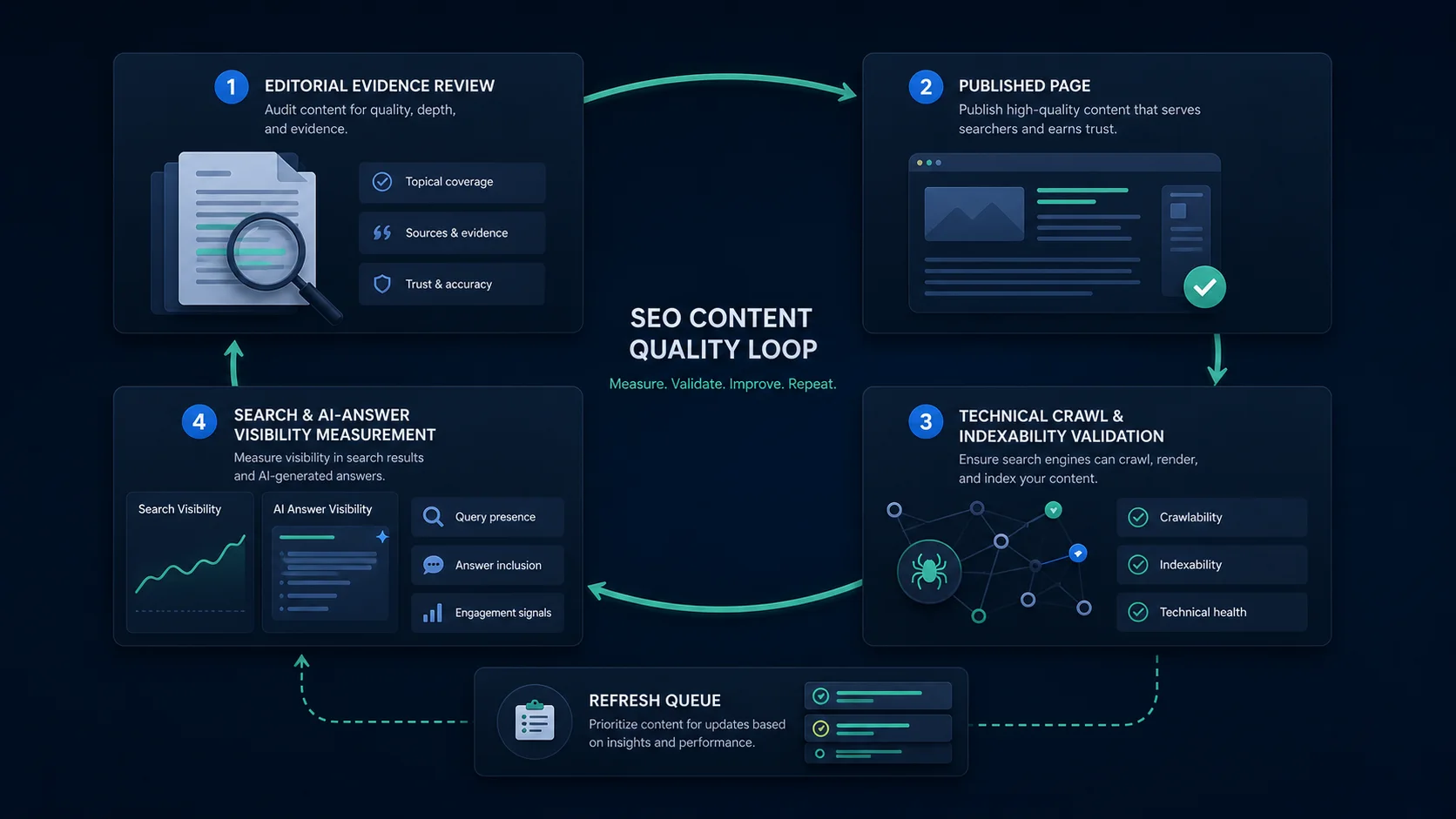
Technical eligibility is part of content quality. If the canonical is wrong, the page is absent from the sitemap, or important body content does not render, the content workflow is not finished.
After launch, measure the page against its job. An explainer needs relevant impressions and query breadth. A parent hub should help readers reach the right child pages. A tool-led page should move qualified visitors into the task. A refresh should recover or improve the signals that justified the update.
Search visibility is only one feedback source. Also watch whether the page's definitions and evidence appear clearly in AI-generated answers, whether the cited passage still matches the current product or policy, and whether new queries reveal a missing child page.
Turn SEO Signals Into The Next Action
The final step is prioritization. Teams usually have more possible content work than they can ship, so each page should feed a ranked queue rather than a vague backlog.
Score the next action using:
- search demand and business relevance
- confidence in the page type and user job
- gap against current site coverage
- information gain that can be verified
- effort for research, visuals, review, and implementation
- technical readiness of the destination
- measurement confidence after the change

The local Searvora product surface positions AI SEO Consultant around turning mixed signals into prioritized, execution-ready recommendations. That is the right role here: use evidence to decide whether the next action is a new article, a refresh, a landing page, a tool, a technical fix, or no page for now.
SEO Content Checklist
Before a page moves toward publication, confirm:
- The core search task is stated in one sentence.
- The page type matches the task better than the alternatives.
- Existing URLs were checked for the same keyword, type, and job.
- The brief names a verifiable information gain.
- Structure matches the article or page archetype.
- Claims, screenshots, and product facts come from valid sources.
- Internal links support distinct next steps.
- Canonical, indexability, sitemap, and locale behavior are correct.
- The rendered page visibly includes its required visuals and content.
- The owner, measurement window, and refresh trigger are recorded.
SEO content is not just copy written around a keyword. It is the result of a page-type decision, an evidence plan, a production workflow, a technical validation, and a measured feedback loop. When those parts stay connected, teams can publish fewer wrong pages and more useful canonical answers.