

If you are asking how to earn more links, start by finding pages that have already proved they can help a reader—not by copying whichever URLs have the largest raw link count. A page can earn attention because it is genuinely useful, because the site already has distribution, or because its topic happens to be easy to cite. Those are different signals, and treating them as the same leads to weak content briefs.
The useful job is to identify pages that outperform the context around them, learn what made them useful, fix anything that would make your own page hard to trust or crawl, and only then decide whether promotion is warranted. The Ahrefs article that surfaced this opportunity makes the same important distinction: compare content, not only big websites.
This workflow does not promise a backlink count. It gives an SEO team a defensible way to decide which content deserves improvement, internal support, or careful outreach next.
Start With Pages That Have a Citation Reason
Not every successful page is a model for link earning. A home page, a heavily promoted sales page, or a news post with a temporary spike may attract attention without teaching you what a durable reference should look like.
Begin with a small set of pages from your own inventory, competitors you are allowed to review, public search results, or sources your team has permission to use. For each page, record the same evidence:
| Evidence | Why it matters | What to avoid assuming |
|---|---|---|
| Page job | A definition, method, template, original data point, or decision aid is easier to cite than a generic pitch | A popular topic is automatically a cite-worthy asset |
| Observable references | Relevant editorial references can show that a page helps another reader task | Every reference is a quality signal |
| Site context | Compare a page with similarly aged and similarly purposed pages on the same site | A large site makes every linked page exceptional |
| Search and audience fit | The heading, examples, and structure should answer a persistent question | A traffic spike proves evergreen value |
| Proof depth | Sources, examples, methods, tools, or templates give someone a reason to refer to the page | Longer content is automatically stronger |
If the content does not have a clear citation reason, do not send it into promotion. First decide whether it needs a better format. The linkable assets workflow helps separate a page that deserves to be referenced from a page that merely wants links.
Measure Content in Context
Raw link totals hide the question that matters: did this page do unusually well for a page of its type on this site? Build a short comparison set before drawing conclusions. Keep page purpose, age, update cadence, internal support, and topic close enough that the comparison is useful.
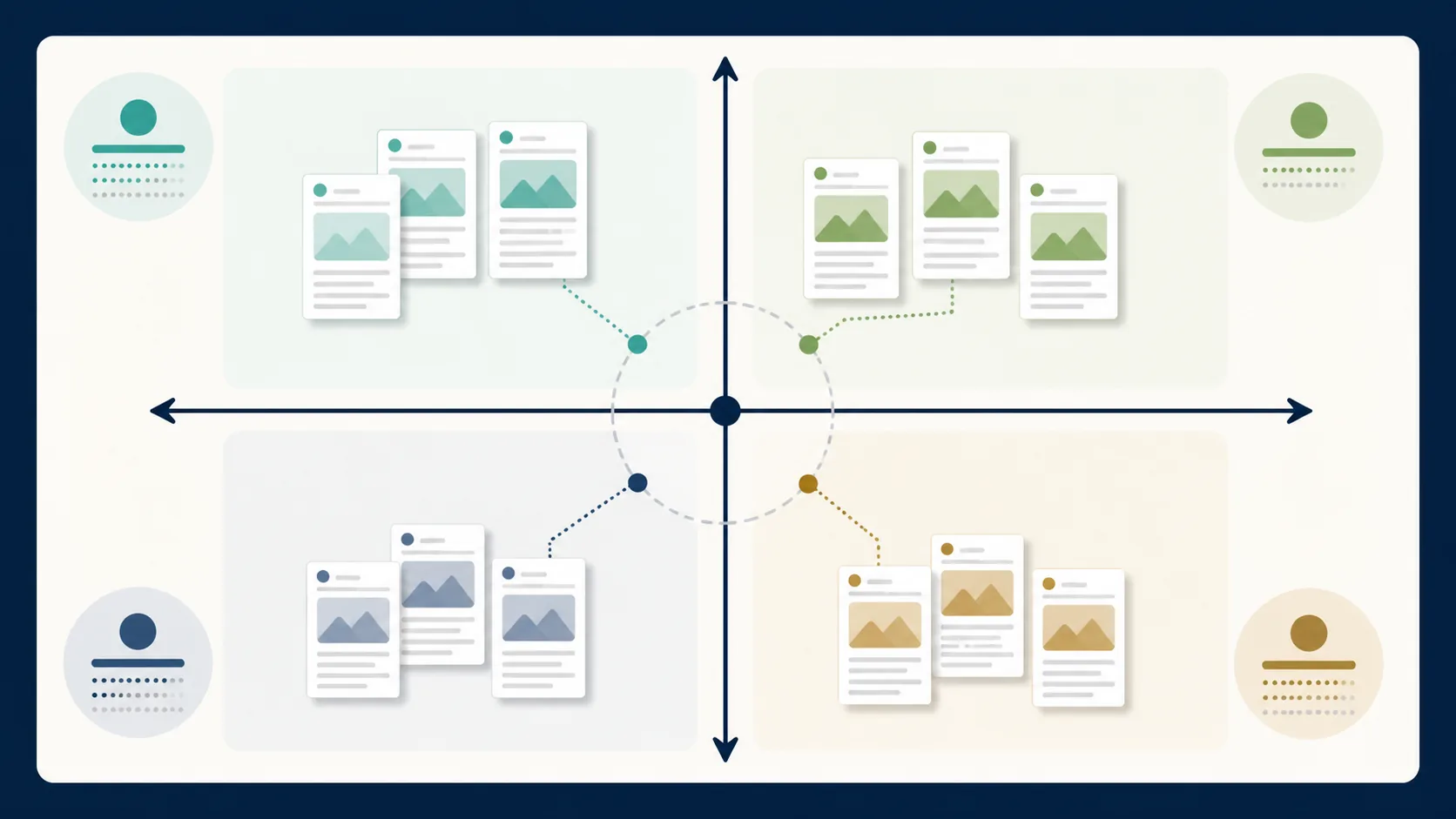
Use two axes in your working sheet:
- Absolute evidence: the references, visibility, engagement, or demand you can observe from approved sources.
- Relative evidence: how the page compares with other pages of a similar job on the same site.
The result is not a universal score. It is a conversation starter about what to inspect next.
| Pattern | Likely interpretation | Next action |
|---|---|---|
| Strong absolute and relative evidence | The page is useful even after its site advantage is considered | Study its format, proof, and internal support; protect or extend it |
| Modest absolute evidence but strong relative evidence | A quieter page may be an overlooked model | Look for a repeatable reader problem and build a better version |
| Strong absolute evidence but weak relative evidence | Distribution, brand reach, or temporary demand may be doing most of the work | Inspect the source of attention before copying the format |
| Weak on both axes | The page has not shown a credible signal yet | Do not make it the basis for a promotion brief |
This is where the workflow stays distinct from generic link-building advice. The goal is not to reverse-engineer a competitor word for word. It is to find the combination of reader task, evidence, format, and page quality that made a page relatively effective.
Turn the Analysis Into a Defensible Shortlist
After the first pass, keep only a few candidate pages. A short list is useful when every entry has a page-level rationale, not just a metric beside it.
For each candidate, answer these questions before assigning work:
- What reader problem does the page solve better than nearby alternatives?
- Which proof element carries the value: an example, process, source, template, or original framing?
- Is the current page type correct for that problem, or should it become a tool, hub, reference, or downloadable asset?
- What is missing from our version that would make it clearer, more current, or easier to verify?
- Can the team describe the next action without saying only “build links”?
If a candidate page is simply a thin version of a competitor topic, stop. Add information gain before production. That might be a better decision table, an execution checklist, original examples, a more precise page type, or a stronger route between a parent hub and its child content.
If the shortlist starts with an existing inventory rather than a new idea, pair this step with a content audit. It helps a team assess page health, cannibalization risk, and the choice between refreshing, merging, expanding, or retiring a page before more work is added.
Fix the Page Before You Promote It
A useful page can still fail as a promotion target if it is hard to crawl, carries a confused canonical, lacks internal routes, or gives the reader no clear reason to stay. Promotion should follow page readiness, not replace it.

Run a pre-promotion check that includes both content and technical evidence:
| Readiness check | Pass condition | Owner-ready follow-up if it fails |
|---|---|---|
| Canonical and indexability | The intended URL is crawlable, indexable, and points to itself where appropriate | Fix the canonical, noindex, redirect, or blocked-resource issue first |
| Reader task | The introduction and headings answer one specific question | Rewrite the promise or route the work to a better page type |
| Proof and freshness | Sources, examples, and claims are current enough to trust | Add primary-source context, a date, or a concrete example |
| Internal support | Relevant parent, child, and related pages can naturally send readers here | Add one useful contextual route instead of a pile of keyword anchors |
| Promotion rationale | The team can explain how the source page's reader benefits | Hold the campaign until the editorial reason is specific |
The link building for SEO workflow is the next layer once the asset is ready. It covers safer campaign choices, prospect quality, and measurement. Keep the boundary intact: this article decides whether the page deserves promotion; the campaign workflow decides whether a particular prospect is a responsible fit.
Measure the Result and Change the Brief
Treat promotion as a learning loop. A few useful references, a new query pattern, or a clear rejection from the audience can reveal more than a long list of low-context placements.
Review these outcomes after the work has had time to settle:
| Signal | What it can teach | Better next decision |
|---|---|---|
| Strong editorial use | The page solved a real information gap | Expand the supporting examples or build a related child page |
| Interest with no citation | The topic may be useful but the proof or format is weak | Improve the evidence, utility, or page type before another outreach round |
| Technical or UX friction | The page was hard to reach, render, understand, or trust | Fix access, structure, and internal routes before more promotion |
| Repeated irrelevant prospects | The team is choosing targets from metrics rather than reader fit | Narrow the source-page criteria and rewrite the stop rule |
| A better adjacent opportunity | Another page serves the task more directly | Move the brief instead of forcing the original URL |
The output should be explicit: keep improving the page, support it internally, create a new asset, hand a small prospect set to review, or stop. That decision makes content analysis useful to the next person on the team.
Where Searvora Fits
Searvora AI SEO Consultant is useful after the initial evidence is collected. It is a planning layer for turning mixed signals into ranked, owner-ready actions—not a tool for buying links, scraping contacts, or guaranteeing citations.
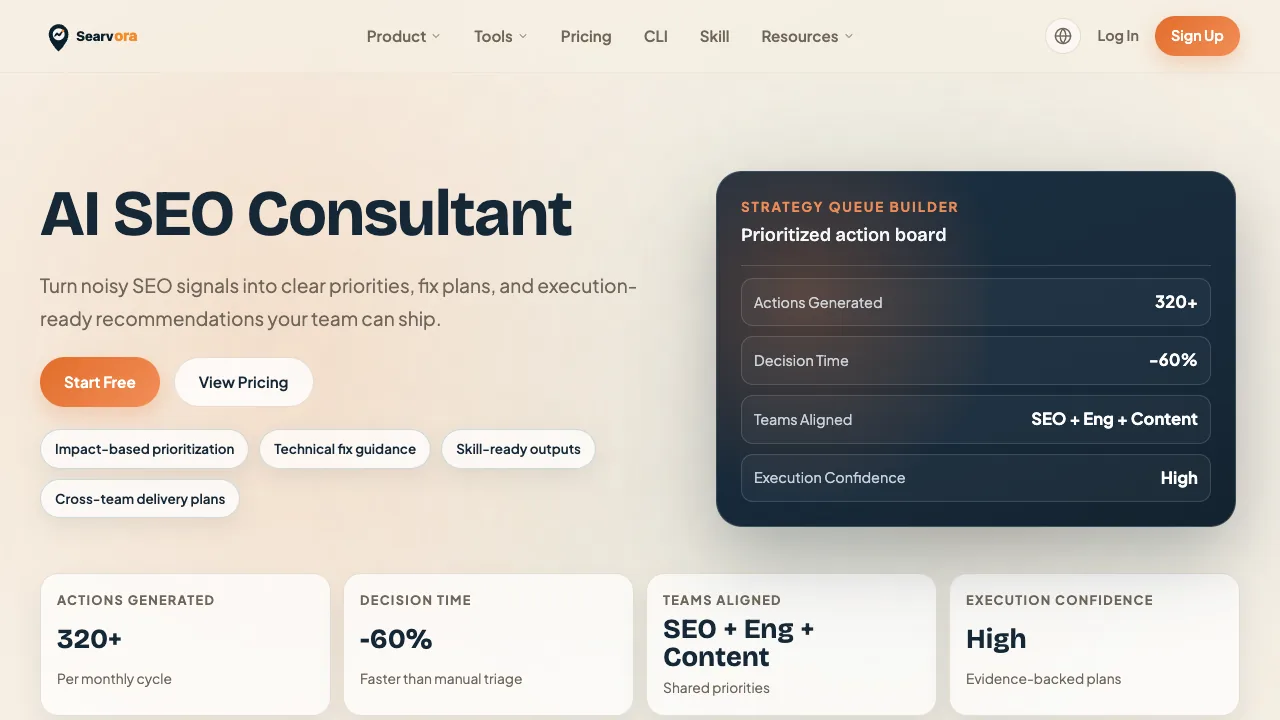
Use it to structure the handoff:
| Decision | Practical use of the consultant |
|---|---|
| Choose a page to improve | Compare reader value, proof depth, effort, and confidence instead of relying on one metric |
| Decide which blocker comes first | Turn content and technical evidence into an ordered action list with rationale |
| Assign the next step | Give SEO, content, or engineering an explicit task and validation point |
| Preserve the decision trail | Keep the reason a page was promoted, held, or deprioritized visible for the next review |
Content Analysis Checklist for Earning More Links
- Start with pages that have a specific citation reason.
- Compare pages with similar jobs and site context, not just a raw total.
- Separate absolute visibility from relative overperformance.
- Keep only candidates with a reader-level rationale.
- Add information gain instead of reproducing a competitor's format.
- Fix canonical, indexability, structure, and internal routes before promotion.
- Hand off only prospects that benefit a real source-page reader.
- Measure the result and update the content brief, page type, or stop rule.