

Linkable assets are pages, tools, references, studies, templates, or visuals that people can reasonably cite because they help a real reader task. The useful question is not "what can we publish to get links?" It is "which asset format would make another page better if it referenced us?"
Use this workflow before production:
- Name the audience that would cite the asset.
- Choose the asset format that matches the evidence you can provide.
- Confirm the page can be crawled, understood, and internally supported.
- Qualify outreach only where the source page's reader benefits.
- Measure citation quality, search movement, and refresh decisions after launch.
What Makes An Asset Linkable
The Ahrefs article that surfaced this opportunity frames linkable assets as content created to attract links and walks through common formats. Searvora's information gain is the operating layer around that idea: pick the format based on proof, production cost, crawl readiness, internal support, outreach fit, and AI-search source value before the campaign starts.
Use this first-pass test:
| Question | Good sign | Weak sign |
|---|---|---|
| Who would cite it? | A named audience has a page, guide, report, or workflow where the asset fits | "People in our industry" is the only audience |
| What job does it support? | The asset answers a definition, data, tool, template, checklist, or comparison task | The page is only a sales angle with a resource wrapper |
| What proof can it carry? | Public sources, original examples, data, methods, templates, or clear process evidence | The page repeats generic advice |
| Can search systems understand it? | The URL, canonical, headings, images, and internal links are clean | The asset is hidden, thin, orphaned, or hard to crawl |
| How will success be judged? | Citation quality, page performance, AI-search readiness, and next action are tracked | The only metric is raw backlink count |
This keeps the topic separate from link bait. Link bait asks whether an idea deserves attention before promotion. Linkable assets ask which concrete format should carry that idea and how the team should route it through production.
Choose The Right Asset Format
Different asset types win links for different reasons. A template is not a data study. A calculator is not a checklist. Choosing the wrong format creates a page that looks useful from a campaign spreadsheet but fails when a publisher asks whether it actually helps the reader.
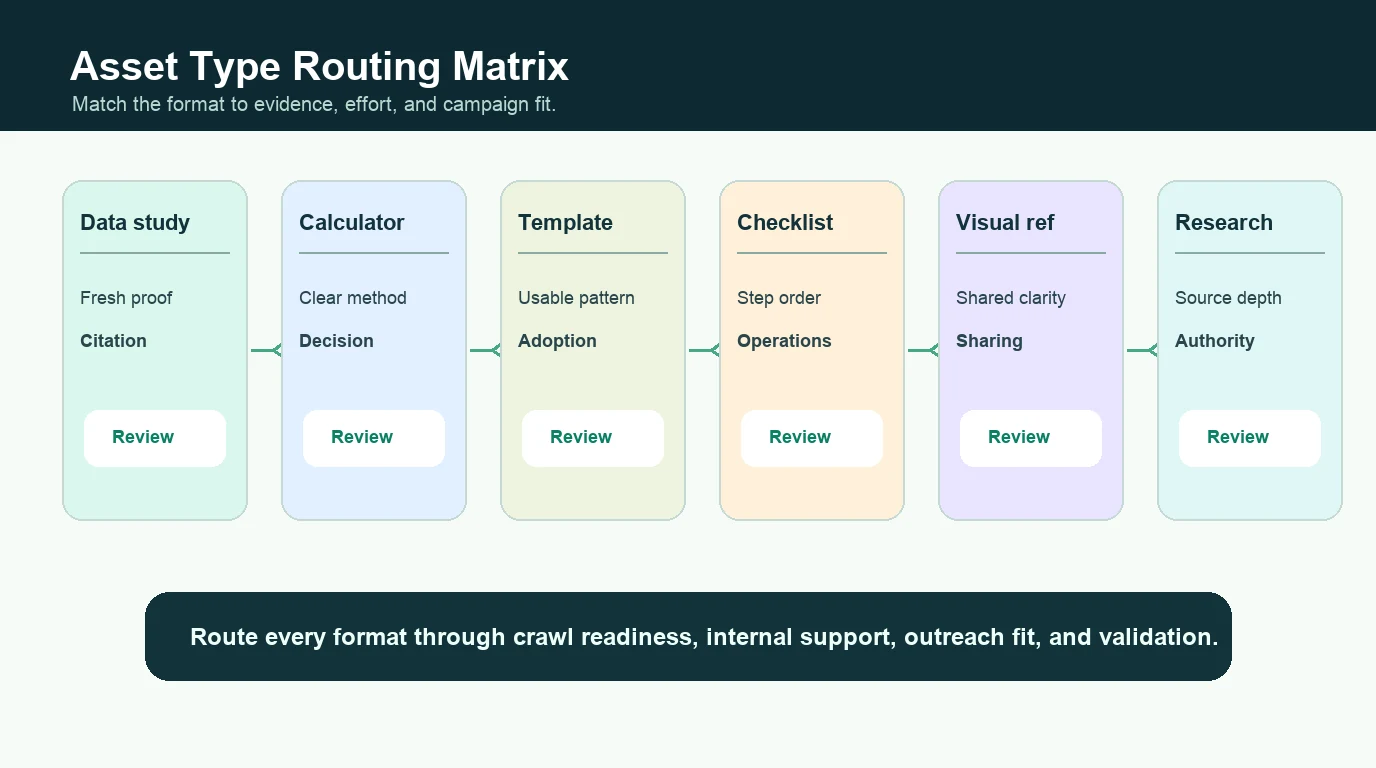
Use this routing table:
| Asset format | Best when | Evidence required | Avoid when |
|---|---|---|---|
| Data study | The market needs a current benchmark, pattern, or surprising statistic | Clear method, sample size, date, definitions, and limitations | You cannot explain the methodology |
| Calculator or tool | The reader needs an output to decide something | Transparent assumptions, stable inputs, and useful result copy | The answer is too vague or mostly promotional |
| Template | The reader needs a repeatable starting point | Example fields, instructions, and a real workflow fit | It is a thin download with no context |
| Checklist | The task has a clear sequence or quality gate | Steps, pass conditions, and validation notes | The topic needs judgment, not only boxes |
| Visual reference | The concept is easier to compare or explain visually | Searchable supporting text and concise alt text | The diagram traps all useful information in the image |
| Original research | The brand can add source depth or examples others lack | Sources, collection notes, and a clear angle | The research is stale, anecdotal, or too small to support claims |
The page type should follow the asset job. If the asset is a calculator, the better Searvora target may be a tool page. If it is a template, a downloadable asset or resource page may be cleaner than a blog post. If it is a framework, a blog article can work as the parent that routes readers into child guides.
Check Production Readiness Before Outreach
A linkable asset can fail technically even when the idea is strong. If the page is difficult to crawl, has a confused canonical, sits outside the sitemap, or lacks internal support, earned links may send authority to a weak URL. Fix that before asking anyone to reference it.
Use this production-readiness checklist:
| Readiness layer | What to check | Owner |
|---|---|---|
| URL and canonical | The asset has one clean URL and the canonical points to itself | SEO or engineering |
| Indexability | The page returns 200, is not noindexed, and is not blocked by robots rules | Technical SEO |
| Heading structure | The H1 and H2s explain the asset job without forcing keywords | Content |
| Image access | Key visuals have local files, useful alt text, and do not carry fake data | Content or design |
| Internal links | Relevant hubs, parent articles, and product pages can naturally route to the asset | SEO |
| Structured support | Tables, definitions, examples, or methods are searchable in the page body | Content |
| Validation plan | The team knows what to recrawl, monitor, and refresh after launch | SEO lead |
A technical SEO crawler is useful here because the asset has to work as a page before it works as a campaign target. Crawl status, metadata, canonicals, internal links, image alt text, and sitemap inclusion are not cosmetic checks. They decide whether the asset can become a durable reference.
The same logic applies to internal routing. A useful resource should not sit alone. The internal links for SEO workflow helps decide where the asset belongs in the site architecture and which pages should support it.
Qualify Outreach By Reader Fit
Outreach should not start from a domain metric. It should start from the source page's reader. A linkable asset earns attention when it improves a page that already discusses the same task, gap, example, or source need.
Use this outreach qualification table:
| Prospect question | Approve | Skip |
|---|---|---|
| Does the source page already discuss this job? | The asset strengthens a section, example, list, definition, or method | The page is unrelated but has attractive authority |
| Would their reader benefit immediately? | The asset answers a question the page raises | The benefit is mostly your backlink target |
| Is the placement natural? | A branded, descriptive, or URL anchor would fit the sentence | The pitch depends on exact-match anchor control |
| Is the relationship honest? | The note explains one specific reason for sharing | The email uses fake familiarity or inflated praise |
| Is there a risk flag? | No paid placement pressure, exchange pattern, or irrelevant guest post angle | The opportunity depends on manipulative link behavior |
Google's spam policies are the boundary. Linkable assets should earn editorial citations because the resource helps the web. If a campaign needs payment pressure, mass automation, or anchor control to work, the asset was not strong enough for that prospect.
For campaign execution, pair this article with the broader link building for SEO workflow. Link building manages the campaign system. Linkable assets define whether the page itself deserves to be promoted.
Measure The Asset As A Decision Loop
The first version of a linkable asset is a hypothesis. Measurement tells you whether the format, audience, and promotion logic were right.
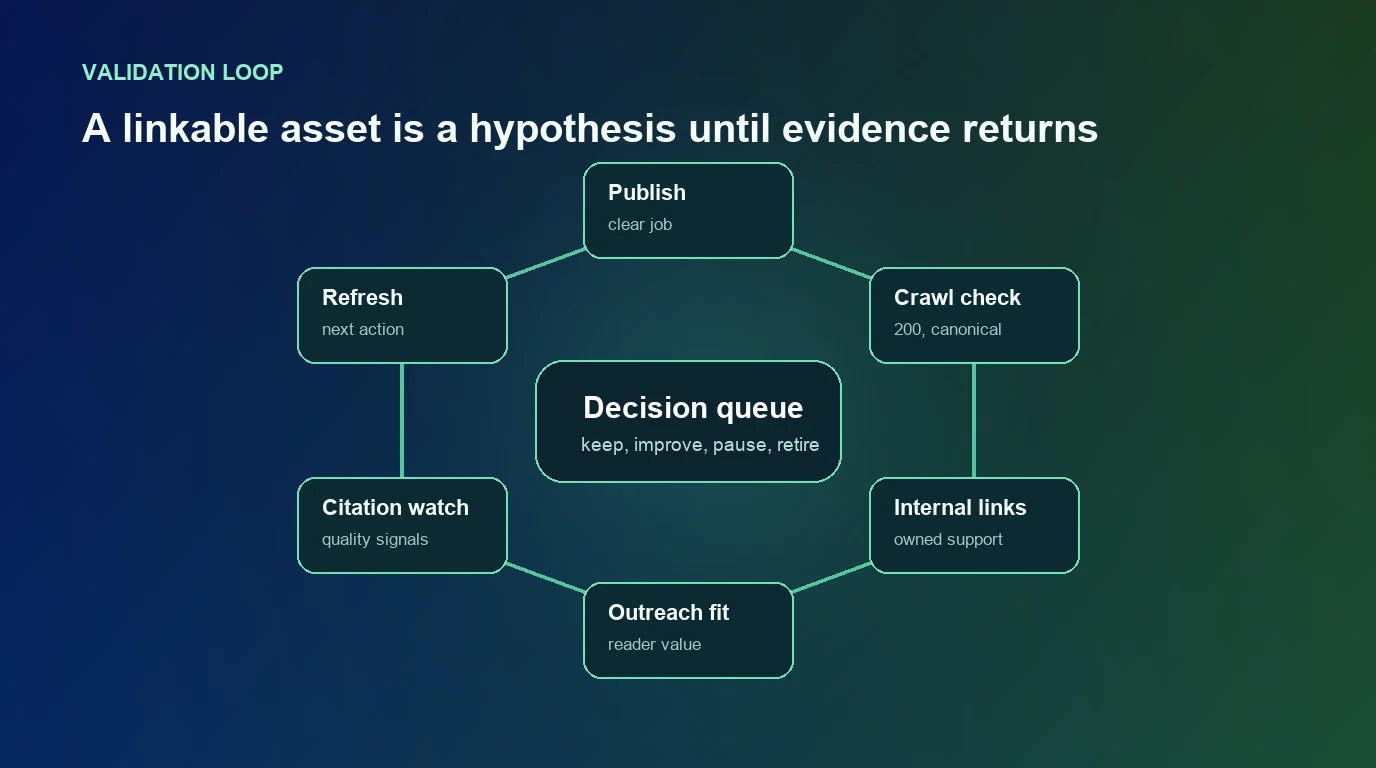
Track these signals after launch:
| Measurement layer | What to review | Better next action |
|---|---|---|
| Crawl and index signals | Status, canonical, sitemap presence, rendered text, image access, and internal links | Fix access before more promotion |
| Citation quality | Source relevance, placement context, anchor naturalness, and reader fit | Keep strong source patterns and remove weak ones |
| Search demand | Impressions, queries, assisted rankings, and page type fit | Adjust the title, section depth, or internal links |
| AI-search readiness | Whether the asset is source-backed, quotable, and easy to summarize | Add clearer definitions, examples, and source context |
| Outreach feedback | Questions, objections, skipped prospects, and earned mentions | Improve the asset before contacting more pages |
| Business support | Whether the asset helps related hubs, product pages, or conversion paths | Add internal links or route to a better canonical page |
The decision after measurement should be explicit: keep promoting, improve the asset, build a child resource, merge it into a stronger page, pause outreach, or retire the idea. That stops linkable assets from becoming abandoned campaign leftovers.
Where Searvora Fits
Searvora AI SEO Consultant fits the planning and prioritization layer around linkable assets. It does not buy links, scrape contacts, or guarantee citations. Its useful role is turning asset ideas, crawl evidence, internal-link gaps, risk notes, and performance signals into a prioritized action queue.
Use the AI SEO consultant when the team needs to decide:
| Decision | How Searvora helps structure it |
|---|---|
| Which asset format deserves production | Compare citation reason, proof strength, effort, and business fit |
| Which weak asset should be improved first | Connect content gaps with crawlability and internal-link issues |
| Which prospect types should be skipped | Turn risk flags and low reader-fit evidence into queue rules |
| Which result changed priority | Convert citation, crawl, and performance signals into next actions |
The value is not inventing more assets. The value is choosing fewer, stronger formats, building them so search systems and readers can understand them, and measuring the work well enough that the next decision is clearer.
Linkable Asset Checklist
Use this checklist before approving the next asset:
- Write the asset's citation reason in one sentence.
- Name the audience that would reference it and why.
- Choose the format that fits the evidence you can actually provide.
- Confirm the asset is not just a commercial page with a resource label.
- Put the core value in searchable text, not only in images.
- Check status, canonical, robots, sitemap inclusion, headings, and image alt text.
- Add internal links from relevant hubs and adjacent articles.
- Qualify outreach by source-page reader benefit.
- Avoid paid placement pressure, exact-match anchor control, and irrelevant guest posts.
- Track citation quality, search movement, AI-search readiness, and next actions.
Linkable assets work when they behave like useful publishing. Choose the format that carries real proof, make the page technically ready, promote it only where it helps, and let the evidence decide whether the asset deserves the next round of work.