
Link bait is content built to earn editorial links because people have a real reason to cite it, share it, reference it, or use it in their own work. The useful version is not clickbait. It is a resource with enough proof, utility, novelty, or clarity that another publisher can link to it without stretching.
The risky version starts with "we need backlinks" and then invents an asset after the outreach target list is already built. The safer workflow starts earlier: define the citation job, score the idea, make the page crawlable and internally supported, promote only when the fit is real, and measure whether the asset became easier to discover and cite.
Use this seven-step workflow:
- Name the audience that would cite the asset.
- Define the search or research task the asset supports.
- Check whether the idea has a clear source, example, template, data point, or decision framework.
- Build the page so it is crawlable, quotable, and internally linked.
- Qualify promotion targets by editorial fit, not domain metrics alone.
- Track earned citations, AI-search visibility, and page impact after launch.
- Refresh, expand, or retire the asset based on evidence.
What Link Bait Should Mean
The Ahrefs article that surfaced this opportunity defines link bait as content designed to attract backlinks and gives practical examples. Searvora's information gain is the operating layer around that idea: decide which assets deserve production before the team spends budget, design them for citation quality, and keep the measurement tied to safer SEO work.
Use this first-pass definition:
| Link bait is | Link bait is not |
|---|---|
| A page with a clear reason to be cited | A headline trick that disappoints the reader |
| Useful enough for editors, operators, researchers, or communities | A generic article that only exists to request links |
| Built with proof, examples, tools, templates, data, or a sharper framework | A thin sales page with a "resources" wrapper |
| Promoted only where it improves the source page | Pushed through mass outreach without reader fit |
| Measured by quality, visibility, and next actions | Measured only by raw backlink count |
Score The Idea Before You Build
Most weak link-bait projects fail before writing starts. The idea sounds interesting internally, but nobody outside the company has a reason to reference it. A scorecard forces the team to test that gap before production.
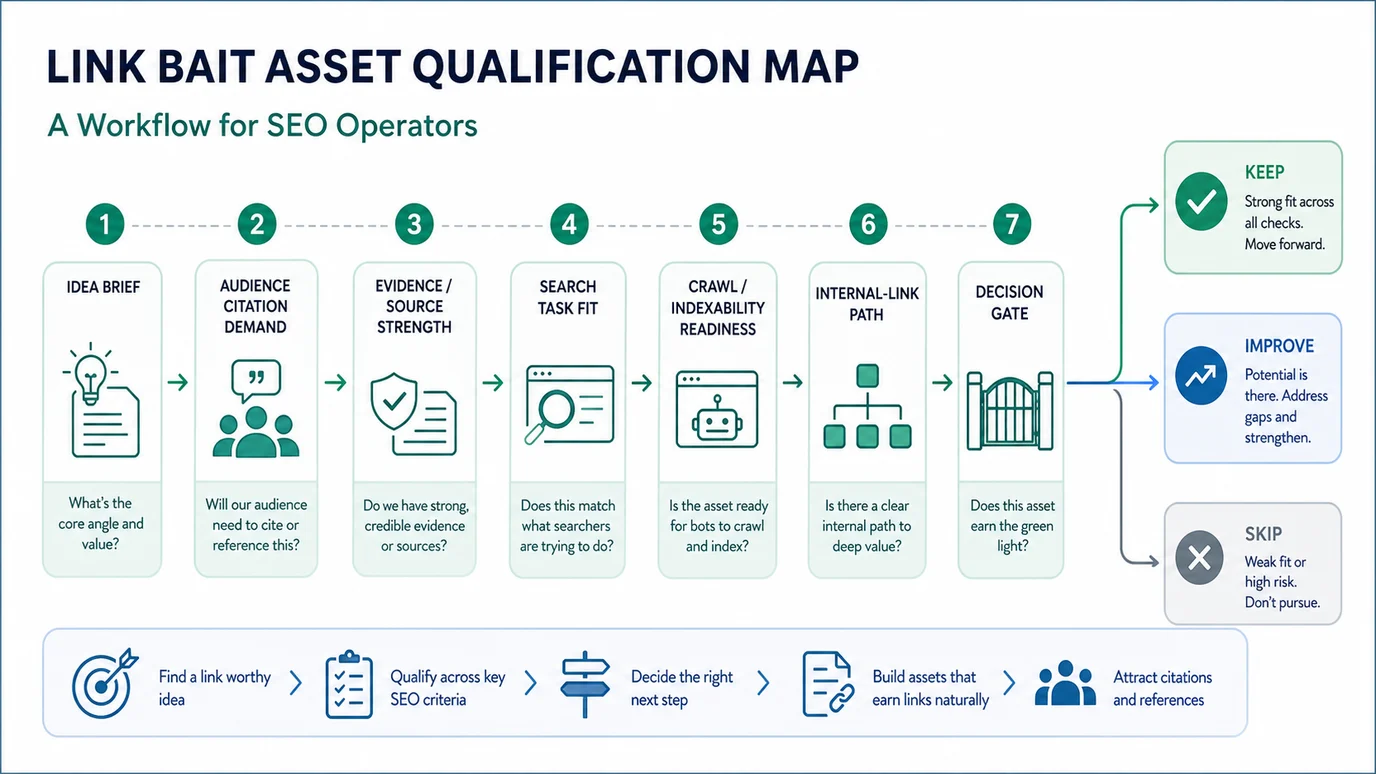
Use this qualification table:
| Score layer | Pass condition | Fix before production |
|---|---|---|
| Audience citation demand | A specific group would quote, reference, embed, or bookmark the asset | Name the audience and the page types they maintain |
| Search task fit | The page answers a keyword, comparison, template, checklist, data, or definition job | Change the page type or tighten the query target |
| Evidence strength | The asset includes public sources, original examples, data, expert process, or useful templates | Add proof before asking anyone to cite it |
| Difference from existing pages | The angle is sharper than current coverage and not a duplicate of another owned page | Merge, refresh, or narrow the idea |
| Crawl readiness | The page can return 200, canonicalize cleanly, load fast enough, and expose useful headings | Fix technical access before promotion |
| Internal support | The asset has a route from relevant hubs, articles, product pages, or tools | Add internal links where they help the reader |
| Outreach fit | You can describe why a third-party page becomes better with this resource | Do not promote until the reader benefit is clear |
This keeps the topic separate from the broader link building for SEO workflow. Link building asks whether a campaign should exist. Link bait asks whether the asset itself deserves attention before a campaign starts.
Build Something People Can Actually Cite
A citation-worthy asset usually has one strong job. It may explain a concept better than the alternatives, publish original data, collect examples, provide a template, visualize a process, or help a reader make a decision. It should not try to be every format at once.
Use this format map:
| Asset format | Works when | Watch out for |
|---|---|---|
| Original data or benchmark | The data is current, sourced, and easy to interpret | Thin surveys, unclear methods, or stale claims |
| Template or checklist | The reader can use it immediately | Generic downloads with no real workflow |
| Example gallery | The examples teach a pattern | Screenshot piles with no analysis |
| Calculator or tool | The output helps a decision | Tool pages that hide the method or fail crawl checks |
| Explainer framework | The idea is confusing in the market | Definitions with no operator action |
| Visual reference | The diagram clarifies a repeatable process | Text trapped inside images instead of searchable copy |
For a Searvora-style asset, the strongest angle is often operational: show how a team moves from signal to decision. That can mean a crawlability checklist, a content refresh matrix, an AI-search citation framework, a Shopify blog planning template, or a link-risk decision tree.
The page should also be technically ready. Before promotion, confirm the canonical URL, indexability, headings, image alt text, internal links, and sitemap inclusion. If the asset is hard for crawlers or readers to understand, outside links will not fix the underlying problem.
Decide Whether Promotion Is Safe
Link bait still needs distribution. The issue is how the team decides where to send it. If promotion starts from "who has a high authority score," the campaign can drift into irrelevant outreach. If it starts from "which page would become better with this resource," the campaign stays closer to editorial value.
Use this promotion gate:
| Promotion question | Good sign | Stop or review |
|---|---|---|
| Does the source page already discuss the asset's job? | The resource strengthens a claim, example, list, guide, or template | The source page is only attractive because of a metric |
| Would their reader benefit? | The asset answers a question the page already raises | The benefit is mostly your backlink target |
| Is the suggested placement natural? | A branded, URL, or descriptive anchor would fit the sentence | The campaign requires exact-match anchor control |
| Is the relationship honest? | The note explains one specific reason for sharing | The email uses fake familiarity or inflated praise |
| Is there a risk flag? | No paid placement, exchange pressure, or irrelevant guest post angle | The opportunity depends on manipulative link behavior |
Google's spam policies are the boundary. Link bait should earn attention because the asset helps the web, not because the campaign pressures publishers into unnatural links.
If the team is ready to contact publishers, use the link building outreach workflow as the narrower execution guide. Keep the pitch short, specific, and optional. The outreach note should explain the source page's reader benefit, not the ranking goal.
Measure The Asset After Launch
The first version of a link-bait asset is a hypothesis. Post-launch measurement tells you whether the market agreed.
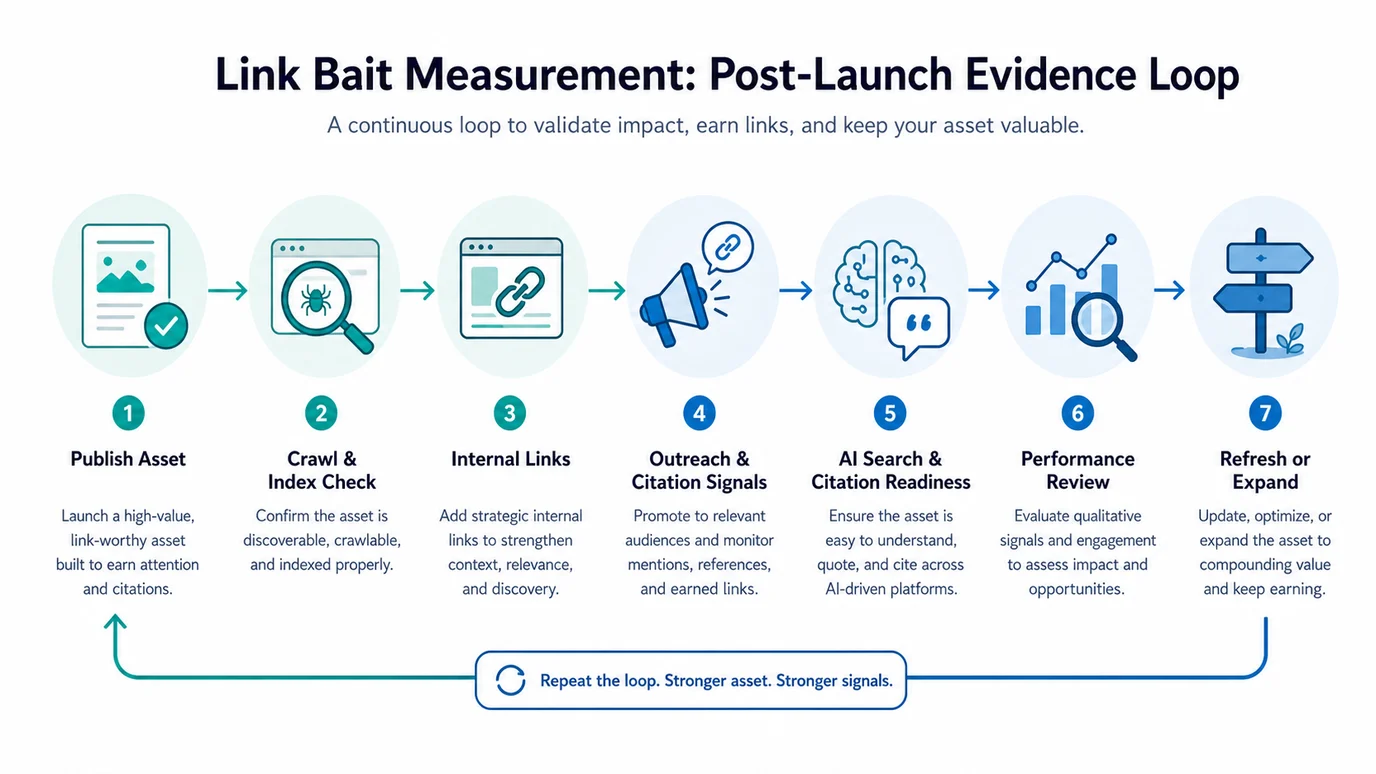
Track more than backlink count:
| Measurement layer | What to review | Better next action |
|---|---|---|
| Crawl and index signals | Status, canonical, sitemap presence, headings, image access, and internal path | Fix access before expanding promotion |
| Citation quality | Source relevance, placement context, anchor naturalness, and reader fit | Keep good patterns, stop weak sources |
| Search demand | Impressions, queries, assisted rankings, and page type fit | Refresh the title, section depth, or internal links |
| AI-search readiness | Whether the asset is quotable, source-backed, and easy to summarize | Add clearer definitions, examples, and source context |
| Outreach feedback | Questions, objections, ignored angles, and earned mentions | Improve the asset before sending more messages |
| Business support | Whether the asset helps related hubs, product pages, or conversion paths | Add useful internal links or route to a better page |
The best link-bait report is small enough to review. It should name the asset, audience, citation reason, pages promoted, links or mentions earned, risk notes, search movement, and the next decision. That decision may be refresh, expand, build a child asset, add internal support, pause outreach, or retire the idea.
Where Searvora Fits
Searvora AI SEO Consultant fits the planning layer around link bait. It does not buy links, scrape contacts, or guarantee citations. Its useful role is turning content, crawl, link, and performance evidence into a prioritized action queue.
Use the AI SEO consultant when the team needs to decide:
| Decision | How Searvora helps structure it |
|---|---|
| Which asset idea deserves production | Compare citation reason, search task, effort, and business fit |
| Which weak asset should be improved first | Connect content gaps with crawlability and internal-link issues |
| Which promotion targets should be skipped | Turn relevance, risk, and editorial-fit notes into queue rules |
| Which result changed priority | Convert earned mentions, crawl findings, and search movement into next actions |
The value is not producing flashier ideas. The value is stopping weak assets before they consume budget, improving promising assets before outreach, and measuring the work in a way that makes the next SEO decision clearer.
Link Bait Checklist
Use this checklist before approving the next asset:
- Write the asset's citation reason in one sentence.
- Name the audience that would reference it and why.
- Match the asset to one search task, page type, or research job.
- Add proof through data, examples, templates, public sources, or a sharper framework.
- Check that the page is crawlable, canonical, internally linked, and included in the sitemap.
- Keep key explanations in searchable text, not only inside images.
- Qualify promotion targets by reader benefit and editorial fit.
- Avoid paid placement pressure, exchange patterns, and exact-match anchor demands.
- Measure citation quality, search movement, AI-search readiness, and asset feedback.
- Turn the evidence into the next action: improve, promote, expand, merge, pause, or retire.
Link bait works when it behaves like useful publishing. Build something people can cite without embarrassment, make it easy for search systems and readers to understand, promote it only where it helps, and let the evidence decide whether the asset deserves the next round of work.