

An E-E-A-T audit is a sitewide review of the evidence behind important pages. Its job is not to award a trust score. Its job is to find where a page asks a reader to believe something without showing enough source, experience, responsibility, or validation—and turn that gap into owned work.
That distinction matters. Google's public guidance says its Quality Rater Guidelines do not directly influence rankings, while still giving creators a useful way to self-assess helpful, reliable content. Google's E-E-A-T update also makes experience part of that evaluation: some tasks need firsthand use, while others need demonstrated subject expertise.
Use this workflow after pages already exist. The output is an evidence register, a risk-ranked fix queue, named owners, and validation checks. That makes it distinct from a pre-publish proof pass: you are checking whether a whole site can still substantiate the claims it has already put into the world.
Start With Page Risk, Not a Universal Checklist
An E-E-A-T audit should not give every URL the same burden of proof. A low-risk glossary, a technical implementation guide, and a page that affects financial or health decisions need different scrutiny.
Start by sorting indexable pages into practical risk groups:
| Page type | What the reader needs to trust | Audit focus |
|---|---|---|
| Concept or glossary page | A clear, accurate explanation | Definitions, sources, examples, and page ownership |
| Technical SEO workflow | Advice that can be tested safely | Official documentation, constraints, screenshots or crawl evidence, and recheck steps |
| Review or comparison | A fair basis for choosing | Public-source evidence, dates, limitations, and no invented hands-on experience |
| Product or service page | What the product does and who it suits | Clear claims, visible policies, current pricing or support links, and responsible ownership |
| High-stakes guidance | Safe, accountable information | Primary sources, specialist review, dates, limits, and escalation paths |
The audit starts with a simple question: what would a careful reader challenge first on this page? Mark the claim, then decide what proof would make it accountable. That is more useful than adding author bios, schema, or generic trust badges everywhere.
Build an Evidence Register for Each Priority Page
The evidence register is the working document behind the audit. It connects a page promise to a proof source, the person responsible for keeping it current, and the exact check that closes the gap.
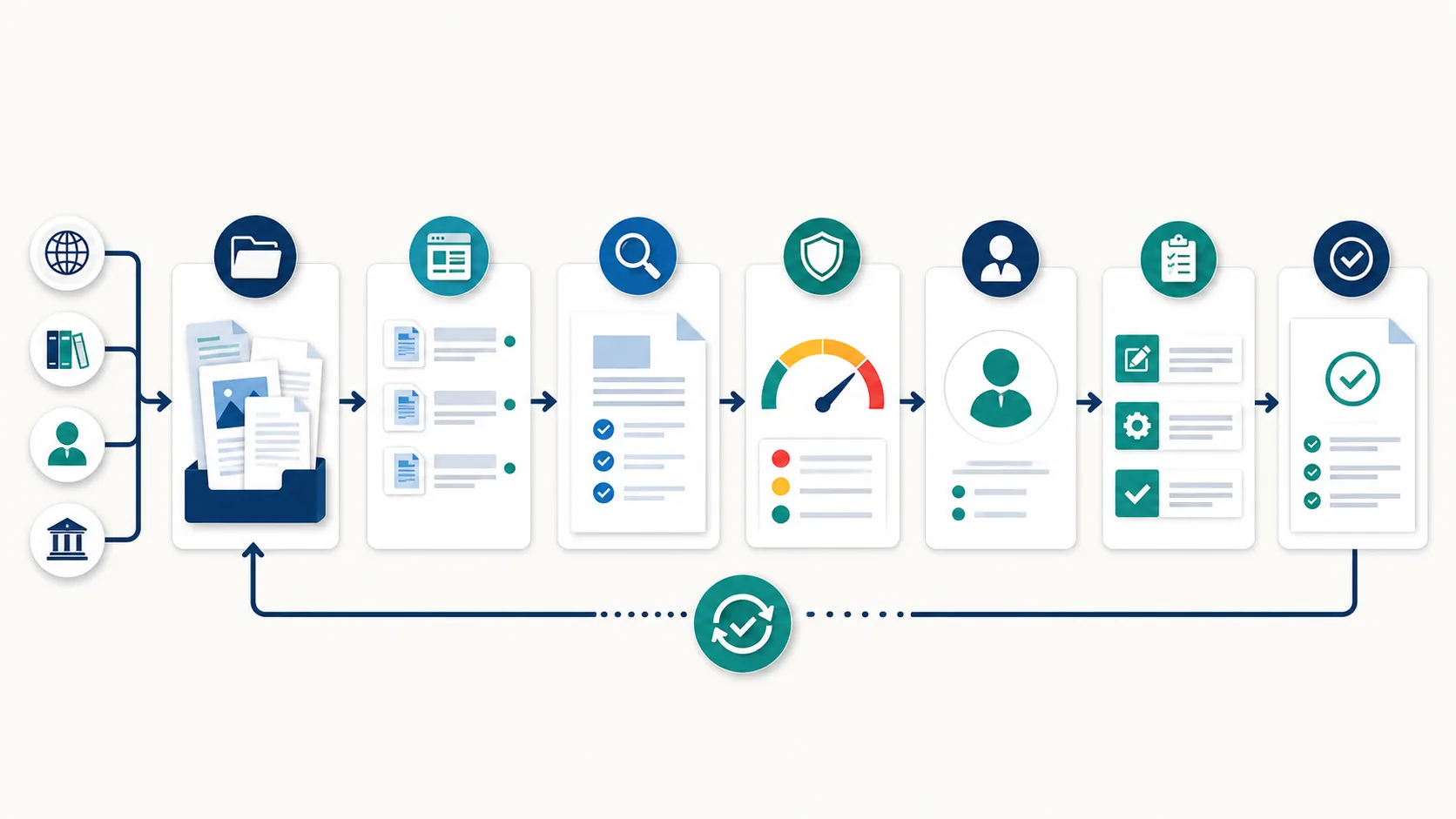
Use one row per meaningful claim, not one row per sentence:
| Register field | What to record | A useful validation check |
|---|---|---|
| Page and page job | Canonical URL plus the search task it should answer | Title, H1, opening answer, and page type agree |
| Claim or recommendation | The statement a reader needs to rely on | It is specific enough to source or qualify |
| Proof type | Official source, firsthand evidence, internal policy, SME review, or data | The proof is visible, current, and relevant to the claim |
| Evidence location | Source URL, on-page section, screenshot, or internal review record | A reviewer can locate it without guessing |
| Risk and impact | Harm if wrong plus the page's business or visibility role | High-risk gaps appear before polish tasks |
| Owner and due action | Content, SEO, product, support, legal, or subject expert | One person or team is accountable for the next change |
| Validation | Re-crawl, fact check, link check, approval, or observation window | The audit has a pass condition, not only a task title |
This turns vague comments such as “add more authority” into an action that can be completed: “Replace the outdated implementation claim in section two with the current official documentation, have the technical owner review it, then recheck the rendered external link.”
For broader URL inventory, performance, crawl, overlap, and refresh decisions, pair this with the content audit fix-queue workflow. The E-E-A-T register goes one layer deeper: it asks whether the surviving page can prove its most important claims.
Triage Gaps by Impact, Confidence, and Fixability
Do not try to fix every imperfection at once. Use three signals to decide what ships first:
- Impact: How much does the gap affect a reader's decision, a high-value page, or a critical search task?
- Confidence: Is the missing proof clear enough to diagnose, or does someone need to investigate before writing?
- Fixability: Can the right owner resolve it with a source update, an example, a disclosure, a technical change, or an escalation?

| Priority | Typical gap | Best next action |
|---|---|---|
| Fix now | A core claim is unsupported, stale, or unsafe for the page's risk level | Remove or qualify the claim, add primary evidence, and get the right review before publishing or promoting it |
| Plan next | The page is useful but lacks a worked example, updated ownership, or a supporting source | Write a scoped brief with an owner and a validation date |
| Monitor | The page has adequate proof but its source, policy, or data may age | Set a review window and record the triggering change that would reopen it |
| Leave alone | The finding is cosmetic and does not change understanding, safety, or the page's main job | Avoid creating busywork or decorative “trust” tasks |
If a gap is real but the evidence is unavailable, record that honestly. Narrow the claim, link to a reliable source, or remove the recommendation. Do not simulate experience with stock screenshots, claims of testing, invented ratings, or unsourced statistics.
Assign an Owner and a Definition of Done
An E-E-A-T audit fails when it ends as a list of observations. Each approved fix needs a named responsibility boundary and a test that confirms the page changed in the intended way.
Use this handoff format:
| Handoff field | Example |
|---|---|
| Finding | The technical tutorial recommends a configuration without naming the supported version or source |
| Risk | A reader could follow an outdated implementation path |
| Owner | Technical content owner with engineering review |
| Change | Add the supported version, a primary documentation link, and the known limitation |
| Definition of done | Reviewer confirms the source, the link renders, and the limitation appears beside the recommendation |
| Follow-up | Re-crawl the page and revisit after the next relevant version change |
This also keeps content, product, and SEO teams aligned. Content can improve the explanation. A subject expert can confirm a constraint. SEO can check crawlability, canonical behavior, internal links, and whether a more appropriate URL already owns the job. No one needs to pretend that a single generic “E-E-A-T score” explains all of that work.
Check Whether Proof Is Easy to Find and Reuse
A claim may be technically sourced but still be hard for a reader to use. Review the rendered page, not only the source document or CMS field.
Check these conditions on each high-priority page:
- The direct answer appears near the relevant question, rather than being buried after a long introduction.
- The source, example, or limitation sits next to the claim it supports.
- Important proof exists as visible text, tables, captions, or accessible links—not only as an unexplained image.
- The canonical page returns successfully, is indexable when intended, and has a consistent title, H1, and metadata.
- Related internal pages lead readers to the next useful task without duplicating the same job.
That last point matters for AI-search visibility too. Google advises site owners to focus on unique, satisfying content, a good page experience, and technical access to indexable content for both traditional and AI search experiences. Its AI-search guidance emphasizes those foundations rather than a special E-E-A-T trick.
If the question is whether AI search engines actually cite a site, use a separate measurement loop. The AI search citation audit covers prompt logs, source URL checks, crawl eligibility, and action queues. This E-E-A-T audit prepares the source page to be easier for people to inspect and systems to understand.
Turn the Register Into a Monthly Operating Loop
Run the first audit across pages that carry the most consequence: high-traffic guides, conversion pages, technical instructions, reviews, high-stakes topics, and content that supports a strategic cluster. Then repeat the review when a source changes, a product changes, a policy changes, a page loses relevance, or a new visibility question appears.
The loop is deliberately small:
- Choose the priority page set and classify risk.
- Capture page promises and proof gaps in the evidence register.
- Score gaps by impact, confidence, and fixability.
- Assign one owner and a definition of done to each approved task.
- Ship the fix, then verify the rendered page, source links, canonical, metadata, and internal links.
- Record what changed and set the next review trigger.
E-E-A-T Audit Checklist
Before you close a sitewide E-E-A-T audit, confirm that every priority finding has a practical path forward:
- The page's search job and risk level are documented.
- The central claims have an appropriate proof type and location.
- Unsupported, stale, or overly broad claims are removed, qualified, or escalated.
- Firsthand evidence is used only when it is real and relevant.
- The page shows sources, examples, limits, and ownership where readers need them.
- High-impact gaps have a named owner, a scoped change, and a definition of done.
- The rendered page remains crawlable, canonical, internally linked, and easy to read.
- Future review triggers are recorded for sources, policies, product changes, and visibility shifts.
An E-E-A-T audit is valuable when it makes a site more accountable to its readers. Build the register, fix the proof gaps that matter, validate the page someone will actually see, and leave the next owner with a clear reason to act.