
E-E-A-T SEO is the work of making a page visibly easier to trust. It stands for experience, expertise, authoritativeness, and trustworthiness, but the useful question is not whether the acronym appears in a brief. The useful question is whether the page shows enough evidence for a reader, reviewer, search system, or AI answer surface to understand why this source deserves attention.
The Ahrefs E-E-A-T SEO article that surfaced this competitor opportunity explains the framework and its connection to search and AI visibility. Searvora's information gain is the operating layer: turn E-E-A-T into a repeatable source-evidence review before publishing, then validate whether the page becomes easier to crawl, cite, refresh, and monitor.
What E-E-A-T SEO Should Mean
Google's helpful, reliable, people-first content guidance frames E-E-A-T as part of self-assessing whether content is useful and trustworthy. Google's public Search Quality Rater Guidelines give human raters a way to evaluate page quality. That does not make E-E-A-T a checklist hack or a hidden score.
For operators, E-E-A-T SEO should become four visible proof lanes:
| E-E-A-T lane | The practical question | Evidence to add or verify |
|---|---|---|
| Experience | Has someone used, tested, audited, or operated the thing being explained? | Screenshots, examples, workflows, constraints, lessons, and firsthand context |
| Expertise | Is the explanation accurate enough for the topic risk? | Author review, source quality, definitions, edge cases, and expert input |
| Authoritativeness | Is this page connected to a credible site, topic cluster, or source set? | Internal links, external references, reputation signals, topic depth, and citations |
| Trustworthiness | Can the reader tell who is responsible and what to do safely? | Clear ownership, dates, disclosures, policy boundaries, contact paths, and transparent claims |
Build The Evidence Before The Draft
Weak E-E-A-T work starts after the draft is written. Strong E-E-A-T work starts inside the brief.
Before drafting, the content owner should answer five questions:
- What claim would a careful reader question first?
- Which official source, product page, dataset, screenshot, or internal expert can support that claim?
- Which parts require firsthand experience rather than generic explanation?
- Which claims should be softened, removed, or routed to a safer source?
- Which page in the cluster should this article link to, and which page should link back?
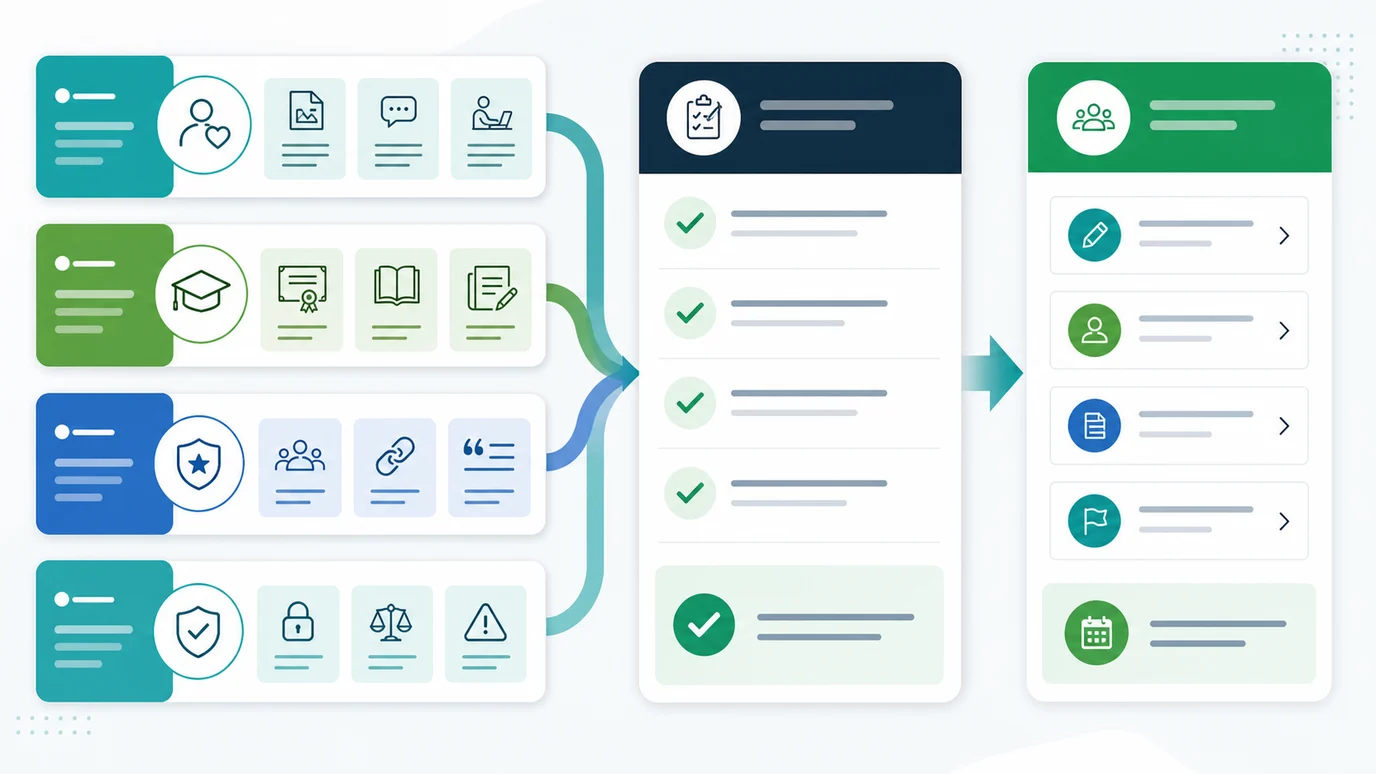
Use this pre-draft evidence table:
| Draft input | Pass condition | Fix before writing |
|---|---|---|
| Source list | Official or primary sources support factual claims | Replace generic roundup references with original sources |
| Experience proof | The article includes examples, screenshots, product use, or workflow detail | Add a test note, source screenshot, internal SME note, or narrower claim |
| Author proof | The creator, reviewer, or responsible team is clear | Add reviewer context or remove unsupported expertise claims |
| Trust boundary | The article states when advice should not be followed | Add warnings, exclusions, or escalation rules for risky topics |
| Cluster role | The page has a distinct job in the topic map | Merge, refresh, or reposition if another URL already owns the same job |
The content briefs workflow is the natural companion here. A brief is where intent, sources, visuals, internal links, and validation criteria get locked before the writing pass starts.
Match Proof To Page Risk
Not every page needs the same proof burden. A low-risk glossary article and a medical, financial, legal, or security article should not be reviewed with the same standard.
Google's announcement of the extra E for experience is a useful reminder that helpful information can come from different kinds of sources. A firsthand product walkthrough may need usage evidence. A technical SEO article may need crawl examples and official documentation. A YMYL topic may need stronger expert review, safer wording, and clearer responsibility.
Use risk to decide proof depth:
| Page risk | E-E-A-T proof to require | What to avoid |
|---|---|---|
| Low-risk concept | Clear definition, examples, and useful internal links | Padding the article with fake authority signals |
| Technical SEO workflow | Crawl evidence, official docs, screenshots, validation steps | Claiming a fix works without a recheck path |
| Tool or product review | Public-source screenshots, official pricing/help pages, fair limitations | Invented hands-on testing, ratings, logos, or UI behavior |
| Health, finance, legal, safety, or civic topic | Expert review, primary sources, dates, disclaimers, and escalation paths | Casual advice that exceeds the site's authority |
| AI-search visibility article | Source-page clarity, citation evidence, extractable answers, monitoring loop | Treating prompt anecdotes as proof |
This keeps E-E-A-T SEO from becoming a decorative author box. The right proof depends on the user's risk, not the writer's desire to sound authoritative.
Turn E-E-A-T Into A QA Checklist
After the draft exists, review it as a page-quality workflow. The reviewer should not only ask whether the copy reads well. They should ask whether the page is trustworthy enough for the task it serves.
Run this QA sequence:
- Confirm the title, H1, and intro answer the same user job.
- Mark every factual claim that needs a source.
- Check whether firsthand examples or screenshots support the most important operational advice.
- Verify that external sources are official, current, and not tracking-heavy.
- Confirm the page names limits, exceptions, or escalation paths when the advice could be risky.
- Add internal links to the parent, child, or product pages that help the reader continue.
- Check crawl eligibility, canonical, sitemap inclusion, image alt text, and rendered HTML.
- Define the validation signal before publishing.
This is where E-E-A-T connects to technical SEO. A trustworthy page still needs to be crawlable, indexable, internally discoverable, and structured in HTML. If the page hides the useful answer inside an image, ships with broken links, or sits outside the internal-link path, the proof is harder for search systems and users to reuse.
Make The Page Easier For AI Answers To Cite
AI answer systems raise the value of visible evidence. A page that buries its answer, hides sources, or uses vague claims is harder to summarize and cite.
Google's guidance on succeeding in AI search points teams back to useful, accessible content rather than special tricks. That fits the E-E-A-T workflow: make the source page clear enough that a person can trust it and a system can understand it.

Use this AI-search trust check:
| Check | Why it matters | Better action |
|---|---|---|
| Direct answer | AI surfaces often summarize the fast answer | Put the definition or recommendation near the top |
| Source clarity | Citations need a page that clearly owns the claim | Link to official sources and keep source claims in text |
| Entity clarity | Brand, product, author, and topic names need consistency | Normalize wording across product pages, articles, and profiles |
| Extractable proof | Systems need structured examples, tables, and evidence | Keep key facts in markdown text, not only visuals |
| Monitoring loop | Trust work should be validated after publishing | Track mentions, citations, impressions, CTR, and page movement |
The AI visibility evidence loop helps after publication. E-E-A-T SEO prepares the source page. AI visibility monitoring checks whether the source page is being mentioned, cited, or ignored.
Where Searvora Fits
Searvora AI SEO Consultant fits the planning and review layer of E-E-A-T SEO. The product page positions it around pattern-based diagnosis, impact-based prioritization, fix-ready guidance, and execution alignment. That is the layer teams need when a content review creates competing tasks: improve the source page, add internal links, update proof, run a crawl, or assign expert review.
Use the AI SEO consultant to turn the review into an action queue:
| Review finding | Better Searvora handoff |
|---|---|
| The page has vague authority claims | Create a content QA task to add sources, examples, and limits |
| The page may not be crawlable or discoverable | Send the URL to the SEO Spider Crawler for crawl, canonical, and link checks |
| The page is part of an AI-search cluster | Add it to an AI SEO Dashboard segment and monitor citation or visibility movement |
| Multiple pages overlap the same trust topic | Prioritize a merge, refresh, or parent-child internal-link decision |
The website authority workflow is useful when the issue is broader site trust. The topical authority workflow is useful when one page needs cluster support. E-E-A-T SEO sits one layer closer to publication: it asks whether this page shows enough proof for this task.
Use This E-E-A-T SEO Review Before Publishing
Run this final review before a high-value article goes live:
- Name the page job, audience, and risk level.
- Confirm the draft answers the search task in the first few paragraphs.
- Check that experience evidence appears where operational advice is strongest.
- Verify expertise with official sources, SME review, or safer wording.
- Strengthen authoritativeness through relevant internal links, topic coverage, and credible references.
- Prove trustworthiness with ownership, dates, disclosures, limits, and clean external links.
- Make the answer extractable with concise definitions, tables, examples, and useful headings.
- Check crawl eligibility, canonical, sitemap inclusion, and visible body images.
- Assign the next action if any proof gap remains.
- Recheck search, AI visibility, and page performance after publication.
E-E-A-T SEO is not a badge to add after writing. It is a proof workflow. Build the evidence before the draft, review the page against risk, make the source easy to cite, and monitor whether trust work turns into measurable visibility.