
Parasite SEO is the practice of publishing content on a third-party site with stronger authority so the page can rank faster than it might on your own domain. It can look tempting when a new site has weak authority, but it also creates control, policy, brand, and measurement risks.
The safer question is not "Can we borrow someone else's authority?" It is "Can this placement survive policy review, preserve brand trust, and still lead to owned search visibility?" Use parasite SEO only after a risk check, and prefer owned assets when the topic should become part of your long-term authority.
The Ahrefs parasite SEO explainer that surfaced this opportunity is useful because it treats the tactic as nuanced instead of automatically evil. Searvora's information gain is the operating layer: a decision workflow that helps SEO teams separate acceptable distribution from risky reputation borrowing.
What Parasite SEO Actually Means
Parasite SEO usually has three parts:
| Element | What it looks like | Why it matters |
|---|---|---|
| Third-party host | Marketplace, media site, directory, review platform, community, or partner domain | The page may inherit trust, crawl frequency, and link equity you do not control. |
| Search-led page | Content is shaped around a query the publisher can rank for | The page may be useful, promotional, thin, or purely manipulative. |
| Borrowed authority | The host's existing signals do most of the ranking work | You may gain visibility without building durable authority on your own domain. |
That does not mean every third-party page is spam. Guest columns, partner documentation, public profiles, marketplace listings, and syndication can be legitimate when they help the host's audience. The risk rises when the page exists mainly to exploit the host's ranking signals while offering little first-party value.
Google's site reputation abuse policy is the key reference. It focuses on third-party content published mainly because of the host site's established ranking signals. Google's broader spam policies also call out link spam and scaled content abuse, which often travel with aggressive parasite SEO campaigns.
Run This Risk Check Before Publishing
Before you pitch, buy, upload, or scale a third-party placement, put it through a simple decision path.
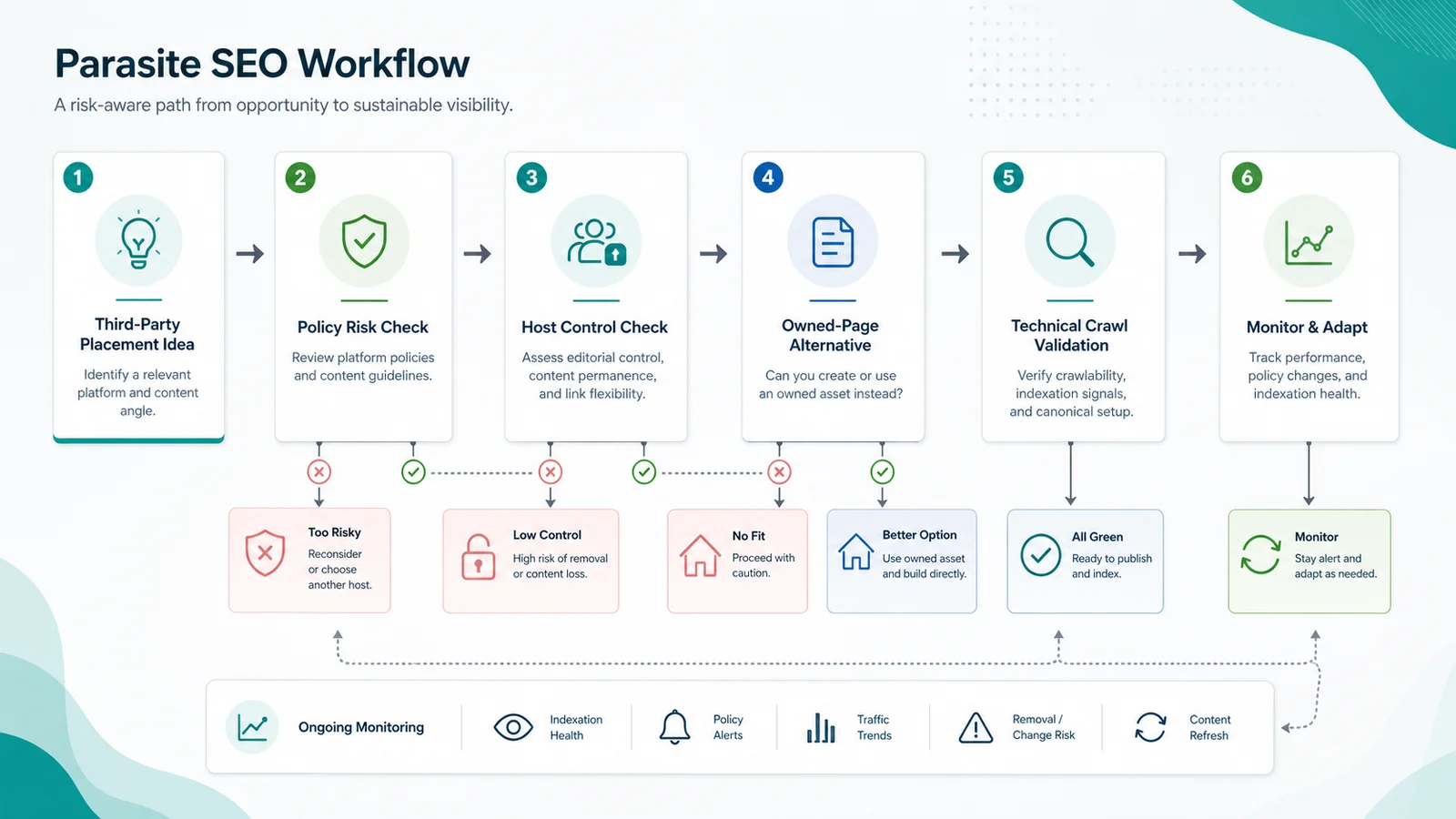
Use this order:
- Confirm the user job. The page should solve a real search task for the host's audience, not just carry your keyword.
- Check the host relationship. A real editorial, partner, marketplace, or documentation relationship is safer than anonymous posting access.
- Review policy risk. Compare the placement with Google's site reputation, link spam, and scaled content abuse policies.
- Check control. Ask who can edit, redirect, noindex, remove, or surround the page with unrelated content later.
- Test the owned alternative. If the page should belong to your brand, build or improve a first-party page instead.
- Validate technical basics. Make sure the destination path, canonical signals, links, and indexability are clean.
- Monitor the placement and the owned page together. Borrowed visibility should not hide decay in your own authority.
If any step fails, the answer is not always "never publish." It may be "use nofollow," "make it a brand profile," "write for referral value only," "turn it into a partner page," or "build the owned article first."
Decide When The Risk Is Too High
The quickest way to overuse parasite SEO is to treat every high-authority domain as a shortcut. Instead, classify the placement by control and value.
| Placement pattern | Risk level | Better decision |
|---|---|---|
| Real expert contribution on a relevant publisher | Lower | Publish if the article serves that audience and links are editorially appropriate. |
| Partner, marketplace, or app listing with accurate product detail | Lower | Keep it factual, maintainable, and useful without over-optimized anchors. |
| Thin third-party page created mainly for a money keyword | High | Build an owned page or a useful partner resource instead. |
| Paid post on an unrelated high-authority host | High | Avoid if ranking manipulation is the main value. |
| Scaled placements across many hosts with similar copy | High | Stop and rebuild around original, people-first content. |
| Page where you cannot update or remove outdated claims | Medium to high | Use only for evergreen, low-risk information or avoid it. |
Google's people-first content guidance is a useful second check. If the page would not be useful to the host's audience without the ranking opportunity, the placement is already suspect.
This is also where link risk enters. Parasite SEO campaigns can drift into exact-match anchors, paid placements, and artificial link patterns. If that is the real problem, step back into a safer toxic backlinks or Google disavow links review before the campaign creates cleanup work.
Build Owned Authority Instead Of Renting It
Most teams should use parasite SEO research as a signal for owned content, not a replacement for owned content. If a third-party page can rank, ask what owned asset should exist next.
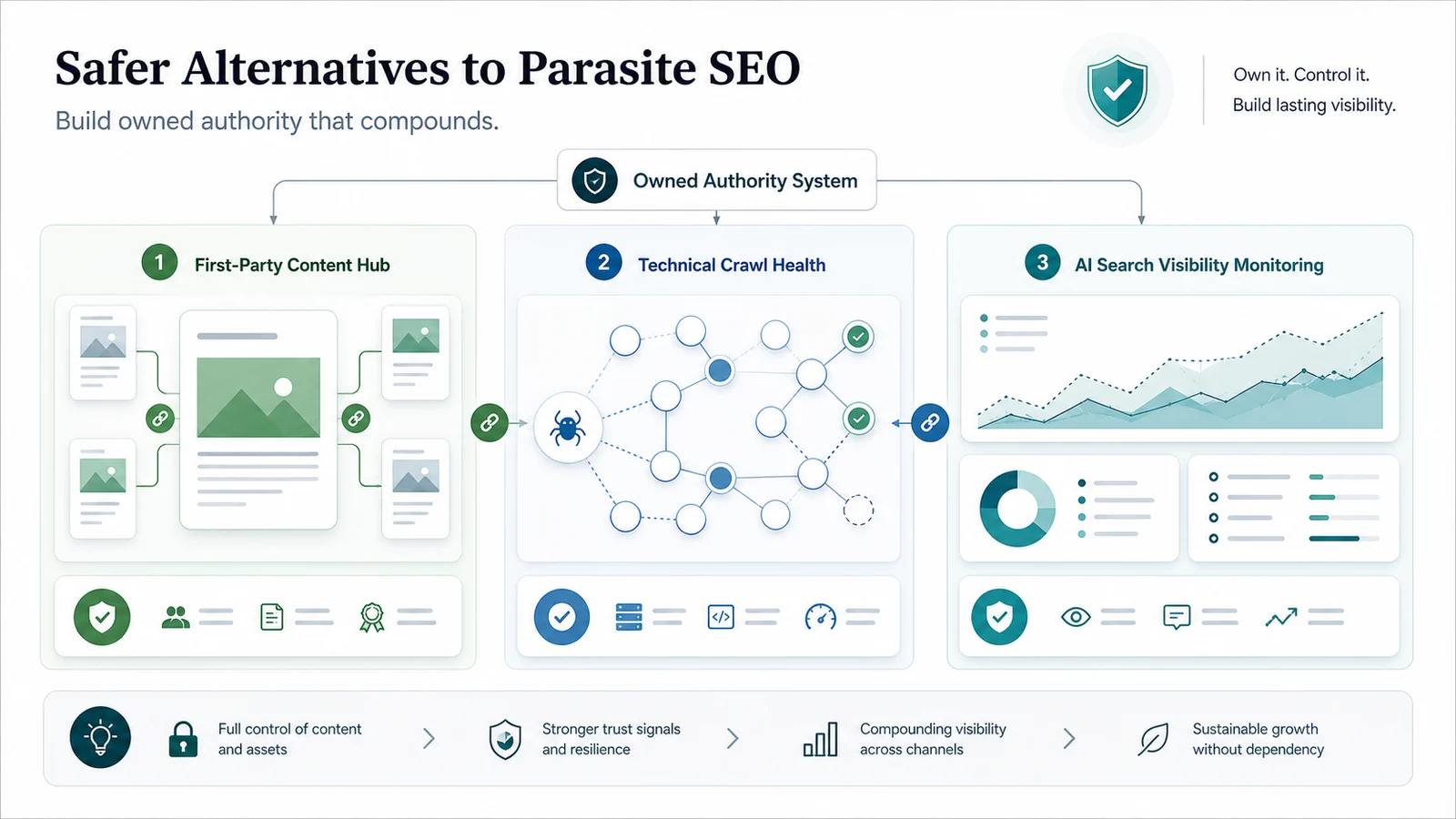
Use this owned-authority map:
| If the parasite idea is... | Build this instead | Why |
|---|---|---|
| A definition query | A concise first-party explainer with examples and a next-step checklist | It can earn trust and support AI-search citations over time. |
| A comparison query | A fair comparison or decision guide | You control updates, disclosures, and positioning. |
| A support/intercept query | A task-focused help article or product workflow | It can rank and reduce sales/support friction without misleading the reader. |
| A broad topic cluster | A hub plus child articles | You own the internal links, crawl paths, and maintenance model. |
| A temporary campaign | A landing page or partner page with clear lifespan | You can expire, redirect, or refresh it cleanly. |
The goal is not to avoid distribution. It is to stop distribution from becoming your only authority strategy. A strong third-party page should point back to a useful owned resource, and the owned resource should be technically crawlable, internally linked, and maintained.
The SEO topical map workflow is the better planning layer when the topic deserves a cluster. It helps decide whether the next asset should be a blog post, product page, hub, support article, or update to an existing URL.
How Searvora Helps Turn Risk Into A Queue
Searvora does not decide whether a publisher relationship is legal, contractual, or brand-safe by itself. That judgment belongs to your team. Searvora helps once you have evidence and need to turn it into actions.
Use the Searvora stack this way:
| Workstream | What to check | Searvora role |
|---|---|---|
| Policy and brand review | Host relevance, user value, disclosures, link intent, copy originality | AI SEO Consultant can structure the decision, owner, rationale, and next action. |
| Owned-page alternative | Existing page coverage, page type, cannibalization, internal-link path | AI SEO Consultant can compare build, update, merge, and defer paths. |
| Technical validation | Indexability, canonical signals, internal links, redirects, sitemap inclusion | SEO Spider Crawler can surface crawl and architecture issues before launch. |
| Monitoring | Page group visibility, AI-search mentions, traffic movement, and decay | AI SEO Dashboard can keep borrowed and owned visibility in the same view. |
That keeps the tactic from becoming a rogue channel. If a third-party placement is approved, it has a reason, owner, and monitoring plan. If it is rejected, the team still leaves with an owned-asset backlog.
Parasite SEO Checklist
Use this checklist before approving a third-party search placement:
- Name the exact query and user job.
- Confirm the host audience would value the page without a ranking shortcut.
- Check whether the page risks site reputation abuse, link spam, or scaled content abuse.
- Document the host relationship and who controls edits, links, canonical signals, and removal.
- Compare the placement with an owned article, hub, landing page, or product page.
- Avoid exact-match anchors, thin copy, duplicate templates, and unverifiable claims.
- Add a technical validation step for the owned destination URL.
- Set a monitoring window for rankings, traffic, indexability, AI-search mentions, and policy changes.
- Assign an owner for refresh, removal, or owned-page expansion.
- Stop scaling the tactic if the only value is borrowed authority.
Parasite SEO is not automatically evil, but it is rarely a durable strategy by itself. Use it only when the placement is useful, transparent, controlled, and defensible. When in doubt, build the owned asset first and let third-party visibility support it instead of replacing it.