

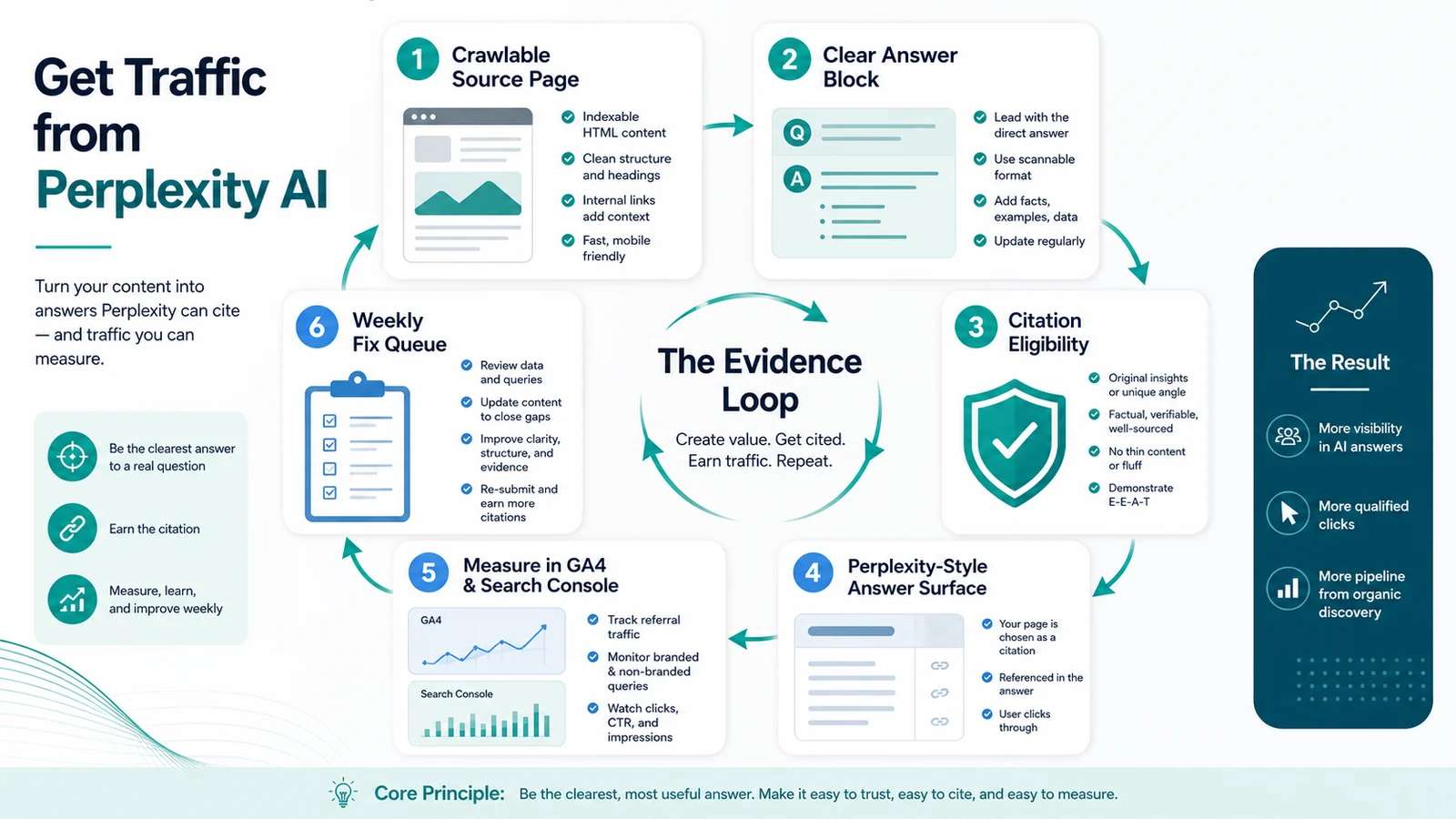
If you want to know how to get traffic from Perplexity AI, start with the page Perplexity could cite. Traffic does not come from a trick. It comes from a source page that answers a real question clearly, can be crawled, can be trusted, and gives searchers a reason to click through for depth.
The practical workflow is to choose the query set, build or improve the source page, verify crawl and citation eligibility, watch Perplexity-style visibility, and measure whether the topic starts sending qualified discovery traffic.
Start With The Source Page Perplexity Can Cite
Perplexity is an answer engine, so the page has to work as a source before it can work as a traffic channel. A vague marketing page is harder to cite than a page with a clear answer, useful structure, current facts, and visible evidence.
The official Perplexity crawler documentation identifies Perplexity crawler user agents and explains that publishers may need to allow the relevant crawlers to access content. Treat that as a technical eligibility check, not a ranking promise.
Use this first source-page checklist:
| Source-page layer | What to check | Why it matters |
|---|---|---|
| Query fit | The page answers one clear search or research task | Answer systems need a clean reason to use the page |
| Crawl access | Robots rules, status code, canonical, and rendering are clean | Crawlers cannot cite what they cannot fetch |
| Extractable answer | The answer appears in visible HTML with headings, tables, examples, or steps | Thin or buried copy is harder to summarize |
| Trust evidence | Facts, examples, author or product context, dates, and sources are visible | The answer needs support, not only claims |
| Click reason | The page offers depth beyond the short answer | Users need a reason to leave the answer surface |
Choose Query Sets Where A Click Still Makes Sense
Some Perplexity answers can satisfy the whole task. Others introduce the topic and send users to sources for examples, tools, implementation details, or verification. Focus on the second group.
Good candidates usually have one of these shapes:
| Query type | Why it can send traffic | Better page format |
|---|---|---|
| Comparison | The user needs criteria and tradeoffs | Decision guide or comparison page |
| Technical how-to | The answer is useful, but implementation needs detail | Step-by-step workflow |
| Current evidence | The user wants data, examples, or source freshness | Maintained source page |
| B2B product research | The user needs a shortlist and proof | Product-led guide or use-case page |
| Troubleshooting | The answer introduces causes, but fixes need diagnosis | Diagnostic article with validation checks |
The AI search citation audit workflow is a useful companion because it separates a brand mention from a cited source. For Perplexity traffic, you want source-level visibility, not only awareness.
Make The Page Easy To Crawl And Understand
Before rewriting content, run the technical checks. Perplexity visibility still depends on ordinary web access signals.
| Technical check | Good state | Fix when weak |
|---|---|---|
| HTTP status | Important URL returns 200 | Remove redirect loops, soft 404s, and blocked variants |
| Robots rules | Relevant crawlers can access the page | Review disallow rules and blocked assets |
| Canonical | The page points to itself or the intended representative URL | Resolve duplicate or parameter confusion |
| Internal links | The page is discoverable from related pages | Add contextual links from hubs, product pages, or supporting articles |
| Sitemap | The canonical URL is present when sitemap inclusion is useful | Regenerate and submit a clean sitemap |
| Main content | The answer is rendered in crawlable HTML | Move critical facts out of hidden widgets or images |
Google's AI features guidance is helpful because it keeps the baseline grounded in normal Search eligibility: useful, accessible pages are still the base. Do not skip technical SEO just because the target surface is an AI answer.
Separate Crawler Access From Attributable Visits
Perplexity's crawler documentation distinguishes PerplexityBot, which supports search discovery, from Perplexity-User, which can fetch a page in response to a user's request. The user-request fetcher generally ignores robots.txt. Allowing the search crawler therefore does not describe every fetch path, and it does not guarantee a citation. When configuring a WAF, use the current published IP ranges together with user-agent checks; a user-agent string alone can be spoofed.
A citation observation and a referral session also answer different questions. Keep a stable prompt sample in a separate record, with the date, query wording, cited URL, and answer surface. Then measure attributable visits in analytics without assuming every visitor or citation leaves a referrer.
Here is an invented seven-day worksheet for one landing-page group. These counts illustrate the arithmetic; they are not Searvora traffic results.
| Record | Observation | Valid conclusion |
|---|---|---|
| Repeated prompt sample | 4 of 10 answers cite a URL in the group | The URL appeared in those sampled answers |
| Referral sessions | 24 sessions have a verified Perplexity referral source | Those sessions are attributable under that source rule |
| Matched sessions with the chosen event | 3 of those 24 sessions contain the event | Session conversion rate in this small cohort is 12.5% |
| Direct sessions to the same pages | 11 sessions have no usable referrer | Their origin remains unknown |
Do not divide four sampled citations by 24 sessions, or add the direct sessions to Perplexity traffic. Prompt samples, sessions, and converting sessions are different units. For a real comparison, hold landing-page scope, event definition, and date window constant and preserve raw source/medium alongside any custom grouping.
Use the observations to choose a next action: improve a cited source's useful depth, repair blocked access, or review the conversion path. A change in the small cohort does not establish causation. Keep a dated page-change record so the next review can compare the same task and measurement rules.
Measure Perplexity Traffic Without Overclaiming
Perplexity traffic may appear as referral traffic, browser traffic, branded search lift, or a source citation that does not send clicks every time. Keep those signals separate.
Track these fields weekly:
| Signal | Where to look | How to read it |
|---|---|---|
| Referral sessions | GA4 referral reports and landing pages | Direct click evidence when a referrer is visible |
| Query movement | Search Console page and query data | Demand and click changes around the same topic |
| Citation presence | Manual or tool-based Perplexity checks | Source visibility, with or without the click |
| Brand mention | Prompt samples by query group | Awareness signal, not traffic attribution |
| Page changes | Content, crawl, and internal-link log | Explains what might have moved the signal |
The AI traffic in GA4 workflow can help with the referral side. For source visibility, pair that with a citation log so the team does not confuse traffic attribution with answer presence.
Use Searvora To Keep The Evidence Loop Alive
Perplexity visibility gets useful when it becomes an operating rhythm. You need the query set, source-page checks, citation observations, traffic signals, and next actions in the same review.
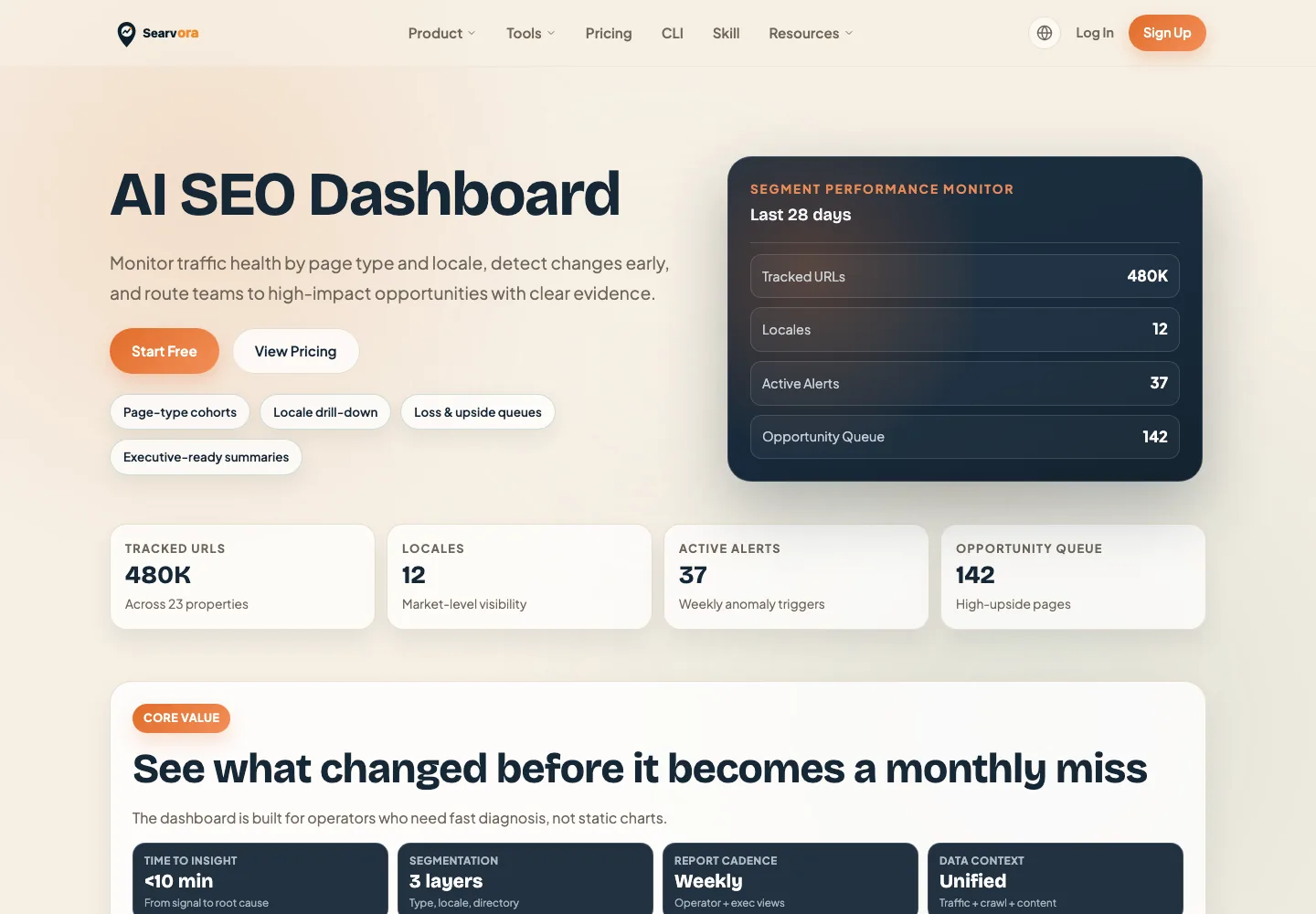
Use the AI SEO Dashboard to monitor traffic health by page type and locale, detect changes early, and route teams to high-impact opportunities with clear evidence. That fits Perplexity work because the same page can need content, crawl, internal-link, and measurement fixes over time.
A Practical Perplexity Traffic Workflow
Use this sequence when the goal is qualified discovery traffic, not vanity mentions:
- Pick five to twenty queries where your page should be a credible source.
- Choose the canonical source page for each query group.
- Confirm crawl access, canonical behavior, internal links, and sitemap coverage.
- Rewrite the opening answer so it directly satisfies the question.
- Add examples, tables, evidence, and implementation detail that make the page worth clicking.
- Log whether Perplexity mentions the brand, cites the URL, or cites competitors.
- Compare referral traffic, Search Console movement, and shipped page changes weekly.
- Assign one next action at a time: improve source depth, fix crawl blockers, add internal links, or build a better supporting page.
Perplexity AI can become a useful discovery channel when the page deserves to be cited and the team keeps measuring the evidence. Build the source, verify the access, and improve the loop every week.