

Google Maps SEO is the work of making a business more eligible, relevant, and trusted in Google Maps results and the local pack. The practical job is not only to fill out a profile. It is to keep profile facts, review proof, local landing pages, crawl health, and measurement moving together.
If your Business Profile is accurate but the business still misses map-pack visibility, treat that as an evidence problem. The team needs to prove what the business is, where it serves customers, which pages support that promise, and which fix should ship next.
What Google Maps SEO Should Actually Optimize
Google's local ranking guidance explains that local results depend on relevance, distance, and prominence. Those are useful ranking concepts, but they only become operational when you translate them into page and profile checks.
| Maps visibility driver | What to inspect | Work it creates |
|---|---|---|
| Relevance | Categories, services, attributes, page copy, internal links, and FAQs | Profile cleanup, service mapping, page refreshes |
| Distance | Address, service area, location pages, and market coverage | Location-page decisions and service-area clarity |
| Prominence | Reviews, mentions, links, local proof, and brand consistency | Review response cadence, proof sections, citation cleanup |
| Eligibility | Indexability, canonicals, sitemap inclusion, structured data, and page speed | Crawl fixes, schema checks, recrawl validation |
| Measurement | Profile actions, page performance, local queries, and AI/local visibility | Weekly monitoring and prioritized action queues |
The important shift is simple: do not optimize the Google Business Profile in isolation. A profile that says "emergency plumber" should be supported by a crawlable service page, local proof, consistent contact details, and a measurement view that can show whether the work changed user actions.
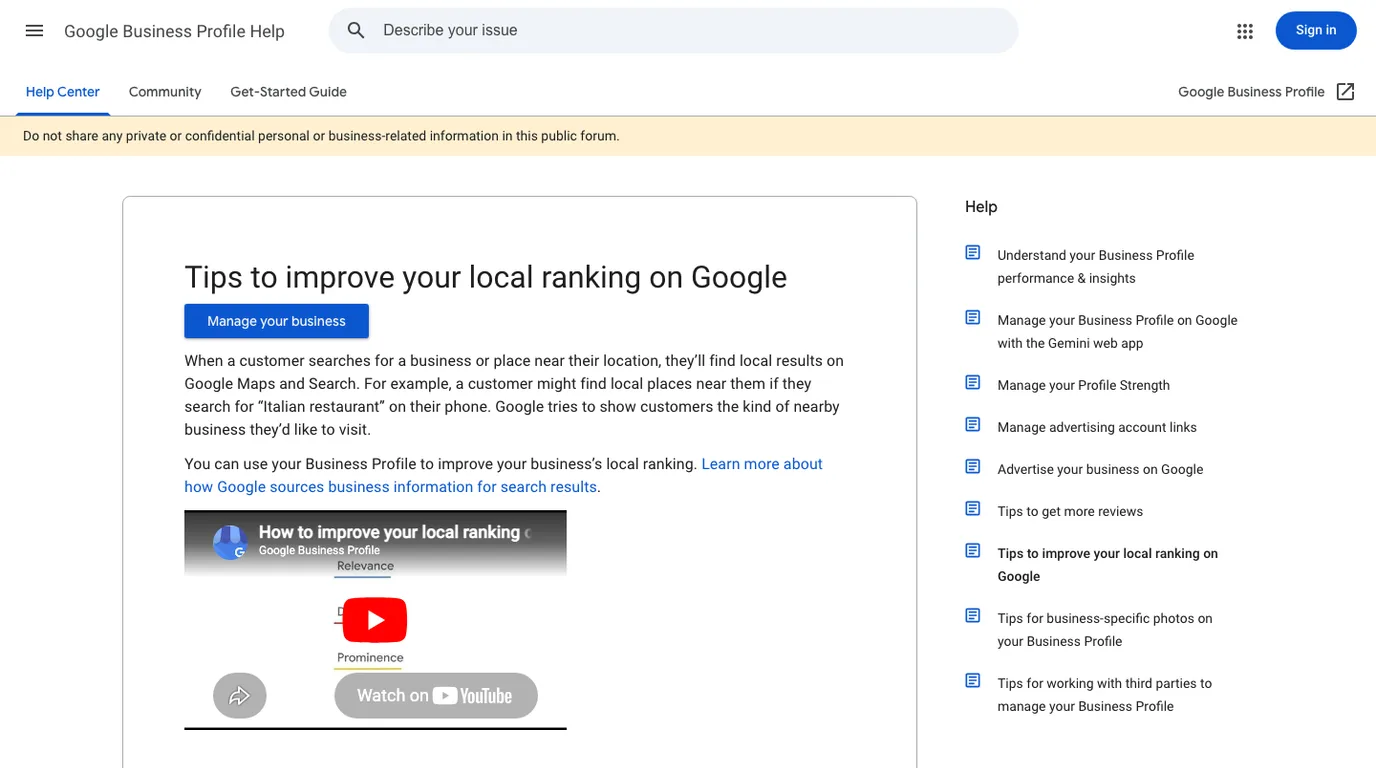
Google's local ranking guidance is the baseline source for this workflow. Use it to keep the team honest, then add the missing operating layer: which profile field, page, review theme, or crawl issue should be fixed first.
Start With Business Profile Evidence
The Business Profile is the source of many local facts searchers see first. Before writing new pages or chasing more reviews, confirm that the profile represents the real business clearly and follows platform rules.
Use this profile evidence pass:
- Confirm the business name, category, address or service area, phone number, hours, and appointment path.
- Map products, services, attributes, and photos to what the website actually supports.
- Remove keyword stuffing, fake locations, duplicate profiles, and stale hours before they become trust problems.
- Compare profile services with the site's service and location pages.
- Record the proof source for each important field so future edits are easier to review.
Google's Business Profile guidelines are the guardrail here. They matter because local visibility work can create risk when teams over-optimize names, categories, or service areas. The durable play is accuracy first, then better supporting evidence.
Connect Maps Visibility To Local Landing Pages
Google Maps SEO usually fails when the profile and the website drift apart. A profile can create the first impression, but local landing pages carry the deeper proof: services, local context, conversion paths, FAQs, internal links, and crawlable content.
Use this page check for every market or service area:
| Page question | Good evidence | Common failure |
|---|---|---|
| Does the page serve a distinct local job? | Unique service, market, staff, proof, or location context | A city name swapped into copied copy |
| Is the page technically eligible? | 200 status, indexable, self-canonical, sitemap included | Noindex, canonical to a parent, redirect chain |
| Does the page reinforce the profile? | Same services, hours, contact path, and local proof | Profile lists services the page never explains |
| Can users act from the page? | Calls, bookings, directions, forms, or store details | Useful profile, but a generic website page |
| Can the team recheck it? | Crawl result, Search Console query, profile action, and owner | No baseline before the update ships |
The parent local SEO workflow covers the broader system. This Google Maps SEO article narrows the job to profile-page alignment, map-pack proof, and the checks that keep local pages eligible.
For structured data, use Google's LocalBusiness structured data documentation only when the markup matches visible page content. Structured data can help clarify facts, but it cannot rescue a weak page or a misleading profile.
Build A Repeatable Evidence Loop
Google Maps SEO becomes easier to manage when each pass follows the same loop: collect profile facts, check the matching page, review public proof, validate crawl eligibility, then monitor the next action.
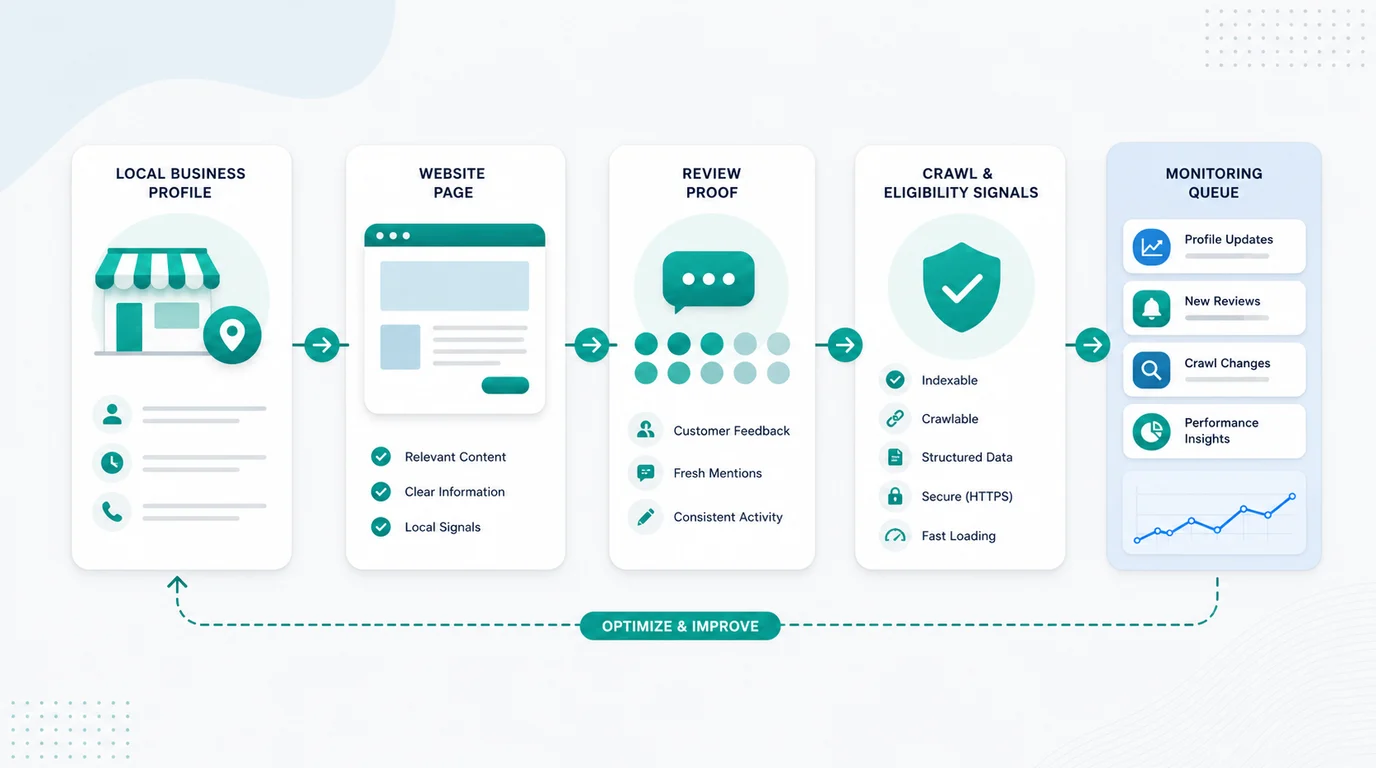
Use the loop this way:
- Profile facts: confirm categories, hours, services, service area, photos, and contact paths.
- Local page: match the profile to a useful page with local proof and a clear conversion path.
- Review proof: extract repeated customer language and common objections, then answer them on the profile and page.
- Crawl eligibility: validate indexability, canonical, sitemap, internal links, structured data, and page speed.
- Monitoring queue: review profile actions, local queries, page clicks, and visibility changes before assigning the next fix.
This keeps the work from becoming a vague "optimize the listing" request. Each step creates an evidence artifact the next owner can inspect.
Use Reviews And Prominence Without Faking Authority
Reviews matter for local trust, but they are not a place to invent shortcuts. The safer workflow is to improve the review request process, respond consistently, and turn real customer language into better page content.
Review these signals together:
| Review signal | What it tells you | Useful next action |
|---|---|---|
| Recency | Whether the business still looks active | Add a post-purchase or post-service review request step |
| Themes | Which services, locations, or objections customers mention | Add proof, FAQs, or examples to local pages |
| Response quality | Whether the business handles feedback in public | Create a response cadence and owner |
| Keyword relevance | Whether real customers describe the service in useful language | Reflect common language naturally on pages |
| Negative patterns | Whether operational issues are hurting trust | Route fixes to service, support, or operations |
Prominence also comes from local mentions, links, citations, community resources, and brand consistency. Treat those as proof signals, not as a reason to build thin doorway pages or chase low-quality directories.
Prioritize The Fix Queue
Most local SEO teams have too many possible tasks. Google Maps SEO needs a queue that separates profile hygiene from page work, technical eligibility, reputation proof, and monitoring.
Score each task by impact, confidence, and effort:
| Task | Impact signal | Confidence signal | Typical owner |
|---|---|---|---|
| Fix category or service mismatch | Important query group underperforms | Profile and page disagree | Local operations or SEO |
| Refresh a local landing page | High-intent market lacks proof | Page has weak copy or missing service detail | Content or growth |
| Repair crawl eligibility | Local page is missing from search | Crawl shows noindex, canonical, redirect, or sitemap issue | SEO and engineering |
| Improve review response cadence | Recent reviews mention the same objection | Review themes repeat weekly | Local operations |
| Add internal links to local pages | Useful page is buried or orphaned | Crawl depth and inlink data show the gap | SEO or content |
| Monitor profile and page movement | Work shipped but impact is unclear | Baseline exists for profile actions and page clicks | SEO operations |
The crawl layer matters because local pages often fail quietly. If a location page is canonicalized to a generic parent, excluded from the sitemap, or orphaned, more profile edits will not fix the website evidence problem. Pair the local review with the technical SEO workflow when eligibility or template issues look suspicious.
Where Searvora Fits
Searvora is useful after the local SEO checklist becomes a recurring operating cadence. Use the AI SEO dashboard to monitor local page groups, visibility shifts, profile-adjacent content, and action queues together instead of reviewing disconnected exports.
The practical handoff looks like this:
- Group local pages by market, service, or page type.
- Watch movement in clicks, impressions, query groups, and page cohorts.
- Add crawl findings beside visibility changes when a page looks eligible on the surface but underperforms.
- Rank the next profile, page, review, or technical task by impact and confidence.
- Recheck the same local cohort after the fix ships.
Google Maps SEO Checklist
Use this checklist when the team needs the work to become repeatable:
- Confirm the Business Profile is eligible, verified, accurate, and guideline-safe.
- Align categories, services, attributes, photos, hours, and contact paths with the website.
- Map each important service or market to a useful local landing page.
- Add local proof, FAQs, service details, internal links, and conversion paths where they are missing.
- Validate indexability, canonicals, sitemap inclusion, structured data, redirects, and crawl depth.
- Review customer language from real reviews and support questions.
- Prioritize profile, page, review, technical, and measurement tasks separately.
- Track profile actions, local page performance, and visibility changes in the same weekly review.
- Recheck the profile and page after each fix so the next queue is based on evidence, not habit.
Google Maps SEO works when the business becomes easier to verify. Keep the profile accurate, make the supporting pages useful and crawlable, earn real review proof, and measure the same local cohort after each change.