

If the question is "is SEO worth it," the answer depends on evidence. SEO is worth it when enough people search for the problem you solve, your site can become eligible to rank, your team can ship the required work, and the payback window fits the business.
The practical question is not "Does SEO work?" It is "Do we have a search opportunity that can become shipped work and measured progress?" Use that framing before buying software, hiring an agency, or asking a small team to publish more pages.
The Short Answer
The competing Ahrefs decision guide is useful because it treats the question as a fit decision instead of a universal yes. Searvora's stronger angle is the operating proof after that decision: demand evidence, crawl readiness, content capacity, AI-search visibility, owner handoff, and validation.
Use this first screen:
| Question | SEO is more likely worth it when | SEO is weaker when |
|---|---|---|
| Is there search demand? | Buyers search for problems, comparisons, workflows, or products you can answer | Demand is tiny, purely branded to another company, or only news-driven |
| Can the site compete? | Important pages are crawlable, indexable, internally linked, and useful | Technical blockers or thin pages prevent eligibility |
| Can the team ship? | SEO, content, engineering, and leadership can own tasks | Recommendations become reports with no owner |
| Is the payoff realistic? | The payback window fits margins, sales cycle, and retention | The business needs immediate returns only paid channels can provide |
| Can progress be measured? | Baselines, leading indicators, and review dates are defined | Nobody can tell whether the work changed anything |
Use The SEO Worth It Matrix
Start with a matrix, not a budget number. The same SEO spend can be smart for one business and wasteful for another because the bottleneck changes.
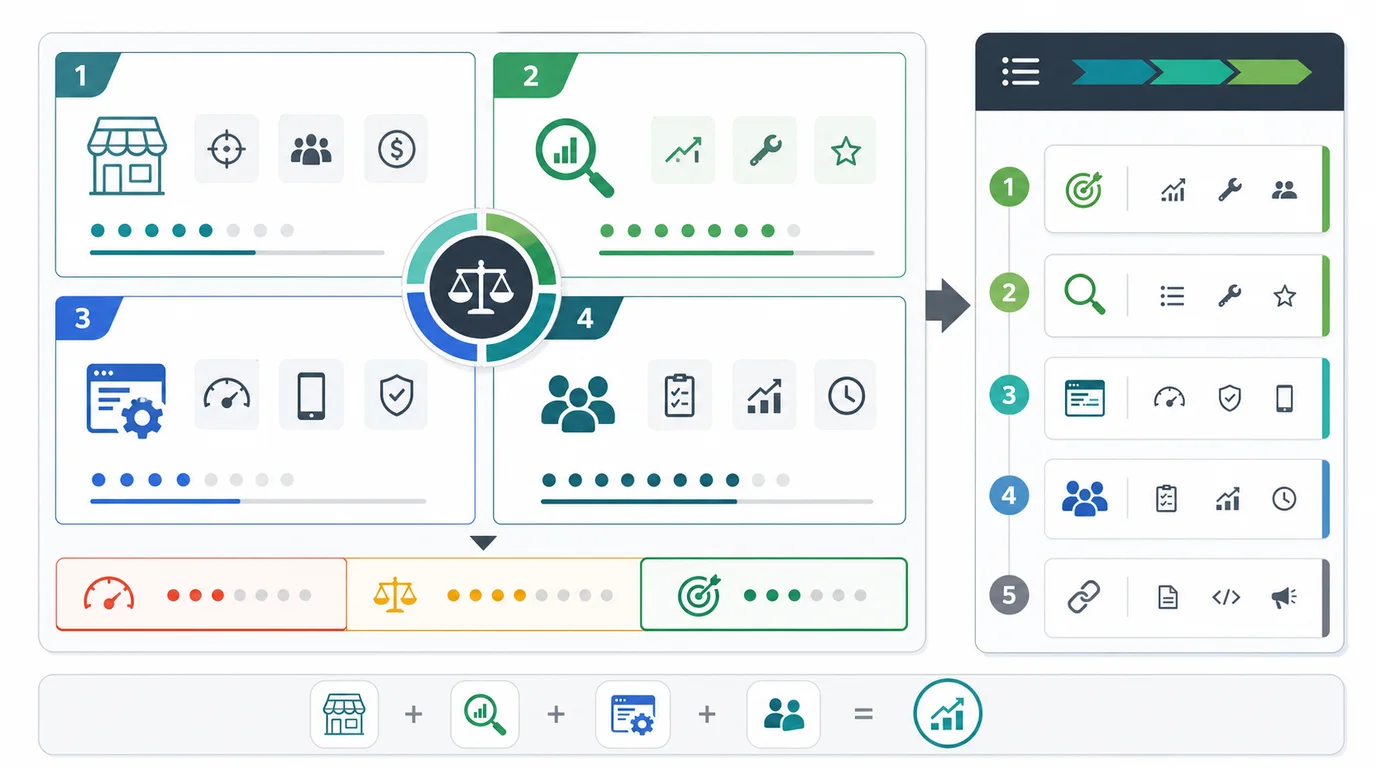
Score the opportunity across four gates:
| Gate | What to check | Strong signal |
|---|---|---|
| Business model fit | Margin, lifetime value, buying cycle, repeat demand | Organic acquisition can pay back over months, not only days |
| Search demand | Query families, competitor page types, content gaps | Real buyers search before they buy, compare, troubleshoot, or renew |
| Site readiness | Crawl access, indexability, internal links, page templates | Search systems can discover and understand the pages that matter |
| Execution capacity | Writers, engineers, product owners, approval process | The team can ship fixes and content without a quarterly bottleneck |
If one gate is weak, SEO may still be worth it, but the investment should match the bottleneck. A site with high demand and poor crawl access should not start with ten new articles. A site with clean architecture and weak content should not buy another audit before assigning briefs.
Check Search Demand Before Buying Activity
SEO is a demand-capture and demand-shaping channel. It is strongest when people already search for categories, comparisons, problems, templates, tutorials, or questions related to your business.
Google's guidance on deciding whether you need an SEO is a useful sanity check: SEO work touches site review, technical advice, content development, keyword research, training, and market expertise. Those are different jobs. A company should not approve "SEO" as one budget line until it knows which job matters most.
Use this demand filter:
| Demand pattern | Better SEO investment | Why it matters |
|---|---|---|
| People search for the problem | Explainer, how-to, or decision-guide content | Organic can intercept the research moment |
| People compare options | Comparison article or product page | SEO can shorten evaluation work |
| People troubleshoot a symptom | Fix guide plus crawl validation | SEO can earn high-intent operational demand |
| People need a repeatable workflow | Playbook, checklist, or template | SEO can create a reusable acquisition asset |
| People only search a competitor brand | Fair intercept or alternative page only if useful | SEO must answer the original task without misleading the reader |
This is where SEO pricing should be grounded. A scope-first SEO pricing framework helps compare retainers, projects, software, and consulting only after the demand job is clear.
Prove The Site Is Ready To Rank
Demand does not help if the site cannot be crawled, indexed, understood, or trusted. Before approving more content, check whether important pages are technically eligible and whether the current page set deserves the queries it targets.
Google's SEO starter guide is a broad baseline for useful content, crawlable structure, links, snippets, and site organization. For a budget decision, translate that guidance into readiness checks:
- Important URLs return healthy status codes.
- Robots rules, noindex tags, and canonicals allow the intended pages to compete.
- Internal links make priority pages discoverable.
- Titles, H1s, and intros match the reader task.
- Content has enough proof, examples, and next-step clarity.
- Technical fixes have owners and validation dates.
If the readiness layer is weak, start with a technical SEO workflow. Technical cleanup can be the highest-ROI SEO investment when it restores eligibility for pages that already have demand.
Separate Payback From Forecasting Theater
SEO becomes easier to approve when the payback model is honest. A forecast should not promise a perfect traffic number. It should show the range of outcomes, the assumptions, and the work required to make the upside plausible.
Use three payback questions:
| Payback question | Evidence to use | Decision it supports |
|---|---|---|
| How much demand exists? | Search Console, keyword research, competitor page shape, current impressions | Whether the opportunity is large enough |
| What has to ship? | Content briefs, technical fixes, internal links, product pages, templates | Whether the team can execute |
| When should signal appear? | Crawl/index timing, impressions, CTR, AI visibility checks, sales cycle | Whether the review window is fair |
A practical SEO forecasting workflow is useful here because it forces assumptions into the open. If the forecast depends on engineering work, content approvals, or a new page type, the budget decision should name that dependency.
Include AI Search In The Decision
SEO is still worth evaluating even when clicks are messier than they used to be. AI answers, zero-click experiences, and fragmented discovery make the decision more evidence-heavy, not less relevant.
For Searvora-style planning, include AI-search readiness in the investment model:
| AI-search question | What to inspect | Better action |
|---|---|---|
| Can answer systems identify the entity? | Brand, product, author, and topical clarity | Strengthen entity and page context |
| Can the page be cited or summarized? | Clear definitions, tables, source evidence, and structured sections | Add extractable answers and proof |
| Are important pages crawlable? | Robots, rendered HTML, canonicals, internal links | Fix eligibility before content expansion |
| Are page types clear? | Product, comparison, article, tool, support, or hub role | Route the topic to the right URL type |
| Can changes be monitored? | Segment-level visibility, query mix, AI mentions, page cohorts | Define a weekly review loop |
This does not mean every article needs AI language. It means the worth-it decision should account for how modern search systems discover, summarize, and route attention.
Turn The Investment Into A Validation Loop
SEO is worth funding only if the team can check whether the work moved. The validation loop should be part of the investment, not an afterthought.
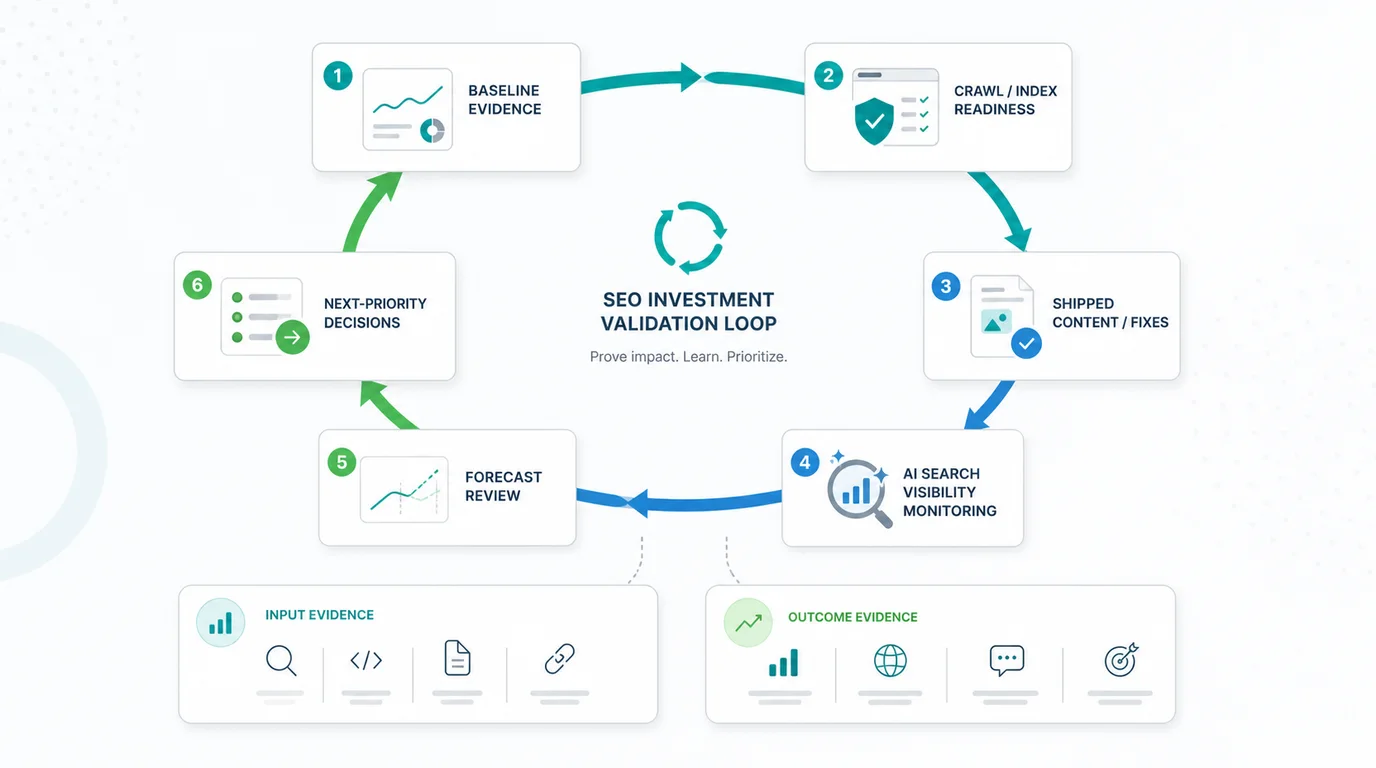
Use this loop:
- Save baseline demand, traffic, crawl, and content evidence.
- Confirm crawl and index readiness before promising impact.
- Ship the content, internal links, technical fixes, or page-type changes.
- Monitor leading indicators before judging final traffic.
- Compare actual movement against the forecast range.
- Decide whether to continue, pause, expand, or change the queue.
Google's Search Console Performance report is one useful baseline for clicks, impressions, CTR, average position, pages, queries, countries, devices, and date comparisons. Pair it with crawl checks, content review, and business context so SEO does not become a single-chart argument.
Where Searvora Fits
Searvora fits when the worth-it decision needs to become assigned work. Use the AI SEO consultant to connect demand evidence, crawl constraints, content gaps, AI-search visibility, and team capacity into a ranked action plan.
The useful handoff looks like this:
| Input | Searvora workflow role | Output |
|---|---|---|
| Search and content demand | Model whether organic can create qualified opportunities | Opportunity queue by page type and confidence |
| Crawl and indexability evidence | Separate eligibility problems from content problems | Fix-ready technical priorities |
| Forecast and budget assumptions | Challenge scope, timing, and expected signal | Approved work with review windows |
| AI-search visibility signals | Add citation and answer-readiness checks | Modern search validation loop |
| Team capacity | Match work to owners and dependencies | Assignable SEO, content, and engineering tasks |
SEO Worth It Checklist
Use this checklist before approving the next SEO budget:
- Name the business outcome SEO is expected to support.
- Confirm there is search demand for the problem, product, category, or workflow.
- Identify the page type that should own the opportunity.
- Check crawl, indexability, internal links, and template readiness.
- Separate technical fixes, content work, authority building, and reporting.
- Confirm the team can ship the required work.
- Estimate the payback range and timeline.
- Define leading indicators before final traffic outcomes.
- Set a validation date and owner.
- Pause or reshape the investment if the evidence does not support the spend.
SEO is worth it when it behaves like an operating system for demand, eligibility, execution, and learning. If it is only a recurring line item with no proof loop, fix the decision model before increasing the budget.