

HARO link building is the practice of answering relevant journalist source requests with genuine expertise, then earning editorial coverage that may include a backlink or an unlinked brand mention. The link is an outcome of helping a reporter complete a story. It should never be the reason to send a weak, off-topic, or fabricated response.
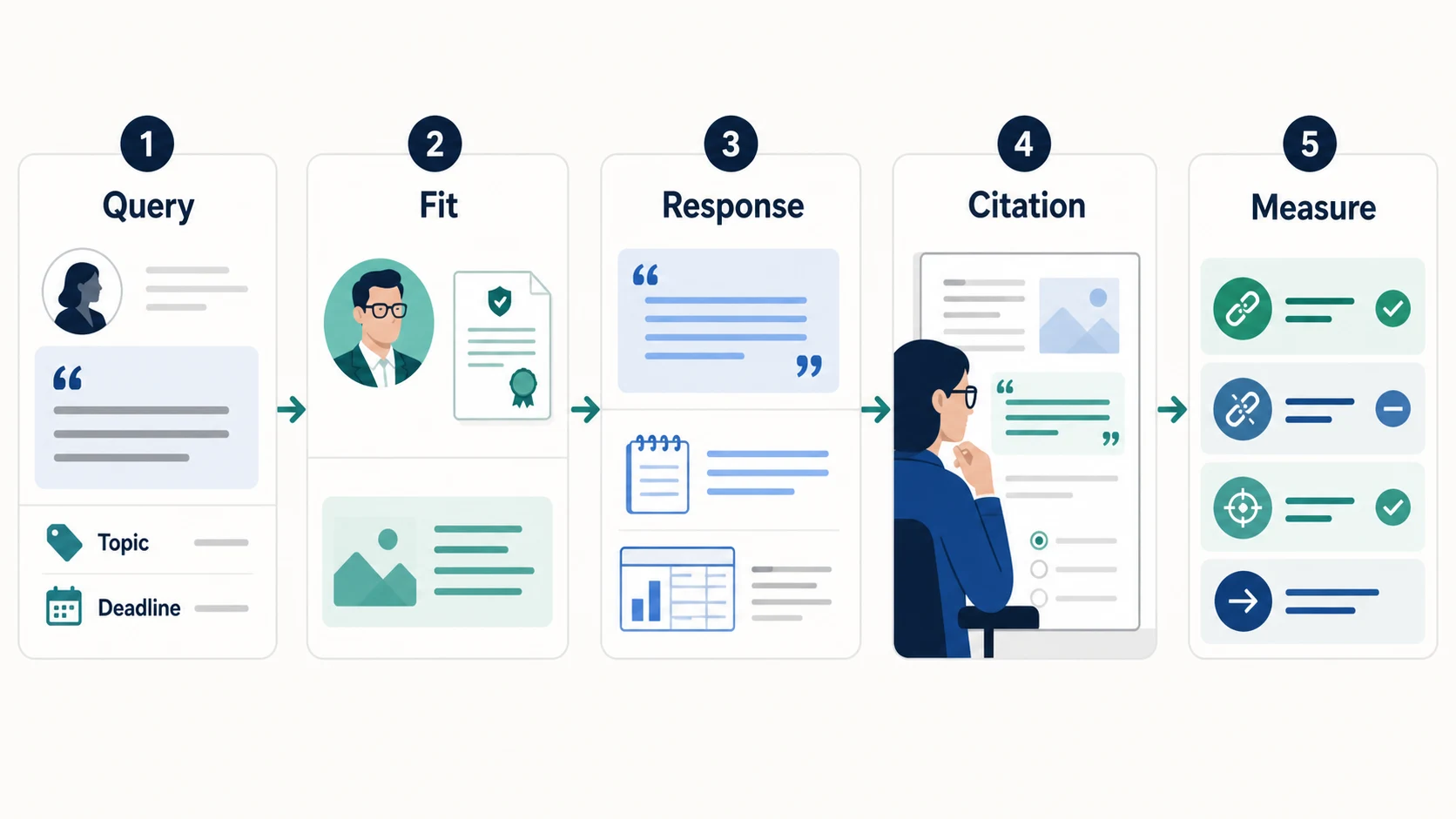
The current HARO service is active again under Featured. Its official workflow is simple: journalists submit queries, sources receive weekday email digests, and reporters choose the responses they want to use. A defensible campaign therefore has five stages:
- Qualify the query before anyone drafts a response.
- Match the request to a real expert with relevant evidence.
- Package a concise, quotable answer before the deadline.
- Let the journalist decide whether and how to use it.
- Measure coverage, citations, relationships, and next actions.
The broader link building outreach workflow covers editorial prospecting and email campaigns. This guide is narrower: it shows how to operate inside journalist-request platforms without turning expert sourcing into backlink spam.
Confirm How HARO Works Today
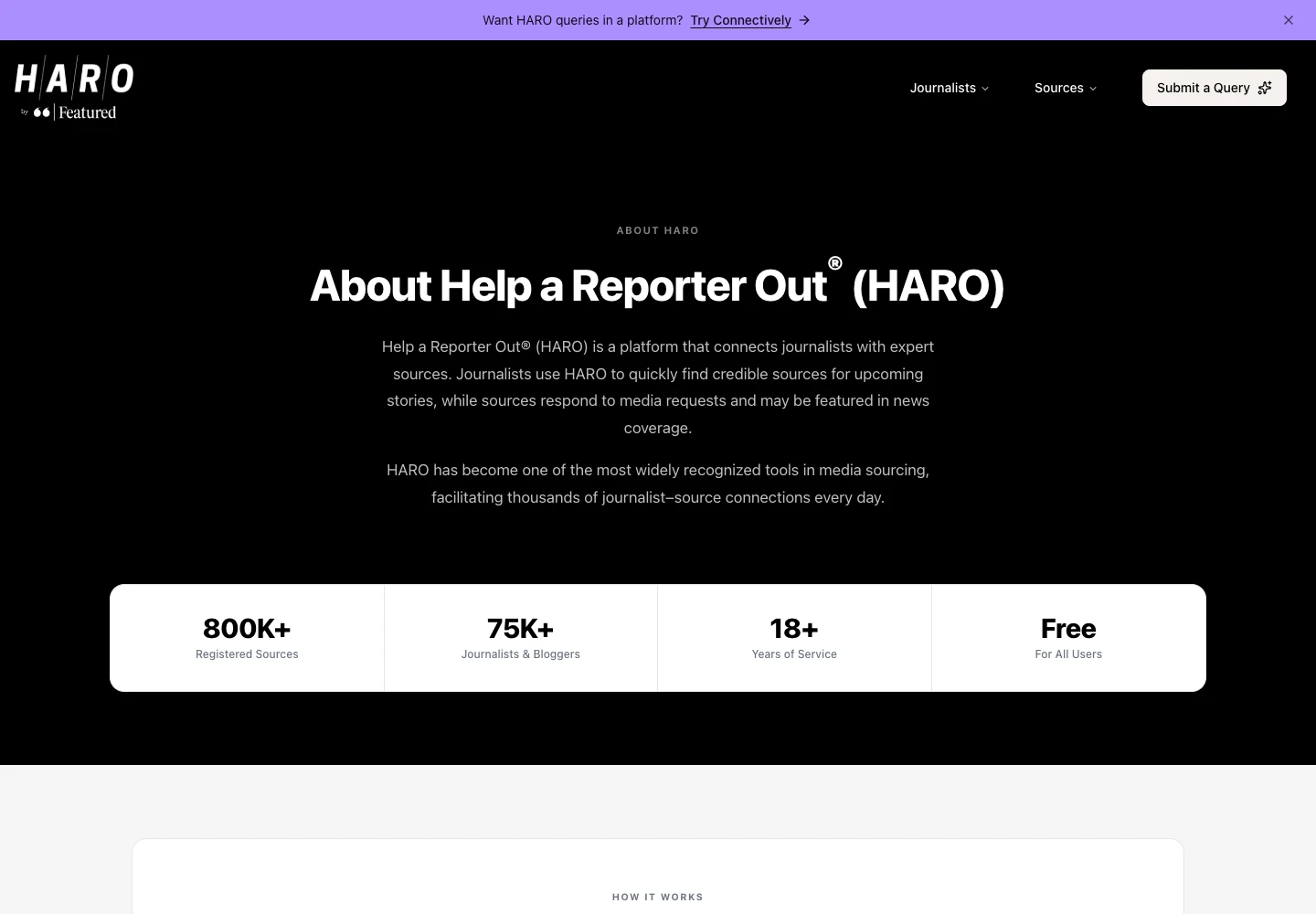
HARO has changed ownership and delivery models over time, so old tactics and screenshots can be misleading. The official HARO overview says the service returned to its email-newsletter roots after Featured acquired it in 2025. Sources can receive up to three digests each weekday, scan active requests, and respond directly when they have relevant expertise.
The platform is not a guaranteed-link marketplace. A reporter may use a response without linking, may ask follow-up questions, or may not use it at all. Build the operating plan around editorial usefulness rather than an assumed placement rate.
Use this current-state check before a campaign starts:
| Question | Evidence to verify | Why it matters |
|---|---|---|
| Is the request active? | Deadline, category, outlet, and response route | Prevents late or misdirected pitches |
| Is the outlet credible? | Live publication, recent bylines, and an identifiable editorial purpose | Reduces fake-query and low-value-placement risk |
| Is the expert qualified? | Role, direct experience, data access, or professional credentials | Gives the journalist a reason to trust the answer |
| Can the claim be supported? | Public source, original data, documented process, or first-hand observation | Keeps the quote accurate and defensible |
| Is the response permitted? | Platform rules and the reporter's specific request | Avoids spam, product pitching, and misuse of query details |
HARO's current terms and source rules require relevant responses to specific queries, prohibit off-topic spam, and tell sources not to pitch products unless the request asks for one. Treat those rules as campaign gates, not fine print.
Qualify the Query Before You Draft
The fastest way to waste a reporter's time is to answer every request that contains a broad industry word. A query deserves a response only when the expert, evidence, outlet, and deadline all fit.
Score each request with a simple decision table:
| Gate | Pass | Hold or reject |
|---|---|---|
| Expertise fit | The source has direct knowledge of the exact question | The source can only summarize common advice |
| Evidence fit | The answer can include a concrete example, result, process, or observation | The response would rely on unsupported claims |
| Outlet fit | The publication and audience are relevant to the expert's work | The only attraction is a domain metric |
| Editorial fit | The reporter wants insight the expert can supply | The request is really a product roundup, paid placement, or link exchange |
| Deadline fit | The expert can review and approve the answer on time | A ghostwritten response would be sent without expert review |
| Disclosure fit | Affiliations and commercial interests can be stated clearly | The response would hide who benefits from the mention |
This gate is what separates HARO link building from generic prospect outreach. You are not trying to persuade an editor that an existing asset deserves a link. You are supplying a source-ready contribution to a story already in progress.
Build a Source-Ready Response Packet
A journalist should not have to excavate the usable quote from a company biography. Put the answer first, make the evidence easy to verify, and keep the source identity complete.
Use this response packet:
- Direct answer. Open with one or two sentences that address the exact question.
- Useful detail. Add a concrete example, mechanism, tradeoff, or result that makes the answer distinct.
- Evidence. Link to a public source, identify original data, or explain the first-hand basis for the claim.
- Quote-ready wording. Keep the strongest point concise enough to use without heavy rewriting.
- Source identity. Include the expert's name, role, organization, relevant qualification, and contact details.
- Disclosure. State any commercial relationship or interest that a reader should know.
- Asset note. Offer an approved headshot or supporting material only when the request calls for it.
A practical response can look like this:
Direct answer
[Answer the reporter's question in two concise sentences.]

Why this happens
[Give one concrete mechanism, example, or observed pattern.]

Evidence
[Name the public source, original dataset, or first-hand basis.]

Source
[Name, role, organization, relevant qualification, contact details.]

Disclosure
[State any relevant commercial relationship or write "None".]
Do not attach a demand for a followed link or exact anchor text. If the reporter credits the source, the publication decides the final wording, placement, and link treatment.
Protect Journalist Trust
Source platforms are vulnerable to generic submissions because one query can attract many responses. The answer is not more automation. It is stricter relevance, human review, and evidence ownership.
HARO says its restored service includes safeguards against spam and AI-generated content. Qwoted's code of conduct goes further and explicitly prohibits AI-generated media pitches on its platform. The operational lesson is the same even when platform policies differ: do not invent expertise, automate a person's identity, or submit text the named expert has not reviewed.
Use AI, if your organization allows it, only around the edges of the workflow:
- classify incoming requests by topic and deadline;
- assemble already approved credentials and source links;
- flag missing disclosures or unsupported claims;
- format a response after the expert supplies the substance;
- maintain the outcome ledger.
Keep the expert responsible for the claim and the final words. A polished response that says nothing original is still a poor source.
Google's spam policies define link spam as creating links primarily to manipulate rankings. Do not pay for a promised editorial mention, trade links for coverage, manufacture credentials, or turn journalist queries into a scalable exact-anchor scheme. Earned media is valuable because an editor independently decided the contribution improved the story.
Choose the Right Source-Request Channel
HARO is not the only route to journalists, and the best channel depends on how your team wants to find and manage requests. This is a workflow choice, not a universal ranking.
| Channel | Public workflow | Best fit | Operational caution |
|---|---|---|---|
| HARO | Free weekday email digests with journalist queries | Teams comfortable scanning scheduled email batches | Qualify aggressively and verify current rules |
| Featured | HARO queries appear on a platform as they are submitted | Experts who want earlier access and in-platform tracking | Use the current public plan details, not old screenshots |
| Qwoted | A feed of matched Calls for Experts with profile-based pitching | Teams that prefer profiles, search, and a managed opportunity feed | Pitch credits and reporter-identity rules can vary by plan |
| Direct journalist relationships | Relevant follow-up with reporters who already know the source | Experts with a proven beat and useful recurring evidence | Never harvest query contact data for unrelated promotion |
Featured's HARO page says its members can see HARO queries when reporters submit them, before the email digest. Qwoted's official source guide describes a profile, matched feed, search, pitch credits, and direct responses to Calls for Experts. Recheck those public pages before documenting a permanent team process because platform access and plan rules can change.
Measure Editorial Evidence, Not Just Links
A HARO campaign can produce several useful outcomes: a followed link, a nofollow link, an unlinked brand mention, a quoted expert, a new reporter relationship, or evidence that a topic is not landing. Track them separately.
Use one outcome ledger:
| Field | What to record | Next decision it supports |
|---|---|---|
| Query | Topic, outlet, journalist, deadline, and platform | Which requests deserve future attention |
| Expert | Name, qualification, approval owner, and evidence supplied | Which source profiles are credible and responsive |
| Response | Sent time, answer angle, source links, and disclosure | Which formats editors can use |
| Coverage | Publication URL, date, quote, brand mention, and link attribute | Whether the result is editorially and topically relevant |
| Source quality | Audience fit, page quality, indexability, and context | Whether the placement supports a durable reputation |
| Search evidence | Referral visits, branded demand, page impressions, and assisted visibility | Whether to expand, revise, or pause the campaign |
| AI-search evidence | Accurate entity mention, cited source, and source ownership | Which public page or brand description needs work |
| Follow-up | Thank-you, correction, asset refresh, internal link, or watchlist | The next owner-ready action |
The brand mentions in AI answers workflow helps separate plain awareness from citation ownership. An unlinked mention is worth recording, but it is not the same as a cited page or a measurable referral.
Avoid a single “links won” score. Ten irrelevant placements are not automatically better than one accurate quote in a publication that reaches the right audience. Review relevance, editorial context, accuracy, and what the evidence tells the team to do next.
Turn Campaign Evidence Into an Action Queue
HARO does not connect directly to Searvora, and Searvora should not be presented as a pitch-sending tool. The useful product fit begins after the team has campaign evidence to prioritize.

Use the AI SEO consultant to structure decisions around the evidence you collected:
| Campaign finding | Action to prioritize |
|---|---|
| One expert earns strong coverage repeatedly | Build a maintained source profile and evidence library for that topic |
| Relevant responses get no follow-up | Tighten the answer, proof, or source qualification before increasing volume |
| Mentions appear but the wrong page is cited | Improve the owned page that should answer the topic and strengthen internal context |
| Coverage links to an isolated asset | Repair internal links, canonical ownership, and crawl paths |
| Queries expose missing public proof | Create a useful data page, methodology note, glossary, or case evidence before pitching again |
| A channel produces spam or weak outlets | Remove it from the approved process and redirect time to higher-fit requests |
The goal is not to automate more responses. It is to decide which expert topics deserve investment, which public pages need stronger evidence, and which campaign findings should become assigned work.
HARO Link Building Checklist
Before responding:
- verify the platform, outlet, request, reporter, and deadline;
- confirm the expert has direct knowledge of the question;
- identify the evidence behind every important claim;
- reject requests where the only attraction is a backlink metric;
- record the disclosure and approval owner.
Before sending:
- answer the exact question in the opening lines;
- include one concrete, quotable insight;
- keep the biography short and relevant;
- provide source links or original-data context;
- remove product promotion, link demands, exact-anchor requests, and invented experience;
- obtain the expert's final approval.
After publication:
- verify the quote, brand name, source URL, and link attributes;
- thank the journalist without asking for unrelated promotion;
- log linked and unlinked mentions separately;
- connect useful coverage to the right owned page and internal links;
- route the next content, technical, or authority task to an owner;
- review the campaign by relevance and evidence, not raw link count.
HARO link building works when the source contribution is useful before a link exists. Qualify fewer requests, send stronger evidence, protect the expert's identity, and let editorial judgment decide the outcome.