

Link building outreach is the process of contacting a specific site owner, editor, partner, or publisher because a page on their site would genuinely be better with your resource included. The useful version is not a mass email blast. It is a small campaign that starts with a linkable asset, qualifies prospects by editorial fit, writes a relevant pitch, follows up without pressure, and measures whether the earned links helped the pages that matter.
The safest outreach workflow has five steps:
- Confirm the asset deserves citations before building a prospect list.
- Qualify each prospect page for topical fit, audience overlap, and editorial reason.
- Write one email around the prospect page's reader, not your backlink target.
- Limit follow-ups and record risk signals before anyone sends more mail.
- Measure the campaign by link quality, page impact, and next actions.
The broader link building for SEO workflow explains when outreach should exist at all. This guide goes narrower: how to run the outreach part without drifting into spam, risky anchors, or fake personalization.
Start With A Page Worth Citing
Outreach should not begin with a domain metric export. It should begin with a page that has a real reason to be cited.
Use this asset check before any email work:
| Asset question | Ready for outreach | Fix before outreach |
|---|---|---|
| What would someone cite? | Original data, a template, a technical explanation, examples, or a useful process | A generic article with no distinct proof |
| Who would benefit? | A named audience such as editors, operators, founders, developers, or community owners | "Anyone interested in SEO" |
| Which page job does it support? | A clear guide, checklist, reference, tool, comparison, or report | A vague commercial page with no editorial value |
| What anchor range is natural? | Brand, URL, descriptive, or citation-style anchors | Forced exact-match anchors |
| How will the link be evaluated? | Relevance, source quality, assisted visibility, and page impact | Raw link count only |
The Ahrefs article that surfaced this opportunity frames outreach as a beginner link building task with templates. Searvora's information gain is the operating layer around that idea: the asset has to pass a citation test before the campaign is allowed to send.
Qualify Prospects Before You Write
Prospect qualification is where most safe outreach campaigns are won. A smaller list of relevant pages usually beats a large list of sites that only look attractive because a tool assigned them a high score.
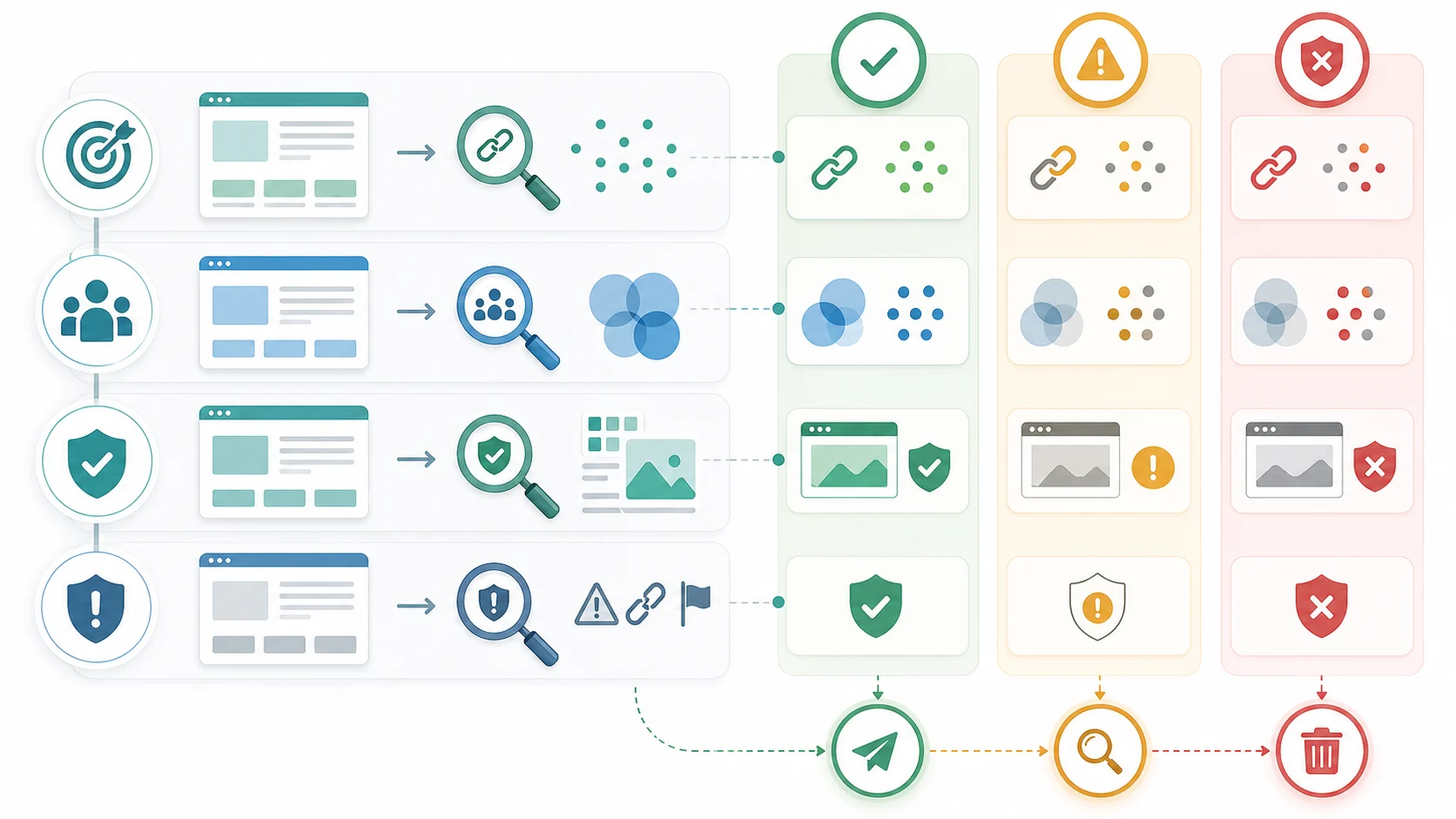
Use this triage table for every prospect URL:
| Qualification layer | Good sign | Risk sign | Decision |
|---|---|---|---|
| Topic fit | The page already discusses the subject or a close adjacent task | The site is unrelated but has attractive metrics | Keep only if the asset adds real context |
| Audience overlap | Their reader would use, cite, or understand the resource | Their reader would see the pitch as random promotion | Remove from the campaign |
| Page quality | The page is maintained, indexed, and useful | Thin directory, link farm, expired resource, or scraped content | Remove or review manually |
| Editorial reason | The link improves an example, source list, broken reference, or explanation | The only reason is that you want authority | Remove |
| Anchor naturalness | A branded or descriptive anchor would fit the sentence | The campaign requires exact-match anchor control | Rewrite the expectation |
| Relationship context | You can name why this person or site is relevant | Contact was scraped with no page-specific reason | Do not send |
For broken-link or resource-page outreach, this qualification step should happen before the template is written. If a page has a missing source, your asset still has to match the lost reference. If a resource list has not been maintained for years, sending five follow-ups will not fix the campaign.
Internal linking belongs in the same quality check. Before asking another site to cite a resource, confirm your own site routes authority and users cleanly. The internal links for SEO process helps catch orphan pages, weak anchors, and crawl-depth problems before an outreach win lands on a page that is hard to discover.
Write The Email Around The Source Page
A good outreach email is short because the reasoning is specific. It does not need a long biography, inflated praise, or a fake relationship. It needs to show that you understand the prospect page and that the resource improves it.
Use this structure:
| Email part | What to include | What to avoid |
|---|---|---|
| Subject | The page, resource, or missing reference you are writing about | Hype, urgency, or misleading familiarity |
| First line | One concrete reason the prospect page is relevant | Generic praise that could fit any site |
| Resource fit | How your asset helps that page's reader | "It would be great for SEO" |
| Link suggestion | A natural sentence-level placement or reference use case | Demands for exact anchor text |
| Exit path | A polite note that it may not be a fit | Pressure, guilt, or repeated asks |
Here is a reusable safe template:
Subject: Resource for your page on [specific topic]

Hi [name],

I was reviewing your page on [specific page topic] and noticed the section about [specific point].

We published [asset type] that may help readers who need [reader job]. It includes [specific proof, example, template, or data], so it could be useful as a supporting reference near [section or idea].

Here it is: [URL]

No pressure if it is not a fit. I only wanted to send it because the page already helps people with [reader task].

Best,
[name]
The template works only when the bracketed parts are real. If the team cannot fill them in without stretching, the prospect should go back to review.
Google's spam policies are the safety line. Outreach becomes risky when links are intended to manipulate rankings through paid placements, excessive exchanges, automated link creation, or unnatural anchors. Link building outreach should create editorial reasons to cite useful work, not pressure people into patterns that search systems can treat as manipulation.
Keep Follow-Ups Useful And Limited
Follow-up rules should be written before the first email goes out. Without a policy, teams often keep sending because the campaign has not hit a link target yet.
Use this simple follow-up policy:
| Rule | Safer default |
|---|---|
| Follow-up count | One follow-up, sometimes two for a high-fit relationship |
| Timing | Wait several business days; do not send daily reminders |
| Message content | Add one useful clarification or alternate placement idea |
| Stop condition | Stop after no response, refusal, weak fit, paid-link request, or exchange pressure |
| Recordkeeping | Log sent date, response, risk flag, earned URL, anchor, and next action |
Do not try to rescue a weak first email with more volume. If the first pitch did not clearly connect the resource to the prospect page, fix the qualification and asset notes before sending more.
This is also where outreach teams should record risk. Paid placement requests, irrelevant guest post offers, exact-match anchor demands, link exchange pressure, and repeated low-quality sources should all be flagged. Most sites do not need to panic about every strange backlink, but teams should know when a campaign is creating patterns they would rather avoid. The Google disavow links workflow is a better fit when there is manual action risk, a history of manipulative link building, or clear evidence that links need to be disassociated.
Measure Outcomes Beyond Replies
Replies are not the result. Links are not the whole result either. A link building outreach campaign should tell the team whether the promoted asset became easier to discover, cite, and trust.
Track these outcomes:
| Measurement layer | What to review | Better next action |
|---|---|---|
| Reply quality | Which page types, audiences, or reasons got real responses | Narrow future prospect lists |
| Earned links | Source relevance, page usefulness, anchor naturalness, and target URL | Keep quality patterns, stop weak patterns |
| Asset feedback | Questions, objections, missing examples, or sections editors cared about | Refresh the asset before the next batch |
| Search impact | Impressions, clicks, assisted rankings, and AI-search citation readiness | Decide whether to expand, refresh, or pause |
| Internal routing | Whether the linked asset supports hubs, product pages, or related articles | Add internal links where the asset should pass context |
| Risk pattern | Paid requests, exchange pressure, irrelevant sites, or exact-match anchors | Tighten policy and remove risky sources |
The campaign report should fit on one page. It should name the asset, the audience, approved prospect types, removed prospect types, emails sent, responses, earned URLs, risk notes, and the next decision. If that report cannot explain what to do next, the campaign is still a spreadsheet rather than an SEO workflow.
Where Searvora Fits
Searvora AI SEO Consultant fits the planning and prioritization layer around link building outreach. It should not be used to manufacture contacts, buy links, or automate risky emails. Its stronger role is turning campaign evidence into an action queue the team can review.
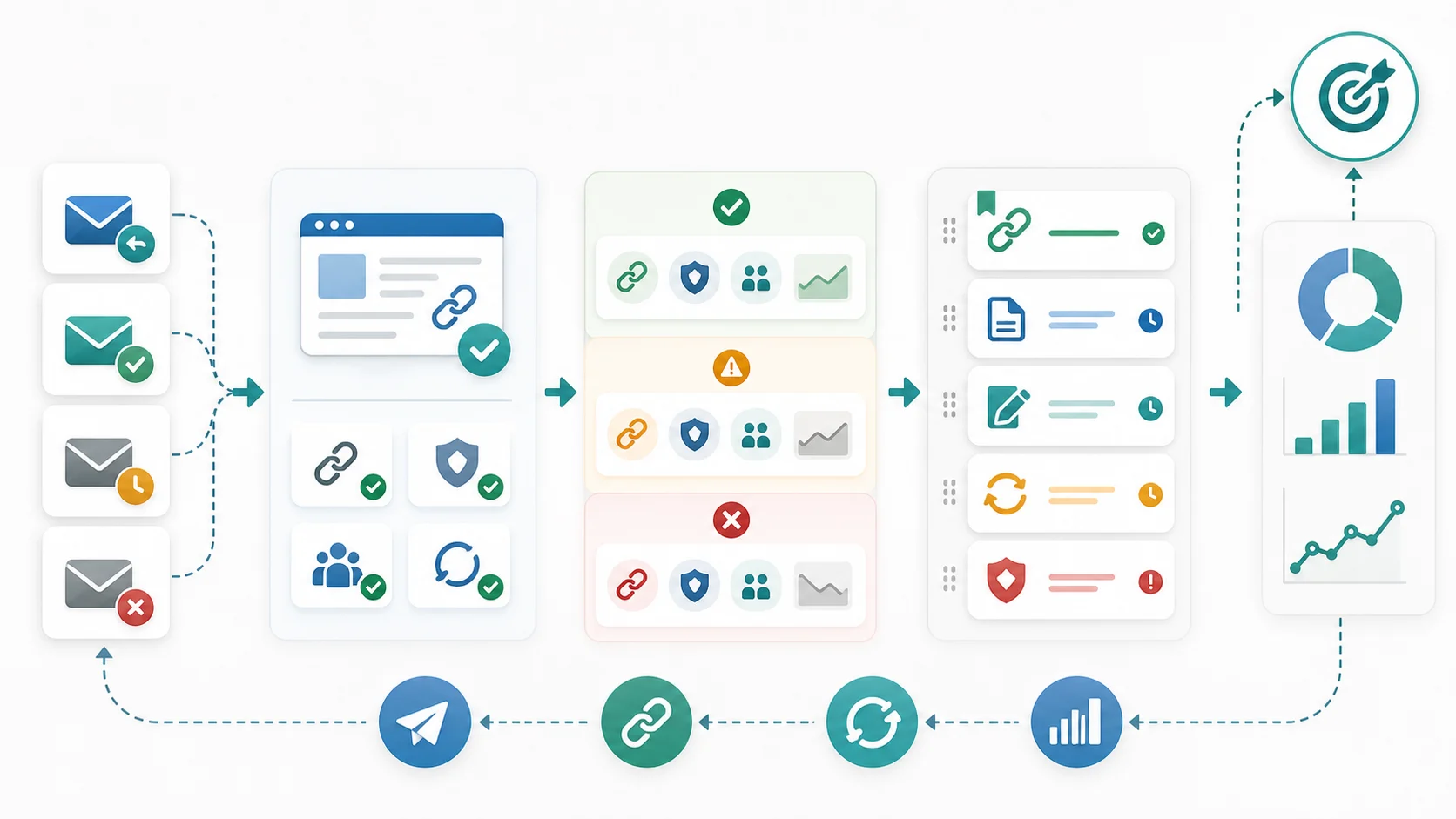
Use the AI SEO consultant when outreach decisions need to become assignable work:
| Outreach decision | What Searvora helps structure |
|---|---|
| Which asset deserves promotion | Prioritize assets by business fit, search task, and information gain |
| Which prospects to skip | Convert risk and fit signals into campaign rules |
| Which campaign result matters | Separate earned attention from raw link count |
| What to improve next | Turn replies, objections, crawl evidence, and content gaps into owner-ready actions |
The value is decision quality. A team that knows which assets deserve outreach, which prospects should be skipped, and which outcomes matter will send fewer emails and build better evidence.
Link Building Outreach Checklist
Use this checklist before launching a campaign:
- Pick one linkable asset, not a broad site section.
- Write the citation reason in one sentence.
- Confirm the asset helps a specific reader task.
- Remove prospects that lack topical fit or audience overlap.
- Remove sites where the only appeal is a metric.
- Write each email around the prospect page, not the backlink target.
- Keep anchor expectations branded, descriptive, or natural.
- Limit follow-ups before the campaign starts.
- Record paid-link requests, exchange pressure, irrelevant sources, and exact-match anchor demands.
- Measure reply quality, earned link quality, asset feedback, search impact, internal routing, and risk.
- Turn the campaign report into a next action: refresh the asset, narrow prospects, improve internal links, pause, or expand.
Link building outreach works when it behaves like editorial operations. Build something worth citing, find the pages where it genuinely helps, write with context, stop when the fit is weak, and measure whether the campaign created durable search value.