

SEO case studies are useful when they help a team understand why growth happened, what changed on the site, and how the lesson could be tested in a different context. They are less useful when they become a gallery of impressive traffic numbers with no operating model behind them.
The Ahrefs SEO case studies list that surfaced this opportunity shows clear demand for real-world examples. Searvora's angle is the workflow layer: read each case study as evidence, extract the repeatable lever, then turn it into an assigned experiment or fix queue.
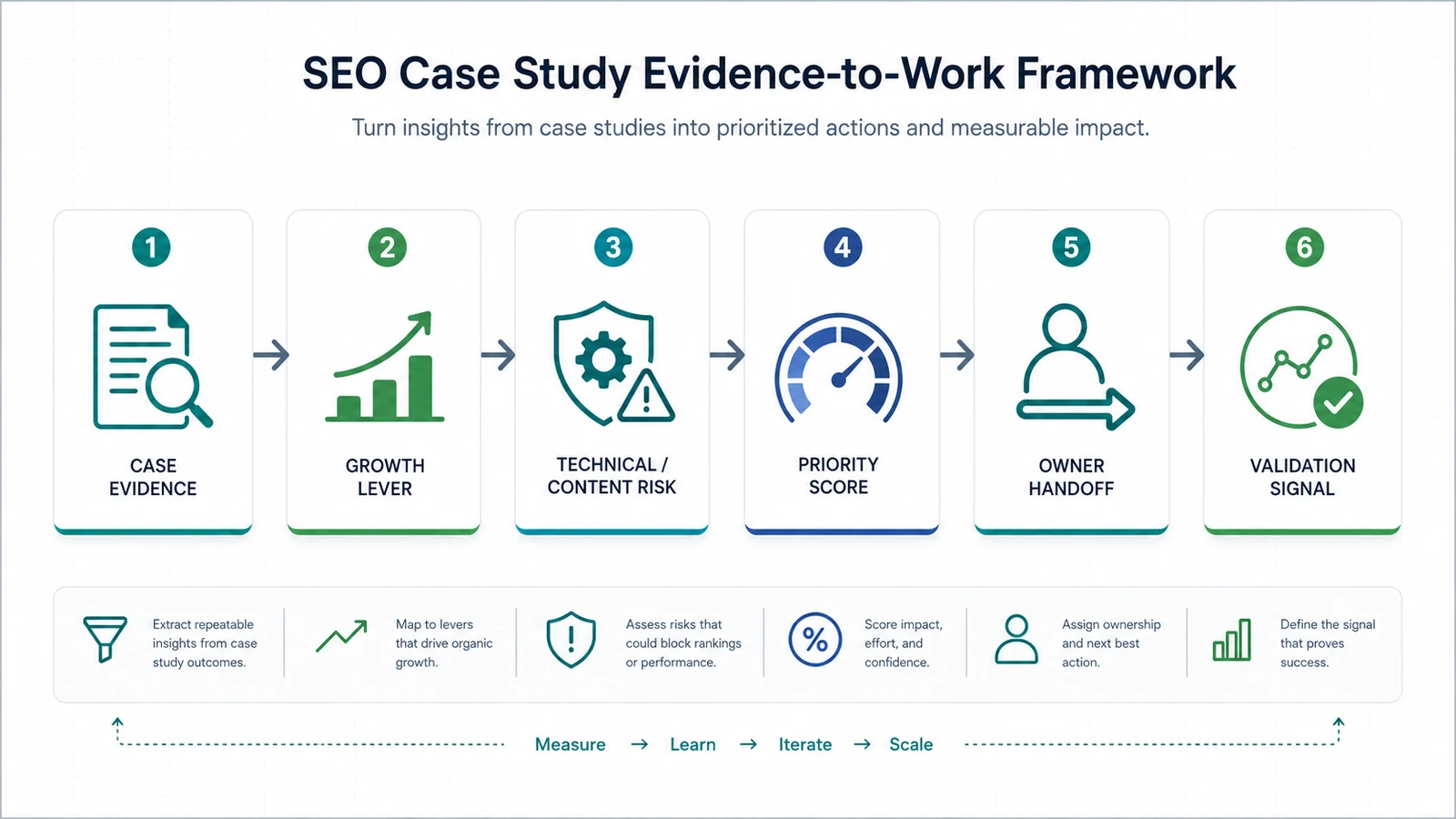
Read Case Studies Like Evidence
A good SEO case study should not tell you to copy another company's site. It should help you isolate the conditions that made a tactic work.
Use this first pass before adding a lesson to your roadmap:
| What to extract | Why it matters | What to avoid |
|---|---|---|
| Starting condition | Shows whether the case had brand demand, technical debt, content scale, or link authority already in place | Copying tactics from a site with a completely different baseline |
| Growth lever | Identifies the actual mechanism: templates, internal links, schema, content refreshes, topical depth, or reporting | Treating all wins as "more content" |
| Risk or constraint | Reveals what could fail on your site, such as crawl waste, thin templates, legal review, or weak authority | Ignoring implementation cost |
| Validation signal | Defines how the team will know the work improved discovery, indexing, impressions, clicks, or conversions | Calling a tactic successful before measurement |
| Owner and cadence | Converts inspiration into work that someone can ship and recheck | Leaving the lesson in a slide deck |
Case Examples Worth Studying
These public examples are not templates to clone. They are useful because each one exposes a different growth lever an SEO team can translate into its own operating system.
| Case study | What the public case shows | Repeatable lesson |
|---|---|---|
| Zapier SEO strategy | Ahrefs analyzed how Zapier reaches product-adjacent searchers through workflow and app-category content. | Map adjacent demand to real product use cases, then route readers into useful next steps instead of forcing product mentions everywhere. |
| Wise SEO case study | Ahrefs highlighted Wise's custom CMS, internal linking, metadata, hreflang, canonical handling, and platform monitoring. | Treat scale as a technical and editorial system; templates need crawl checks, locale logic, and monitoring before they become growth assets. |
| Wix Search Central case study | Google reported that Wix integrated Search Console and URL inspection capabilities into its UI, with measurable lift for connected sites. | Put search evidence where operators make decisions; the dashboard experience can change whether issues are found and fixed. |
| Google video SEO case studies | Publishers used video best practices, structured data, and Search Console reports to improve video discoverability. | Structured data is not a one-time markup task; it needs eligibility checks, error monitoring, and post-release measurement. |
| Jobrapido JobPosting case study | Google reported major organic-traffic and registration gains after Jobrapido integrated with the jobs experience on Search. | Rich-result work should start with a real user journey and the correct schema type, then be monitored by outcome quality, not markup presence alone. |
| Wirecutter SEO case study | Ahrefs analyzed review depth, trust signals, category pages, freshness, and distribution in an affiliate content model. | Review content needs proof, upkeep, and source quality; thin comparison pages cannot borrow trust from a famous example. |
The useful pattern is not "publish like Zapier" or "build like Wise." The useful pattern is to ask what condition, lever, and measurement system made the result possible.
Turn Each Lesson Into A Work Queue
After reviewing a case study, decide whether the lesson belongs in content, technical SEO, reporting, product, or no action. Many case-study ideas sound attractive but fail when they meet the current site.
Use this queue model:
| Lesson type | Good next action | Validation signal |
|---|---|---|
| Product-adjacent content works | Build or refresh one page cluster around a real user job | Query variety, assisted product clicks, internal-link paths |
| Templates can scale organic pages | Crawl a small template cohort before expanding | Indexable URL count, duplicate patterns, canonical consistency |
| Structured data improved discovery | Add markup only to eligible page types and validate live output | Rich-result eligibility, error reduction, impressions by page type |
| Trust signals improved review content | Add source, testing, author, update, and disclosure checks | Engagement, rankings for comparison queries, lower refresh churn |
| Dashboard evidence changed behavior | Put the metric where the owner can act on it weekly | Faster issue triage and more closed actions |
For broader prioritization, pair the case-study review with SEO forecasting. Forecasting helps decide whether an idea is large enough to warrant engineering, content, or design time. If the case exposes competitor movement, use SEO competitor analysis before turning the lesson into a brief.
Where Searvora Fits
Searvora AI SEO Dashboard fits the monitoring and prioritization layer of this work. The local product page positions the dashboard around page-type cohorts, locale drill-down, anomaly detection, opportunity scoring, cross-team reporting, and weekly action queues.
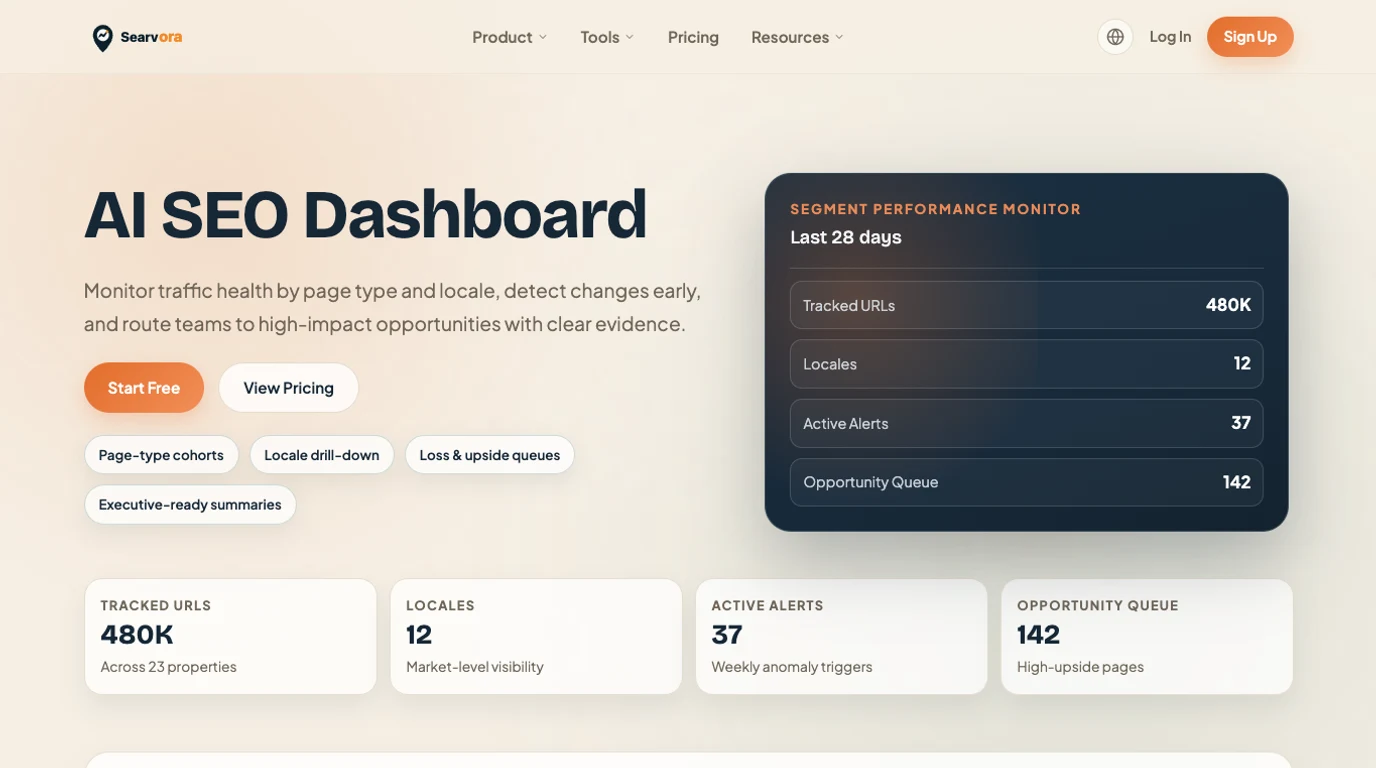
Use the AI SEO dashboard after a case-study idea has been translated into a testable action:
- Group the affected pages by template, directory, locale, or content type.
- Watch the baseline before the change ships.
- Track whether discovery, indexing, impressions, CTR, clicks, or conversions move in the expected order.
- Keep the action tied to an owner and a review cadence.
- Stop expanding the tactic if the first cohort does not produce a clear signal.
This is also where a content audit helps. If a case-study lesson points to refresh work, do not start by rewriting everything. Identify which pages have demand, which pages have technical blockers, and which pages only need stronger internal links or a clearer section.
A Case Study Review Checklist
Before a case study becomes a project, run this checklist:
- Name the exact user task the case study improved.
- Record the site conditions that made the tactic possible.
- Separate content, technical, authority, product, and reporting levers.
- Check whether an existing page should be updated before creating a new one.
- Decide the first cohort, not the whole rollout.
- Assign one owner and one validation date.
- Define the metric that should move first.
- Recheck crawl, indexability, and internal links before judging content quality.
- Document the result so the next case-study review gets smarter.
SEO case studies should make your team more specific. The goal is not to admire a famous growth story. The goal is to turn public evidence into a smaller, testable, measurable piece of work your own site can actually support.