

Hreflang tags tell Google which localized versions of a page belong together so the right language or regional URL can be shown to the right searcher. They are most useful when several URLs serve the same core page job in different languages, countries, or scripts.
The hard part is not writing one tag. The hard part is keeping every locale variant, canonical URL, sitemap entry, and rendered page output in sync after templates, CMS rules, or redirects change. Treat hreflang as a validation workflow, not a one-time code snippet.
Use Hreflang Only When Pages Are True Alternates
Start by deciding whether the URLs really deserve to be in the same alternate cluster. Hreflang works best when the pages are equivalent choices for the same user task.
| Page situation | Hreflang fit | What to check first |
|---|---|---|
| Same product page translated for English, Simplified Chinese, and Traditional Chinese | Strong | Each URL is indexable, canonical to itself, and equivalent in intent |
| Same service page for US and UK markets with localized pricing or spelling | Strong | The regional variants should be distinct enough to help the user |
| Blog posts that cover different examples or angles by market | Possible | Make sure they are alternates, not separate articles |
| Auto-translated thin pages | Weak | Improve content quality before adding technical markup |
| One canonical page plus many filtered or duplicate URLs | Weak | Fix canonicalization instead of creating hreflang clusters |
Google's localized versions documentation explains the supported methods and return-link expectations. Use that guidance as the implementation source of truth, then build your own crawl checks around it.
Map The Locale Cluster Before Writing Tags
Every eligible URL in a hreflang cluster should reference itself and every other eligible alternate. If the English page links to the Chinese pages but the Chinese pages do not link back, the cluster is incomplete.
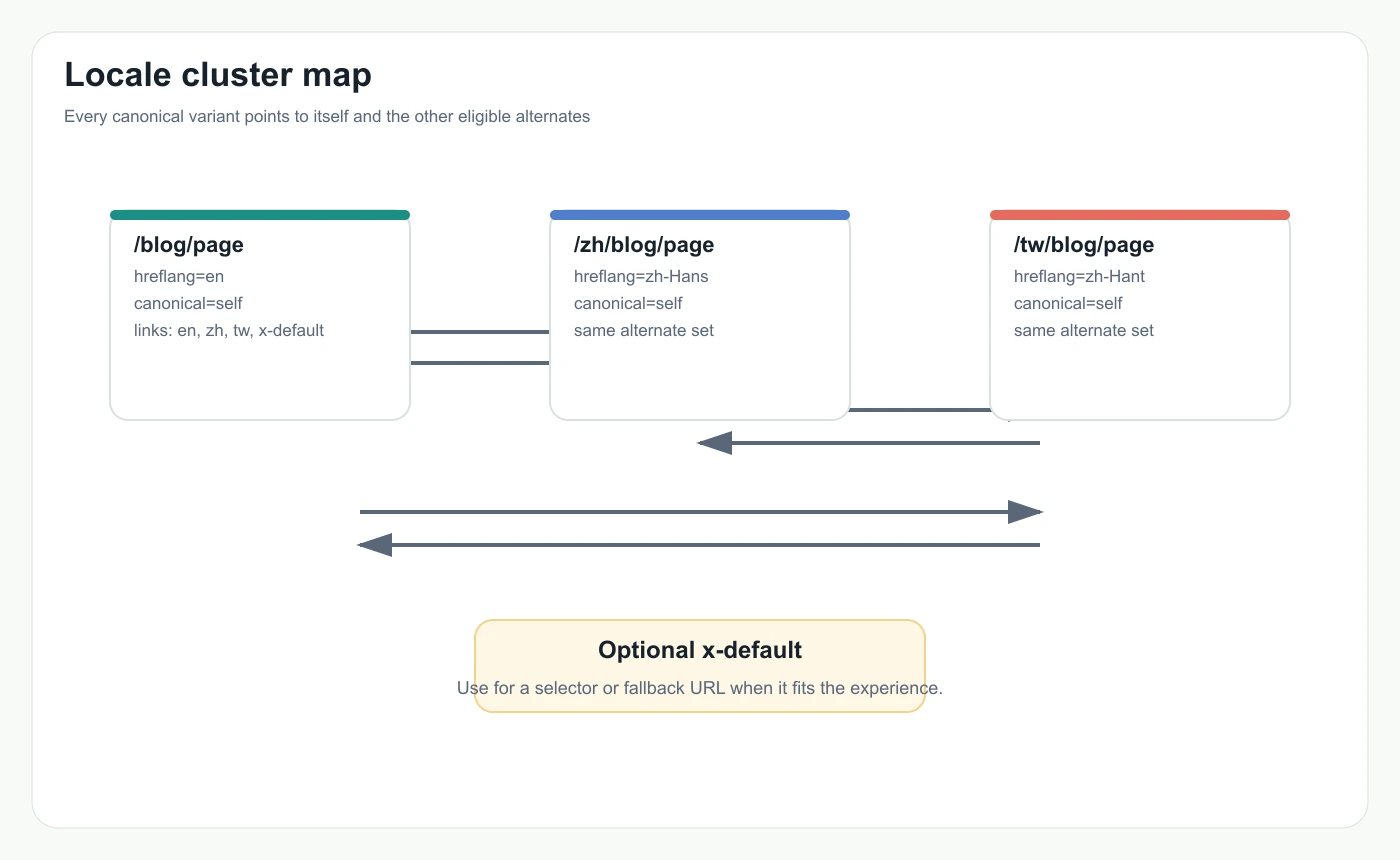
For a Searvora-style multilingual blog page, the cluster map might look like this:
| Locale URL | Hreflang value | Canonical target | Required alternates |
|---|---|---|---|
https://searvora.com/blog/example | en | Self | en, zh-Hans, zh-Hant, optional x-default |
https://searvora.com/zh/blog/example | zh-Hans | Self | en, zh-Hans, zh-Hant, optional x-default |
https://searvora.com/tw/blog/example | zh-Hant | Self | en, zh-Hans, zh-Hant, optional x-default |
The exact language and region codes should match the page experience. Use language-only values when the content targets a language broadly, such as en. Add region when the page is specifically regional, such as en-us or en-gb. Use script codes only when script distinctions matter, such as zh-Hans and zh-Hant.
Choose One Implementation Method Per Page Type
Google supports hreflang in the HTML head, HTTP headers, or XML sitemaps. Mixing methods is possible, but it usually makes QA harder. Pick one main method for each page type and keep it consistent.
| Method | Best for | Operational risk |
|---|---|---|
HTML <link> tags | Normal HTML pages and rendered blog/product templates | Template changes can remove or duplicate tags |
| XML sitemap alternates | Large sites where sitemap generation is reliable | Sitemap and page output can drift apart |
HTTP Link headers | PDFs or non-HTML files | Harder for content teams to inspect manually |
A normal HTML page can use tags like this:
<link rel="alternate" hreflang="en" href="https://example.com/blog/hreflang-guide" />
<link rel="alternate" hreflang="zh-Hans" href="https://example.com/zh/blog/hreflang-guide" />
<link rel="alternate" hreflang="zh-Hant" href="https://example.com/tw/blog/hreflang-guide" />
<link rel="alternate" hreflang="x-default" href="https://example.com/blog/hreflang-guide" />
Use x-default when you have a true fallback URL, language selector, or global default. Do not add it just to make the tag set look complete.
Align Hreflang With Canonicals And Indexability
Hreflang and canonical tags answer different questions. Canonical tells search engines which URL should represent a duplicate or near-duplicate set. Hreflang tells Google which localized alternates belong together.
That means each localized page should usually be canonical to itself. If the Traditional Chinese URL canonicals to the English URL, then it is telling Google not to treat the Traditional Chinese URL as the canonical page. That conflicts with the goal of serving it to Traditional Chinese searchers.
Check these rules before publishing:
- Each alternate URL returns a 200 status.
- Each alternate URL is indexable and not blocked by robots rules.
- Each alternate URL has a self-referencing canonical unless there is a deliberate exception.
- Each alternate URL includes the same alternate set.
- No alternate points to a redirected, noindex, error, or canonicalized-away URL.
- The language code matches the visible page language.
For canonical edge cases, use Google's canonicalization guidance alongside the hreflang documentation. The two systems need to agree.
Validate With A Crawl Before And After Release
Manual spot checks catch obvious errors. A crawl catches template and scale errors.
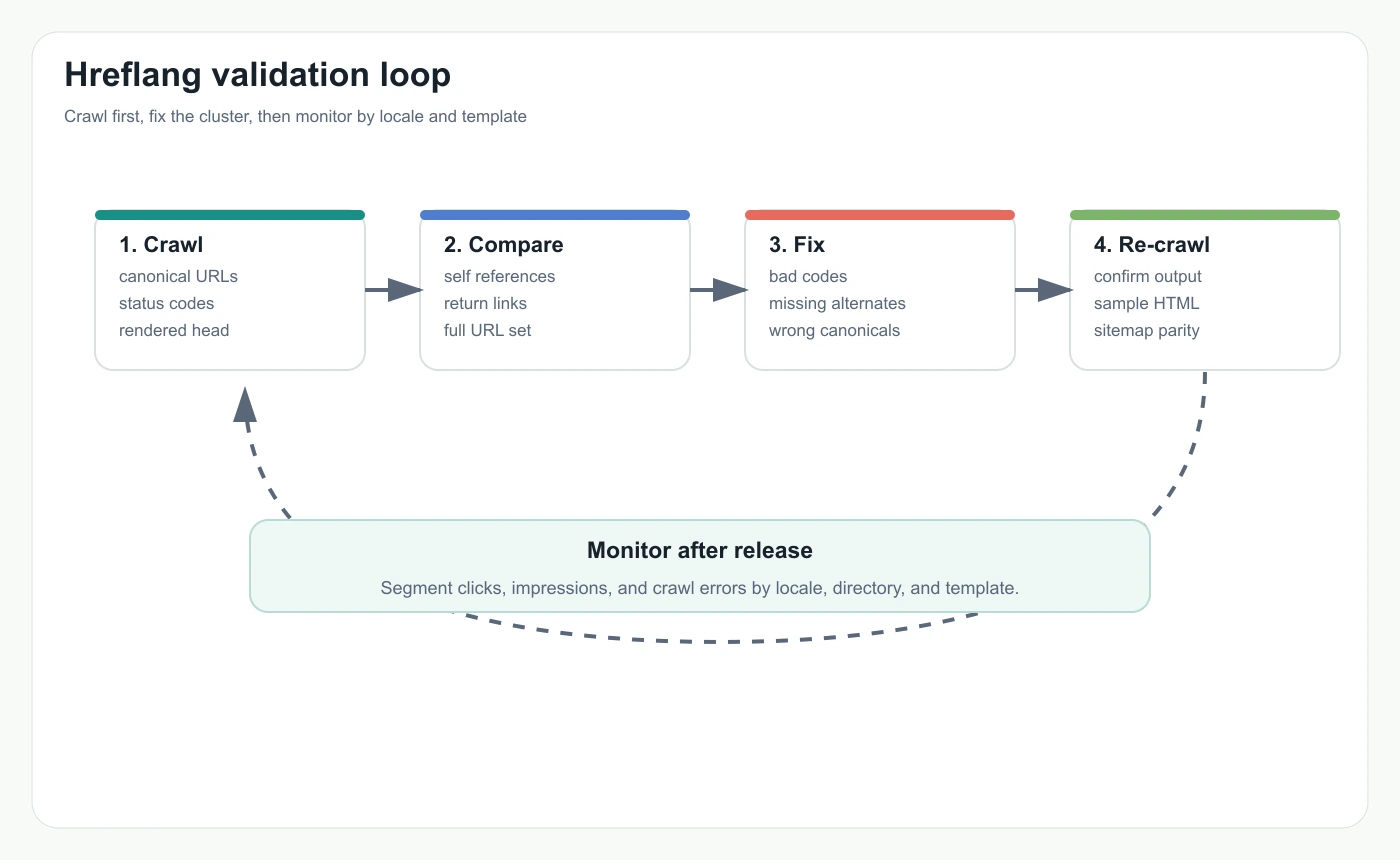
Run this validation loop whenever you add a locale, migrate URLs, change routing, or publish a new translated content set:
| Step | What to inspect | Why it matters |
|---|---|---|
| Crawl canonical URLs | Status, indexability, canonical, rendered head, sitemap inclusion | Removes invalid URLs from the cluster |
| Extract hreflang sets | Self reference, return links, code format, full URL set | Finds missing or one-way references |
| Compare page and sitemap output | HTML tags versus sitemap alternates | Catches generator drift |
| Fix by template group | Blog, product, collection, docs, or landing templates | Prevents one-off patches that fail on the next publish |
| Re-crawl changed URLs | Same checks after deployment | Confirms the live output, not the intended output |
| Monitor by locale | Clicks, impressions, indexed pages, crawl errors | Shows whether the right market is stabilizing |
This is where a technical SEO crawler fits naturally. Searvora SEO Spider Crawler is positioned around status codes, metadata, canonicals, hreflang validation, sitemap checks, and issue grouping, so the article workflow maps to a real product surface instead of a vague "audit your site" suggestion.
Fix The Errors That Break Clusters
Most hreflang mistakes are cluster-management problems. They often appear when one locale is published late, a CMS template changes, or redirects are added without updating alternates.
| Error | Why it breaks trust | Fix |
|---|---|---|
| Missing return link | Google cannot confirm the pages agree they are alternates | Add the full alternate set to every variant |
| Wrong language code | The annotation promises the wrong experience | Use valid language, script, and region codes |
| Alternate points to redirect | The target is not the final page | Update the tag to the final canonical URL |
| Canonical points to another locale | Canonical and hreflang send conflicting signals | Make localized canonical pages self-canonical |
noindex alternate | The page cannot be served as a search result | Remove noindex or remove the URL from the cluster |
| Sitemap and HTML disagree | Different systems publish different truth | Choose a source of generation and re-sync templates |
If multilingual metadata also changed during the release, pair this work with a page title SEO audit. Titles, H1s, canonicals, and hreflang tags should describe the same page job in each market.
Monitor Locale Quality After The Tags Are Live
Hreflang validation is not done when the crawl passes. You still need to watch whether the right locale earns the right search visibility.
Create a lightweight monitoring view by locale:
- Group clicks, impressions, CTR, and average position by locale directory.
- Track indexable URL counts and sitemap coverage by locale.
- Watch for traffic drops after language-template or routing changes.
- Sample brand and category queries from each target market.
- Review AI-search and citation behavior for pages that define products, categories, or technical concepts.
The broader operating model is the same one used in Geo SEO Foundations: diagnostics are only useful when they create a decision, an owner, and a shipped fix.
A Practical Hreflang Tags Checklist
Use this checklist before release:
- Confirm the pages are true localized alternates.
- Choose HTML tags, XML sitemap alternates, or HTTP headers as the primary method.
- Use absolute final URLs.
- Include a self-reference on every variant.
- Include return links from every variant to every other variant.
- Use valid language, script, and region codes.
- Add
x-defaultonly when there is a real fallback or selector URL. - Keep each localized canonical URL self-referencing.
- Remove redirects, errors, blocked URLs, and noindex pages from the cluster.
- Re-crawl after deployment and compare HTML output with sitemap output.
- Monitor performance by locale after Google has time to recrawl the pages.
Hreflang tags work when the cluster is clean, reciprocal, crawlable, and aligned with canonicals. Build the map first, publish through one reliable method, validate the live output, and keep locale monitoring in the same weekly rhythm as technical SEO fixes.