
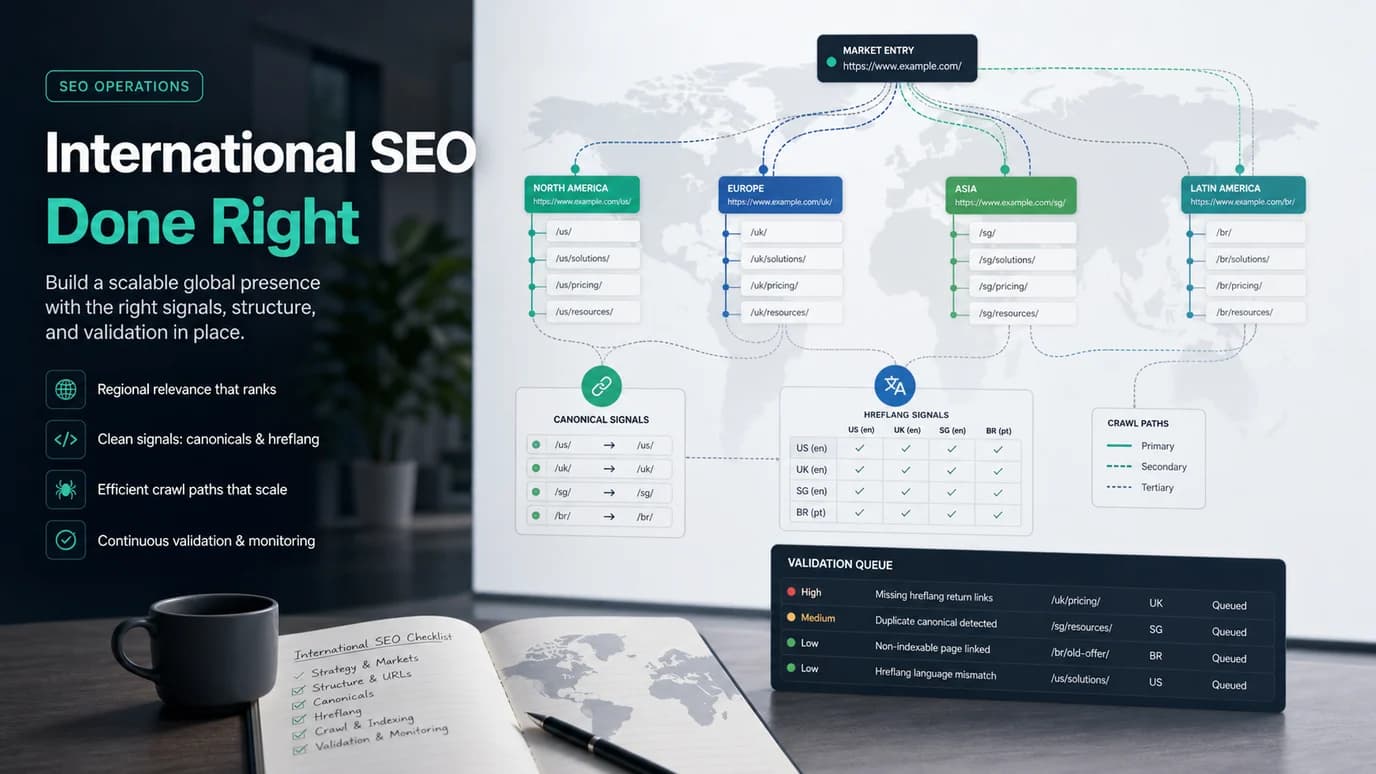
International SEO is the work of making the right language or regional page discoverable, indexable, and useful for the right market. It is not only translation. A strong international SEO workflow connects market demand, URL structure, hreflang, canonicals, sitemaps, localized content, and post-launch monitoring.
The practical risk is drift. A team launches a new country folder, translates a few templates, ships hreflang once, and then product, blog, or CMS changes slowly break the cluster. Treat international SEO as an operating system: map the market pages, validate the technical signals, localize the search job, and monitor each market separately.
Start With A Market URL Map
Before touching hreflang tags, decide which URLs should exist for each market. A market URL map prevents teams from mixing language alternates, regional pages, product variants, and unrelated blog posts into one messy cluster.
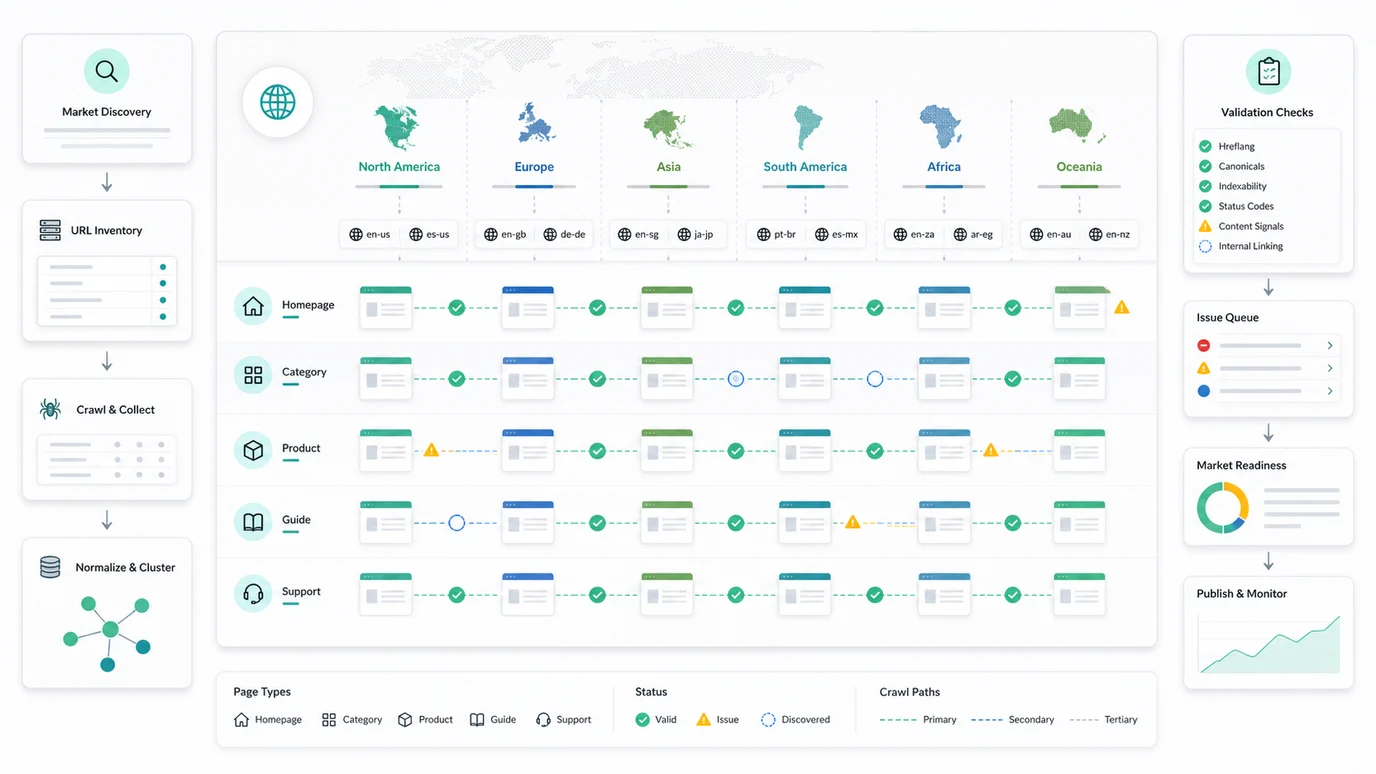
Use a table like this before implementation:
| Page group | Market decision | SEO evidence to collect |
|---|---|---|
| Homepage or regional entry page | Which country, language, or global audience owns the route? | Final URL, status code, canonical, hreflang set, navigation links |
| Product or service pages | Does each market need a separate page or a shared language page? | Local offer, pricing, availability, copy, structured data, internal links |
| Category or collection pages | Which market demand deserves indexable pages? | Query pattern, crawl depth, template metadata, faceted URL rules |
| Blog and guide content | Is this a true alternate or a market-specific article? | Search intent, examples, internal links, localized title/H1 |
| Support or documentation | Does the task vary by language, regulation, or product availability? | Help intent, canonical target, support navigation, language switcher |
The key rule is simple: do not create alternates until the pages answer the same user task. If a German guide covers a different product set than the English guide, it may need its own SEO plan instead of a shared hreflang cluster.
Separate Language, Region, And Page Type
International SEO gets noisy because "international" can mean several different things. A site might need language pages, country pages, currency variants, market-specific product pages, or translated blog posts. Each pattern has a different risk.
| Pattern | Good use | Common failure |
|---|---|---|
Language folder, such as /es/ | One language experience for many markets | Assumes Spain, Mexico, and other Spanish-speaking markets have the same demand |
Country folder, such as /uk/ | A specific market has unique pricing, shipping, or laws | Canonicals back to the global page and erases the market URL |
Language-region page, such as /en-gb/ | Same language, different market offer | Duplicate copy with no local usefulness |
| Localized blog post | Same search task needs a translated answer | Translation changes examples, intent, or links enough to become a different article |
| Market-specific collection | Local product availability affects the category | Faceted URLs multiply without crawl or index rules |
Google's localized versions documentation is the source of truth for supported hreflang methods and reciprocal alternate expectations. Use it after the market URL map is clear, not as a substitute for deciding which pages deserve to exist.
Validate Hreflang, Canonicals, And Sitemaps Together
Hreflang, canonicals, and sitemaps can quietly contradict each other. A page can declare alternates while its canonical points elsewhere. A sitemap can include one market but omit the others. A translated route can return 200 during launch and then redirect after a CMS rule changes.
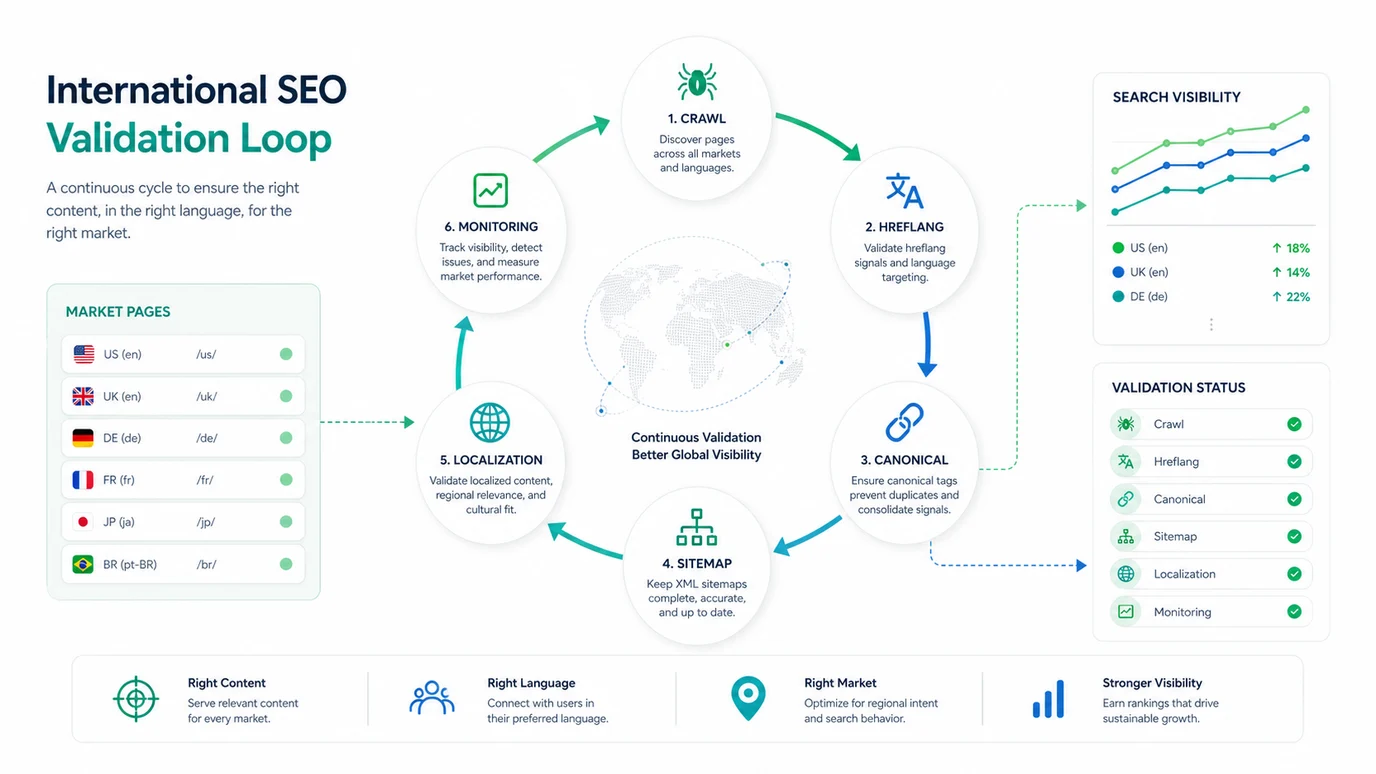
Run these checks as one validation pass:
| Signal | Pass condition | Fix when it fails |
|---|---|---|
| Status and crawl access | Every important market URL returns a final 200 and is crawlable | Remove blocked, redirected, or error URLs from the cluster until fixed |
| Canonical | Each market page that should rank has a self-referencing canonical | Do not canonicalize a valid localized page back to the global page by accident |
| Hreflang | Every alternate references itself and the rest of the cluster | Rebuild the cluster from the URL map and check return links |
| Sitemap | Canonical, indexable market URLs appear in the right sitemap | Remove noindex, redirected, blocked, or canonicalized-away URLs |
| Internal links | Language switchers, navigation, and content links point to final market URLs | Update menus and cross-links by locale, not only the tags |
| Rendered metadata | Title, H1, meta description, and language match the visible page | Fix template or translation drift before monitoring performance |
For canonical conflicts, pair hreflang QA with Google's canonicalization guidance. For XML coverage, check Google's sitemap guidance. The operational point is that these systems must agree on which page owns each market.
The hreflang tags workflow is useful when the cluster is already valid and the implementation method needs a cleaner HTML, HTTP header, or XML sitemap format. This article sits one level above it: decide the market architecture first, then validate the tags.
Localize The Search Job, Not Just The Words
Translation changes language. International SEO also has to preserve the search job. A page can be perfectly translated and still weak if the examples, offer, units, product availability, or internal links do not fit the target market.
Use this localization review before publishing:
- Check whether the target market uses the same query language or a different term.
- Rewrite the title and H1 around the local task, not the source-language template.
- Confirm that examples, screenshots, currency, units, and compliance notes are local enough to be useful.
- Link to the correct market product, collection, pricing, or support pages.
- Keep structured data, breadcrumbs, and canonical URLs aligned with the localized route.
- Decide whether a market-specific article should be a true alternate or an independent page.
For ecommerce teams, the international ecommerce audit workflow shows how this becomes page-type work across collections, products, facets, and buying guides. For a SaaS or B2B site, the same principle applies to product pages, pricing pages, comparison pages, and documentation.
Monitor Search And AI Visibility By Market
International SEO does not end when the crawl passes. You still need to know whether each market is earning the right visibility, and whether AI answer systems are using the intended pages as evidence.
Track each market separately:
| Monitoring view | What it tells you | Action when it moves |
|---|---|---|
| Clicks and impressions by locale | Whether localized pages are getting demand | Check indexing, title fit, and internal links before rewriting |
| Indexed URL count by market | Whether Google can keep the intended pages | Compare sitemap, canonical, and noindex changes |
| Crawl issues by route group | Whether templates or redirects are breaking clusters | Assign fixes by template owner and re-crawl |
| AI-search mentions or citations | Whether answer systems recognize the right market page | Improve entity evidence, local examples, and crawlable source pages |
| Conversion or lead quality by market | Whether visibility is routing to useful demand | Revisit page type, local CTA, and market-specific proof |
This is where the broader Geo SEO Foundations loop matters. International pages need technical access, entity clarity, useful content, and measurable validation. Without those, a translated page may exist, but it will not reliably become the market's source of truth.
Use Searvora To Turn Market Checks Into Fix Queues
A global site does not need another spreadsheet full of "international SEO issues." It needs a short list of fixes grouped by market, template, and owner.
Use a workflow like this:
| Step | Searvora-style output | Owner |
|---|---|---|
| Crawl the market inventory | URL groups with status, canonical, indexability, metadata, and sitemap state | SEO and engineering |
| Validate alternate clusters | Missing return links, invalid language codes, redirected alternates, and x-default gaps | Engineering or platform owner |
| Compare localized content | Pages where title, H1, internal links, or local examples do not match the market task | Content and localization |
| Prioritize by impact | Fix queue grouped by route type, affected URLs, and market importance | SEO lead |
| Re-crawl and monitor | Evidence that the live output changed and visibility stabilized | SEO operations |
The natural product fit is the SEO spider crawler. Searvora SEO Spider Crawler is positioned around crawl access, status codes, canonicals, hreflang validation, sitemap behavior, rendered metadata, and issue grouping, so the workflow can move from "we found a problem" to "this owner can ship this fix and validate it."
International SEO Checklist
Use this checklist before a market launch, migration, localization refresh, or traffic recovery review:
- List each market URL pattern by page type.
- Decide whether the market needs language pages, country pages, or language-region pages.
- Confirm that alternate pages answer the same user task before adding hreflang.
- Make indexable market pages self-canonical unless there is a deliberate exception.
- Include only final, crawlable, canonical URLs in the hreflang cluster.
- Keep sitemap coverage aligned with canonical and indexability rules.
- Validate return links across the full alternate set.
- Check language codes, region codes, and optional
x-defaultbehavior. - Localize titles, H1s, examples, internal links, and CTAs around market intent.
- Group crawl findings by market, route template, severity, and owner.
- Re-crawl after fixes ship.
- Monitor search visibility, indexed pages, and AI citations by market.
International SEO works when the market architecture, technical signals, localized content, and monitoring loop all agree. Start with the URL map, validate the live output, and keep the fix queue close enough to the team that international growth does not depend on memory.